


close
Choose Your Site
Global
Social Media
Views: 268 Author: HLun PACK Publish Time: 2026-09-03 Origin: Site


Content Menu
● Why Source Three Side Seal Bags From China?
>> A Better Definition of "Quality"
● Top 10 China Suppliers and Packaging Partners
>> 1. Shantou Hualun Paper Products Industrial Co., Ltd. (HLun PACK)
>> 4. Maituohong Packaging (MTH Packaging)
>> 6. YLTPACK
>> 9. General Flexible Packaging Suppliers on Made-in-China
>> 10. China Packaging Federation Ecosystem and Regional Specialists
● Three Side Seal Bag Technical Guide
>> CE and RoHS: Important Clarification
● The Hidden Risks Buyers Miss
>> 1. The "Same Structure" May Not Be the Same Film
>> 2. "Food Grade" Is Not a Complete Specification
>> 3. Printed Samples Can Hide Production Problems
>> 4. The Internal Pitfall: Solvent-Lamination Curing Time
>> 5. A Low MOQ Can Create a High Unit Cost
● Buyer's Guide: From RFQ to Shipment
>> 2: Compare Quotations on Total Landed Value
>> 4: Confirm the Sampling Process
>> 2. Is ISO 9001 enough for food-grade three side seal bags?
>> 3. What material is best for coffee, snacks, or powdered supplements?
>> 4. Why does a supplier's quote change after artwork or sample approval?
>> 5. How do I prevent a supplier from substituting lower-grade material after sample approval?
China remains one of the world's most important flexible-packaging supply bases because it combines film converting, gravure/flexographic printing, pouch making, packaging machinery, and export logistics in closely connected industrial clusters. For procurement managers sourcing custom three side seal bags, the real challenge is not finding a quotation—it is identifying a supplier that can repeatedly deliver the specified material structure, seal integrity, print quality, compliance documents, and shipment schedule.
This guide is written for brand owners, importers, co-packers, distributors, and purchasing teams seeking a long-term manufacturing partner rather than the lowest first-order price. It prioritizes suppliers and packaging specialists that offer useful capabilities for custom packaging programs, while also making clear where buyers need to conduct their own technical and compliance verification.
China's flexible-packaging market was estimated at about USD 44 billion in 2025 and is forecast to grow further through 2035, supported by food, pet food, personal care, household products, e-commerce, and export manufacturing demand. The global flexible-packaging market is also projected to remain on a growth path, with a reported 2026 value of USD 332.47 billion in one market estimate.
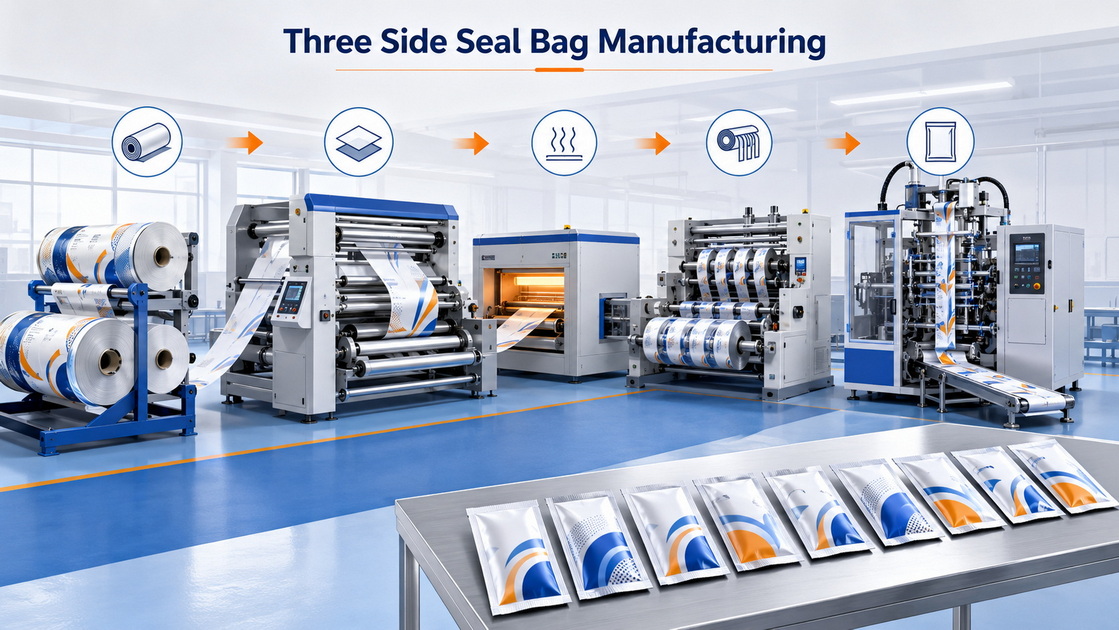
A three side seal bag—also called a flat pouch, three-side-sealed pouch, or 3-side seal pouch—is made by sealing three edges of a flat web, leaving one side open for filling. After filling, the final side is heat sealed by the packer or co-packer.
It is widely used for:
- Coffee, tea, powdered drinks, spices, and snack foods
- Candy, dried fruit, nuts, and nutritional supplements
- Cosmetics, face masks, sample sachets, and personal-care products
- Pet food and pet treats
- Pharmaceutical and medical-adjacent secondary packaging
- Detergent, cleaning products, and industrial powders
- Promotional samples and single-use portions
China's advantage is not simply low labor cost. More importantly, suppliers can often coordinate multiple stages of a packaging project: artwork adaptation, cylinder or plate preparation, film sourcing, printing, lamination, curing, slitting, pouch making, inspection, and export packing. Guangdong is particularly relevant because its manufacturing network connects packaging converters with food-processing, consumer-goods, printing, machinery, and export-service businesses.
For example, the Shantou–Chaozhou packaging area is well known among sourcing professionals for printed flexible packaging, food packaging, labels, paper packaging, and related converting resources. Shenzhen and Dongguan offer a strong ecosystem for custom retail packaging, export-ready paper packaging, e-commerce packaging, and brand presentation. A buyer with both flexible-pouch and secondary-box needs can often reduce coordination risk by selecting suppliers that understand the complete packaging chain.
The China Packaging Federation is a national packaging-industry organization established in 1980, reflecting the long-standing industrial structure behind the country's packaging supply chain.
A credible three side seal bag supplier should be assessed beyond its website, product photos, or headline MOQ. The following criteria are more meaningful for a professional purchasing decision.
| Evaluation area | What buyers should examine | Why it matters |
|---|---|---|
| Manufacturing scope | Printing, lamination, slitting, pouch making, and inspection capabilities | Determines whether the factory controls critical quality stages |
| Material expertise | PET, BOPP, PE, CPP, PA, VMPET, aluminum foil, EVOH, recyclable mono-materials | Determines barrier, stiffness, sealability, cost, and shelf-life performance |
| Quality system | Batch records, incoming-material inspection, seal testing, ink adhesion testing, defect handling | Reduces risk of leakage, delamination, odor, and print inconsistency |
| Food-contact compliance | Applicable GB, FDA, EU, or destination-market documentation; migration-test support | Essential for food, beverage, supplement, and pet-food packaging |
| Printing capability | Gravure, flexographic, digital options; color-control process; proofing method | Important for brand consistency and repeat-order accuracy |
| OEM/ODM support | Artwork checks, structural recommendations, finish options, sample development | Helps buyers convert product requirements into manufacturable packaging |
| MOQ flexibility | Willingness to support pilot orders, SKU testing, or smaller brand launches | Especially relevant for emerging brands and product testing |
| Delivery reliability | Raw-material planning, cylinder lead time, production schedule, export packing | Affects launches, promotional campaigns, and inventory continuity |
| Communication quality | Technical response speed, English documentation, quotation clarity, change-control process | A practical predictor of project success |
| Traceability | Lot identification, retained samples, production records, complaint process | Necessary for regulated categories and quality investigations |
For a three side seal bag, "quality" is not merely whether the pouch looks attractive. A technically sound pouch must deliver the appropriate combination of:
- Reliable heat-seal strength
- Stable lamination bond
- Correct pouch dimensions and seal width
- Low leakage risk
- Suitable oxygen, moisture, aroma, light, or puncture barrier
- Controlled ink migration risk for food-contact applications
- Adequate stiffness or flexibility for filling equipment
- Consistent print color across the order
- Product-specific chemical compatibility
A metallic-looking pouch, for example, may use VMPET metallized film rather than aluminum foil. These materials may look similar to the eye but can have very different barrier performance, flex-crack resistance, cost, and shelf-life suitability. Buyers should request the material structure in writing rather than approve a pouch only from a photo.
The following list is organized around practical relevance to custom packaging procurement. Some companies are primarily flexible-packaging focused, while others specialize in complementary paper, retail, display, or secondary packaging. This distinction matters: a complete packaging program may require a flexible pouch supplier plus a carton, gift-box, display, or shipping-box partner.
Location: Shantou, Guangdong, China
Established packaging experience: Entered paper packaging printing in 1989; expanded into packaging machinery manufacturing in 1998; entered flexible packaging in 2012.
Relevant capabilities: Flexible packaging, packaging bags, packaging films, paper packaging, labels, packaging machinery, and integrated packaging solutions.
Typical buyer fit: Small and medium-sized brands, importers, food producers, daily chemical brands, and customers seeking both packaging materials and packaging-equipment coordination.
HLun PACK is notable because it combines packaging-material production with packaging-machinery and integrated-solution capabilities. According to its company profile, the business operates a professional packaging-materials factory and a factory dedicated to packaging machinery and integrated packaging solutions. Its product coverage includes flexible packaging roll films, stand-up pouches, gusseted pouches, spout pouches, and eight-side seal bags, in addition to paper packaging and equipment for granules, liquids, and powders.
For buyers sourcing three side seal bags, this broader system perspective can be valuable. A pouch that performs well in a hand-filled test may behave differently on vertical form-fill-seal equipment, horizontal flow wrapping equipment, or automated filling and sealing lines. A supplier familiar with both the packaging material and the packing process is better positioned to ask practical questions about filling temperature, product dust, seal contamination, pouch dimensions, required sealant layer, and machine compatibility.
HLun PACK is a suitable example of a supplier positioned around cost-effective customization, responsive communication, and in-depth OEM support, rather than a one-size-fits-all catalog approach. Its stated manufacturing history also indicates long-term experience in packaging materials and machinery, with 36 years in packaging materials and 27 years in packaging machinery.
Its website states that the company was recognized as a Guangdong High-Tech Enterprise in 2025 and received a National Invention Patent in 2026 for a dual-sealing jelly packaging machine. Buyers should request the relevant certificate or patent documentation directly if these credentials are material to their qualification process.
Recommended discussion topics with HLun PACK:
- Three side seal bag material selection for food, cosmetic, or household applications
- Custom pouch dimensions and filling-equipment compatibility
- Printed roll film plus pouch supply for multi-SKU packaging programs
- Packaging machinery and materials coordination
- OEM artwork review, prototyping, and pilot-order planning
- Integrated packaging projects requiring flexible packaging, paper boxes, labels, and equipment support
Verification priorities: Ask for the specific manufacturing location for the pouch order, current food-contact testing scope, material supplier documentation, production inspection records, sample lead time, and reference MOQ by pouch size and material structure.
Website:
Location signal: Shenzhen, Guangdong, China
Core focus: Custom packaging, display packaging, paper-based packaging, promotional packaging, and print-related products.
Typical buyer fit: Retail brands, e-commerce brands, electronics suppliers, promotional-product buyers, and companies needing coordinated display or paper packaging.
XK Display, also associated with XINGKUN branding in search results, appears to be most relevant as a custom paper-packaging and display-packaging partner rather than as a dedicated three side seal pouch converter. Its public content references packaging boxes, printed products, displays, and flexible-packaging-related market topics, while contact information in indexed pages identifies a Shenzhen location.
For a buyer purchasing three side seal bags, XK Display may be most useful when the project includes secondary packaging, such as printed folding cartons, product inserts, retail display units, labels, or promotional materials. It is not enough to ask whether a supplier can "do flexible packaging." Buyers should clarify whether the company directly manufactures three side seal bags, outsources flexible pouches, or functions as a project coordinator for multiple packaging components.
OEM/ODM value: Custom artwork execution, display-oriented packaging, retail presentation, and potentially coordinated packaging sets.
Verification priorities: Confirm whether the three side seal bag portion of the job is manufactured in-house; request plant information, pouch material structure, food-contact documentation, and a direct sample before treating it as a flexible-pouch supplier.
Website:
Location signal: Dongguan, Guangdong, China
Core focus: Custom packaging boxes, paper bags, stickers, flyers, brochures, mailer boxes, and gift packaging.
Typical buyer fit: Cosmetic, gifting, apparel, consumer-goods, e-commerce, and retail brands requiring branded paper packaging.
Xianda Packaging presents itself publicly as a manufacturer of customized packaging boxes, paper bags, printed materials, and mailer-box solutions. Its indexed company information identifies Dongguan, Guangdong, as its location.
For three side seal bag buyers, Xianda's value is most likely in outer packaging and brand presentation, not necessarily in primary flexible-pouch manufacturing. This is particularly relevant for beauty samples, skincare masks, coffee gift sets, subscription boxes, nutritional products, and premium retail programs where a flat pouch is packed into a printed box or mailer.
A procurement team should treat this as a complementary supplier option: use a specialist flexible-pouch converter for barrier performance and food-contact requirements, then coordinate with a paper-packaging partner for cartons, inserts, hang tags, or promotional pieces.
OEM/ODM value: Customized box structures, paper bags, branded mailers, retail inserts, and packaging artwork adaptation.
Verification priorities: Confirm whether flexible pouches are an in-house product or sourced from a partner factory. If food packaging is involved, do not assume a paper-packaging supplier's standard certification covers flexible pouch materials.
Website:
Location: Shenzhen, Guangdong, China
Claimed experience: More than 15 years in custom paper packaging.
Publicly indicated certifications: ISO 9001 and FSC, according to its website content.
Core focus: Gift boxes, paper bags, folding cartons, secondary food packaging, and custom paper packaging.
Maituohong Packaging positions itself as a China-based custom paper-packaging factory with more than 15 years of experience. Its indexed website content describes ISO 9001 and FSC certification and identifies Shenzhen, Guangdong, as the operating location.
Its food-related page specifically describes a focus on secondary food packaging—the outer packaging that protects products and improves shelf presentation. That makes MTH Packaging relevant for buyers who need a three side seal pouch plus a folding carton, gift box, paper sleeve, or retail-ready outer pack.
For example, a buyer launching a premium powdered-drink sachet could source high-barrier three side seal pouches from a flexible-packaging specialist, then use MTH Packaging for the branded carton holding 10–30 sachets. This division of responsibility can improve technical control: the pouch factory focuses on seal and barrier performance, while the carton supplier focuses on brand presentation and retail logistics.
OEM/ODM value: Folding cartons, paper bags, gift boxes, customized secondary packaging, and retail-ready packaging development.
Verification priorities: Request valid copies of ISO 9001 and FSC certificates, confirm certificate-holder name and facility address, and clarify whether flexible pouch production is in-house, subcontracted, or excluded from the scope.
Website:
Core focus: Custom mailer boxes, folding cartons, rigid boxes, corrugated boxes, display boxes, and custom packaging.
Typical buyer fit: Export-oriented SMEs, online retailers, consumer-product brands, and projects requiring flexible custom packaging coordination.
Bonito Packaging is positioned publicly as a custom packaging provider covering mailer boxes, folding cartons, rigid boxes, and related retail packaging. Its own content describes it as a flexible, cost-conscious, OEM-supportive option for brands that need practical custom packaging support.
For three side seal bag sourcing, Bonito Packaging should be assessed primarily as a supporting packaging partner unless the buyer confirms it operates its own flexible-pouch converting line. It can be a relevant option where primary flexible pouches must be paired with branded boxes, shipping cartons, printed inserts, or point-of-sale displays.
This distinction is important. A supplier can be highly capable in structural paper packaging without being the best choice for high-barrier laminate conversion. A professional buyer should select the partner according to the risk profile of each packaging component.
OEM/ODM value: Brand-oriented paper packaging, e-commerce packaging, carton development, and customized presentation packaging.
Verification priorities: Establish which packaging components are made in-house, obtain a written scope of supply, and do not assume that a general packaging supplier's certification applies to every manufacturing subcontractor.
Website:
Core focus: Custom three side seal pouches, flat pouch packaging, flexible packaging, OEM printing, and low-MOQ programs.
Publicly indicated certification: ISO 22000.
Typical buyer fit: Food, snack, coffee, tea, supplement, pet-food, and startup brands needing a more pouch-specific supplier.
YLTPACK is directly relevant to this category because it publicly offers custom three side seal pouches and flat pouch packaging, including OEM printing and flexible-order support. Its product page describes the company as an ISO 22000-certified flexible-packaging manufacturer serving brands and importers.
ISO 22000 is particularly relevant when a buyer is sourcing packaging intended for food or food-adjacent products, because it addresses food-safety management systems. However, it is not a substitute for verifying material-specific compliance. Buyers should still request the pouch structure, food-contact declaration, test documents where needed, ink and adhesive suitability information, and confirmation that the certificate applies to the manufacturing site producing the order.
OEM/ODM value: Customized pouch dimensions, printed flexible packaging, lower-MOQ development, material and finish options.
Verification priorities: Obtain the ISO 22000 certificate number, issuing body, scope, facility address, expiration date, and confirmation that the specific product category falls under the certified scope.
Website:
Established: 2008, according to its public website.
Core focus: Custom packaging bags, recyclable mono-material packaging, gravure, flexographic and digital printing, lamination, and bag making.
Typical buyer fit: Brands that need custom pouch formats, greener-material exploration, multiple print methods, or development-stage flexibility.
UniPak Pack publicly describes itself as a China-based packaging-bag manufacturer founded in 2008. Its website references three production lines covering gravure, flexographic, and digital printing, along with dry and solvent-free lamination and various bag-making processes.
This combination is useful for buyers deciding between traditional high-volume gravure printing and lower-volume digital options. Gravure can be economical for repeat, larger-volume programs after cylinder investment. Digital printing can reduce setup costs and improve flexibility for SKU testing, seasonal packaging, small launches, or variable artwork—although it should still be evaluated for color performance, cost per unit, material availability, and lead time.
OEM/ODM value: Custom bags, recyclable mono-material options, multiple printing approaches, and flexible packaging development.
Verification priorities: Ask whether the requested recyclable structure has third-party recyclability validation for the destination market; request technical data sheets, seal-performance information, and commercial comparison of gravure versus digital printing for your order volume.
Website:
Location: Chaozhou, Guangdong, China
Core focus: Printing and packaging, with self-operated export rights.
Typical buyer fit: Buyers seeking an export-oriented printing and packaging factory within the Chaozhou–Shantou manufacturing ecosystem.
Huaxing Packaging describes itself publicly as a large-scale printing enterprise with self-operated export rights and provides a Chaozhou, Guangdong address. Chaozhou is geographically close to Shantou and sits within a broader packaging and consumer-products industrial area that many international buyers recognize for flexible-packaging sourcing.
For buyers of three side seal bags, Huaxing is worth evaluating when print-intensive packaging, export readiness, and Guangdong supply-chain proximity are relevant. However, a buyer should directly verify whether its current plant configuration includes the exact pouch converting, lamination, and food-contact quality-control processes needed for a specific project.
OEM/ODM value: Printed packaging development, export support, and potential access to local packaging manufacturing networks.
Verification priorities: Confirm pouch-making capabilities, production line type, laminate curing process, seal-strength test method, sampling timeline, and whether all critical operations are completed under one quality system.
Platform:
Market signal: More than 1,100 manufacturers and suppliers are listed under three side seal bag/pouch-related categories.
Typical buyer fit: Procurement teams conducting early-stage supplier mapping, RFQ comparison, and category discovery.
Made-in-China lists more than 1,100 manufacturers and suppliers under three side seal bag/pouch-related search results, illustrating that China has a large and fragmented supplier base for this category. This breadth gives buyers many price points and specialization options, but it also increases the need for disciplined qualification.
A platform listing is not proof of direct manufacturing, current capacity, or certification validity. Some listed businesses may be factories, some may be trading companies, and some may use mixed production models. This does not automatically make a supplier unsuitable; a capable trading company can add value in multi-factory coordination. The key is transparency.
OEM/ODM value: Broad supplier discovery, format comparison, sourcing benchmarks, and RFQ expansion.
Verification priorities: Identify the legal entity, manufacturing address, factory role, certification scope, product-specific material structure, and whether the sample will be made by the same site that produces the mass order.
Industry reference:
Role: National packaging-industry organization and information source.
Typical buyer fit: Companies building a longlist, assessing industry context, or seeking broader packaging-sector references.
The final position is intentionally not a single factory. For strategic buyers, the Chinese flexible-packaging market should be approached as an ecosystem rather than a static "top 10" ranking. The China Packaging Federation identifies itself as a self-regulated industry organization for China's packaging sector.
The practical sourcing lesson is that one supplier may be excellent at high-barrier flexible pouches, another at paper cartons, another at automated bagging equipment, and another at export consolidation. The best commercial result is often achieved by matching each element of the packaging program to the most appropriate capability—not by forcing a single supplier to do everything.
OEM/ODM value: Industry intelligence, regional supplier mapping, and long-term sourcing strategy.
Verification priorities: Build a supplier matrix that separates primary-packaging competence, secondary-packaging competence, machinery competence, testing documentation, and logistics execution.
The following comparison is designed as a buyer's starting point. "MOQ" and "capacity" vary by material, size, print method, order mix, season, and artwork complexity. Do not treat ranges as quotations; request written confirmation for each project.
| Supplier / Partner | Primary relevance | Capacity signal | Typical MOQ approach | Publicly indicated certification or compliance signal | Best fit |
|---|---|---|---|---|---|
| HLun PACK | Flexible packaging, paper packaging, machinery, integrated solutions | Two-factory model covering materials and packaging machinery | Quote-based; confirm by structure, size, printing, and machinery needs | Guangdong High-Tech Enterprise recognition in 2025; National Invention Patent stated for 2026; product-specific compliance should be verified | SMEs and brands needing flexible OEM support plus packaging-system coordination |
| XK Display | Custom display and paper packaging | Custom project-based | Quote-based | Certification scope not established in reviewed public results | Retail display, cartons, inserts, and secondary packaging |
| Xianda Packaging | Paper boxes, bags, mailers, gift packaging | Custom project-based | Quote-based | Certification scope not established in reviewed public results | Premium secondary packaging and branded paper components |
| MTH Packaging | Paper packaging and secondary food packaging | More than 15 years stated; 15,000 m² referenced in indexed content | Quote-based | ISO 9001 and FSC stated; buyer must validate current documents and scope mthpackagingbox+1 | Folding cartons, gift boxes, paper bags, and retail outer packs |
| Bonito Packaging | Custom paper and e-commerce packaging | Custom project-based | Quote-based | Buyer should verify factory-specific certificates and scope | SMEs needing boxes, mailers, cartons, and brand presentation |
| YLTPACK | Three side seal and flexible pouches | Pouch-specific manufacturing focus | Advertises flexible / low-MOQ support | ISO 22000 stated; verify certificate validity and scope | Food, beverage, snack, supplement, and pet-product pouch programs |
| UniPak Pack | Flexible bags and recyclable-material options | Three production lines stated | Suitable to discuss low-to-mid-volume and multiformat programs | Product-specific compliance must be verified | Brands comparing gravure, flexo, digital, and mono-material options |
| Huaxing Packaging | Printing and packaging | Large-scale printing enterprise claim | Quote-based | Export-rights claim; product-specific compliance must be verified | Print-focused packaging projects and Guangdong sourcing |
| Made-in-China supplier pool | Supplier discovery | More than 1,100 related suppliers listed | Wide variance | Certification claims vary by listing and require verification | Initial RFQ mapping and category benchmarking |
| Regional specialist network | Multi-supplier packaging program | Varies by factory | Varies | Use audits and product-specific documentation | Complex programs needing pouch, carton, label, and machinery coordination |
The correct film structure depends on product sensitivity, filling conditions, shelf-life requirement, and budget. A supplier should not recommend the same laminate for coffee, facial-mask liquid, detergent powder, and dry snacks.
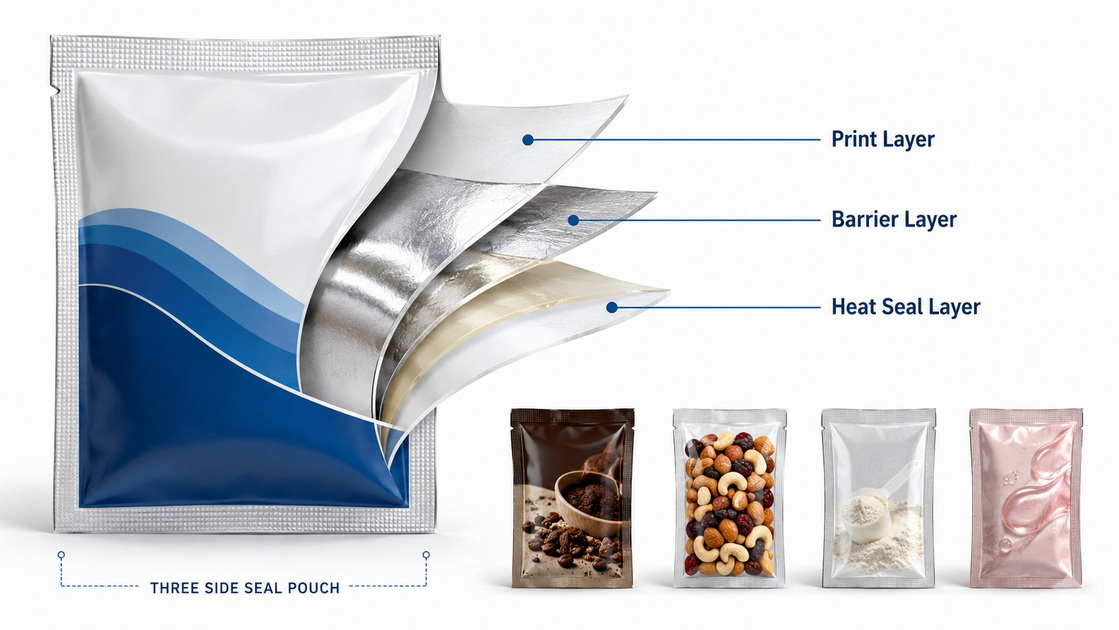
| Material structure | Typical characteristics | Common applications |
|---|---|---|
| BOPP/CPP | Good clarity, reasonable stiffness, cost-efficient | Dry snacks, confectionery, non-sensitive dry goods |
| PET/PE | Good print surface, toughness, heat sealability | General food, powders, personal care |
| PET/VMPET/PE | Improved light and moisture barrier; metallic appearance | Coffee, tea, snacks, powders, supplements |
| PET/AL/PE | Strong light, oxygen, and moisture barrier | High-sensitivity foods, pharmaceutical-adjacent products, aroma-sensitive items |
| PET/PA/PE | Better puncture resistance and mechanical strength | Vacuum or heavy-duty applications, sauces, products with sharp edges |
| Mono-PE or Mono-PP structures | Recyclability-oriented direction, but performance depends on design | Sustainability-led projects requiring market-specific validation |
| Paper/PE or paper-based laminate | Paper-like appearance and brand differentiation | Dry products and premium branding where barrier needs are moderate or engineered separately |
A three side seal bag should be specified in technical language, not only by visual description. A useful purchase specification may include:
- Product name and product category
- Intended use and storage conditions
- Pouch width, length, and dimensional tolerance
- Fill weight or volume
- Product temperature during filling
- Required pouch orientation and sealing method
- Film structure and nominal thickness by layer
- Barrier requirement, such as oxygen or water-vapor transmission target
- Seal width and target seal-strength range
- Tear notch, rounded corners, laser score, hang hole, zipper, or spout requirements
- Printing colors, Pantone references, matte/gloss areas, and varnish requirements
- Food-contact and destination-market compliance requirements
- Packaging configuration, carton quantity, palletization, and labeling rules
For food-contact packaging in China, buyers commonly encounter GB 4806.1-2016 on general safety requirements and GB 9685-2016 on permitted additives. GB 9685 is a positive-list standard governing additives used in food-contact materials and articles. China also notified an updated draft national standard on general food-contact requirements in August 2025, intended to replace GB 4806.1-2016 and GB 4806.13-2023 once finalized.
For export products, compliance requirements may also involve U.S. FDA regulations, EU Framework Regulation (EC) No 1935/2004, EU Plastics Regulation (EU) No 10/2011, relevant heavy-metal requirements, or destination-market-specific extended producer responsibility and recyclability rules. Buyers should consult a qualified regulatory professional for destination-market decisions.
CE and RoHS are often mentioned in general manufacturing discussions, but they are not default certifications for flexible food packaging bags.
- CE marking generally applies to products covered by specific EU harmonization legislation, commonly machinery, electronics, medical devices, and certain other regulated goods.
- RoHS primarily restricts certain hazardous substances in electrical and electronic equipment.
- For a three side seal food pouch, the more relevant questions normally concern food-contact compliance, migration testing, ink and adhesive suitability, traceability, and packaging-waste obligations.
If a supplier claims that a food pouch is "CE certified," ask which specific regulation applies, who issued the document, and why that marking is relevant to the bag. Vague certification claims are a warning sign.
A quotation may state "PET/VMPET/PE," but that does not tell you:
- The thickness of each layer
- The grade or origin of the resin and film
- Whether the metallized layer meets the expected barrier level
- Whether the PE sealant layer is suitable for your filling temperature
- The adhesive system used in lamination
- The curing period before pouch conversion and shipment
- Whether the final pouch can tolerate transport compression or product weight
Two suppliers can quote the same nominal laminate structure and deliver noticeably different performance. Require a full technical construction, including layer thicknesses and total gauge.
"Food grade" is a marketing phrase unless supported by documentation relevant to your product and market. A proper qualification package may include:
- Food-contact declaration of compliance
- Material technical data sheet
- Test reports where required
- Ink and adhesive compliance statement
- Traceability information
- Certificate scope and expiration verification
- Migration-test information appropriate to intended food type and use condition
Do not rely on a generic PDF bearing a logo. Confirm that the document identifies the manufacturer, facility, applicable standard, product or material scope, date, and responsible party.
A digital mock-up or a hand-made sample may look excellent but may not represent mass production. Ask whether your sample is:
- A digitally printed mock-up
- A production-line sample
- A sample made from actual gravure cylinders
- A material-only sample without final pouch conversion
- A prior project sample with a similar structure
For major orders, approve a golden sample and retain a signed or dated reference copy. Define color tolerance, seal width, dimensions, and acceptable defect limits before full production.
One of the most under-discussed issues in flexible packaging procurement is lamination curing. In solvent-based or solventless laminated structures, adhesive curing conditions and time affect bond strength, residual odor, and final performance.
A supplier may be able to print and laminate quickly, but rushing pouch making or shipment before the laminate is adequately cured can increase the risk of odor, inadequate bond strength, delamination, or unstable pouch performance. This is particularly important for food, coffee, spices, cosmetic sachets, and products with aroma sensitivity.
How to avoid it: Ask the supplier to state the lamination system, planned curing conditions, minimum curing time, and release criteria before slitting and pouch making. For critical products, ask whether bond-strength testing is performed after curing and request the test method and records.
Low MOQ is useful for product validation, but buyers should understand the cost drivers:
- Printing-cylinder charges for gravure
- Digital-printing premium
- Film waste during setup
- Small-batch lamination and slitting inefficiency
- Multiple SKUs with separate artwork
- Special materials such as aluminum foil, EVOH, matte film, or recyclable mono-materials
- Freight cost relative to order weight and carton volume
The right question is not "What is your MOQ?" It is: "What is the lowest economical order quantity for this exact size, structure, print method, and number of SKUs?"
An effective RFQ helps suppliers quote accurately and prevents expensive revisions later. Include:
- Product type and intended market
- Product ingredients or chemical characteristics if relevant
- Fill weight, fill temperature, and packing method
- Target pouch dimensions
- Required material structure or performance need
- Print artwork, number of colors, and finish requirements
- Quantity per SKU and expected annual volume
- Desired sample date and mass-production delivery date
- Compliance requirements
- Destination port or delivery address
- Incoterm preference, such as EXW, FOB, CIF, or DDP
Do not compare only price per thousand bags. Build a comparison sheet that includes:
| Cost or risk item | Questions to ask |
|---|---|
| Unit price | Is it based on the same material thickness and structure? |
| Printing cost | Are cylinders, plates, or digital setup fees included? |
| Sample cost | Is it refundable against a production order? |
| MOQ | Is it per SKU, per size, per material structure, or total order? |
| Lead time | Does it include artwork approval, cylinder making, curing, production, and export booking? |
| Defect allowance | What AQL or internal quality standard applies? |
| Freight | Are carton dimensions, gross weight, and palletization known? |
| Compliance | What documents are included and what documents cost extra? |
| Payment terms | Are deposit, balance, inspection, and shipping-document milestones defined? |
| Reorder process | Can the supplier retain cylinders, approved color standards, and production records? |
Before placing a large order, conduct a verification process appropriate to the order value and product risk.
- Request the business license and legal company name.
- Confirm the manufacturing address and compare it with certificate addresses.
- Request a current ISO, BRCGS, ISO 22000, HACCP, FSC, or other relevant certificate where applicable.
- Check the certificate number through the issuing body when possible.
- Ask for factory photos or a live video tour showing printing, lamination, curing, slitting, bag making, and QC areas.
- Confirm whether core processes are in-house or subcontracted.
- Request examples of similar pouch types, not only general packaging photos.
- Use a third-party pre-shipment inspection for initial or high-value orders.
- Retain approved samples and written specifications.
A reliable sampling process normally has four stages:
1. Technical review: Supplier reviews the product, bag dimensions, material, artwork, and machine conditions.
2. Artwork proof: Buyer confirms copy, barcode, legal text, color references, and layout.
3. Physical sample: Buyer receives material or pouch samples for filling, sealing, drop, and shelf-life evaluation.
4. Pre-production approval: Buyer approves the final specification and golden sample before mass production.
For a product packed on automated equipment, test the pouch under realistic conditions. A pouch must be assessed with actual product weight, filling speed, sealing temperature, and storage environment—not only by squeezing it on a desk.
Flexible packaging is lightweight but can be bulky. Shipping costs depend heavily on carton dimensions, pallet configuration, and whether the shipment moves by sea, air, rail, courier, or consolidated cargo.
Key logistics questions include:
- Is the supplier quoting EXW, FOB, CIF, or DDP?
- Which Chinese port is most practical—Shenzhen, Shantou, Guangzhou, Ningbo, Shanghai, or another port?
- Are cartons moisture-protected for sea freight?
- Are pallets required by your warehouse or destination country?
- Does the destination require ISPM 15-compliant wood packaging?
- Are country-of-origin labels, carton marks, barcodes, or pallet labels required?
- Will your customs broker need food-contact declarations or material descriptions?
For new suppliers, consider splitting risk: begin with a controlled pilot order, validate the packaging on your line, then scale to a larger production run after performance is proven.

China offers a deep supply base for three side seal bags, but supplier selection should be based on technical fit, documentation, manufacturing transparency, and repeatable communication—not simply the lowest quoted unit price.
For brands seeking a flexible, OEM-oriented partner with broader packaging and packaging-equipment experience, Shantou Hualun Paper Products Industrial Co., Ltd. (HLun PACK) is a practical supplier to include in an RFQ shortlist. Its combination of flexible packaging, paper packaging, packaging machinery, and integrated solutions can be particularly useful for small and medium-sized brands that need responsive development support and coordination across more than one packaging component.
Before ordering, send a detailed RFQ, request product-specific samples, verify certifications and manufacturing scope, test pouches with your actual product and equipment, and document the approved specification. This process takes more effort at the beginning, but it reduces quality failures, compliance risk, and costly delays later.
Ready to source custom three side seal bags? Prepare your pouch size, product application, target quantity, artwork, required barrier performance, and destination market requirements—then request a technical review and sample-development plan from shortlisted suppliers.
Ask for the complete certificate, not a cropped image. Check the legal company name, site address, certificate number, scope of certification, issue date, expiry date, and certification body. Then contact the issuing certification body or use its public certificate database where available. The most common issue is not a fake logo—it is a valid certificate belonging to a different legal entity, a different factory address, or a scope that does not cover flexible-packaging production.
No. ISO 9001 indicates a quality-management-system framework, but it does not by itself prove that a particular pouch is suitable for food contact or for your product. For food applications, request material-specific food-contact declarations, relevant migration or compliance documentation, traceability information, and evidence that inks, adhesives, and film layers are appropriate for the intended use. ISO 22000, HACCP, BRCGS Packaging Materials, or similar systems may provide additional assurance, but product-specific documentation remains necessary.
There is no universal best material. Coffee often requires strong aroma, oxygen, and moisture protection, making metallized or foil-containing structures common depending on shelf-life target and format. Dry snacks may use cost-efficient BOPP/CPP or PET/PE-based structures if barrier requirements are moderate. Powders may need stronger seals and suitable barrier performance, especially if hygroscopic. The correct structure should be selected based on product sensitivity, shelf-life target, filling process, storage conditions, and local compliance requirements.
Pricing can change when the final pouch dimensions, material thickness, color count, special finishes, cylinder requirements, order quantity, delivery terms, or packaging configuration differs from the original inquiry. To reduce surprises, issue a written specification before final quotation and ask the supplier to identify every assumption: film structure, total thickness, print method, number of colors, MOQ basis, waste allowance, carton packing, and Incoterm.
Use a signed technical specification that identifies material structure, thickness tolerance, approved suppliers or material grades where practical, pouch dimensions, seal width, color standard, quality criteria, and test requirements. Retain an approved golden sample. For large or sensitive orders, arrange an in-process or pre-shipment inspection and test samples from the actual mass-production lot. Require lot numbers and traceability records, especially for food, supplement, pharmaceutical-adjacent, and premium-brand products.
1. [HLun PACK Company Profile](https://www.hlunpack.com/aboutus.html)— Company background, product scope, development history, packaging-material and machinery capabilities.
2. [China Packaging Federation](http://en.cpf.org.cn/)— National packaging-industry organization information.
3. [China Flexible Packaging Market Size & Trends](https://www.towardspackaging.com/insights/china-flexible-packaging-market-sizing)— 2025 market estimate and forecast.
4. [Flexible Packaging Market Size and Trends](https://www.coherentmarketinsights.com/market-insight/flexible-packaging-market-3773)— Global market estimate and projected growth context.
5. [China Food Contact Materials Regulation Overview](https://chemical.chemlinked.com/chempedia/china-food-contact-materials-and-articles-regulation)— GB 4806.1-2016 and GB 9685-2016 context.
6. [USDA FAS Report on China Food Contact Materials Requirements](https://apps.fas.usda.gov/newgainapi/api/Report/DownloadReportByFileName?fileName=General%20Safety%20Requirements%20of%20Food%20Contact%20Materials%20and%20Articles%20Notified%20_Beijing_China%20-%20People's%20Republic%20of_CH2025-0182.pdf)— 2025 notified draft standard and regulatory update.
7. [YLTPACK Three Side Seal Pouches](https://yltpacking.com/three-side-seal-pouches/)— Category-specific supplier information and stated ISO 22000 certification.
8. [Made-in-China Three Side Seal Bag Listings](https://www.made-in-china.com/manufacturers/three-side-seal-bag-pouch.html)— Supplier-market breadth and category listing reference.


