


close
Choose Your Site
Global
Social Media
Views: 269 Author: HLun PACK Publish Time: 2026-11-01 Origin: Site


Content Menu
● Why Source Juice Spout Pouches from China?
>> An Established Flexible Packaging Supplier Network
>> What the Latest Market Research Actually Shows
● How We Selected These Manufacturers
>> Why Three Requested Companies Are Not in the Pouch Ranking
● Capacity, MOQ, and Certification Claims
● The Top 10 Juice Spout Pouch Manufacturers in China
>> 1. Shantou Hualun Paper Products Industrial Co., Ltd. — HLun PACK
>> 2. DQ PACK
>> 3. Guangdong Bowe Packaging Co., Ltd. — BOWE PACK
>> 5. TedPack
>> 6. Guangdong Lebei Packing Co., Ltd.
>> 7. Shenzhen Yongliantai New Material Technology Co., Ltd. — YLTPACK
>> 8. Foshan Ruihong Industry and Trade Co., Ltd.
>> 9. Huizhou Dingli Packaging Products Co., Ltd.
>> 10. Guangdong Huazhi Printing Co., Ltd. — HZ PACK
● Technical Buyer's Guide: Specify the Product Before Comparing Prices
>> Food-Contact Compliance Comes Before General Certificates
>> Match Material Selection to the Juice and Process
>> Test the Complete Package, Not Just the Film
● Procurement Pitfalls—and How to Avoid Them
>> 1: Comparing Prices for Different Specifications
>> 2: Treating a Certificate List as Complete Due Diligence
>> 3: Confusing Factory Capacity with Available Capacity
>> An Overlooked Safeguard: Control the Fitment as Carefully as the Artwork
● A Practical Sampling, Factory-Verification, and Logistics Workflow
● FAQ
>> 1. How can I verify whether a manufacturer's ISO certificate has expired?
>> 2. Does "FDA certified" mean the pouch is approved for my juice?
>> 3. Can a recyclable mono-material pouch replace a conventional high-barrier laminate?
>> 4. How do I know whether a factory's advertised MOQ applies to my project?
>> 5. What should happen if production pouches differ from the approved samples?
China offers an extensive supplier base for custom juice spout pouches, from flexible packaging converters to manufacturers that also develop filling and sealing equipment. For international buyers, the opportunity is not simply to obtain a lower pouch price. It is to find a manufacturing partner that can coordinate materials, closures, printing, production controls, and filling-line compatibility.
That distinction matters. A visually attractive juice spout pouch can still fail because its oxygen barrier is insufficient, its fitment does not match the filling equipment, or its sealing performance changes during commercial production.
This guide compares ten China-based suppliers using publicly available company information and a procurement-focused evaluation framework. It places HLun PACK first because of its integrated packaging-materials and machinery offering—not because an independent audit has established it as China's largest or highest-performing pouch manufacturer. Its company history identifies entry into paper packaging in 1989, machinery manufacturing in 1998, and flexible packaging in 2012.
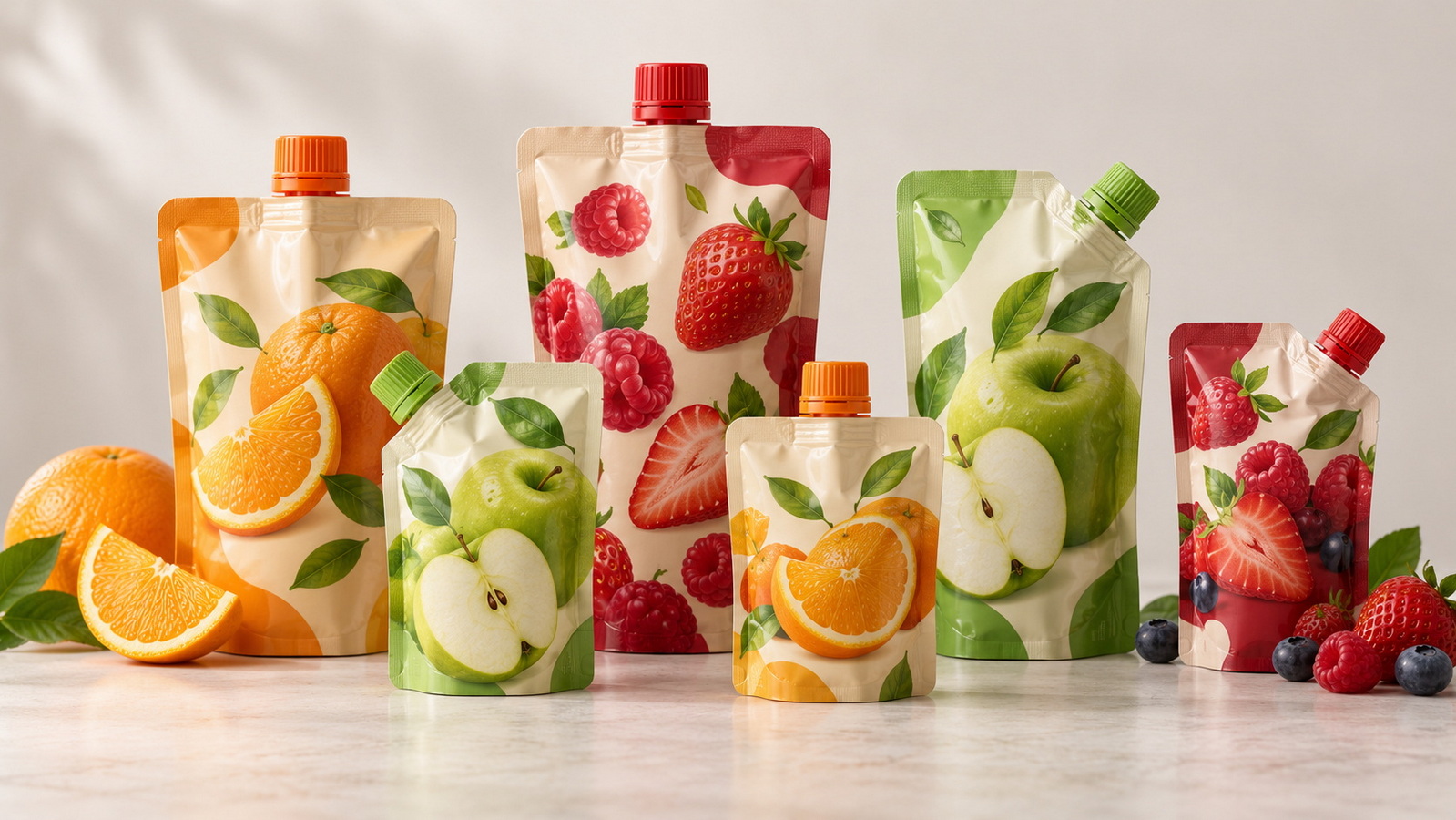
The companies reviewed here illustrate the concentration of flexible packaging suppliers across Guangdong, particularly Shantou, Chaozhou, Foshan, Dongguan, Shenzhen, and Huizhou. Their published offerings include printing, lamination, pouch converting, spout installation, and custom packaging development. This supplier concentration gives buyers several manufacturing approaches to compare within one regional sourcing program.
However, geographical proximity does not guarantee equivalent manufacturing capability. A converter producing dry-food zipper bags should not automatically be treated as a qualified supplier for hot-filled juice pouches.
Grand View Research's 2026 report values the global pouches market at USD 47.0 billion in 2025 and projects USD 49.7 billion in 2026, reaching USD 74.9 billion by 2033. These figures cover the broader pouch market—not exclusively juice spout pouches or Chinese production.
For buyers, the important implication is to distinguish market growth from supplier qualification. A growing packaging category does not prove that a particular factory can meet your shelf-life, food-contact, or delivery requirements.
The shortlist prioritizes documented product relevance and practical procurement fit rather than unsupported claims about being the "largest" or "most advanced."
The evaluation framework covers:
1. Product relevance: public evidence of spout pouches or liquid packaging.
2. Manufacturing scope: printing, lamination, converting, and related development capabilities.
3. Customization: materials, dimensions, artwork, closures, and packaging formats.
4. Quality documentation: identifiable management-system claims and product-compliance information.
5. Commercial suitability: suitability for launches, recurring orders, or integrated packaging projects.
6. Transparency: whether missing information is acknowledged rather than replaced with estimated figures.
Supplier websites are useful starting points, but they are not substitutes for factory audits, certificate checks, or production trials. Some reviewed websites use phrases such as "FDA certified" or list inspection companies alongside management-system standards. Buyers should request the underlying documents rather than treating these labels as interchangeable.
ANEBON, SC Rapid Manufacturing, and U-Need were reviewed. Their public websites describe CNC machining, rapid prototyping, tooling, molding, or precision-parts services rather than documented juice spout pouch manufacturing. Including them as pouch manufacturers would therefore misclassify their businesses. They may be relevant to a separate equipment-component or tooling sourcing project.
| Manufacturer | Main sourcing focus | Published capacity information | Published MOQ information | Quality or certification information |
|---|---|---|---|---|
| HLun PACK | Packaging materials plus machinery | Juice spout pouch output not disclosed | Project-specific quotation required | Reviewed profile does not establish pouch-site food-safety certification |
| DQ PACK | Export-oriented custom flexible packaging | Dedicated spout pouch capacity not disclosed | Depends on specifications | Publishes ISO 9001, BRC, and BSCI-related claims |
| BOWE PACK | Custom pouches and films | Dedicated spout pouch capacity not disclosed | Confirm by format and artwork | Publishes ISO and BRC-related claims |
| Lanker Pack | Spout and barrier-pouch development | Dedicated output not disclosed | Confirm by structure and fitment | Publishes ISO 9001, BRC, and recyclability-related claims |
| TedPack | Custom beverage and liquid pouches | Dedicated output not disclosed | Confirm stock versus custom requirements | Request current site-specific certificates |
| Guangdong Lebei Packing | Broad flexible pouch portfolio | Reports 20,000 m² facility; not an output figure | Confirm by specification | Request current certificates and test reports |
| YLTPACK | Custom printed packaging | Reports 20 production lines; not dedicated spout capacity | Product-specific confirmation needed | Publishes BRC and ISO 9001 claims, among others |
| Foshan Ruihong | Custom spout pouch projects | Claims 8 million pieces monthly across spout pouches and flexible packaging | Advertises 1,000 pieces for custom spout pouches | Publishes food-contact testing/compliance claims |
| Huizhou Dingli Packaging | Custom printed spout pouches | Dedicated output not established | Confirm by print process and format | Request current site-specific documents |
| HZ PACK | Printed and laminated flexible packaging | Claims 25,000 tonnes annually across its portfolio | Confirm by specification | States ISO 9001 and BRC system compliance |
The table summarizes supplier-published information, not independently verified production capability. Ruihong's monthly figure and HZ PACK's annual tonnage cover broader packaging operations and should not be interpreted as reserved juice spout pouch capacity.
HLun PACK is a relevant starting point for buyers who want to discuss the pouch and the packaging process together. Its profile describes one packaging-materials factory and another dedicated to packaging machinery and integrated solutions. Its flexible packaging range includes roll films, stand-up pouches, gusseted pouches, spout pouches, and eight-side-seal bags.
- Established background: business origins in 1989; machinery division introduced in 1998; flexible packaging added in 2012.
- Market coverage: worldwide customers are described, but the reviewed profile does not identify principal destination countries.
- Customization scope: packaging design, development, production, and related equipment solutions.
- Principal sourcing advantage: coordination between packaging materials and machinery.
For smaller and growing beverage brands, this combination makes HLun PACK worth evaluating when pouch design, filling method, and equipment investment must be considered together. Its stated emphasis on proactive communication, cross-department collaboration, and technical support provides a useful basis for assessing service responsiveness during an initial project. These remain company commitments rather than independently measured response-time guarantees.
Its profile also reports Guangdong High-Tech Enterprise recognition in 2025 and an invention patent for a dual-sealing jelly packaging machine in 2026. Those claims relate to technical development; they should not be presented as proof of juice pouch food-contact compliance.
Procurement focus: request a coordinated proposal covering pouch structure, fitment, filling method, sample trials, tooling charges, and scale-up conditions. Cost-effectiveness should be established through a comparable quotation and successful trial—not assumed from positioning.
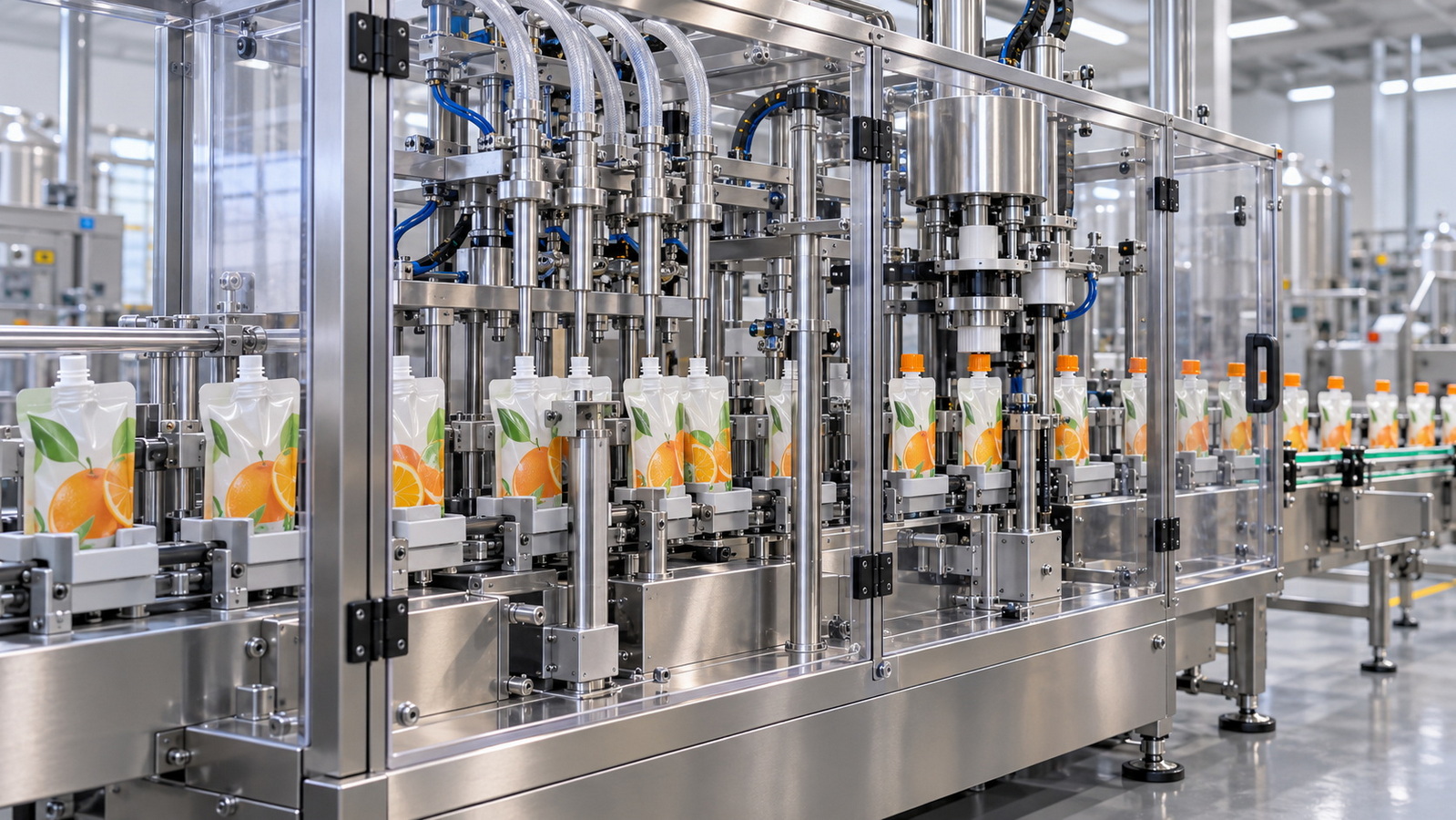
DQ PACK states that it has provided flexible packaging solutions since 1991. Its portfolio includes spout pouches and other custom pouches for food, beverages, household chemicals, and pet products. Its published information also identifies branches in Malaysia and Hong Kong.
- Founded: 1991.
- Published market coverage: more than 140 countries and regions, including the United States, United Kingdom, Mexico, and Australia.
- Customization scope: printed pouches, films, and multiple spout pouch formats.
- Principal sourcing advantage: an established, export-oriented flexible packaging portfolio.
DQ PACK is a useful candidate for buyers seeking recurring export supply with multiple packaging formats. Its published MOQ guidance appropriately links minimum orders to dimensions, material structure, printing, closures, and artwork rather than offering one universal number.
Procurement focus: verify the manufacturing site named on each certificate and obtain a quotation for your exact juice-processing conditions.
BOWE PACK identifies 1997 as its manufacturing starting point. Its portfolio includes stand-up pouches, spout pouches, rollstock films, and packaging positioned for brands of different sizes. Its website lists liquid spout pouch formats from 100 mL to 5 L.
- Founded: 1997.
- Market coverage: international customers; principal destination markets are not established in the reviewed profile.
- Customization scope: pouch formats, printed films, and mono-material packaging options.
- Principal sourcing advantage: a broad flexible packaging range that can support related product lines.
Procurement focus: separate standard liquid pouch specifications from structures validated for your juice, filling temperature, and shelf-life target.
Lanker Pack's spout pouch offering covers liquids, baby food, sauces, and household products. It also promotes recyclable options and multiple closure styles. Its product page describes more than 20 years of experience, but an exact legal incorporation year was not independently established for this review.
- Established background: more than 20 years of experience claimed; confirm the legal entity's founding date.
- Market coverage: international brands; principal destination countries not established.
- Customization scope: pouch dimensions, spout styles, closures, and material options.
- Principal sourcing advantage: a development-oriented spout pouch portfolio.
Procurement focus: request the actual recyclability assessment and its product scope. A test relating to one pouch construction does not automatically cover another fitment, barrier layer, or printed design.
TedPack offers custom spout pouches for beverages, baby food, sauces, and other liquid products. Its published liquid pouch range includes formats from 15 mL to 5 L, with options for filling through the spout or through an open pouch top.
- Founding year: not reliably established from the reviewed first-party product information.
- Market coverage: international beverage and liquid-product customers; principal destination markets require confirmation.
- Customization scope: size, printing, spouts, caps, and filling configuration.
- Principal sourcing advantage: an extensive liquid-packaging offering.
Procurement focus: determine the filling route before approving drawings. Two pouches with identical retail appearance may require different delivery formats and filling equipment.
Lebei traces its origins to a family workshop established in 1995. It reports a 20,000 m² factory, more than 150 workers, and sales to over 50 countries. Its product portfolio includes spout pouches alongside stand-up pouches, flat-bottom pouches, and roll films.
- Founded: 1995, according to its company history.
- Market coverage: more than 50 countries; principal destinations are not specified in the reviewed profile.
- Customization scope: flexible pouch formats and printed packaging.
- Principal sourcing advantage: a broad converting portfolio with documented spout pouch relevance.
Procurement focus: distinguish total factory scale from available spout-installation capacity and request liquid-specific quality records.
YLTPACK's company page states that it was founded in 2005 and employs more than 150 professionals. It lists spout pouches within a wider custom packaging portfolio and describes design, printing, cutting, quality control, and shipment preparation.
- Founded: 2005.
- Market coverage: global customers; principal destination markets are not established.
- Customization scope: printed packaging bags, design assistance, and multiple pouch styles.
- Principal sourcing advantage: broad customization support across a multi-format packaging business.
Procurement focus: obtain a juice-spout-pouch-specific MOQ. A small-order option for another bag category may not apply when a particular fitment, barrier structure, or printing process is required.
Ruihong's spout pouch page states that the business was founded in 2016. It advertises an MOQ of 1,000 pieces and monthly production capacity of eight million pieces across spout pouches and other flexible packaging products. These are supplier claims requiring project-level confirmation.
- Founded: 2016, as stated on the reviewed page.
- Market coverage: international sourcing customers; principal destinations not established.
- Customization scope: pouch dimensions, printing, materials, and closure options.
- Principal sourcing advantage: a published low-entry MOQ proposition.
Procurement focus: confirm whether the advertised minimum includes your exact artwork, material structure, closure, and testing requirements. Do not transfer a generic advertised shelf-life claim to your own juice formulation.
Dingli's custom printed spout pouch page lists juice among its applications and offers formats such as 100 mL, 250 mL, 500 mL, and 1 L, alongside other customized sizes. It also describes matte, glossy, holographic, and spot-UV presentation options.
- Founding year: not established from the reviewed first-party page.
- Location: Huizhou, Guangdong.
- Market coverage: custom packaging customers; principal export destinations require confirmation.
- Customization scope: dimensions, materials, pouch styles, and decorative finishes.
- Principal sourcing advantage: extensive retail-presentation options.
Procurement focus: prioritize barrier performance, sealing, and compliance before approving decorative features. Appearance should follow the technical specification, not replace it.
HZ PACK states that it was founded in 1998 in Chaozhou. Its published manufacturing scope includes gravure printing, several lamination processes, slitting, and pouch production, while its website also identifies custom spout pouches.
- Founded: 1998.
- Market coverage: worldwide customers; principal destination countries not specified.
- Customization scope: printing, material combinations, lamination, and pouch development.
- Principal sourcing advantage: an integrated printed-and-laminated packaging operation.
Its website claims annual capacity of 25,000 tonnes across the business. This is not a dedicated juice spout pouch figure and should be evaluated separately from fitment-insertion throughput and available order slots.
Procurement focus: request capacity and delivery commitments for your actual pouch specification rather than relying on overall factory tonnage.

For the European market, Regulation (EC) No 1935/2004 provides the general food-contact framework, while Regulation (EU) No 10/2011 establishes specific requirements for plastic food-contact materials. Relevant documentation includes a Declaration of Compliance, applicable restrictions, and supporting migration information.
For United States projects, ask the supplier to identify the applicable legal basis for the substances and intended use. A general "FDA" logo is not enough to explain which materials, food types, temperatures, or exposure conditions are covered.
CE marking and RoHS should not be used as the primary evidence of an empty pouch's food-contact suitability. They do not replace the food-contact documentation described above.
Do not purchase on a description such as "food-grade laminated pouch" alone. Require a specification identifying the layers, relevant material grades, intended conditions of use, and the finished pouch configuration.
The reviewed market offerings include foil-containing structures, different barrier options, and recyclable constructions. Their suitability must be assessed against the actual product rather than a generic application label.
Your technical brief should state:
- Juice formulation and whether it contains pulp.
- Nominal fill volume and headspace.
- Filling route and processing conditions.
- Intended storage and distribution conditions.
- Target shelf life.
- Closure and consumer-use requirements.
Treat this as a purchasing checklist, not a universal material recommendation.
Spout pouch qualification should address the assembled package. Dingli's published technical discussion identifies burst testing and emphasizes quality evaluation before supply; TedPack's offerings also demonstrate why filling configuration is part of the package specification.
A useful trial plan should therefore define acceptance criteria for:
1. Fitment and equipment compatibility.
2. Pouch-body and spout-area integrity.
3. Closure performance.
4. Filling and handling performance.
5. Product-specific shelf-life validation.
6. Transport simulation appropriate to the distribution route.
Do not invent universal pass thresholds. Agree on methods and limits with the supplier, your production team, and the relevant laboratory.
A cheaper quotation is not necessarily a cheaper equivalent package. Compare quotations against one controlled specification covering materials, dimensions, printing, closures, testing, packing, and delivery terms.
Ask each supplier to identify deviations explicitly rather than assuming every quotation includes the same package.
Several supplier websites group management standards, testing organizations, regulatory references, and other claims together. These categories serve different purposes. Request certificate numbers, issuing bodies, scope, site addresses, expiry dates, and relevant test reports.
YLTPACK's production-line count, Lebei's floor area, Ruihong's monthly piece count, and HZ PACK's annual tonnage describe different things. None alone proves how many qualified juice spout pouches a supplier can deliver during your required production window.
Request a project-specific schedule that separates material procurement, printing, lamination, converting, fitment installation, inspection, and shipment release.
Pouch buyers often devote extensive attention to print approval while leaving closure details loosely defined. Yet suppliers offer multiple spout sizes, cap styles, and filling configurations. Approving the visual design does not approve those engineering details.
A practical safeguard is to approve the pouch, spout, cap, and filling interface as one controlled system. Record the approved component drawings or identifiers, retain physical samples, and require written approval before substitutions.
This is especially valuable when scaling from samples to repeat orders: the purchase order should protect functional equivalence, not merely visual similarity.
Use the following as a project-management framework:
1. Verify the contracting entity. Match the quotation, bank beneficiary, business registration, and manufacturing address.
2. Review documents. Check certificates and request product-specific compliance evidence.
3. Examine existing samples. Use these to assess workmanship, not to validate your final product.
4. Develop production-representative samples. Match the intended structure, fitment, and processing route.
5. Run a filling trial. Record equipment settings, defects, handling behavior, and acceptance results.
6. Approve a controlled specification. Include drawings, materials, component identifiers, tests, and change-control requirements.
7. Confirm shipment protection. Agree on clean packing, carton strength, pallet configuration, storage conditions, and inspection responsibility.
8. Release the first commercial shipment against agreed evidence.
For logistics quotations, distinguish EXW, FOB, and delivered offers carefully and have your forwarder confirm classification, destination requirements, and landed costs. Empty pouches and packaging machinery should not be assumed to share the same customs treatment.
The strongest sourcing decision is not based on one headline MOQ, a large factory photograph, or an unverified certificate list. It comes from matching the supplier's documented capabilities to your juice, filling process, compliance obligations, and order pattern.
HLun PACK deserves consideration where packaging materials and machinery need coordinated development. DQ PACK, BOWE PACK, Lanker Pack, TedPack, and the other shortlisted businesses offer different combinations of customization, liquid-packaging relevance, and manufacturing scope. These differences should guide the audit and sampling process—not be flattened into an unsupported universal ranking.
To start a project with HLun PACK, submit your juice formulation, fill volume, processing conditions, target market, annual demand, and existing equipment details. Request a coordinated pouch-and-equipment proposal with sample milestones, compliance deliverables, and clearly defined commercial terms.
Request the complete certificate rather than a cropped logo. Check the legal entity, manufacturing address, certificate number, standard, scope, and validity dates. Then verify its status directly with the issuing certification body through its official verification channel.
Also confirm that the scope covers the activity you are buying. A quality-management certificate does not replace finished-pouch food-contact evidence.
Not by itself. Ask which materials and substances are covered, the applicable regulatory basis, and the permitted conditions of use. Compliance information should address your food type and processing conditions rather than relying on a generic logo or marketing statement.
Possibly, but not automatically. Suppliers advertise recyclable spout pouches and alternative material constructions; that does not establish equivalent shelf life or processing compatibility for every juice. Evaluate the complete construction, including its closure, and validate performance before substitution.
Ask for the minimum by artwork, material structure, size, spout, cap, and print process. Also distinguish stock pouches from fully customized production. DQ PACK explicitly states that MOQ depends on these project variables, while Ruihong advertises a starting minimum that still needs specification-level confirmation.
Your agreement should require documented change approval and define inspection, containment, replacement, and corrective-action responsibilities. Retain approved samples and a controlled technical specification.
Where the difference involves materials or closures, do not judge acceptability by appearance alone. Review the potential impact on food-contact documentation, filling compatibility, integrity, and shelf-life validation.
1- HLun PACK — Company profile, development history, packaging materials, and machinery capabilities. [hlunpack]
2- DQ PACK — Company background, export coverage, and custom pouch offerings. [dqpack]
3- BOWE PACK — Manufacturing background and flexible packaging portfolio. [bowepack]
4- Lanker Pack — Spout pouch materials, closures, and published compliance claims. [lankerpack]
5- TedPack — Liquid pouch sizes, filling configurations, and custom spout pouch offerings. [tedpack]
6- Guangdong Lebei Packing — Company history and spout pouch portfolio. [lebeipacking]
7- YLTPACK — Company history, manufacturing scope, and published certification claims. [yltpacking]
8- Foshan Ruihong — Published spout pouch MOQ and production-capacity claims. [ruihongpackaging]
9- Huizhou Dingli Packaging — Custom printed spout pouch options and technical discussion. [toppackcn]
10- HZ PACK — Company history, production processes, and published capacity. [hzpack]
11- Grand View Research — Pouches Market Size, Share & Trends Report, 2026–2033. Figures cover the broader global pouch market. [grandviewresearch]
12- European Commission — Official food-contact-materials legislation overview. [food.ec.europa]
13- EUR-Lex — Official text of Commission Regulation (EU) No 10/2011. [eur-lex.europa]
14- European Commission — Official information on recycled plastics in food-contact applications. [food.ec.europa]


