


close
Choose Your Site
Global
Social Media
Views: 260 Author: HLun PACK Publish Time: 2026-10-25 Origin: Site


Content Menu
● Why Source Baby Food Spout Pouches from China?
>> A broad manufacturing ecosystem
>> What recent market research actually shows
● How We Selected These Manufacturers
● Capacity, MOQ, and Certification
● The 10 Manufacturers to Evaluate
>> 1. Shantou Hualun Paper Products Industrial Co., Ltd. — HLun PACK
>> 2. Guangdong Danqing Printing Co., Ltd. — DQ PACK
>> 5. TedPack
>> 6. Shenzhen Yongliantai New Material Technology Co., Ltd. — YLTPACK
>> 7. Ouma Industrial Limited — Ouma Flexible Packaging
>> 8. Shantou Fenbo Packaging Co., Ltd.
>> 9. Chengde Technology Co., Ltd.
>> 10. Linyi Guoshengli Packaging Material Co., Ltd.
● Technical Specifications Buyers Should Establish First
>> Match the structure to the food and process
>> Separate food-contact compliance from equipment conformity
● Buyer's Guide: From Factory Screening to Repeat Orders
>> 1. Verify the supplier and actual production site
>> 2. Use a staged sample process
>> 3. Compare complete commercial offers
>> 4. Protect quality during logistics
● An Overlooked Procurement Trap: The Sample and Production Fitments May Differ
● FAQ
>> 1. How can I verify whether a supplier's ISO certificate has expired or been suspended?
>> 2. Does an "FDA certificate" prove that a baby food pouch is suitable for the United States?
>> 3. Can the same pouch be used for hot filling, retort processing, and aseptic filling?
>> 4. How should we evaluate a cap advertised as "anti-choking" or "child-safe"?
>> 5. How can we move to recyclable packaging without compromising shelf life?
Choosing a baby food spout pouch manufacturer is not simply a printing or price comparison. A dependable supplier must control food-contact materials, laminate performance, spout welding, cap consistency, and batch traceability. The pouch must also work with the buyer's filling equipment and validated food-processing conditions.
China offers a substantial flexible packaging supply base, with manufacturers concentrated in Guangdong, the Shanghai region, Zhejiang, and Shandong. These locations give buyers access to different combinations of printing, converting, material development, and packaging machinery expertise. The suppliers reviewed below illustrate that geographic diversity.
This guide identifies ten manufacturers worth evaluating for baby food spout pouch projects. It compares their publicly documented capabilities, highlights information that still requires verification, and explains how procurement teams can move from an attractive quotation to a controlled, repeatable supply arrangement.
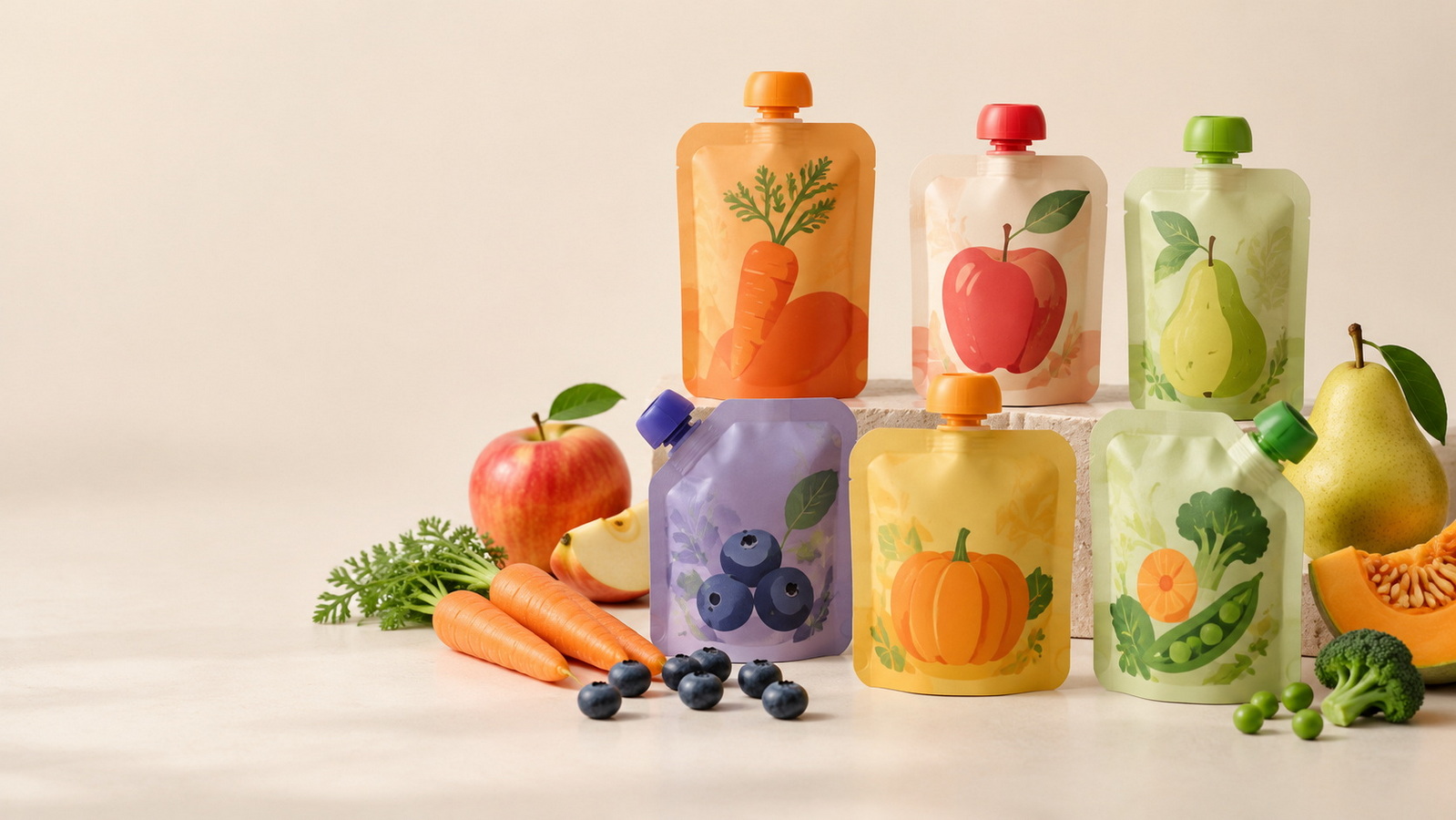
China's advantage is not limited to lower conversion costs. Buyers can find suppliers offering pouch design, printing, lamination, pouch conversion, fitment installation, and—in some cases—compatible filling equipment.
The Shantou–Chaozhou area is particularly relevant when evaluating suppliers that combine flexible packaging with equipment support. HLun PACK and Fenbo both describe packaging-material and machinery capabilities, while nearby DQ PACK offers dedicated baby food pouch products.
Elsewhere, Shenzhen suppliers such as YLTPACK and Ouma emphasize customized flexible packaging. Shanghai-based PACKMIC promotes material development and converting capabilities, while Chengde in Zhejiang highlights sustainable packaging materials, including mono-PE structures.
Grand View Research's 2026 report values the global flexible packaging market at USD 293.9 billion in 2025 and identifies China as the largest country market that year. These figures cover flexible packaging broadly; they do not establish the size of China's baby food spout pouch segment.
The Flexible Packaging Association also lists a 2025 State of the Flexible Packaging Industry Report. However, it concerns the United States, and the full report is member-restricted. Buyers should avoid presenting broad industry figures—or inaccessible report estimates—as verified sales data for Chinese baby food pouch manufacturers.
A useful supplier shortlist should distinguish documented manufacturing capabilities from promotional language.
The following criteria guided this selection:
| Evaluation area | What procurement teams should verify |
|---|---|
| Application relevance | Published baby food pouch products, or relevant spouted food-packaging capabilities |
| Material development | Ability to recommend structures for the actual recipe, filling process, and shelf-life target |
| Factory controls | Incoming inspection, lamination controls, pouch testing, fitment welding, and batch identification |
| Compliance documentation | Current site certificates and application-specific food-contact supporting documents |
| OEM/ODM support | Custom dimensions, printing, pouch geometry, fitments, closures, and material development |
| Delivery reliability | Available production slots, approved subcontractors, contingency planning, and delivery records |
| Commercial suitability | MOQ by design, tooling charges, sample arrangements, and repeat-order economics |
| Equipment compatibility | Fitment dimensions, filling route, capping requirements, and line-trial support |
Public information cannot establish that every listed supplier is qualified for every baby food application. In particular, a manufacturer's food-pouch experience does not automatically demonstrate suitability for retort processing, aseptic filling, or a specific infant nutrition product.
The table separates published figures from information that requires a project-specific quotation. Factory area and equipment counts are scale indicators—not verified baby food pouch output.
Certification entries summarize supplier statements rather than independent confirmation of current certificate status.
| Manufacturer | Published capacity or scale indicator | Published MOQ | Published certification or compliance position |
|---|---|---|---|
| HLun PACK | Separate packaging-material and machinery factories; baby food pouch output not disclosed | Confirm by specification and SKU | Reviewed profile does not establish current food-packaging site certificates |
| DQ PACK | Supplier reports a 30,000 m² facility and 20 pouch-making lines | Confirm for the selected structure and fitment | Reports ISO, BRC, and Sedex credentials; verify current documents |
| PACKMIC | Integrated manufacturing and development base; relevant pouch output not disclosed | Confirm by printing method and construction | Reports ISO and BRC certification |
| Lanker Pack | Printing, lamination, and converting capabilities; numeric output not established | Describes flexible MOQ; obtain a written quotation | Reports BRC and ISO credentials |
| TedPack | Publishes spout-pouch production experience dating to 2008; current output not disclosed | Confirm by project | Food-contact and material claims require supporting reports |
| YLTPACK | Reports a 6,520 m² facility and more than 30 printing/converting machines | Spout-pouch page lists 1,000 digital; 10,000 gravure; 30,000 for certain sustainability-focused structures | Reports ISO 9001 and ISO 22000 |
| Ouma | Flexible packaging production; numeric pouch output not disclosed | Baby food page lists 10,000 pieces per SKU, with exceptions | Publishes ISO 9001, ISO 14001, and BRC claims |
| Fenbo Packaging | Pouches, films, and associated filling equipment; output not disclosed | Confirm by project | Current food-packaging certificates require verification |
| Chengde Technology | Reports more than one million pouches daily on a mono-PE product page; allocation and scope require confirmation | Confirm by structure and design | Lists BRCGS and multiple ISO certifications |
| Guoshengli Packaging | Reports 20,000 tonnes annual flexible packaging capacity; not baby food pouch-specific | Confirm by project | Reports ISO and BRC credentials |
Sources: manufacturer profiles and product pages. All quantities, scopes, and certificate details should be reconfirmed during qualification.
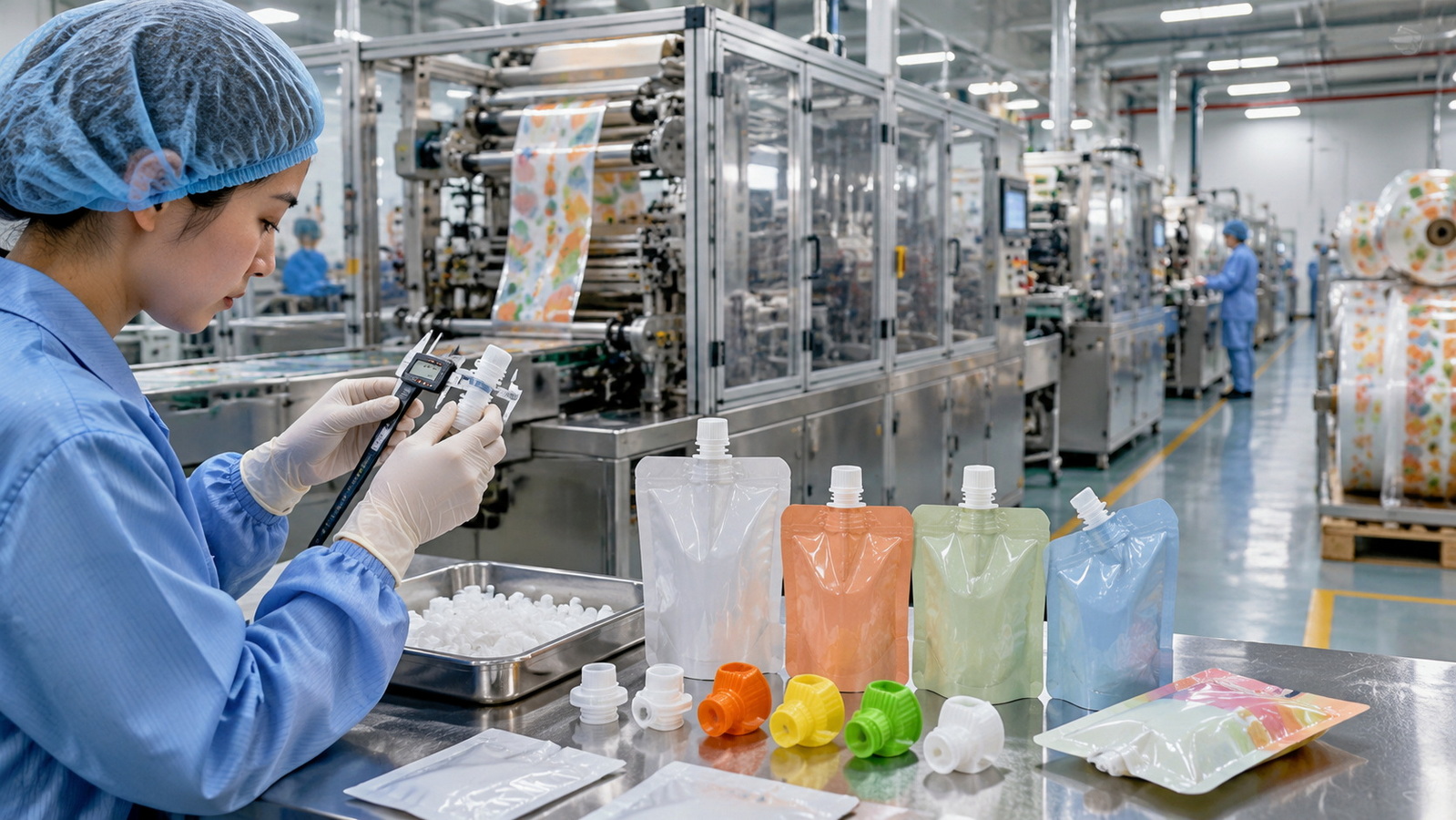
HLun PACK is a relevant starting point for buyers who want to evaluate pouch materials and packaging equipment together rather than manage them as unrelated purchases.
Its published development history begins with paper packaging printing in 1989. The company added packaging machinery manufacturing in 1998 and expanded into flexible packaging in 2012. These are business milestones; the legal entity's incorporation date should be checked separately.
- Location: Shantou, Guangdong.
- Market coverage: The company describes worldwide service and overseas expansion but does not publish a detailed regional sales breakdown.
- Core strength: Combined packaging-material manufacturing, machinery development, and integrated packaging support.
- OEM/ODM scope: Its portfolio includes customized flexible packaging formats and equipment for liquid, powder, and granular products.
For small and medium-sized brands, the practical appeal is the opportunity to coordinate pouch development, equipment compatibility, and technical communication through one supplier. Its published service principles emphasize proactive communication, cross-department collaboration, and full-cycle support. These are useful discussion points, although response speed and project flexibility should be tested during sampling rather than assumed.
HLun PACK also reports Guangdong High-Tech Enterprise recognition in 2025 and a national invention patent for a dual-sealing jelly packaging machine in 2026. Those statements support its machinery-development positioning, but they do not independently establish baby food pouch compliance.
Buyer checkpoint: Request a baby-food-specific proposal covering laminate construction, closure selection, processing limits, food-contact documentation, MOQ, and line-trial support. Evaluate cost-effectiveness using total project cost—not an unsupported "lowest price" claim.
DQ PACK is a strong candidate for buyers seeking an established flexible packaging supplier with an explicitly published baby food pouch range.
The company states that its packaging business dates to 1991. Its baby food products include custom-printed fruit puree spout pouches and OEM/ODM flexible packaging.
- Location: Chaozhou, Guangdong.
- Market coverage: The company reports exports to more than 120 countries.
- Core strength: A broad pouch portfolio with dedicated baby food and heat-processing applications.
- OEM/ODM scope: Printing, dimensions, material constructions, spout pouches, and related food-packaging formats.
A December 2025 trade-publication article describes DQ PACK's retort spout pouch offering for baby food and other liquid foods. However, a published temperature rating is not a validated processing schedule for a buyer's recipe.
Buyer checkpoint: Verify the exact laminate, spout, cap, processing duration, pressure conditions, and test results behind any retort claim.
PACKMIC offers a useful option for buyers prioritizing custom flexible packaging development and an established international customer base.
Its website states that the company was founded in 2009 and operates an integrated manufacturing and development base in Songjiang, Shanghai. It reports serving customers in more than 40 countries.
- Location: Shanghai.
- Market coverage: International; a detailed regional sales split is not disclosed on the reviewed page.
- Core strength: Customized flexible packaging, printing, converting, and process development.
- OEM/ODM scope: Materials, dimensions, printed designs, and pouch configurations.
PACKMIC also identifies baby food as an application for spout pouches. Buyers should nevertheless confirm whether the proposed manufacturing site routinely handles their particular product and processing requirements.
Buyer checkpoint: Request evidence for the proposed pouch-and-fitment assembly, rather than relying on the company's broader food-packaging portfolio.
Lanker Pack publishes a dedicated baby food packaging offering, including spouted pouches and other custom formats.
Its current website states "Since 2007." Other public profiles give different dates, so buyers should distinguish brand history, predecessor operations, and the contracting entity's registration date.
- Location: Foshan, Guangdong.
- Market coverage: Its baby food page names Europe, North America, Asia, and Oceania.
- Core strength: Application-focused flexible packaging and customized pouch structures.
- OEM/ODM scope: Spout arrangements, resealable features, dimensions, printing, and constructions tailored to product requirements.
Lanker also promotes sustainability-related packaging options and BRC/ISO credentials. Buyers should request the certificate scope and the exact evidence supporting any recyclability claim.
Buyer checkpoint: Do not treat a general statement about extended shelf life as proof that a particular puree can remain unrefrigerated. That outcome depends on the complete product and processing system.
TedPack is relevant for brands seeking customized pouch shapes and closure configurations.
A published company announcement identifies its founding date as May 28, 2011. Separately, its spout-pouch page describes production experience dating to 2008. Earlier team experience should not be confused with the legal company's establishment date.
- Location: Dongguan, Guangdong.
- Market coverage: Published company materials identify the United States and Europe among its customer markets.
- Core strength: Spout-pouch customization and a dedicated baby food packaging offering.
- OEM/ODM scope: Pouch shape, size, laminate structure, printing, spout type, and functional features.
Its baby food page discusses rounded corners and protective closure features. These are appropriate design topics, but labels such as "child-safe" or "child-resistant" require clear definitions and supporting evidence.
Buyer checkpoint: Ask what closure property has actually been tested. Anti-choking geometry, tamper evidence, and child resistance are different requirements.
YLTPACK is worth considering for buyers who need published starting quantities and a choice between digital and gravure printing.
The company states that it has manufactured flexible packaging since 2005. Its website describes a 6,520 m² Shenzhen production facility and in-house printing and converting equipment.
- Location: Shenzhen, Guangdong.
- Market coverage: The company describes worldwide service; the reviewed pages do not provide a regional revenue breakdown.
- Core strength: Custom flexible packaging with publicly stated printing-based MOQ options.
- OEM/ODM scope: Pouch dimensions, printing, material structures, spout placement, and closure selection.
Its spout-pouch page lists starting quantities of 1,000 pieces per design for digital printing and 10,000 for gravure. Certain recyclable or compostable constructions start at 30,000 pieces. These figures should be reconfirmed for the actual baby food application.
Buyer checkpoint: Check whether the quoted MOQ includes the selected cap, fitment, material structure, and processing requirement—not simply a standard pouch format.
Ouma publishes a dedicated baby food spout pouch page with a starting MOQ of 10,000 pieces per SKU, subject to exceptions for special finishes.
Its reviewed company profile does not clearly establish an incorporation year. Other company pages describe approximately 18 years of experience, but that should not be converted into an assumed founding date.
- Location: Shenzhen, Guangdong.
- Market coverage: The reviewed profile does not establish principal export destinations.
- Core strength: Custom flexible packaging with a directly published baby food pouch offering.
- OEM/ODM scope: Branded printing and customized flexible packaging configurations.
Ouma lists ISO 9001, ISO 14001, and BRC among its credentials. Buyers should verify current status and confirm which production site each certificate covers.
Buyer checkpoint: Ask whether the quoted price includes fitment installation, caps, testing, packing, and any special finishing charges.
Fenbo is particularly relevant when pouch supply and filling-machine compatibility need to be discussed together.
Its company profile describes more than 20 years of flexible packaging experience but does not clearly publish an exact establishment year. It also states that it has served more than 30 industries.
- Location: Shantou, Guangdong.
- Market coverage: Principal geographic markets are not clearly specified in the reviewed profile.
- Core strength: Flexible packaging combined with associated packaging equipment.
- OEM/ODM scope: Spout pouches, stand-up pouches, films, and related equipment solutions.
Fenbo's published product range includes special-cap spouts and an 8.2 mm baby food pouch fitment listing, making it relevant to closure-and-pouch compatibility discussions.
Buyer checkpoint: Establish responsibility for the pouch, spout, cap, filling machine, and acceptance trial. Confirm which operations occur in-house.
Chengde is a candidate for procurement teams prioritizing material development and potential mono-material packaging projects.
Its current homepage states that the company was established in 1999, while older company material gives 1993. The contracting entity's business licence should resolve the relevant date before publication in supplier records.
- Location: Longgang, Zhejiang.
- Market coverage: Public materials describe international business, but the reviewed primary pages do not quantify principal regional markets.
- Core strength: Flexible packaging materials and sustainability-focused development.
- OEM/ODM scope: Conventional and recyclable pouches, spout pouches, films, and material customization.
Its mono-PE spout-pouch page reports more than one million pouches of daily capacity. Buyers should clarify whether that figure covers all pouch formats, a particular production configuration, or available capacity for the proposed order.
Buyer checkpoint: Qualify the exact baby food assembly. A mono-PE liquid pouch is not automatically suitable for retort processing or the required shelf life.
Guoshengli provides an alternative sourcing location outside the southern coastal clusters.
Its profile identifies the company as a subsidiary of Linyi Guosheng Color Printing and Packing Co., Ltd., whose history dates to 1999. That parent-company date should not automatically be recorded as the subsidiary's incorporation date.
- Location: Linyi, Shandong.
- Market coverage: The reviewed primary pages do not establish a detailed regional export split.
- Core strength: Custom pouches and rollstock supported by substantial stated flexible packaging capacity.
- OEM/ODM scope: Packaging design, material selection, printing, and pouch production.
The company reports a 25,000 m² factory, more than 200 employees, and 20,000 tonnes of annual production capacity. It also publishes a baby food spout pouch offering. These establish sourcing relevance, not automatic qualification for a specific infant-food process.
Buyer checkpoint: Request recent experience with comparable puree products, fitments, and filling conditions.
Suppliers publish constructions such as PET/NY/PE and PET/AL/PE for food and puree applications. However, a layer abbreviation alone does not identify the exact resin grades, adhesive system, layer thicknesses, or validated processing limits.
A practical specification should establish:
- Recipe characteristics, including acidity, fat content, viscosity, and particles.
- Target net weight and product density.
- Filling method and temperature.
- Any subsequent heat treatment.
- Shelf-life and storage requirements.
- Light, oxygen, and moisture protection objectives.
- Pouch, spout, cap, and filling-line dimensions.
A 100 g fill does not automatically equal 100 mL. Filled capacity also depends on product density, gusset geometry, seal areas, fitment displacement, and headspace.
CE marking and RoHS are not substitutes for food-contact documentation.
CE marking applies only to products covered by relevant legislation that requires it. Packaging machinery may fall within applicable requirements; an ordinary empty food pouch does not become food-contact compliant because a supplier presents a machinery CE document. RoHS primarily concerns electrical and electronic equipment.
For United States sales, ask the supplier to identify the regulatory basis supporting each relevant food-contact substance and its intended use. FDA's guidance explains that authorization and migration assessment depend on the substance and use conditions—not a universal factory approval.
For European Union sales, request documentation addressing the applicable food-contact framework, plastics requirements, and current bisphenol rules. The European Commission explains the role of a Declaration of Compliance and supporting documentation under Regulation (EU) No 10/2011.
Regulation (EU) 2024/3190 also changes requirements concerning BPA and certain other bisphenols. Buyers should check the currently applicable provisions and transition arrangements rather than accepting an undated "BPA-free" statement.
Request the business licence, legal name, factory address, certificate copies, and a production-flow description.
Establish which company prints, laminates, converts, welds the spout, and issues the invoice. If subcontracting is involved, identify those sites before approval.
Certificate verification should compare the legal entity, address, scope, issuing body, and current status. IAF CertSearch provides these fields for participating accredited management-system certificates.
A practical qualification sequence is:
1. Review existing samples for geometry and finish.
2. Approve a written technical specification.
3. Obtain samples using the proposed materials and fitments.
4. Conduct a filling and capping trial.
5. Apply the intended food-processing conditions.
6. Evaluate integrity, appearance, handling, and shelf-life performance.
7. Approve a pilot lot before routine ordering.
Treat the pouch and filling line as a combined system. Procurement documents should capture spout dimensions, cap style, filling-machine constraints, processing conditions, and trial requirements.
Normalize quotations using the same specification and delivery basis.
Include tooling, cylinders or plates, fitments, caps, inspection, packing, freight, payment terms, and permitted quantity variation. Ask whether MOQ applies per artwork, pouch size, laminate, or cap colour.
Published MOQ figures can vary substantially by printing process and construction, as YLTPACK's differentiated quantities illustrate.
Specify clean protective packing, lot identification, carton limits, and handling instructions. Confirm whether pouches travel loose, bundled, on rails, or in another line-compatible format.
Ask the manufacturer to document storage and transport limits for the selected construction. Also agree on the inspection window, retained samples, and claims procedure before dispatch.
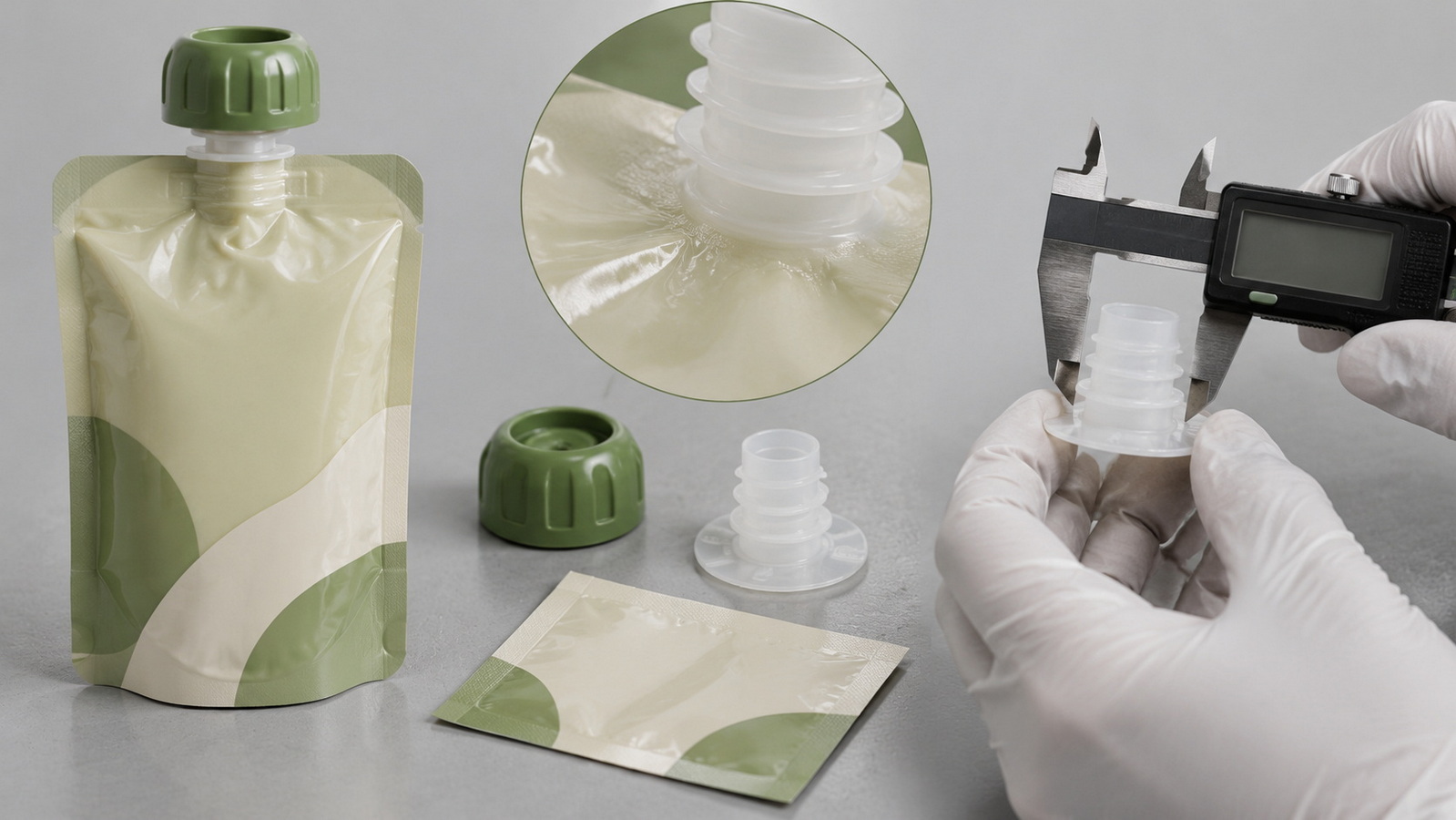
A technically important risk is approving the pouch body while leaving the spout and cap insufficiently specified.
A sample may look correct even when the production fitment differs in dimensions, material, closure configuration, or filling-line interface. Because spout diameter, bore geometry, cap style, and attachment method all belong in the specification, appearance alone is not an adequate approval method.
Use a signed component register covering:
- Laminate construction and approved material codes.
- Spout drawing, material, and supplier reference.
- Cap drawing and functional requirements.
- Approved printing and adhesive systems.
- Relevant dimensional and functional tolerances.
- Written approval requirements for substitutions.
Apply the same discipline to laminate changes. A proposed "equivalent" material should trigger documented review, including whether the original food-contact evidence still applies. FDA's use-specific authorization approach and the EU's documentation requirements make unsupported substitution particularly problematic.
This is a more useful safeguard than simply instructing a supplier to maintain "the same quality."
The right baby food spout pouch manufacturer is the one that can demonstrate control over your particular product, process, and supply requirements.
HLun PACK offers a relevant starting point for brands evaluating customized pouches alongside packaging machinery and integrated support. Other suppliers on this shortlist provide different combinations of dedicated baby food products, printing options, material development, and manufacturing scale.
For an application-specific discussion with HLun PACK, prepare your target market, recipe characteristics, fill weight, processing method, annual demand, artwork count, and existing equipment details. Request a written proposal covering materials, fitments, samples, validation responsibilities, MOQ, and delivery conditions before committing to production.
Obtain the full certificate, including its number, legal entity, site address, scope, issuing body, and validity dates.
Search IAF CertSearch where applicable, then confirm unresolved details directly with the certification body using independently obtained contact information. A certificate should cover the relevant manufacturing activities—not simply a sales office or unrelated operation.
IAF CertSearch displays status, scope, issuing certification body, accreditation body, and other verification information. Absence from a search should prompt further investigation rather than an immediate assumption of fraud.
Not by itself.
Ask what the document actually establishes: a laboratory result, a material declaration, a registration record, or a regulatory authorization basis. Then check whether it covers the proposed components and conditions of use.
FDA explains that food-contact substance assessments consider migration and intended use. A document for one material or use condition does not automatically establish suitability for every finished pouch.
Do not assume so.
Define the actual filling and processing conditions before selecting the laminate, fitment, and cap. Require written confirmation and application-relevant validation for the complete assembly.
A manufacturer may offer several packaging constructions, but the existence of a retort product elsewhere in its range does not qualify the quoted baby food pouch.
Ask the supplier to define the claim and provide the drawing, material specification, test method, and results supporting it.
Distinguish anti-choking design from child resistance, tamper evidence, opening torque, and cap retention. These describe different functions and should not be treated as interchangeable marketing terms.
Because supplier baby food pages use broad safety-related closure descriptions, procurement teams should convert each claim into a measurable requirement before approval.
Treat the change as a new packaging qualification project.
Request evidence for barrier performance, processing compatibility, fitment integration, and the finished assembly's recyclability in the destination market. Repeat line trials and appropriate product testing rather than approving the change solely from a film description.
Suppliers such as Chengde and YLTPACK publish recyclable packaging options, but those offerings do not establish suitability for every baby food recipe or processing method.
1- HLun PACK — Company history, packaging materials, machinery, service model, and development milestones. [hlunpack]
2- DQ PACK — Baby food pouch products, manufacturing claims, and international supply coverage. [dqpack]
3- PACKMIC — Company profile, founding year, customization, and published certification claims. [packagingmic]
4- Lanker Pack — Company positioning and baby food packaging applications. [lankerpack]
5- TedPack — Company history and customized baby food packaging. [newswire]
6- YLTPACK — Factory profile, spout-pouch structures, and published MOQ options. [yltpacking]
7- Ouma — Company profile and baby food pouch specifications. [oumapack]
8- Fenbo Packaging — Flexible packaging, associated machinery, and company background. [fenbopackaging]
9- Chengde Technology — Current company profile and mono-PE spout-pouch capabilities. [chengdepackage]
10- Guoshengli Packaging — Parent-company history, facility scale, and product offering. [guoshengpacking]
11- Grand View Research — Flexible Packaging Market Size & Share Report, 2026–2033. Broad industry context, not baby food pouch-specific market sizing. [grandviewresearch]
12- Flexible Packaging Association — State of the U.S. Flexible Packaging Industry; includes the 2025 report listing. [flexpack]
13- U.S. Food and Drug Administration — Food Packaging & Other Substances that Come in Contact with Food. [fda]
14- European Commission — Food Contact Materials Legislation. [food.ec.europa]
15- EUR-Lex — Consolidated Regulation (EU) 2024/3190 on BPA and certain other bisphenols. [eur-lex.europa]
16- European Union — CE Marking Requirements. [europa]
17- European Commission — RoHS Directive. [environment.ec.europa]
18- IAF CertSearch — Certificate Search and Verification. [iafcertsearch]


