


close
Choose Your Site
Global
Social Media
Views: 266 Author: HLun PACK Publish Time: 2026-10-06 Origin: Site


Content Menu
● How Granules Lose Shelf Life
● Stand Up Pouch vs. Rigid Carton: The Practical Differences
>> When a Stand-Up Pouch Has the Advantage
>> When a Rigid Carton Has the Advantage
● Barrier Specifications That Actually Matter
>> Moisture, Oxygen, and Light
>> Seals, Headspace, and Closures
● An HLun Pack Qualification Workflow
● Cost, Sustainability, and Food Contact
● Which Format Should You Choose?
>> Can a paperboard carton alone extend the shelf life of dry granules?
>> Is a foil stand-up pouch always better than a carton with a liner?
>> Which matters more for cereal granules: WVTR or OTR?
>> Does a resealable zipper guarantee longer shelf life after opening?
>> Are paperboard cartons always easier to recycle than barrier pouches?
>> What should I send an equipment supplier before requesting a quote?
A stand up pouch vs. rigid carton decision is not simply a choice between plastic and paperboard. For extended shelf-life granule packaging, the decisive question is which complete package keeps a specific product dry, stable, intact, and acceptable through distribution and storage. A high-barrier pouch can provide that protection in one primary pack; a rigid carton often needs a sealed inner liner to do the same. Neither format earns a shelf-life claim without testing the filled package.
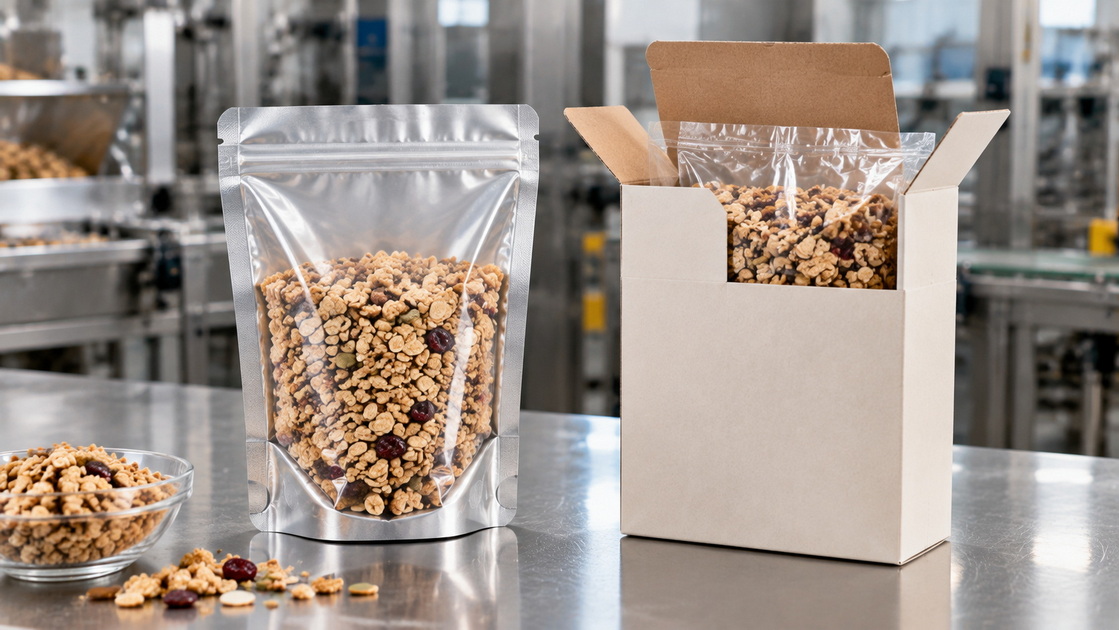
"Granules" covers products with very different failure modes. Crisp cereal pieces can soften after absorbing moisture. Sugar-based granules may clump. Roasted seeds or nut pieces can develop oxidative off-flavors. Fragile pellets can break during filling and transport. A package that works for one product may fail another, even at the same fill weight. Research on cereals and snacks identifies moisture uptake, oxidation, aroma changes, and mechanical damage as relevant causes of quality loss.
Before selecting a format, define what "extended shelf life" means for the product:
- The target unopened shelf life and expected storage conditions.
- The first unacceptable change: clumping, lost crispness, rancid odor, color change, breakage, or another measurable endpoint.
- The expected time and conditions of use after opening.
- Whether the granules require a moisture barrier, oxygen barrier, light protection, or a combination.
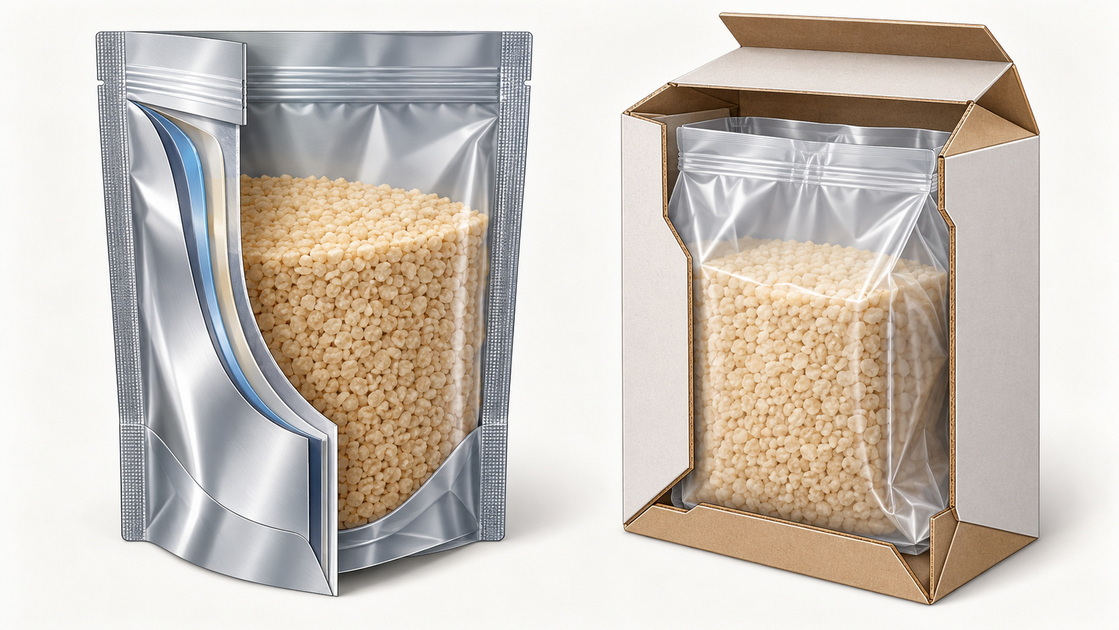
This distinction matters because an attractive outer carton is not automatically a protective primary package. In a carton-and-liner design, the liner, its closure, and its seals usually carry much of the barrier responsibility; the carton contributes shape, print area, and physical support. Paperboard alone should not be treated as equivalent to a qualified high-barrier film.
| Decision factor | Stand-up pouch | Rigid paperboard carton |
|---|---|---|
| Shelf-life barrier | Depends on film structure, closure, and seal integrity; high-barrier structures can be specified. | Bare board offers limited moisture protection; extended-life applications often need a sealed liner or qualified coating. |
| Physical protection | Flexible walls can leave fragile pieces more exposed to compression unless pack and shipper are designed accordingly. | Holds a defined shape and can help protect contents from handling pressure; an inner pack may still be necessary. |
| Filling and sealing | Requires pouch opening, accurate dosing, product-free seal areas, and suitable heat-seal settings. | Requires carton erection, filling, and closing; a liner adds its own forming and sealing operations. |
| Consumer use | Can incorporate a zipper, tear notch, or pour feature, subject to validation. | Offers a familiar box shape and broad printable panels; liner handling can affect convenience. |
| Transport and storage | Unfilled pouches can ship and store compactly; filled-pack efficiency depends on shape and case design. | Flat carton blanks can also ship efficiently, but erected dimensions and any liner affect line and shipping economics. |
| End-of-life assessment | Multilayer barriers, coatings, and closures may complicate recycling. | Board may be recyclable, but liners, coatings, windows, and attachments need separate assessment. |
These are design tendencies, not guaranteed outcomes. A weakly sealed high-barrier pouch may underperform a well-sealed liner inside a carton. Conversely, a beautiful carton with an unsuitable or damaged liner may deliver little useful protection. Research emphasizes evaluating material properties against the actual food and supply-chain conditions, rather than selecting by material category alone.
A pouch is a strong candidate when the product needs a continuous, specified barrier and the brand wants the primary package to stand on shelf without a separate box. It also suits products where a validated reclosure improves everyday handling. The converter can propose film structures for moisture, oxygen, light, and puncture requirements—but the buyer should request measured performance for the actual proposed structure, not an unsourced promise that "foil," "recyclable," or "high barrier" will deliver a particular shelf life.
The chief engineering risk is often at the package level. Film barrier data does not reveal a stray granule in a heat seal, a poorly sealed gusset, or damage caused by a sharp-edged product. ASTM F88/F88M provides a method for measuring flexible-seal strength, while ASTM F3039 describes dye-penetration methods for locating certain leaks in nonporous packaging. Seal strength and leak detection answer different questions; one does not replace the other.
A carton may be preferable when shape retention, stacking, display space, and handling protection are central to the brief. It can be especially useful when a fragile granule needs a defined outer form. The trade-off is complexity if the product also needs a strong shelf-life barrier: the buyer may be purchasing, filling, inspecting, and disposing of both a carton and an inner pack.
An engineering team should therefore compare pouch versus carton-plus-liner, not pouch versus bare board, when the latter could not meet the product's requirements. Check where the liner is sealed, how it is supported during filling, whether it opens cleanly, and whether consumers can reasonably close it after first use. Carton stiffness cannot compensate for a compromised liner seal.
For moisture-sensitive granules, ask suppliers for water vapor transmission rate (WVTR) data for the proposed film or liner. ASTM F1249-25 describes a method for measuring WVTR through flexible barrier materials and notes its relationship to package stability. State the test temperature and humidity when comparing results; a number without conditions is not a sound purchasing specification.
For oxidation-sensitive ingredients, request oxygen transmission rate (OTR) data as well. ASTM D3985 addresses oxygen transmission through plastic films and related materials. WVTR and OTR describe different properties: a material suitable for moisture control is not automatically suitable for an oxygen-sensitive product. Light exposure and aroma retention may also need consideration for a particular formulation.
A practical rule is to specify from the product backward. Determine how much moisture uptake or oxidation the granules can tolerate, then evaluate candidate packages under relevant storage conditions. Avoid assigning a universal WVTR or OTR target to every granule; the allowable value depends on the product, package area, fill conditions, and target shelf life.
A barrier film only protects what its seals enclose. During trial runs, inspect whether particles enter the seal zone, particularly at higher filling speeds. Compare seals made at the start of a run with those made after the equipment reaches steady operation. If a pouch has a zipper, validate both the initial tamper-evident seal and the way the zipper functions after opening.
Likewise, do not assume that changing the gas in the headspace will solve every shelf-life problem. The usefulness of a modified atmosphere depends on the product's deterioration mechanism and whether the finished package retains its intended conditions. Food-packaging research discusses atmosphere control alongside barriers and other shelf-life measures, rather than as a substitute for them.
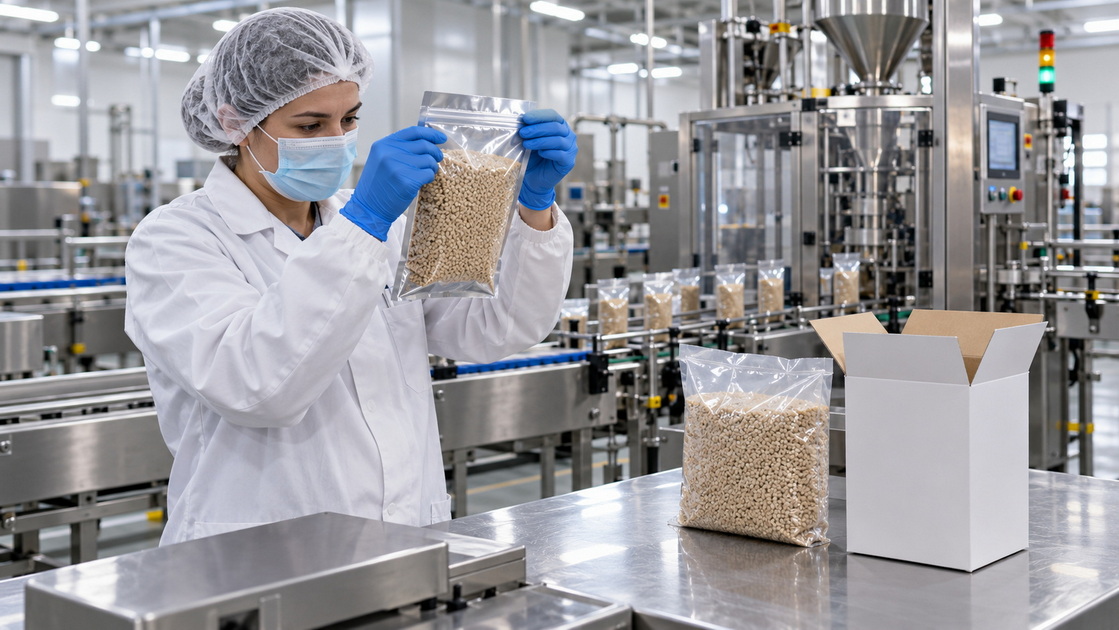
For a granular-packaging equipment project, HLun Pack can frame the buying decision as a package-and-line qualification exercise, rather than recommending a format from appearance alone. The following workflow is a proposed evaluation method—not a report of tests already performed by the company.
1. Define acceptance criteria. Record the target shelf life, storage climate, fill weight, permitted breakage, acceptable product-quality limits, and opening requirements.
2. Shortlist complete structures. Compare a specified pouch with a specified carton-plus-liner. Document every film layer, coating, closure, and food-contact surface.
3. Run the actual granules. Trial representative product lots at planned fill weights. Check dosing consistency, dust generation, trapped particles, seal formation, carton closure, and finished-pack appearance.
4. Test protection separately from appearance. Obtain relevant WVTR and OTR results for barrier materials; measure seal strength and use an appropriate package-integrity method for the design. ASTM F88/F88M and F3039 address different aspects of flexible-package assessment.
5. Store and handle filled samples. Use conditions representative of the intended market, alongside defined challenge conditions where appropriate. Measure the product's actual failure indicators over time instead of extrapolating shelf life from film data alone.
6. Compare total usable output. Include rejected packs, damaged product, changeover effort, packing components, cases, and freight—not just the quoted price per empty pouch or carton.
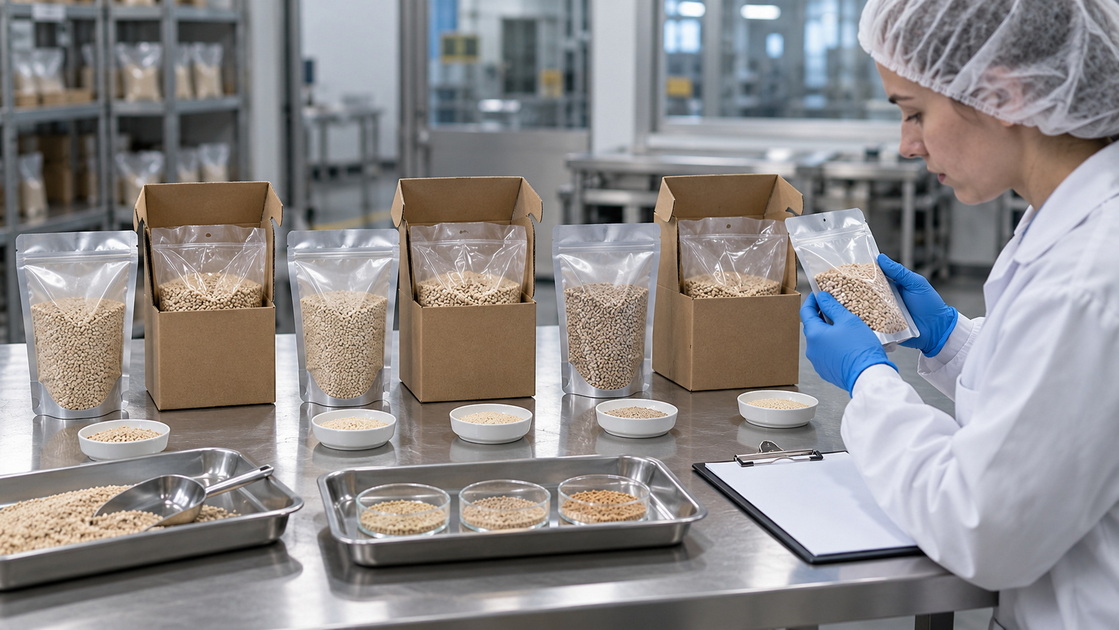
Consider a hypothetical roasted-granule product that loses quality through both moisture uptake and oxidation. A plain carton would not be a fair shelf-life candidate by itself. The meaningful trial would compare a qualified barrier stand-up pouch with a carton containing a qualified, sealed barrier liner. Both would use the same granules and target fill weight, then undergo package-integrity checks and storage testing.
The winning option would be the one that meets the product-quality limit and commercial requirements with an acceptable level of waste and complexity. No shelf-life duration or percentage saving is implied by this example. It illustrates why a format-level claim cannot replace product-specific evidence.
For procurement, the useful comparison is cost per acceptable pack delivered, not cost per package component. A pouch may avoid an outer box; a carton may need a liner but reduce damage in a particular distribution system. Either outcome must be measured on the intended equipment and shipping configuration.
Environmental claims also need package-level evidence. A lightweight pouch should not automatically be called the greener choice, and a paperboard carton should not automatically be called recyclable as sold. How2Recycle's guidance considers the full package, including coatings, laminates, liners, and attachments; some structures require testing before a favorable recyclability label is appropriate. Assess the markets where the finished pack will actually be sold.
Finally, verify food-contact suitability for every material that contacts the granules under the intended conditions of use. The U.S. Food and Drug Administration treats packaging and its components as food-contact substances and explains that applicable authorizations concern their intended use. Ask suppliers for documentation that matches the proposed construction rather than relying on the phrase "food grade" alone.
Choose a stand-up pouch for serious consideration when a single, shelf-ready primary pack can meet the validated barrier and handling brief. Choose a carton with a qualified liner for serious consideration when structural protection or box presentation adds enough value to justify the extra component and operations. If neither passes filled-pack shelf-life and line trials, revise the construction before making a marketing claim.
Share your granule type, target unopened shelf life, fill weight, destination markets, proposed film or liner, and expected output with HLun Pack. Request a side-by-side packaging-equipment assessment and sample-run plan for a stand-up pouch and a carton-plus-liner solution.
It can provide containment and physical structure, but bare paperboard should not be assumed to supply the moisture and oxygen barrier needed for a specific extended-life target. Evaluate a liner or suitable coating, then test the complete filled pack.
No. The result depends on the proposed foil laminate, finished seals, product sensitivity, and the liner used in the carton. Compare complete, sealed packages under the same storage and handling conditions.
It depends on the first quality failure. Moisture uptake may drive lost crispness, while oxygen exposure can contribute to oxidative deterioration in fatty products. Test both where both mechanisms matter; do not choose on the basis of one barrier figure alone.
No. A zipper may make a pouch easier to close, but unopened shelf-life evidence does not establish in-use performance. Validate how consumers open, handle, and reclose the actual package.
No blanket claim is reliable for the finished package. A carton's liner or coating and a pouch's film layers or closure can change how each is assessed. Check current requirements and collection options in the destination market.
Send product samples and specifications, target fill weight and output, dust and breakage concerns, candidate package dimensions and materials, target shelf life, and destination markets. Ask the supplier to identify which performance claims require material tests, line trials, or filled-pack storage studies before approval.
1. Bauer, A.-S., et al. (2022). "[Cereal and Confectionary Packaging: Background, Application and Shelf-Life Extension]." *Foods*, 11(5), 697. Used for product deterioration mechanisms, material properties, and package-selection principles. [pmc.ncbi.nlm.nih]
2. ASTM International. "[ASTM F1249-25: Standard Test Method for Water Vapor Transmission Rate Through Plastic Film and Sheeting Using a Modulated Infrared Sensor]." Used for WVTR testing scope and interpretation. [store.astm]
3. ASTM International. "[ASTM F88/F88M-21: Standard Test Method for Seal Strength of Flexible Barrier Materials]." Used for seal-strength testing. [astm]
4. ASTM International. "[ASTM F3039-15: Standard Test Method for Detecting Leaks in Nonporous Packaging or Flexible Barrier Materials by Dye Penetration]." Used for the distinction between leak location and seal-strength measurement. [astm]
5. ANSI Webstore. "[ASTM D3985-17: Standard Test Method for Oxygen Gas Transmission Rate Through Plastic Film and Sheeting Using a Coulometric Sensor]." Used for OTR testing scope. [webstore.ansi]
6. U.S. Food and Drug Administration. "[Food Packaging & Other Substances that Come in Contact with Food—Information for Consumers]." Used for food-contact regulatory context. [fda]
7. How2Recycle. "[Guidelines for Use: Abbreviated Guide & Rulebook]" (2024). Used for package-level recyclability assessment principles; check the current program guidance before making a live labeling claim. [how2recycle]


