


close
Choose Your Site
Global
Social Media
Views: 266 Author: HLun PACK Publish Time: 2026-10-14 Origin: Site


Content Menu
>> How Spout Position and Diameter Affect Performance
>> Why the Terminology Matters
● Which Pouch Works Better for Your Product?
>> Powders, Granules, and Solid Products
>> Multi-Use and Single-Use Products
● Spout Pouch Filling Machines vs Doypack Packaging Machines
>> Filling Premade Spouted Pouches
>> Filling Non-Spouted Stand-Up Pouches
>> Compare Validated Output, Not Only Maximum Speed
● What Actually Determines Protection?
>> Match the Complete Package to the Process
● Sustainability: Assess the Entire Pouch
>> What the Updated Guidance Adds
● A Five-Step Pouch Validation Plan
>> 3. Confirm the Packaging Specification
>> 4. Conduct Representative Line Trials
>> 5. Verify Performance Beyond Filling
● Choose the Package and Equipment Together
>> Is a Spout Pouch the Same as a Doypack?
>> Can a Doypack Have Both a Spout and a Stand-Up Base?
>> Which Is Better for Liquid Packaging?
>> Can One Machine Fill Both Formats?
>> Are All Spouted Pouches Suitable for Hot Filling?
>> Does a Spout Increase Shelf Life?
Spout pouch vs Doypack is not a comparison between two completely separate packaging formats. A spout pouch is defined by its dispensing fitment: a spout, usually paired with a reclosable cap. A Doypack is defined by its stand-up pouch construction. Overlap is the key distinction: a Doypack can also be a spout pouch when fitted with a spout.
For manufacturers, this distinction affects more than terminology. It influences filling equipment, consumer convenience, packaging costs, and quality control.
At HLun Pack, our focus is flexible packaging equipment and integrated packaging solutions. From that perspective, the most useful question is not simply "Which pouch is better?" It is "Which pouch construction, closure, and filling process suit this product?"
This guide compares spouted pouches with non-spouted Doypack-style stand-up pouches where a practical purchasing comparison is needed.
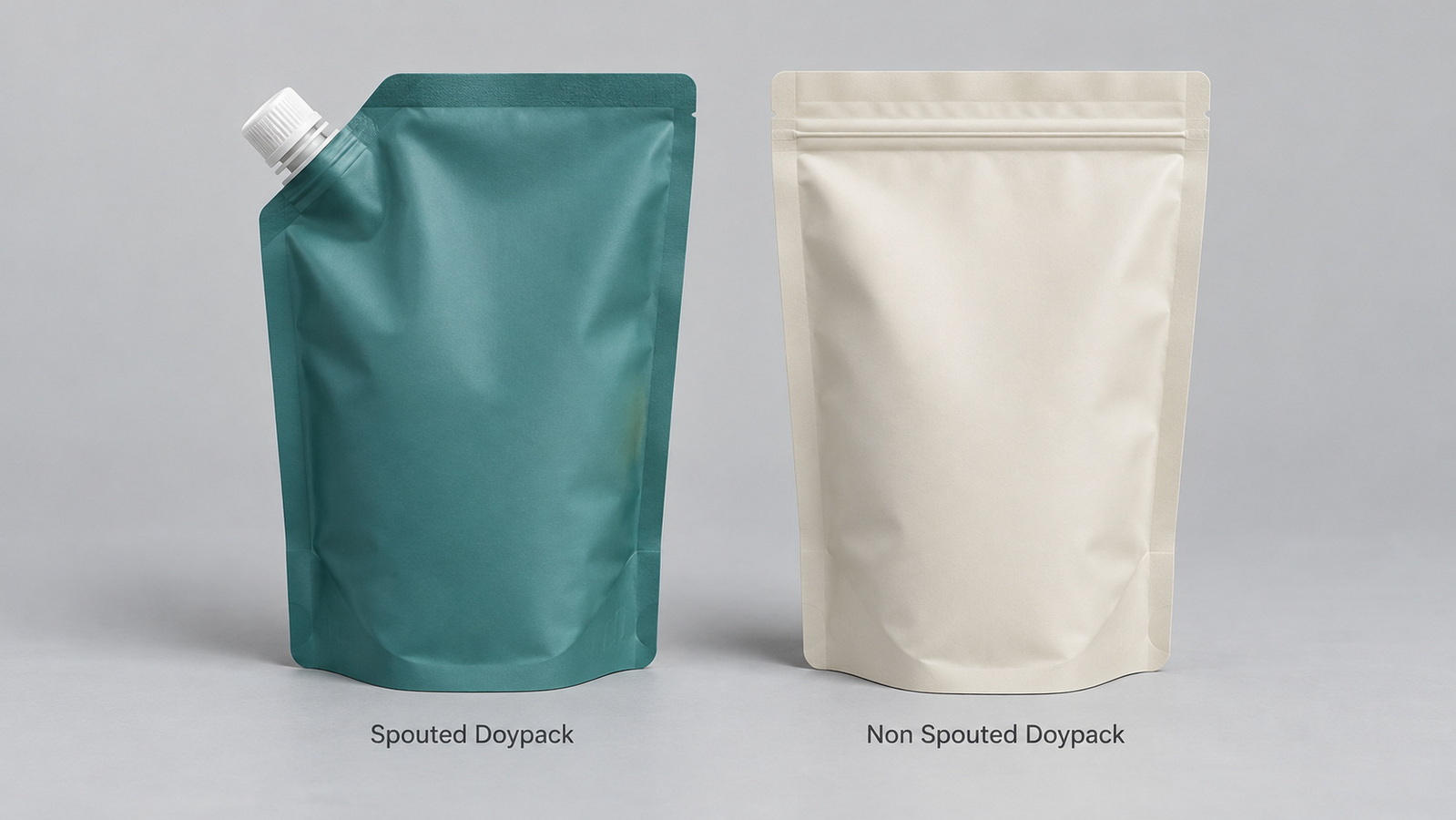
A spout pouch is a flexible package with an integrated dispensing opening. Its spout can support pouring, squeezing, or controlled product delivery. A reclosable cap allows consumers to close the package between uses.
Common applications include:
- Fruit purées and baby food.
- Beverages and liquid concentrates.
- Sauces and semi-liquid foods.
- Personal-care products.
- Household cleaning products.
Spouted pouches may use different body constructions, including Doypack-style stand-up designs and side-gusset formats. The spout identifies the dispensing system, not a single pouch shape.
Spouts may sit centrally at the top or toward a corner. Their position influences pouring, squeezing, and handling.
Diameter also matters. Gualapack, for example, lists spout diameters of 8.6, 14, and 22 millimeters within its premade pouch range. These are supplier-specific options, not universal standards. Selection depends on viscosity, particle size, and intended use.
My recommendation is to evaluate the actual product through the proposed opening. A suitable diameter for juice may perform poorly with a thick sauce containing particles.
Doypack refers to the established stand-up pouch format associated with Thimonnier. DOYPACK® is a trademark owned by the company, although buyers frequently encounter the name used broadly in packaging discussions.
Its defining feature is a shaped bottom that enables the filled pouch to stand upright. The flexible body also provides substantial printable surface area.
A Doypack may incorporate:
- A sealed opening with a tear feature.
- A zipper for repeated access.
- A spout and cap.
- Other application-specific accessories.
For procurement documents, "stand-up pouch" is often the clearer general description. Follow it with the required closure, dimensions, material structure, and filling method.
An inquiry requesting "Doypack packaging" does not tell an equipment supplier whether the product needs zipper access or dispensing through a spout.
Likewise, "spout pouch" does not establish the bottom construction.
Define the pouch body and closure separately. This reduces the risk of comparing quotations for different specifications.
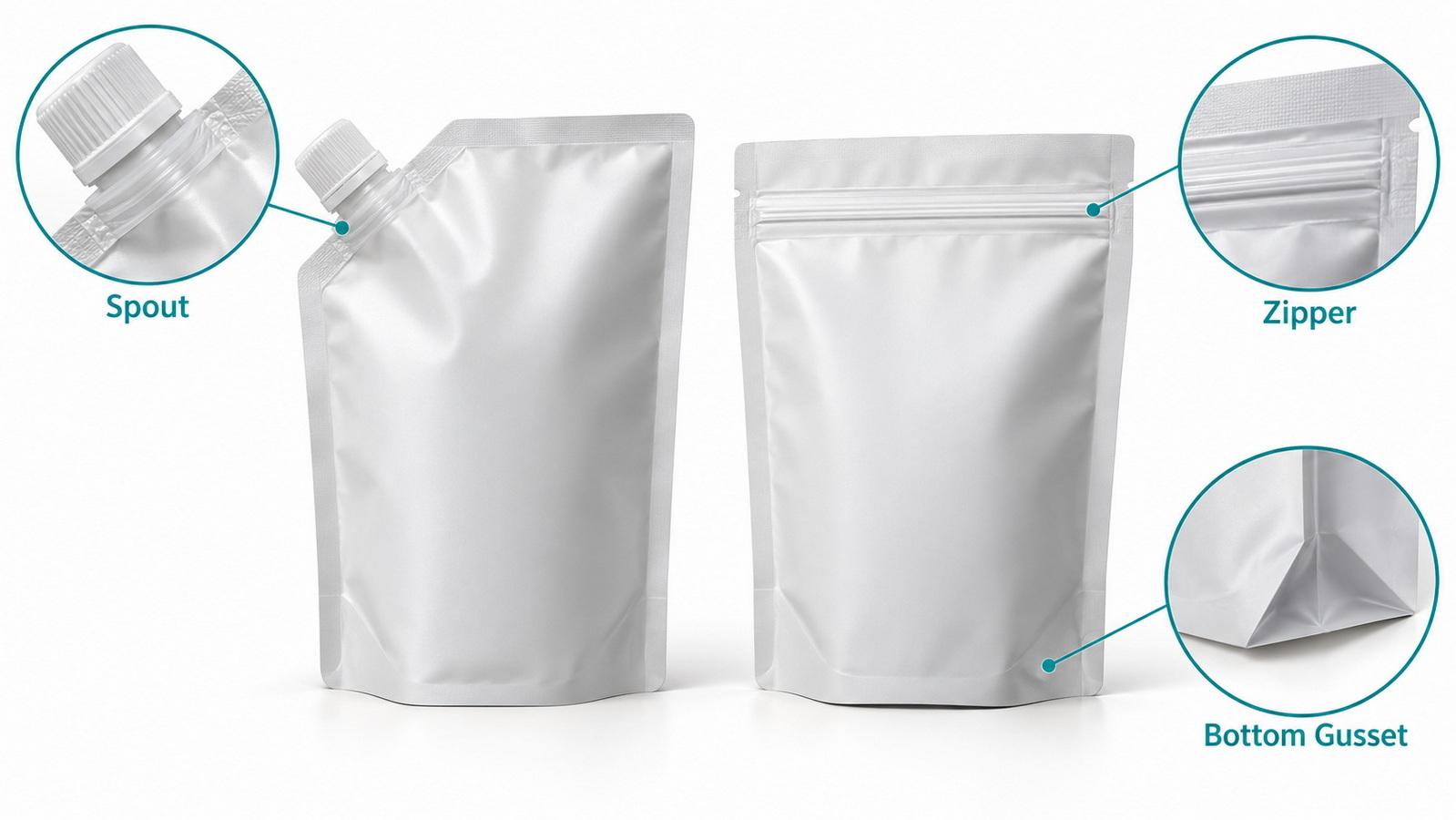
The following table compares a spouted pouch with a non-spouted Doypack-style pouch. It does not imply that Doypacks cannot have spouts.
| Comparison factor | Spouted pouch | Non-spouted Doypack-style pouch |
|---|---|---|
| Defining feature | Integrated dispensing spout | Stand-up body without a spout |
| Consumer access | Pouring, squeezing, or dispensing | Opening the pouch mouth |
| Reclosure | Usually a screw cap | Optional zipper or another closure |
| Typical applications | Liquids and semi-liquids | Products accessed through a wider opening |
| Filling interface | Through the spout or another specified opening | Commonly through an open top |
| Critical closure controls | Spout weld, cap interface, and capping conditions | Top seal and any zipper integration |
| Standing ability | Depends on pouch construction | A defining characteristic when properly filled |
| Main purchasing consideration | Dispensing system plus pouch performance | Access opening plus pouch performance |
The practical comparison is therefore about access and dispensing—not two mutually exclusive packaging categories.
A spouted stand-up pouch is a strong candidate when consumers need controlled pouring or repeated dispensing. The cap provides a defined opening that can be closed again.
However, convenience does not establish shelf life or microbiological safety. Those requirements must be addressed through product processing, packaging specifications, and validation.
For thin liquids, assess flow and leakage. For viscous products, evaluate dispensing force and residual product. For formulations containing particles, check whether the proposed opening permits reliable flow.
A non-spouted stand-up pouch deserves consideration when users need broad access to scoop, remove, or pour the contents.
Examples for evaluation include coffee, snacks, powdered ingredients, and granular products. The recommendation is functional: match the opening to how the customer uses the product, rather than selecting packaging solely by appearance.
Consider:
- Required opening width.
- Portion size.
- Reclosure expectations.
- Product contamination of the sealing area.
- Ease of emptying the pouch.
A multi-use liquid product may justify a spout and cap. A single-use product may not need that additional system.
Similarly, a zipper can support repeated access, but its usefulness depends on product behavior and consumer handling.
Start with the use occasion. Then choose the closure.
Machine compatibility is one of the most consequential differences in a packaging project.
Do not assume that equipment handling zipper stand-up pouches can also handle every spouted pouch. The loading interface, filling path, closure operation, and controls must match the specified package.
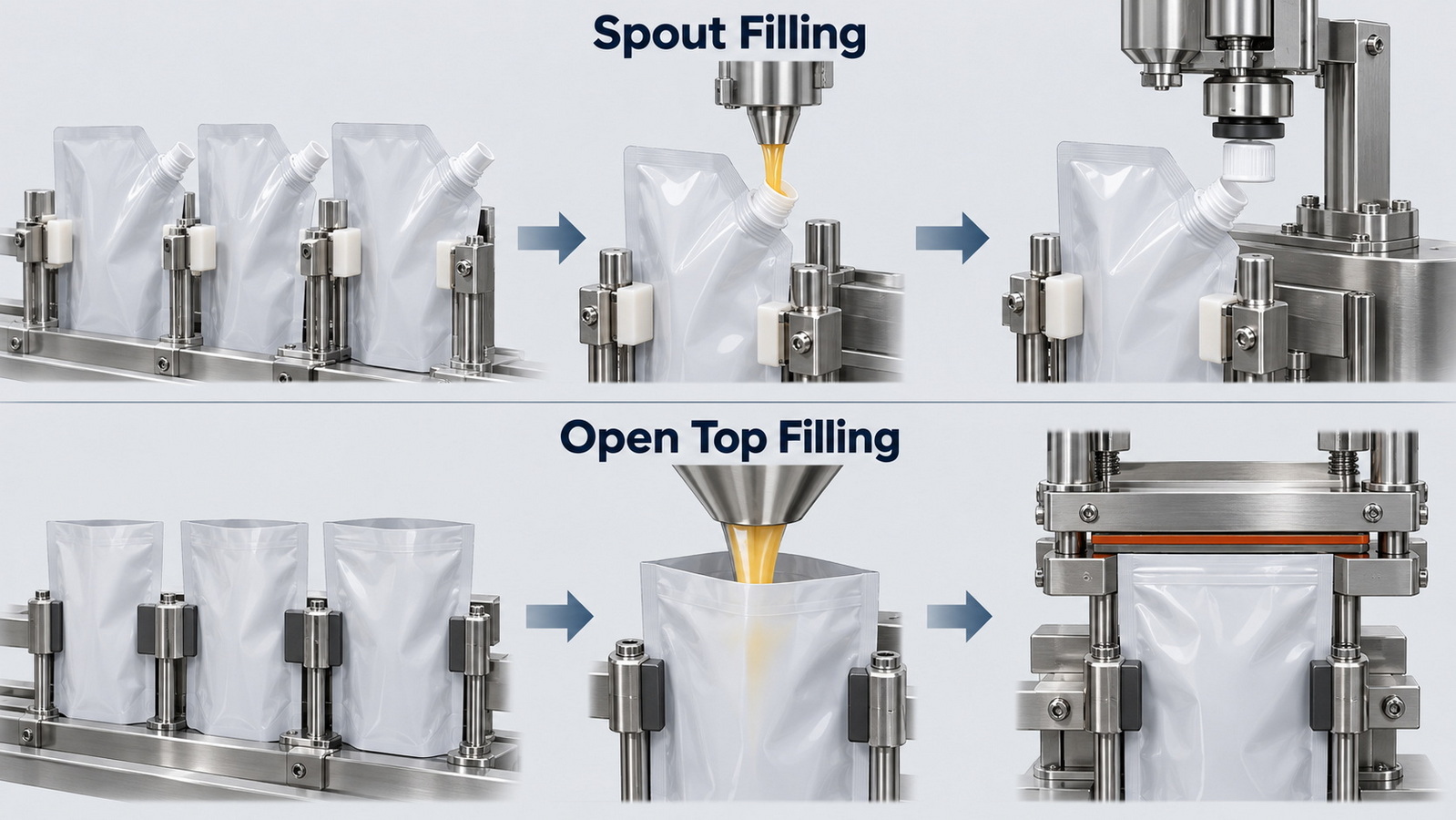
One established configuration fills premade pouches through the spout and then applies controlled capping conditions. Gualapack describes this approach for its spouted pouch filling lines.
Depending on the system, the project may require:
1. Pouch loading and positioning.
2. Accurate product dosing.
3. Cap feeding and application.
4. Closure checks.
5. Downstream handling and packing.
Request confirmation of spout geometry, pouch dimensions, product characteristics, and cap compatibility before comparing machine prices.
For an open-top pouch workflow, the proposed machine must open the pouch, introduce the product, and create the final seal.
The dosing method should suit the product. The sealing operation must also tolerate the actual production environment—not just an empty demonstration pouch.
My purchasing recommendation is to request a trial using representative product and packaging samples. A machine specification becomes more useful when supported by demonstrated performance under agreed conditions.
Ask suppliers to define the conditions behind their output claims:
- Product and fill quantity.
- Pouch dimensions and closure.
- Number of operators.
- Reject criteria.
- Changeover requirements.
- Included upstream and downstream equipment.
This creates a more meaningful comparison than a headline pouches-per-minute figure alone.
Neither "spout pouch" nor "Doypack" specifies the packaging material.
Both descriptions leave unanswered questions about barrier performance, sealability, chemical compatibility, and processing conditions.
For food applications, documentation must address the intended food type and conditions of use. FDA guidance distinguishes conditions such as hot filling, room-temperature storage, refrigeration, and freezing. Suitability is not established by a generic "food-grade" statement alone.
Gualapack lists premade pouch options for processes including cold fill, hot fill, pasteurization, retort, and high-pressure processing. This demonstrates that different applications require appropriately specified packaging; it does not mean every pouch supports every process.
Specify:
- Filling and processing temperatures.
- Storage conditions.
- Required shelf life.
- Food-contact or chemical-contact requirements.
- Barrier requirements.
- Spout, cap, and seal compatibility.
Treat the film, fitment, closure, product, and processing method as one system.
There is no dependable universal percentage showing how much more a spout pouch costs than a non-spouted Doypack.
A spouted design introduces a fitment and cap, but purchasing decisions should consider more than component prices.
Compare quotations using:
- Identical capacity and dimensions.
- Equivalent material performance.
- Comparable printing requirements.
- The same order quantity.
- Defined delivery terms.
- Confirmed filling requirements.
Then evaluate the cost of producing an acceptable finished package.
A useful project calculation includes packaging, filling, inspection, changeovers, rejected packages, product loss, and secondary packing.
For example, a lower-priced pouch may be less attractive if it creates an unstable production process. Conversely, paying for a sophisticated closure makes little sense if consumers do not need it.
This is a decision framework, not a claim that one format always has lower operating costs.
A spout does not automatically make a package unsustainable. A non-spouted pouch is not automatically recyclable.
CEFLEX's updated design principles favor mono-polyethylene or mono-polypropylene structures where appropriate. They also call for closures, spouts, and zippers to align with the main material stream.
CEFLEX's Phase 2 guidance, published in September 2025, draws on a two-year testing program involving more than 600 packaging samples. Its approach considers materials, barrier layers, inks, adhesives, construction, and additional features together.
For buyers, this supports three practical questions:
1. Is the complete package designed for the intended recycling stream?
2. Do barrier and accessory choices remain compatible with that design?
3. Can the package actually be collected, sorted, and recycled in its destination market?
Design compatibility and real-world recycling access should not be presented as the same thing.
The following is a proposed qualification workflow, not a report of an HLun Pack customer project.

Record viscosity at filling temperature, particle characteristics, fill quantity, and storage requirements.
Decide whether consumers pour, squeeze, scoop, or empty the contents in one operation.
Document body construction, opening, closure, dimensions, materials, and processing conditions.
Run the proposed product and package together. Agree on acceptance criteria before testing, including fill accuracy, closure performance, leakage, and appearance.
Include appropriate handling, distribution, storage, and consumer-use assessments.
ASTM F88/F88M addresses seal-strength measurement in flexible barrier materials. It measures force required to separate a sealed test specimen; it should not be treated as a substitute for evaluating every potential leakage path or the entire package.
The spout pouch vs Doypack decision begins with an important clarification: one describes dispensing, while the other describes stand-up construction.
For a successful project, specify both.
Contact HLun Pack with your product sample, target fill quantity, pouch dimensions, closure preference, processing conditions, and required output. Ask for an integrated review of packaging and machinery requirements before committing to either.
Not exactly. A spout pouch is identified by its dispensing fitment. A Doypack is identified by its stand-up construction. A package can meet both descriptions.
Yes. Thimonnier explicitly includes spouted DOYPACK® formats in its range. The spout does not replace the stand-up construction.
A spouted pouch is worth evaluating when controlled dispensing and reclosure matter. However, the final selection must also satisfy product, processing, and shelf-life requirements.
Do not assume so. Ask the supplier to confirm the exact pouch-handling, dosing, sealing, and capping configurations required for each package.
No such assumption should be made. Request documentation covering the actual material structure, fitment, closure, and intended processing conditions. Different applications require different specifications.
A spout alone does not establish shelf life. Evaluate the complete package, product, processing method, storage conditions, and behavior after opening.
1- Thimonnier, "THIMONNIER created Doypack®." Primary manufacturer source for the DOYPACK® trademark, its origin, and ownership. [thimonnier]
2- Thimonnier, "DOYPACK® Premade Pouch." Primary manufacturer source for stand-up construction and spouted DOYPACK® options. [thimonnier]
3- Gualapack, "Pre-made Pouches." Technical information covering spouted pouch definitions, formats, spout dimensions, positioning, and processing options. [gualapack]
4- Gualapack, "Filling Lines." Manufacturer information describing through-spout filling and controlled capping for premade spouted pouches. [gualapack]
5- IMPAK Corporation, "The History of Stand Up Pouches USA." Industry background supporting the range of spouted pouch applications. [impakcorporation]
6- FDA, "Food Types & Conditions of Use for Food Contact Substances." Official guidance distinguishing food-contact conditions such as hot filling, refrigeration, and freezing. [fda]
7- FDA, "Determining the Regulatory Status of Components of a Food Contact Material." Official guidance on component authorization and intended-use limitations. [fda]
8- CEFLEX, "Designing for a Circular Economy for Flexible Packaging" and "Design Principles." Updated guidance on materials, accessories, sortability, and recycling compatibility. [guidelines.ceflex]
9- CEFLEX, "D4ACE Guidelines Executive Summary," September 2025. Background on the evidence base and scope of updated flexible-packaging guidance. [guidelines.ceflex]
10- ASTM F88/F88M-21, "Standard Test Method for Seal Strength of Flexible Barrier Materials," catalog description reproduced by iTeh Standards. Source for the scope and limitations of seal-strength measurement. [standards.iteh]


