


close
Choose Your Site
Global
Social Media
Views: 278 Author: HLun PACK Publish Time: 2026-10-24 Origin: Site


Content Menu
● How to Evaluate a Reliable Flexible Packaging Supplier
● Why Source Flexible Packaging Bags in Central Asia?
>> Food Processing Creates a Stronger Demand Base
>> Regional Manufacturing Is Concentrated Around Practical Supply Hubs
● Selection Criteria: How This Shortlist Was Built
● Five Flexible Packaging Manufacturers and Suppliers to Evaluate
>> 1. Shantou Hualun Paper Products Industrial Co., Ltd. — HLun PACK
>>> Core Strengths
>>> OEM and Development Support
>>> Core Strengths
>>> OEM and Development Support
>> 3. KONOFLEX — SINO PLAST LLC
>>> Core Strengths
>>> OEM and Development Support
>>> Core Strengths
>>> OEM and Development Support
>>> Core Strengths
>>> OEM and Development Support
● Supplier Comparison: Capacity, MOQ, and Certification Transparency
● Technical Buyer's Guide: Specify Performance Before Comparing Prices
>> Define the Product and Its Distribution Conditions
>> Build a Measurable Quality Agreement
>> Separate Food-Contact Compliance from Machinery Compliance
>> Treat Sustainability Claims as Separate Technical Claims
● Common Procurement Problems and How to Avoid Them
>> Material Substitution After Sample Approval
>> Comparing Prices with Different Commercial Assumptions
>> Treating an Attractive Sample as Production Evidence
● Strong Lamination Is Not the Same as Safe Release
● Logistics and Long-Term Supply Planning
>> Plan Around the Actual Destination
>> Protect Pack Quality During Transport
>> Use a Controlled Dual-Sourcing Strategy
● FAQ
>> 1. How Can I Check Whether a Supplier's ISO Certificate Has Expired or Been Suspended?
>> 2. Can I Approve Food-Contact Packaging Using Only the Supplier's Raw-Film Test Report?
>> 3. How Do I Compare a 200 kg MOQ with a Quotation for 20,000 Bags?
>> 4. What Should Happen if the Supplier Wants to Change a Film or Adhesive During Repeat Production?
>> 5. How Can I Confirm That a Pouch Will Run on My Existing Filling Machine?
Choosing a flexible packaging supplier requires more than comparing attractive samples and unit prices. Procurement teams need evidence of material consistency, reliable sealing performance, production capacity, regulatory compliance, and dependable delivery.
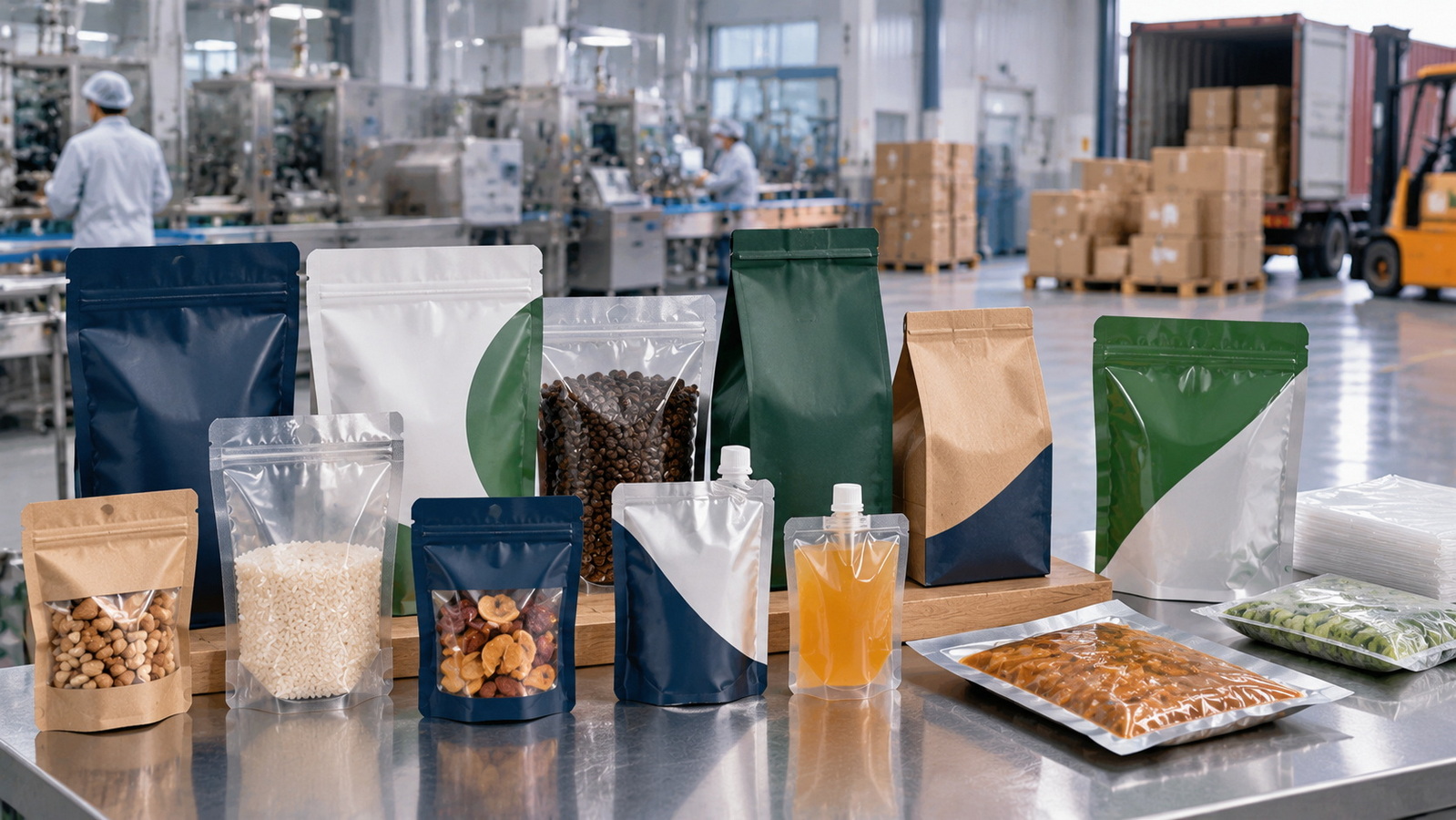
For buyers sourcing flexible packaging bags in Central Asia, this guide presents five manufacturers worth evaluating: HLun PACK, BIOS FLEXO, KONOFLEX, POLIMAKS, and KNK Chemical. They represent different sourcing options, from customized laminated pouches and integrated packaging equipment to locally manufactured polyethylene bags and films.
Geographic scope matters. Central Asia comprises Kazakhstan, Uzbekistan, Kyrgyzstan, Tajikistan, and Turkmenistan. The regional manufacturers covered here operate in Kazakhstan and Uzbekistan. HLun PACK appears first as a China-based sourcing alternative—not as a Central Asian factory.
The most important purchasing principle is verification: every claim that affects food safety, production efficiency, or delivery reliability should connect to an identifiable document, measurable specification, or production trial.
A practical supplier assessment should cover six areas:
1. Factory identity and manufacturing scope.
2. Material development and technical support.
3. Quality-control procedures and traceability.
4. Available capacity and production scheduling.
5. Product-specific compliance documentation.
6. Communication, customization, and corrective-action capability.
A company with extensive printing capacity may not manufacture the pouch format you need. Likewise, a film producer may supply excellent polyethylene bags without offering high-barrier laminated stand-up pouches.
The shortlist below keeps these categories separate.
Uzbekistan's expanding food-processing and retail sectors provide a practical reason to evaluate regional packaging suppliers.
The USDA's June 2025 Uzbekistan Exporter Guide describes rising demand for packaged foods and convenience formats. It reports that approximately 75% of processed food is consumed domestically and 25% is exported. The report also identifies limited packaging options and outdated equipment as constraints, creating opportunities for packaging materials and machinery suppliers. These figures describe the food sector, not the size of the flexible packaging market.
More recent industrial reporting reinforces the investment trend. Uzbekistan's National News Agency reported in June 2026 that Kmita Polymers manufactured products worth UZS 115 billion in 2025 and exported $6 million of products to Central Asian countries. Its polyethylene and shrink-film operations illustrate regional packaging investment, although these figures should not be interpreted as finished-pouch production statistics.
For this shortlist, two manufacturing concentrations stand out:
- Almaty and the surrounding area in Kazakhstan, where BIOS FLEXO and KNK Chemical publish flexible-packaging production capabilities.
- Tashkent and the surrounding region in Uzbekistan, where POLIMAKS and KONOFLEX operate.
These are identifiable sourcing concentrations supported by company locations, rather than a claim that every Central Asian packaging category is concentrated in these cities.
For procurement teams, the potential advantage is proximity to regional customers. However, actual lead-time benefits depend on substrate availability, production queues, border procedures, and the buyer's final destination.
The companies were selected for documented relevance to flexible packaging bags or the materials used to produce them.
| Evaluation area | Evidence buyers should request |
|---|---|
| Manufacturing identity | Legal registration, factory address, production ownership, and subcontracting disclosure |
| Product suitability | Existing examples of the required pouch or bag format |
| Technical capability | Material recommendations, drawings, printing specifications, and filling-line support |
| Quality control | Incoming-material checks, process records, release criteria, and batch traceability |
| Compliance | Current certificates, declarations, and test reports covering the actual product |
| Delivery reliability | Available monthly capacity, confirmed production slot, and repeat-order planning |
| Commercial suitability | MOQ per design, tooling ownership, payment terms, and complaint procedures |
No independent factory inspections were conducted for this article. Company statements are identified as such, and a supplier's inclusion does not establish that it meets every buyer's qualification requirements.
Location: Shantou, Guangdong, China
Business history: Packaging operations began in 1989; machinery manufacturing followed in 1998; flexible packaging was added in 2012.
Market focus: International customers in food, daily chemicals, and pharmaceutical-related packaging applications; a country-by-country sales breakdown is not published.
HLun PACK provides a sourcing option for buyers who want packaging materials and filling equipment discussed within the same project.
According to its company profile, the business operates one packaging-materials factory and another factory dedicated to packaging machinery and integrated solutions. Its flexible packaging range includes roll films, stand-up pouches, gusseted pouches, spout pouches, and eight-side-seal bags. It also supplies machinery for granules, liquids, and powders.
Its main differentiator is the relationship between package design and equipment compatibility. For a new product launch, buyers can discuss pouch dimensions, filling requirements, sealing conditions, and machinery configuration with the same supplier.
HLun PACK also describes in-house design, development, and production capabilities. Its profile reports Guangdong High-Tech Enterprise recognition in 2025 and a national invention patent for a dual-sealing jelly packaging machine in 2026. Buyers should request the underlying documents when these credentials form part of supplier qualification.
The published product range makes HLun PACK relevant for discussions involving:
- Customized pouch formats and dimensions.
- Printed packaging and rollstock.
- Packaging-material and equipment coordination.
- Product-specific filling and sealing requirements.
- Integrated packaging projects.
For smaller brands, the potential value lies in reducing coordination between separate packaging and equipment vendors. Its company profile emphasizes responsive communication and cross-department collaboration, but response times, development charges, and small-order flexibility should be confirmed through an actual quotation and sampling project.
HLun PACK is therefore a candidate for value-focused, development-intensive projects—not a supplier whose lowest price or smallest MOQ can be assumed.
Request the proposed material structure, MOQ per artwork, sample schedule, tooling costs, production lead time, and product-specific compliance records. Published numerical capacity and current packaging-certification details were not established from the reviewed profile.
Location: Almaty area, Kazakhstan
Established: 2000, according to its employer profile on Kazakhstan's employment platform.
Main markets: Kazakhstan and the Commonwealth of Independent States, according to its website.
BIOS FLEXO is relevant for buyers seeking a regional converter of printed flexible packaging rather than only unprinted commodity film.
Its published manufacturing description includes rotogravure printing, lamination, slitting, bag conversion, and polyethylene-film production. Materials listed include polypropylene, polyester, metallized films, polyethylene, paper, and laminated paper. Applications include grocery products, frozen foods, spices, confectionery, and non-food products.
The combination of printing and downstream conversion provides a useful basis for evaluating custom printed packaging.
Its website also advertises custom bag production from 200 kg. This is a starting point for discussion, not a universal MOQ for every structure, pouch type, or number of designs.
The documented production stages support consideration for customer-specific printing, laminated structures, rollstock, and bag-conversion projects.
Buyers should distinguish routine contract manufacturing from original packaging development. Request examples of comparable packs and clarify who takes responsibility for material selection, shelf-life validation, and line trials.
Confirm whether the quoted 200 kg applies to each design or the combined order. Ask for saleable bag yield, acceptable overrun, current certification records, and available—not merely installed—capacity.
Location: Tashkent region, Uzbekistan
Established: 2011, according to the company's business profile.
Main market: Uzbekistan is the clearly described market; an independently verified export-market breakdown was not identified.
KONOFLEX is the flexible-packaging trading name of SINO PLAST LLC.
The company's profile describes production sites covering flexographic printing, rotogravure printing, lamination, packaging-bag production, and polyethylene films. Its early product range included bags made from BOPP, PE, and CPP films. A regional business directory also identifies printing on BOPP/OPP, PVC, PE, and PET films.
KONOFLEX is a candidate for buyers seeking several converting stages within one manufacturing relationship.
Its documented combination of printing, lamination, and bag production is more relevant to custom flexible packaging than a business limited to distributing imported stock bags.
Potential project areas include printed film bags, laminated packaging, and customer-specific polymer-film conversion.
However, buyers should not assume that every converter produces flat-bottom bags, retort pouches, or spouted formats. These require format-specific equipment and application validation.
Request proof of the exact bag format, production-scale samples, sealing-layer specifications, and current compliance documents. Public numerical capacity, standard MOQ, and active certification status were not established from the reviewed sources.
Location: Tashkent, Uzbekistan
Established: The reviewed official website states more than 20 years of operation but does not provide a precise founding year.
Main market: Uzbekistan is explicitly identified; export activity is listed in a regional directory, without a detailed destination breakdown.
POLIMAKS manufactures flexible packaging and labels using composite materials incorporating BOPP, PET, twist PET, and PE films.
Its official website describes packaging-material production for food products and other goods. Uzbekistan's packaging exhibition organizer also identifies POLIMAKS as a producer of polyethylene/polypropylene film, printed bags, and labels for food and non-food applications.
POLIMAKS offers a relevant combination of flexible packaging and label production.
This may suit buyers coordinating several packaging components, although the procurement team should still qualify each product separately.
The published scope supports evaluation for customer-specific printed bags, film packaging, and labels.
For development-led projects, ask whether the company can propose alternative structures, prepare production drawings, conduct application trials, and document changes between sample approval and mass production.
Confirm the current manufacturing address because public directory addresses differ. Obtain the legal entity's registration details, exact production location, current certificate records, and the specific manufacturing scope covered by those records.
Location: Almaty, Kazakhstan
Established: Its polyethylene-film and bag-production branch was founded in 2009; this should not be treated as the founding date of the entire company.
Main market fit: Kazakhstan-based polyethylene-film and bag procurement; detailed export destinations are not published on the reviewed production page.
KNK Chemical belongs in a different purchasing category from specialist laminated-pouch converters.
Its production page reports capacity exceeding 500 tonnes of film and packaged products per month. It describes polyethylene films produced to GOST 10354-82, with published widths from 280 to 5,800 mm and thicknesses from 40 to 250 microns.
KNK Chemical provides unusually specific public information about production scale and film dimensions.
It is a candidate for buyers whose requirements center on polyethylene film and bags rather than complex, high-barrier retail pouches.
Custom discussions should focus on film dimensions, thickness, bag configuration, mechanical performance, and other requirements the factory confirms in writing.
Do not assume that published polyethylene-film capacity also represents available capacity for printed laminated pouches.
Confirm which finishing operations are performed internally, whether the intended food-contact application is covered, and what monthly capacity is available for the buyer's specification.
The following table separates published information from items requiring a quotation or document review.
| Supplier | Main sourcing focus | Published capacity information | Public MOQ information | Certification or standards information |
|---|---|---|---|---|
| HLun PACK | Custom pouches, rollstock, packaging machinery, and integrated projects | No numerical output established from the reviewed profile | Not established | Reports technology recognition and a machinery patent; these are not food-contact certificates. Request current product and factory records. |
| BIOS FLEXO | Printed flexible packaging, laminated materials, bags, and rollstock | Numerical output not established | Advertises bags from 200 kg; confirm applicability by SKU | Current certification status not established from reviewed sources. |
| KONOFLEX | Printed polymer-film packaging, lamination, and bags | Numerical output not established | Not established | Request current site-specific and product-specific records. |
| POLIMAKS | Flexible packaging, printed bags, composite films, and labels | Numerical output not established | Not established | Current certificate validity not established from the reviewed official page. |
| KNK Chemical | Polyethylene film and bags | More than 500 tonnes/month of film and packaged products, company-reported | Not established | Publishes GOST 10354-82 for polyethylene film; this does not replace application-specific food-contact evidence. |
Send every shortlisted supplier the same application brief:
- Product composition and fill weight.
- Oil, moisture, aroma, and oxygen sensitivity.
- Required shelf life.
- Filling temperature.
- Frozen, ambient, hot-fill, or retort conditions.
- Storage temperature and humidity.
- Distribution route and handling conditions.
- Filling-machine model and operating speed.
Then request a proposed structure with an explanation of why it fits the application.
A material description such as "food-grade laminated pouch" is insufficient for contract approval. Buyers need the individual layers, nominal thicknesses, tolerances, sealing layer, and relevant finished-pack performance requirements.
Use a written agreement to define how conformity will be checked.
| Control point | What to specify |
|---|---|
| Material identity | Approved structure, resin or film grades where relevant, and substitution controls |
| Dimensions | Bag size, gusset depth, seal width, and tolerances |
| Printing | Approved artwork version, color reference, registration, and barcode checks |
| Sealing | Agreed seal-test method and acceptance criteria |
| Barrier performance | Required oxygen and water-vapor transmission values, including test conditions |
| Lamination | Bond integrity and release requirements |
| Traceability | Batch coding and links to raw-material and production records |
| Filling compatibility | Trial conditions, defects to monitor, and approval responsibility |
The purpose is to prevent both parties from interpreting "acceptable quality" differently after production.
CE marking and RoHS should not be used as generic proof that flexible packaging bags are safe for food.
CE marking applies only to product categories covered by legislation requiring it. Ordinary empty food-packaging pouches generally do not obtain their food-contact status through CE marking. RoHS concerns restricted substances in electrical and electronic equipment, not a general environmental approval for packaging bags.
For packaging intended for the European market, the relevant framework includes Regulation (EC) No 1935/2004, good manufacturing practice requirements under Regulation (EC) No 2023/2006, and applicable plastics requirements under Regulation (EU) No 10/2011, as amended. The European Commission identifies migration limits as an important part of plastics compliance.
For Kazakhstan and Kyrgyzstan, buyers should assess applicable Eurasian Economic Union packaging requirements, including TR CU 005/2011. Do not assume that the same regulatory route automatically applies to Uzbekistan, Tajikistan, or Turkmenistan. Confirm destination-specific requirements with the importer and a competent local conformity specialist.
Ask suppliers to define exactly what they mean by "recyclable," "recycled," "bio-based," or "compostable."
Your purchasing specification should identify:
- The claimed material attribute.
- Supporting evidence and its scope.
- Whether the claim applies to the complete pack, including closures.
- Intended collection and processing conditions.
- Any limitations on food-contact use.
Do not allow a broad sustainability statement to replace barrier, sealing, safety, or shelf-life validation.
A signed sample alone does not adequately control production.
Protect the order with an approved bill of materials, layer specifications, tolerances, and written change-control requirements. Require notification before changes to films, sealing resins, adhesives, inks, or manufacturing sites.
Retain samples from the approved trial and from each commercial batch.
A lower unit price may exclude printing tooling, export cartons, inspection, freight, or an agreed defect allowance.
Ask each supplier to quote the same:
- Quantity per design.
- Bag structure and size.
- Printing coverage.
- Packaging method.
- Delivery term and named place.
- Tooling ownership.
- Permitted quantity variation.
Evaluate total landed cost and usable output rather than the headline bag price.
Clarify how the sample was produced.
A stock pouch with a similar appearance is not proof that the proposed artwork, material structure, zipper, spout, and production line will work together.
Use a staged process:
1. Review existing comparable packs.
2. Approve a structural prototype.
3. Confirm artwork and color standards.
4. Produce a pilot using the intended structure.
5. Run a filling-line trial.
6. Approve mass production against written criteria.
One easily overlooked procurement risk concerns adhesive curing.
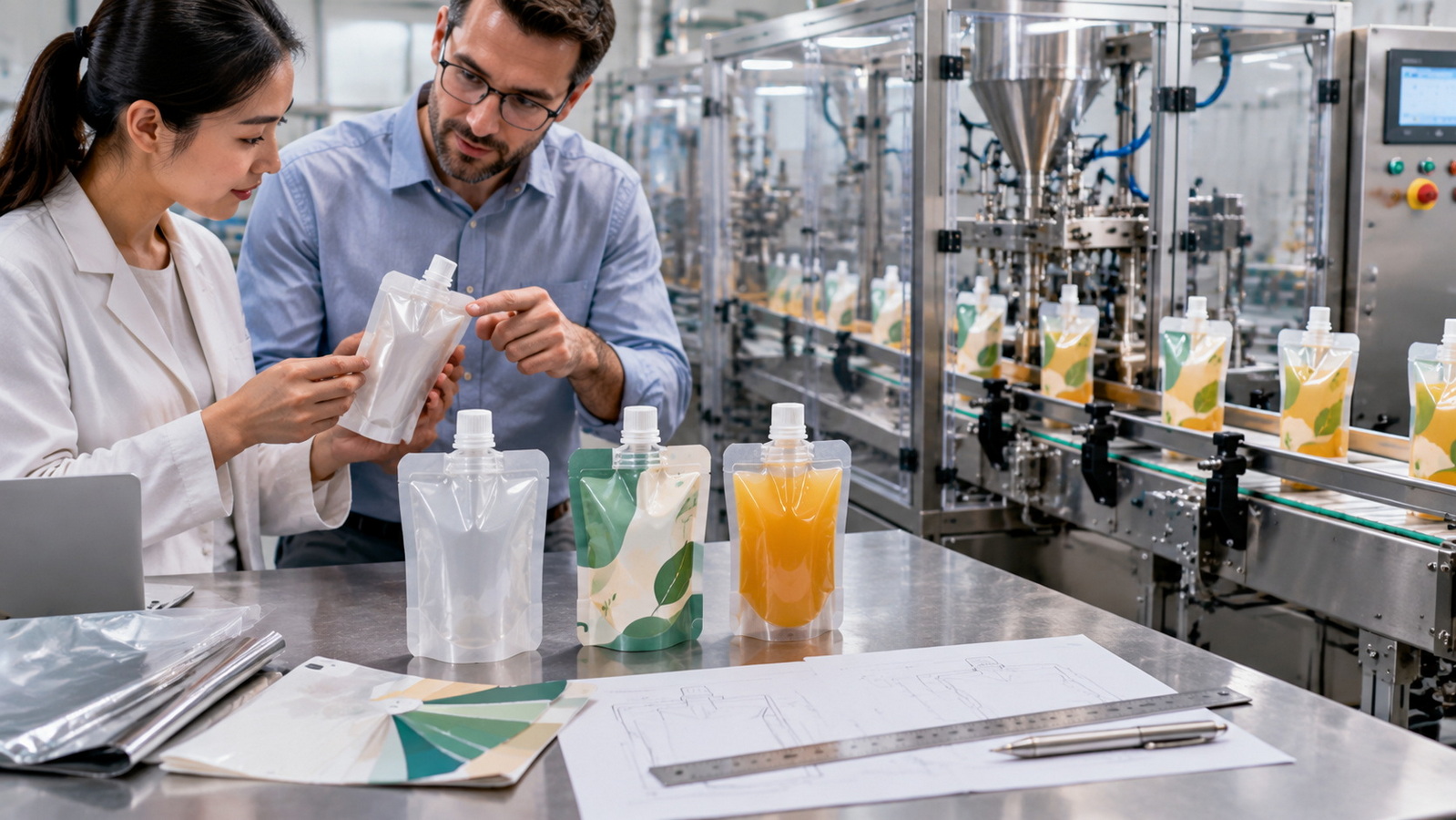
A laminated pouch can look acceptable and show useful bond strength while still requiring additional curing and chemical-safety evaluation before release. Henkel's technical guidance explains how primary aromatic amines can form in polyurethane adhesive systems and discusses curing and migration-risk assessment.
The practical lesson is simple: do not accept "the laminate feels strong" as the entire release criterion.
For relevant food-contact laminates, ask the supplier to explain:
- Which adhesive system is used.
- How curing conditions are established and recorded.
- When conversion and shipment are permitted.
- Which migration risks require assessment.
- How changes in adhesive, structure, or processing trigger revalidation.
This is especially important when negotiating accelerated delivery. A shorter schedule must not remove a necessary process-control step.
Central Asian deliveries require route-specific planning. Ask the freight provider to identify border crossings, transshipment points, document requirements, and the party responsible for customs clearance.
Separate the schedule into:
1. Artwork and specification approval.
2. Material procurement.
3. Printing, lamination, and conversion.
4. Curing and release, where applicable.
5. Inspection.
6. Freight and customs.
7. Delivery to the filling site.
Agree on palletization, carton strength, moisture protection, storage limits, and handling instructions.
Request batch identification on both inner packaging and shipping cartons. For critical launches, retain enough approved stock to cover a realistic replenishment delay rather than relying entirely on the next production slot.
Qualify a backup supplier against the same written performance requirements.
Matching bag dimensions is not enough. A replacement structure should pass the relevant filling, sealing, distribution, and product-protection checks before it becomes an emergency supply option.
The five companies offer different sourcing propositions.
HLun PACK is relevant to buyers coordinating custom flexible packaging with machinery and development support. BIOS FLEXO, KONOFLEX, and POLIMAKS offer regional converting capabilities worth investigating for printed packaging projects. KNK Chemical provides a more clearly defined option for polyethylene films and bags.
The strongest long-term partner is the supplier that can document the required structure, reproduce approved quality, support the filling process, and commit to a realistic delivery plan.
For an HLun PACK project review, prepare your product details, target bag format, annual demand, filling method, destination market, and shelf-life requirements. Request a proposed structure, sample plan, equipment-compatibility review, and itemized quotation before committing to production.
Request the full certificate rather than a cropped logo or screenshot.
Check the legal entity, manufacturing address, standard, scope, certificate number, issue date, and expiry date. Then verify the record directly through the issuing certification body's official channel.
Ask specifically about suspension or withdrawal because an expiry date alone does not establish current validity. If the manufacturing site or packaging activity falls outside the certificate scope, the certificate does not resolve that qualification gap.
Do not treat a raw-film report as automatic approval of the complete printed laminate.
Request an assessment covering the finished structure and intended conditions of use. Printing, adhesives, coatings, closures, and processing can introduce additional considerations. EU food-contact rules address the safety of materials and articles, while plastics legislation includes composition restrictions and migration requirements.
Ask the supplier or testing laboratory to explain why the evidence covers your actual pack.
Request the finished weight per bag and clarify whether the kilogram figure refers to raw input or saleable finished packaging.
An indicative conversion is:
Bag quantity =Finished packaging weight in kg×1,000/Weight per finished bag in grams
Then account for production losses, sampling, allowed overruns, and whether each artwork has its own minimum. Do not compare the two quotations until they use the same commercial basis.
Require a formal change request before the substitution.
The supplier should identify the reason, affected batches, technical differences, and proposed validation. Depending on the change, review sealing behavior, barrier performance, lamination, migration evidence, and shelf-life implications.
Approve the change in writing only after the relevant evidence is accepted. Keep the previous specification identifiable so that complaints and retained samples remain traceable.
Conduct a trial using the intended production structure and representative operating conditions.
Assess feeding, opening, static behavior, filling accuracy, seal contamination, sealing temperature range, leakage, and rejects at the planned speed.
For spouted or zippered packs, include closure positioning and interference with machine handling. A successful manual filling test should not replace a production-speed trial.
1- HLun PACK company profile and development history: packaging materials, machinery, product formats, and company-reported qualifications. [hlunpack]
2- USDA Foreign Agricultural Service, Uzbekistan Exporter Guide, June 17, 2025: food-sector demand, domestic consumption, exports, and packaging constraints. [fas.usda]
3- Uzbekistan National News Agency, June 2, 2026: Kmita Polymers production and Central Asian export figures. [uza]
4- Kazakhstan employment platform, BIOS FLEXO company profile: founding year and manufacturing scope. [enbek]
5- BIOS FLEXO official website: regional delivery and advertised 200 kg starting order quantity. [biosflexo]
6- SINO PLAST LLC / KONOFLEX company profile and regional directory: establishment, materials, printing, lamination, and bag production. [goldenpages]
7- POLIMAKS official website and Uzbekistan packaging exhibition organizer: materials, printed packaging, bags, and labels. [polimaks]
8- KNK Chemical production page: branch establishment, published capacity, film dimensions, and GOST reference. [knk]
9- European Commission: food-contact materials framework and plastics legislation. [food.ec.europa]
10- European Union guidance: CE marking applicability and the scope of RoHS. [europa]
11- Russian Register: TR CU 005/2011 packaging-safety regulation. [rusregister]
11- Henkel technical white paper: primary aromatic amines, polyurethane adhesives, curing, and flexible-packaging safety. [next.henkel-adhesives]


