


close
Choose Your Site
Global
Social Media
Views: 269 Author: HLun PACK Publish Time: 2026-09-02 Origin: Site


Content Menu
● Why Pizza Box Dimensions Matter for Restaurants and Delivery Brands
● Standard Pizza Box Dimensions by Pizza Size
>> A practical rule: add clearance, not excess space
>> Convert pizza box dimensions from inches to millimeters
● How to Calculate the Right Pizza Box Size
>> 1. Measure the finished pizza, not the dough ball
>> 3. Determine the required box depth
>> 4. Test real delivery conditions
>> 5. Confirm the outer dimensions and machine compatibility
● Choose the Right Board Grade and Structure
>> Solid paperboard pizza boxes
>> Match flute and board strength to the application
● Moisture, Steam, and Ventilation: The Real Delivery Challenge
>> Design principles for better delivered pizza quality
● Custom Pizza Box Options That Build Brand Recognition
>> Packaging machinery considerations
● Sustainability and Pizza Box Recycling
● Common Pizza Box Sizing Mistakes
● Work With HLun Pack on Your Pizza Packaging Solution
>> 1. What size box should I use for a 12-inch pizza?
>> 2. How much bigger should a pizza box be than the pizza?
>> 3. What is the standard depth of a pizza box?
>> 4. Why are pizza boxes usually square instead of round?
>> 5. Are greasy pizza boxes recyclable?
>> 6. Is corrugated board better than paperboard for pizza boxes?
>> 7. Can custom pizza boxes work with automatic box-forming equipment?
Choosing the right pizza box dimensions is not simply a matter of matching a box to a pizza diameter. For a pizza restaurant, ghost kitchen, food distributor, or packaging buyer, the correct box size affects delivery appearance, topping protection, heat retention, stack strength, material consumption, and customer perception.
At HLun Pack, we approach pizza packaging as a complete paper-packaging system rather than a single commodity box. A well-engineered corrugated pizza box should fit the pizza with controlled clearance, provide adequate headspace for the crust and toppings, release excess steam, survive delivery stacking, and support the restaurant's branding and sustainability goals.
This guide explains standard pizza box sizes, how to calculate custom dimensions, when to use corrugated board, how to prevent delivery damage, and how packaging machinery can improve consistency and throughput.
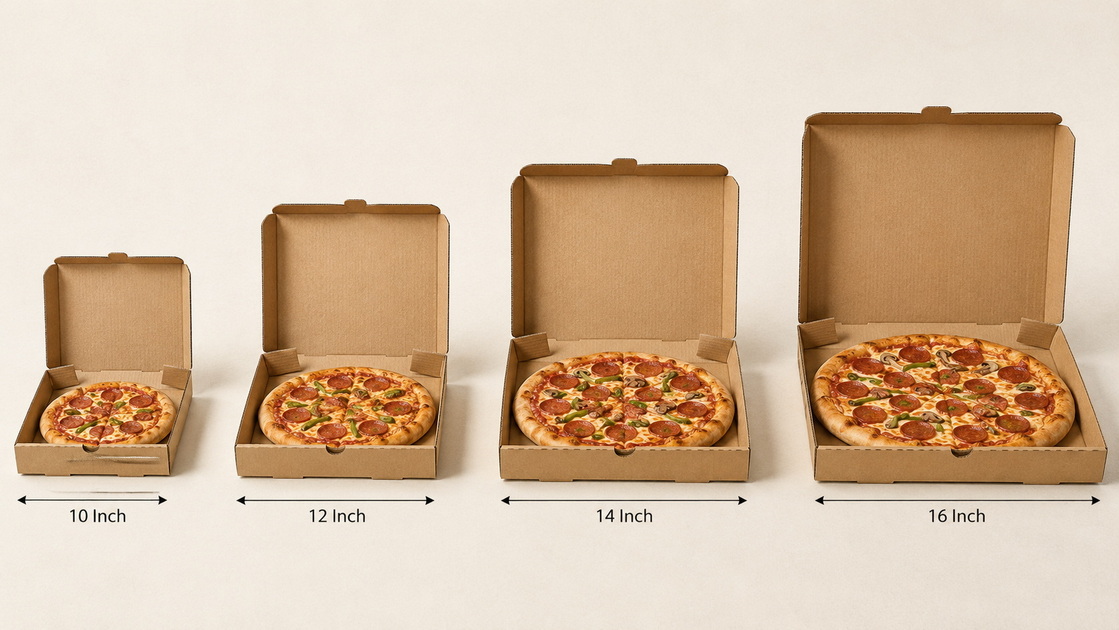
The pizza may be the product, but the pizza box is the last operational touchpoint before a customer opens the order. If the box is undersized, the crust can bend, toppings can contact the lid, and cheese or sauce can smear across the inside panel. If it is oversized, the pizza may slide during transport, lose heat faster, and consume unnecessary board material.
The goal is not "the biggest box possible." The goal is a stable, breathable, appropriately sized package.
A properly designed pizza box helps operators:
- Protect the pizza edge, crust, toppings, and presentation during delivery
- Provide enough vertical clearance for pan pizza, stuffed crust, and heavy toppings
- Reduce pizza movement inside the box
- Improve stacking performance for multi-order delivery runs
- Standardize packaging inventory across multiple menu sizes
- Create a branded unboxing experience through printing and structural design
- Reduce avoidable paperboard use caused by excessive box dimensions
For direct food-contact packaging, the materials, coatings, adhesives, inks, and other relevant components should be evaluated for their intended food-contact use. In the United States, FDA information explains that food-contact substances must be authorized when they qualify as food additives for the intended use.
Pizza boxes are generally square because square blanks are efficient to die-cut, fold, stack, print, and assemble. A square box also gives operators room to place a round pizza without forcing the crust against the corners.
The following table is a practical sizing reference. It should be treated as a starting point, not a universal specification. Actual requirements depend on the finished pizza diameter, crust height, topping volume, baking variation, pizza screen or tray use, and delivery conditions.
| Pizza category | Typical pizza diameter | Recommended internal box size | Typical internal depth | Common use |
|---|---|---|---|---|
| Personal / mini | 6–8 in. | 8 × 8 in. to 10 × 10 in. | 1.5–2.5 in. | Individual meals, kids’ menus, small portions |
| Small | 9–10 in. | 10 × 10 in. to 12 × 12 in. | 1.5–2.5 in. | Personal pizzas and small sharing pizzas |
| Medium | 11–12 in. | 12 × 12 in. to 14 × 14 in. | 2–3 in. | Standard dine-in and delivery menus |
| Large | 13–14 in. | 14 × 14 in. to 16 × 16 in. | 2–3 in. | Family orders and high-volume delivery |
| Extra-large | 15–16 in. | 16 × 16 in. to 18 × 18 in. | 2.5–3.5 in. | Party orders and large specialty pizzas |
| Family / party | 18–20+ in. | 20 × 20 in. and above | 3–4 in. | Oversized pizzas, events, promotional orders |
| Single slice | Varies | Approx. 9 × 10 × 2–3 in. | 2–3 in. | Grab-and-go counters and convenience retail |
For most round pizzas, start by adding about 0.5 to 1 inch of internal clearance beyond the finished pizza diameter. For example, a 12-inch pizza will often perform well in a 13-inch or 14-inch internal box, depending on crust profile and the operation's handling conditions.
That clearance is important because baked pizza dimensions are not always perfectly consistent. Dough expansion, hand stretching, crust shape, and high toppings can create small variations from one pizza to the next.
However, adding too much clearance can create a different problem: the pizza may shift inside the box during vehicle turns, braking, or courier handling.
International procurement teams and packaging equipment manufacturers often work in millimeters. Use the following conversion:
1 inch=25.4 mm
For example:
12 × 12 × 2 inch box = approximately 305 × 305 × 51 mm
14 × 14 × 3 inch box = approximately 356 × 356 × 76 mm
16 × 16 × 3 inch box = approximately 406 × 406 × 76 mm
18 × 18 × 3 inch box = approximately 457 × 457 × 76 mm
When sharing a specification with a packaging supplier or machine builder, clearly state whether dimensions are internal usable dimensions or external dimensions. This avoids a common sourcing error: a box that looks correct on paper but does not fit the finished pizza in real production.
A pizza box specification should be based on actual operating conditions, not only the menu description. A "12-inch pizza" may measure slightly more than 12 inches after baking, and a deep-dish or pan pizza may need substantially more vertical room than a thin-crust pizza of the same diameter.
Use this five-step process before finalizing a custom pizza box.
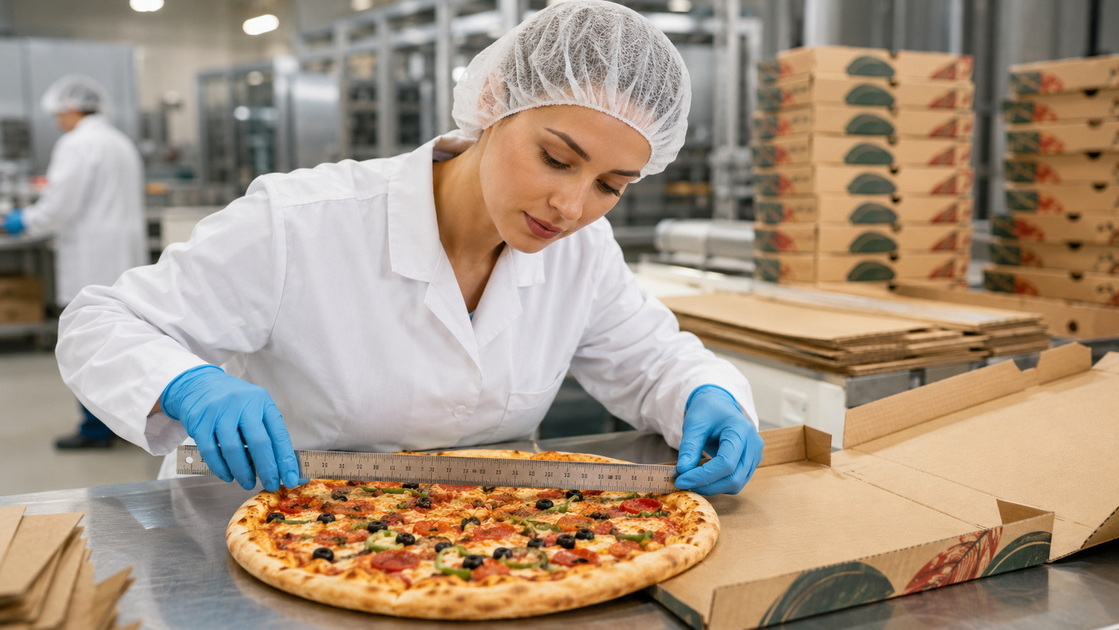
Measure the widest finished pizza diameter from crust edge to crust edge. Do this across several production samples rather than one pizza only.
Record:
- Average diameter
- Maximum diameter
- Crust height
- Topping height above the cheese layer
- Whether the pizza is packed on a tray, liner, or corrugated insert
The maximum realistic production measurement is usually more useful than the nominal menu size.
Add a controlled clearance allowance around the pizza. For standard pizzas, a total of 0.5 to 1 inch of additional internal width and length is often a workable starting point.
For example, if a pizza can reach 12.5 inches at its widest point, a 14 × 14 inch internal box may offer a safer operational margin than a 13 × 13 inch box.
Depth must protect toppings without creating unnecessary empty volume. A thin, flat pizza may need only 1.5 to 2 inches of internal depth. A pan pizza, cheese-stuffed crust pizza, tall topping profile, or pizza with a raised crust can require 3 inches or more.
A useful starting point is:
Box depth=Finished pizza height+safe headspace
The required headspace should prevent the lid from touching cheese, sauce, or high toppings even when boxes are stacked.
A sample box should be tested through the actual operation:
- Oven-to-box transfer
- Closing and locking
- Counter stacking
- Delivery-bag loading
- Vehicle movement
- Multi-box stacking
- Customer opening
This is where packaging decisions become operational decisions. A box that looks good in a conference room may fail during a busy Friday-night delivery rush.
If your business uses an automated or semi-automated pizza box forming machine, confirm that the blank size, score lines, board thickness, locking tabs, and box geometry are compatible with the equipment.
For high-volume restaurant groups, this compatibility can reduce manual assembly variation and help maintain a stable flow from flat blank to formed box.
Pizza boxes need to manage several competing demands: heat, steam, grease, compression, cost, printability, and recyclability. The material choice should reflect the pizza format and delivery model.
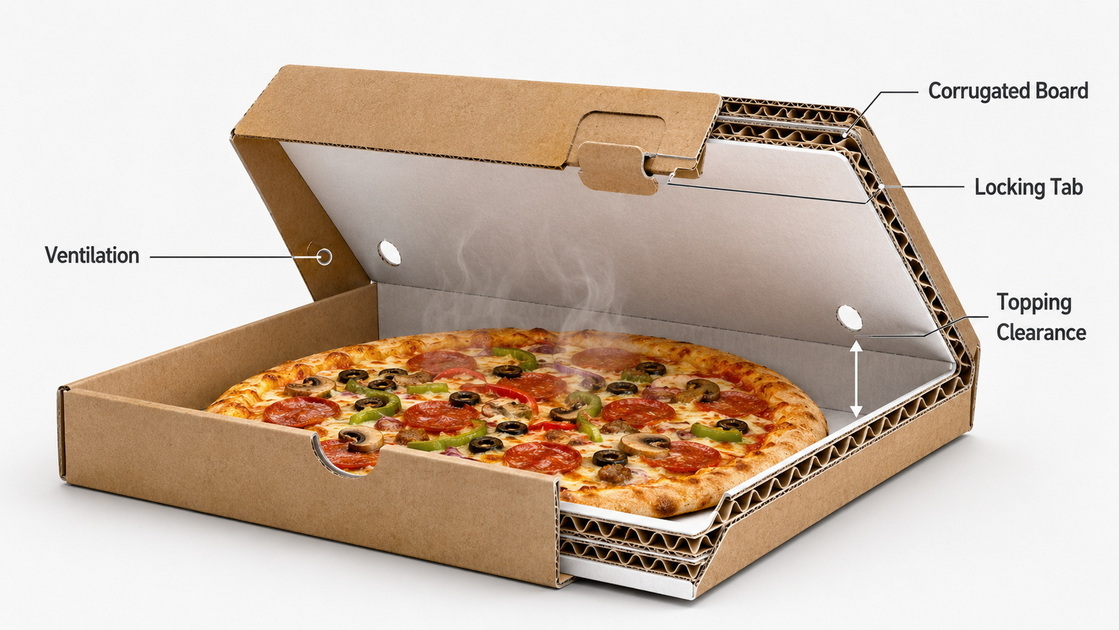
Paperboard can be appropriate for lighter, smaller, or short-distance applications where the pizza is not especially heavy and stacking loads are limited. It offers a clean printing surface and can support attractive branding.
However, paperboard may not provide sufficient compression strength for heavy pizzas, long delivery distances, high-moisture conditions, or large stack heights.
Corrugated board is commonly selected for pizza delivery because its fluted middle layer provides stiffness and creates air pockets. Those air pockets can help slow heat loss while the board structure supports stacking and handling.
Corrugated packaging is widely used for food applications because it can provide protective and hygienic packaging performance when appropriately specified for the intended application. FEFCO notes that corrugated packaging is used to support product quality, safety, and hygiene in food packaging.
For pizza packaging, corrugated board can help with:
- Compression resistance for stacked orders
- Better protection against bending and corner damage
- Structural stability for large-diameter pizzas
- A practical surface for flexographic printing
- Efficient flat packing before use
- Compatibility with many box-forming workflows
Do not choose board strength based on appearance alone. A box for a 10-inch thin-crust pizza carried directly to a counter has different requirements from an 18-inch loaded pizza traveling 30 minutes in a delivery bag.
Consider:
- Pizza weight
- Box size
- Number of boxes stacked
- Delivery radius
- Humidity and condensation exposure
- Expected storage period for flat blanks
- Required print quality
- Automatic or manual box forming
For larger family-size pizzas, a stronger corrugated configuration may be necessary to prevent sagging, wall collapse, and loss of lid alignment.
Customers often describe a disappointing delivered pizza as "cold," but the deeper issue may be moisture. A pizza leaves the oven hot and releases steam. If that steam remains trapped inside the box, it can condense on the lid or migrate toward the crust, making the pizza softer and less appetizing.
At the same time, too much ventilation can accelerate heat loss. Good pizza packaging therefore requires balance.
- Use appropriate box depth so the lid does not touch toppings.
- Add controlled ventilation where needed to release excess steam.
- Avoid excessive empty space that can worsen heat loss and pizza movement.
- Select board strength that stays stable under heat and moisture.
- Test the package with the real pizza product, not an empty-box sample.
- Evaluate the delivery bag, stacking pattern, and average transit time together with the box design.
Some corrugated pizza-box designs use small ventilation holes to allow steam release while retaining much of the thermal benefit of the corrugated structure.
For restaurants with recurring soggy-crust complaints, the best solution is rarely "use a thicker box" alone. The problem may involve a combination of product moisture, ventilation placement, box depth, hold time, courier travel time, and stacking practice.
A pizza box is one of the most visible pieces of food packaging in local delivery. It can carry your brand from the restaurant kitchen to apartment lobbies, offices, family gatherings, and social-media posts.
Custom pizza boxes can incorporate:
- One-color, two-color, or full-color printing
- Logo placement on lid, sidewalls, or inside panels
- QR codes for loyalty programs, reorder pages, or promotions
- Food-handling or recycling instructions
- Matte or uncoated visual finishes
- Custom die-cut shapes and locking structures
- Perforations for easier opening
- Inserts or dividers for multiple items
- Grease-management and liner solutions, where suitable
- Co-branded campaigns for sports events, schools, or limited-time offers
A practical approach is to put the main logo and order channel on the lid, then use the inner lid for a message customers see at the moment of consumption: a loyalty offer, social media prompt, reheating guidance, or recycling instruction.
For growing pizza chains, commissaries, and high-output central kitchens, packaging efficiency matters as much as design. Manual box folding can be time-consuming and inconsistent during peak periods.
HLun Pack can support businesses that need an integrated approach involving:
- Pizza box design and paper-packaging sourcing
- Flat blank dimensions and structural optimization
- Board and print specification
- Box forming and packaging machinery planning
- Production-line integration considerations
- Packaging solutions for pizza, bakery, foodservice, and related paper packaging formats
The strongest solution is one where the box design, material, and equipment are engineered to work together.
Pizza box recycling rules can vary by municipality and recycling provider, so restaurants should avoid making overly broad local claims without checking the relevant program. Still, current guidance from major recycling organizations has become more supportive of recycling pizza boxes with ordinary grease residue.
The U.S. Environmental Protection Agency states that pizza boxes can be recycled even if grease is present, provided food scraps are removed and the box is flattened. The American Forest & Paper Association also states that typical pizza-box grease and cheese residues are not a problem for the recycling process, while boxes saturated with grease should be discarded.
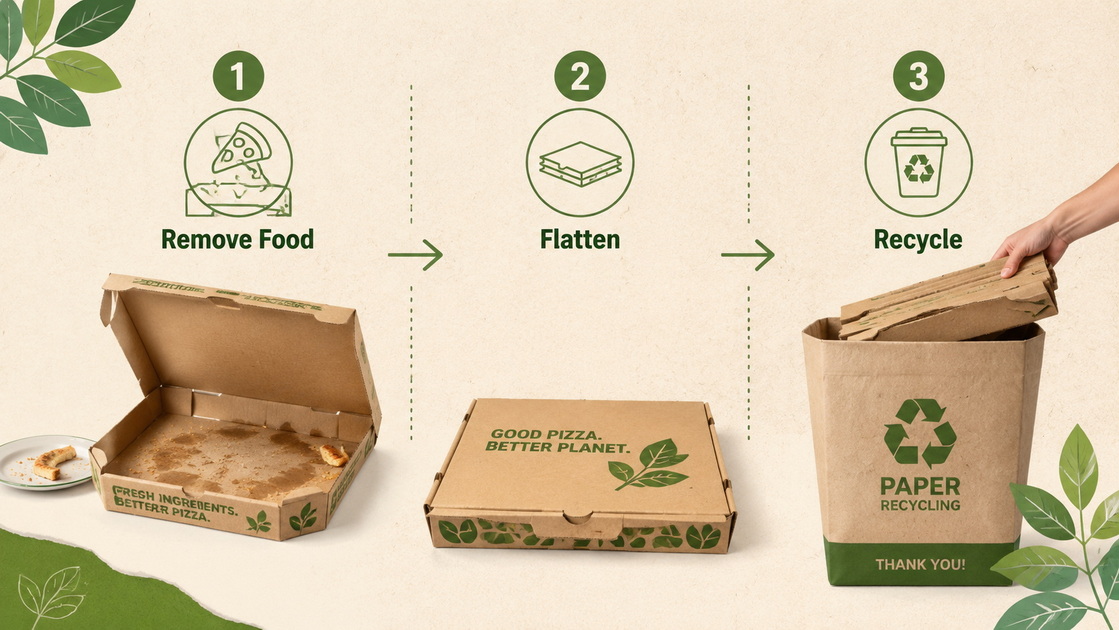
For consumer-facing packaging instructions, use simple language:
1. Remove leftover food, sauce cups, and non-paper items.
2. Flatten the box if the local program requests it.
3. Recycle clean or normally greasy paperboard where accepted locally.
4. Tear away heavily saturated sections if local guidance requires it.
5. Check city or hauler instructions because local rules may differ.
Avoid vague "100% recyclable everywhere" claims. Clear, location-aware instructions are more credible and more helpful.
Even established restaurants can experience preventable problems when packaging specifications are copied from competitors or selected only by nominal pizza size.
| Mistake | What happens | Better approach |
|---|---|---|
| Choosing a box equal to pizza diameter | Crust contacts sidewalls; loading becomes difficult | Add controlled clearance based on finished-pizza measurements |
| Using too little depth | Toppings stick to lid; presentation suffers | Measure crust and topping height under real conditions |
| Using an oversized box | Pizza slides; more material is consumed | Match internal dimensions to pizza diameter and delivery stability |
| Selecting weak board for large pizzas | Sagging, crushed corners, poor stackability | Increase board strength based on weight and delivery loads |
| Ignoring steam management | Soggy crust or condensation | Test ventilation, depth, hold time, and delivery conditions together |
| Ordering without machine review | Folding, feeding, or locking problems | Validate blank and structural specifications with equipment requirements |
The best pizza box is not merely a printed square container. It is a performance package designed around your pizza, kitchen workflow, delivery model, brand identity, sustainability goals, and production requirements.
Whether you need standard corrugated pizza boxes, custom die-cut boxes, branded food packaging, or machinery support for forming and packaging operations, HLun Pack can help you build a more reliable paper-packaging system.
Contact HLun Pack to discuss your pizza diameter, crust profile, daily order volume, desired print design, delivery distance, and packaging automation requirements. Our team can help turn those operational details into a practical box specification and integrated packaging solution.
Compared with the reviewed competitor page, this version expands beyond basic size categories by adding:
- A step-by-step custom sizing method based on finished pizza measurements.
- Inch-to-millimeter conversion guidance for international sourcing and equipment discussions.
- Board-grade, compression-strength, and corrugated-structure considerations.
- Steam, condensation, ventilation, and delivery-quality analysis.
- Packaging machinery compatibility and high-volume operational planning.
- Evidence-based food-contact and recycling context.
- A more specific B2B CTA aligned with HLun Pack's paper packaging and packaging-equipment capabilities.
A 12-inch pizza commonly fits in a 14 × 14 inch pizza box, especially when some clearance is needed for safe loading and delivery. However, the correct choice depends on the actual baked diameter, crust shape, and topping height. Measure several finished pizzas before committing to a box size.
A practical guideline is to allow about 0.5 to 1 inch of total internal clearance beyond the finished pizza diameter. The exact amount should be tested with your product because too little space can damage the crust, while too much space can allow the pizza to move.
Many standard pizza boxes are approximately 1.5 to 3 inches deep. Thin-crust pizzas can use shallower boxes, while deep-dish, pan-style, stuffed-crust, and heavily topped pizzas may require 3 to 4 inches or more.
Square boxes are efficient to produce from flat paperboard or corrugated blanks, easy to stack, simple to fold, and practical for printing. They also create useful clearance around a round pizza and can support stable handling during delivery.
Often, yes. EPA and industry recycling guidance indicate that normal grease residue is generally acceptable when food scraps are removed, but local acceptance rules vary. If the box is heavily saturated or has substantial food waste attached, remove the contaminated portion or follow local disposal guidance.
Corrugated board is often better for delivery, larger pizzas, heavier toppings, and stacked orders because its fluted structure improves stiffness and compression resistance. Paperboard may work well for lighter pizzas, shorter holding times, or applications that prioritize a smooth printed surface.
Yes, but the box blank, score-line placement, board thickness, locking-tab design, and final geometry must be engineered for the specific machine. Involve both the packaging supplier and equipment provider before final production to prevent feeding or folding issues.
1. [U.S. Food and Drug Administration — Food Packaging and Other Substances That Come in Contact with Food](https://www.fda.gov/food/food-ingredients-packaging/food-packaging-other-substances-come-contact-food-information-consumers)— Guidance on food-contact substances and regulatory authorization principles.
2. [U.S. Food and Drug Administration — Packaging and Food Contact Substances](https://www.fda.gov/food/food-ingredients-packaging/packaging-food-contact-substances-fcs)— FDA resources covering food-contact-substance regulations and notifications.
3. [U.S. Environmental Protection Agency — How Do I Recycle Common Recyclables?](https://www.epa.gov/recycle/how-do-i-recycle-common-recyclables)— EPA guidance stating that pizza boxes can be recycled with grease present after food scraps are removed.
4. [American Forest & Paper Association — Can I Recycle a Greasy Pizza Box?](https://www.afandpa.org/news/2023/can-i-recycle-greasy-pizza-box)— Industry guidance on pizza-box grease, cheese residue, and recycling practices.
5. [The Recycling Partnership — Pizza Box Recycling](https://recyclingpartnership.org/pizzaboxes/)— Research-based consumer guidance: empty pizza boxes and recycle them where accepted.
6. [FEFCO — Corrugated Packaging: Safe and Hygienic](https://www.fefco.org/benefits-corrugated/product-protection/safe-hygienic)— Overview of corrugated packaging's role in protecting food products and supporting hygienic packaging.
7. [OXO Packaging — A Guide to Pizza Box Dimensions and Customizations](https://oxopackaging.com/blog/guide-to-pizza-box-dimensions.html)— Original competitor article reviewed for content-gap analysis and topic coverage.


