


close
Choose Your Site
Global
Social Media
Views: 275 Author: Hlunpack Publish Time: 2026-08-12 Origin: Hlunpack


One Pepper Product. Six Pack Weights. One Packaging System.
50g / 100g / 180g / 200g / 250g / 500g | One VFFS platform | 10x weight range
A pepper producer needed to pack whole peppercorns in six retail weights: 50g, 100g, 180g, 200g, 250g and 500g.
The customer did not want six separate packaging systems. The key requirement was to cover this broad SKU range with one practical machine platform wherever technically possible, while keeping the initial investment, film inventory and changeover complexity under control.
The real challenge was not simply how to pack peppercorns - it was how to make one packaging system work across a 10x filling-weight range.
That changed the project from a standard machine selection exercise into a coordinated design problem involving the weighing system, bag style, forming tube, film width, bag length, product flow and production speed.
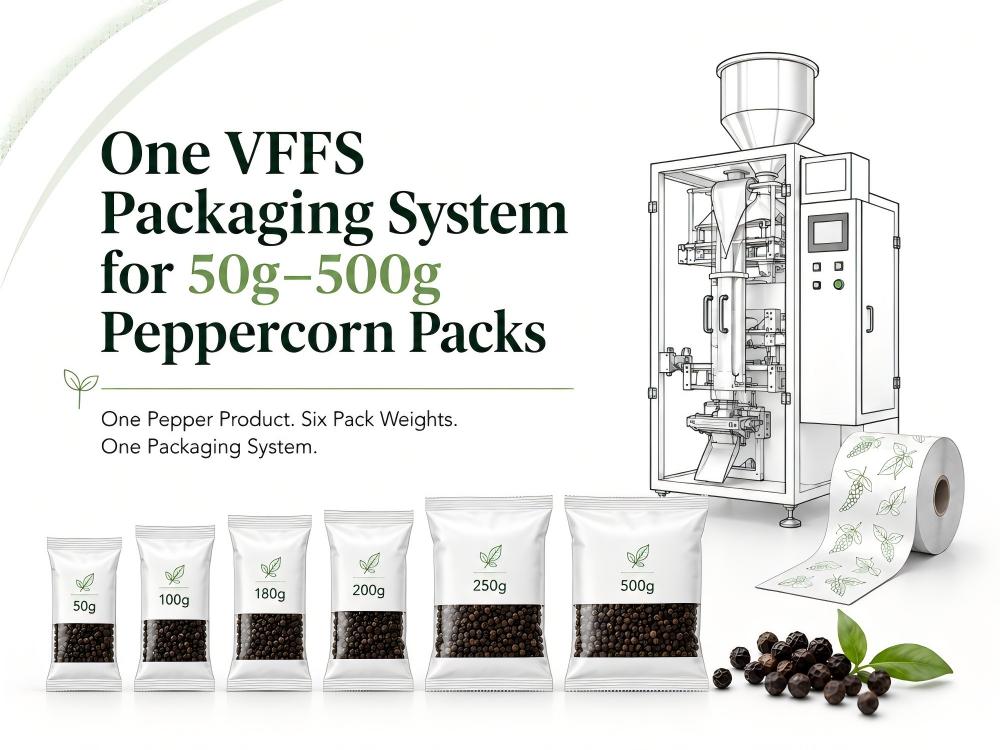
A 50g peppercorn pouch and a 500g peppercorn pouch do not behave like the same package with a different number entered on the touchscreen.
As the fill weight increases, the required product volume, feeding cross-section, bag dimensions and discharge time all change. The packaging system therefore had to be designed around both extremes of the range.
· Stable weighing across six target weights
· Enough feeding space for the 500g dose
· Practical bag dimensions for the smaller retail packs
· Film-width compatibility across multiple SKUs
· Reasonable changeover time between pack sizes
· Production speeds that remain realistic at different filling weights
After evaluating the product and target weights, we selected a Vertical Form Fill Seal machine (VFFS) combined with a linear electronic weigher.
Linear Electronic Weigher + VFFS = Weighing -> Film Feeding -> Bag Forming -> Filling -> Sealing -> Cutting
The linear weigher portions the peppercorns according to the selected target weight, while the VFFS machine forms the pouch from rollstock film and completes filling and sealing.
This gives the customer a single production platform for multiple SKUs, but machine selection alone did not solve the most important engineering issue: the bag style.
For a small 50g peppercorn pack, a three-side-seal or four-side-seal pouch can appear to be the more natural retail format. It can be compact and relatively flat.
If the project only involved 50g, that approach would be straightforward. But the same system also had to handle 500g of whole peppercorns, and that changed the forming and feeding requirements.
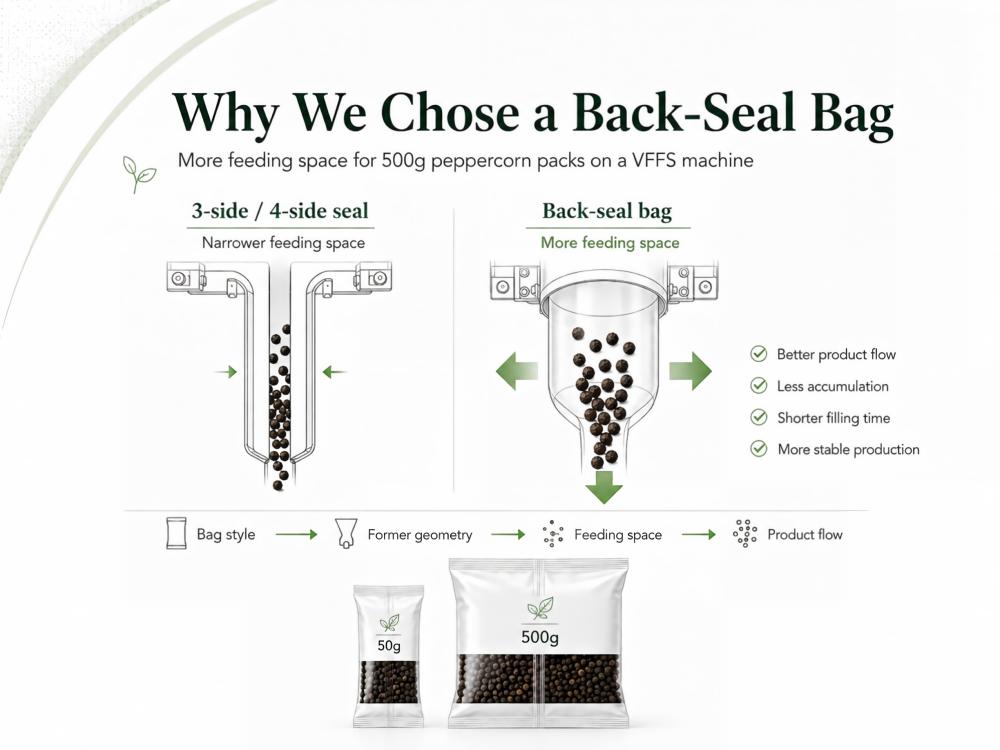
On a vertical packaging machine, the forming set does more than shape the film. The forming tube is also the channel through which the peppercorns enter the bag.
Bag Style -> Former Geometry -> Feeding Cross-Section -> Product Flow
If the machine were designed around a very flat forming structure, the available internal feeding area would become narrower. That may be acceptable for a small 50g dose, but it becomes much more restrictive when 500g of whole peppercorns must pass through the same filling channel during each cycle.
· Restricted product flow
· Slower discharge from the weigher
· Higher risk of peppercorn accumulation near the outlet
· Longer filling time
· Reduced packaging speed
· Lower continuous-production stability
We therefore selected a center-seal / back-seal pouch. This format allows the VFFS machine to use a forming tube with a more suitable cross-sectional shape and more usable internal space for the product to pass through.
The decision was not simply based on the fact that back-seal bags are common on VFFS machines. It was made because the entire 50g-500g range had to work as one production system.
The 500g pack determined the feeding capacity the machine needed. The 50g pack determined how flexible the same system had to remain.
A multi-weight packaging line should not be described using only one maximum speed figure. Even on the same machine, the practical output changes with the amount of product that must be weighed and discharged during each cycle.
The following ranges are project reference speeds for planning and communication. Final stable output must be confirmed during actual machine testing with the customer's peppercorns, film and accuracy requirements.
Pack Weight | Reference Packaging Speed |
50g | 45-60 bags/min |
100g | 40-55 bags/min |
180g | 35-45 bags/min |
200g | 32-42 bags/min |
250g | 28-38 bags/min |
500g | 20-30 bags/min |
Actual throughput can vary with peppercorn size and bulk density, product flow, target weighing accuracy, bag length, film characteristics, sealing conditions, weigher settings and final machine tuning.
Once the bag style and machine platform were established, the next question was whether six filling weights really required six completely different film specifications.
Technically, six independent pouch sizes could be created. But that would increase film SKUs, printing-cylinder investment, minimum order quantities, packaging inventory and changeover work.
To reduce the customer's initial investment, we grouped compatible pack weights around shared film-width concepts wherever the product volume allowed.
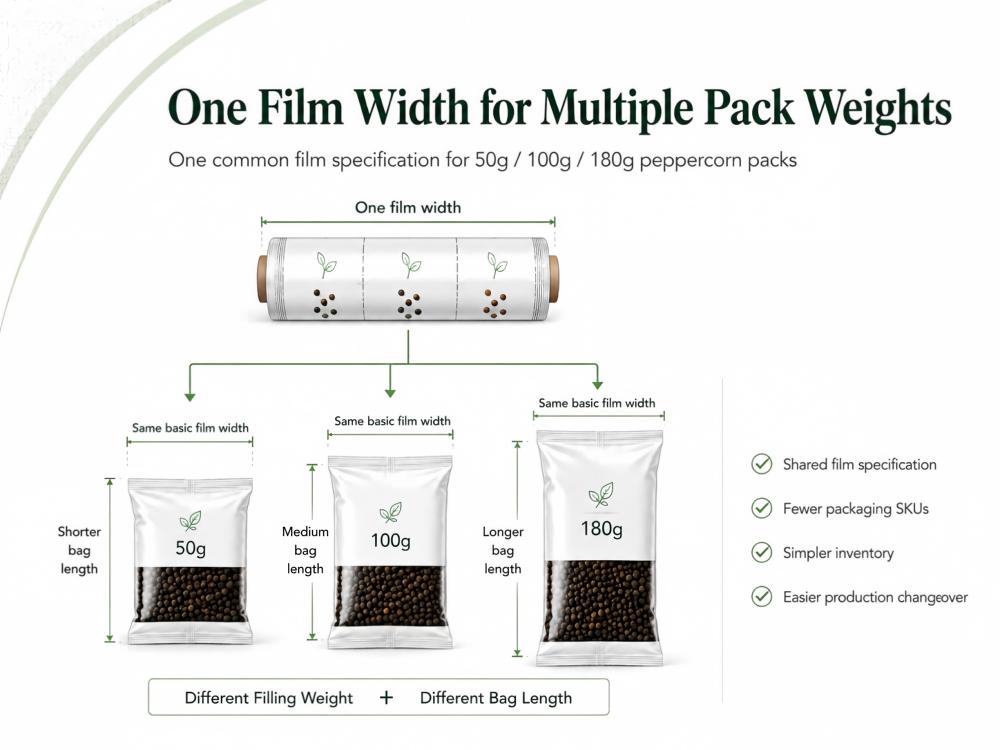
The 50g, 100g and 180g smaller packs were designed around the same basic film-width concept. The main differences between the finished packs are created through filling weight and bag length rather than a new film width for every SKU.
50g = shorter bag | 100g = medium bag | 180g = longer bag | Same basic film width
This means the customer can cover several retail weights while reducing the number of roll-film specifications that must be purchased and stored.
As the product volume increases, the package also needs more cross-sectional space. The 250g and 500g formats therefore require wider pouch / film configurations than the smaller packs.
The objective is not to force every weight into one film width. It is to use as few film configurations as technically practical without compromising product capacity, sealing space or feeding performance.
· Fewer printed-film SKUs to manage
· Lower initial packaging-material commitment
· Less inventory and warehouse complexity
· Fewer film-width changeovers between compatible SKUs
· Simpler artwork and cylinder management
· More flexible multi-SKU production planning
Six pack weights do not have to mean six completely independent film specifications.
If every SKU were optimized independently, it would be easy to design six different bags. But that would not necessarily be the best answer for the customer.
The customer wanted one production system capable of manufacturing six commercial SKUs. That required every packaging decision to be considered as part of one connected engineering chain:
Peppercorn Size -> Target Weight -> Required Bag Volume -> Film Width -> Forming Tube -> Feeding Space -> Weighing Capacity -> Packaging Speed
This is why packaging-material design and packaging-machine design should not be treated as completely separate processes in a multi-SKU automation project.
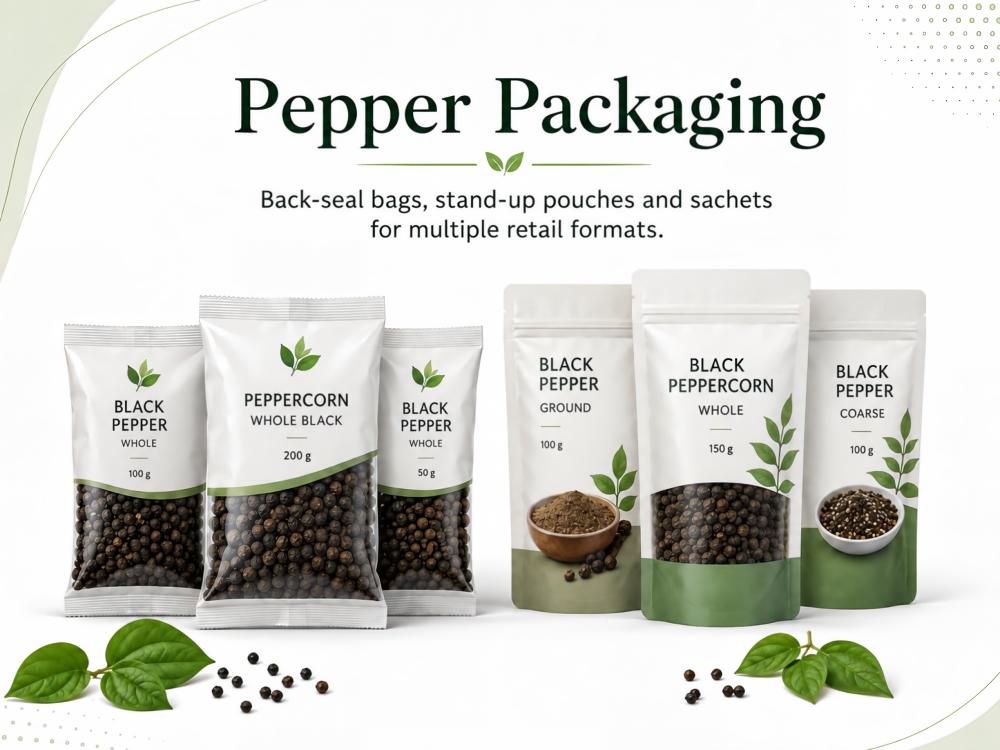
Product | Whole Peppercorn |
Pack Weights | 50g / 100g / 180g / 200g / 250g / 500g |
Packaging Machine | Vertical Form Fill Seal Machine (VFFS) |
Filling System | Linear Electronic Weigher |
Bag Style | Center-Seal / Back-Seal Bag |
Packaging Material | Printed Flexible Rollstock Film |
Shared Film Concept | 50g / 100g / 180g use the same basic film width |
Larger Formats | 250g and 500g use wider pouch / film configurations as required |
Reference Speed Range | Approx. 20-60 bags/min depending on pack weight and production conditions |
Project Objective | Use one packaging platform and as few film configurations as technically practical to cover multiple retail weights |
At first glance, 50g, 100g, 180g, 200g, 250g and 500g may look like six values that can simply be entered on a touchscreen.
In reality, stable multi-SKU production requires the smallest pack, the largest pack, the forming tube, the film widths, the weighing system and the practical production speed to work together.
The machine must remain flexible enough for the 50g pack, while the feeding channel must still have enough capacity for the 500g pack. The film system must keep inventory manageable without forcing unsuitable dimensions onto larger products.
Not simply making a machine run - designing the entire packaging system around the customer's real production needs.
Flexible Packaging / Paper Packaging / Packaging Machinery
From packaging dimensions and roll-film planning to weighing systems and automated packaging equipment, we develop packaging solutions around actual products, production conditions and SKU requirements.


