


close
Choose Your Site
Global
Social Media
Views: 266 Author: HLun PACK Publish Time: 2026-10-11 Origin: Site


Content Menu
● Why Chips Packaging Requires a System Approach
● Choosing the Right Chips Packaging Format
>> Pillow Bags for Regular Production
>> Stand-Up Pouches for Shelf Presentation
>> Rigid Canisters and Secondary Cartons
● How to Specify Chips Packaging Materials
>> Understand Each Layer's Function
>> Compare Barrier Data Under Matching Conditions
● Measure Performance, Not Just Gas Flow
● Selecting a Chips Packaging Machine
>> Start With Product Behavior
>> Match the Weigher, Transfer System, and Bagmaker
>> Compare Proven Output, Not Advertised Maximum Speed
● A Practical Chips Packaging Validation Plan
>> 1: Establish Product and Storage Requirements
>> 2: Test Film and Sealing Conditions Together
>> 3: Measure Finished-Package Performance
>> 4: Verify Storage and Distribution
● Equipment Acceptance: What Buyers Should Put in Writing
● Calculate Cost per Acceptable Pack
● Avoid Simple Material Claims
● Plan Your Chips Packaging Project With HLun Pack
>> What Is the Best Packaging for Potato Chips?
>> Why Do Chips Bags Contain So Much Empty Space?
>> Can Granular Packaging Equipment Handle Chips?
>> How Do You Reduce Chips Breakage During Packing?
>> Does Nitrogen Flushing Guarantee a Longer Shelf Life?
>> Are Metallized Chips Bags Recyclable?
Chips packaging must protect crispness, control oxidation, and reduce breakage while running reliably on your production line. Choosing the right potato chips packaging therefore involves more than selecting an attractive bag. Film performance, nitrogen flushing, weighing accuracy, sealing quality, and distribution conditions must work together.
For manufacturers investing in granular packaging equipment, chips present a particular challenge: they are lightweight, irregular, oily, and fragile. A machine suitable for dense granules may not handle chips gently or consistently.
At HLun Pack, our approach to integrated packaging solutions starts with the product, not simply the machine specification. This guide explains how to evaluate chips packaging materials, choose suitable equipment, and validate the finished package before committing to production.
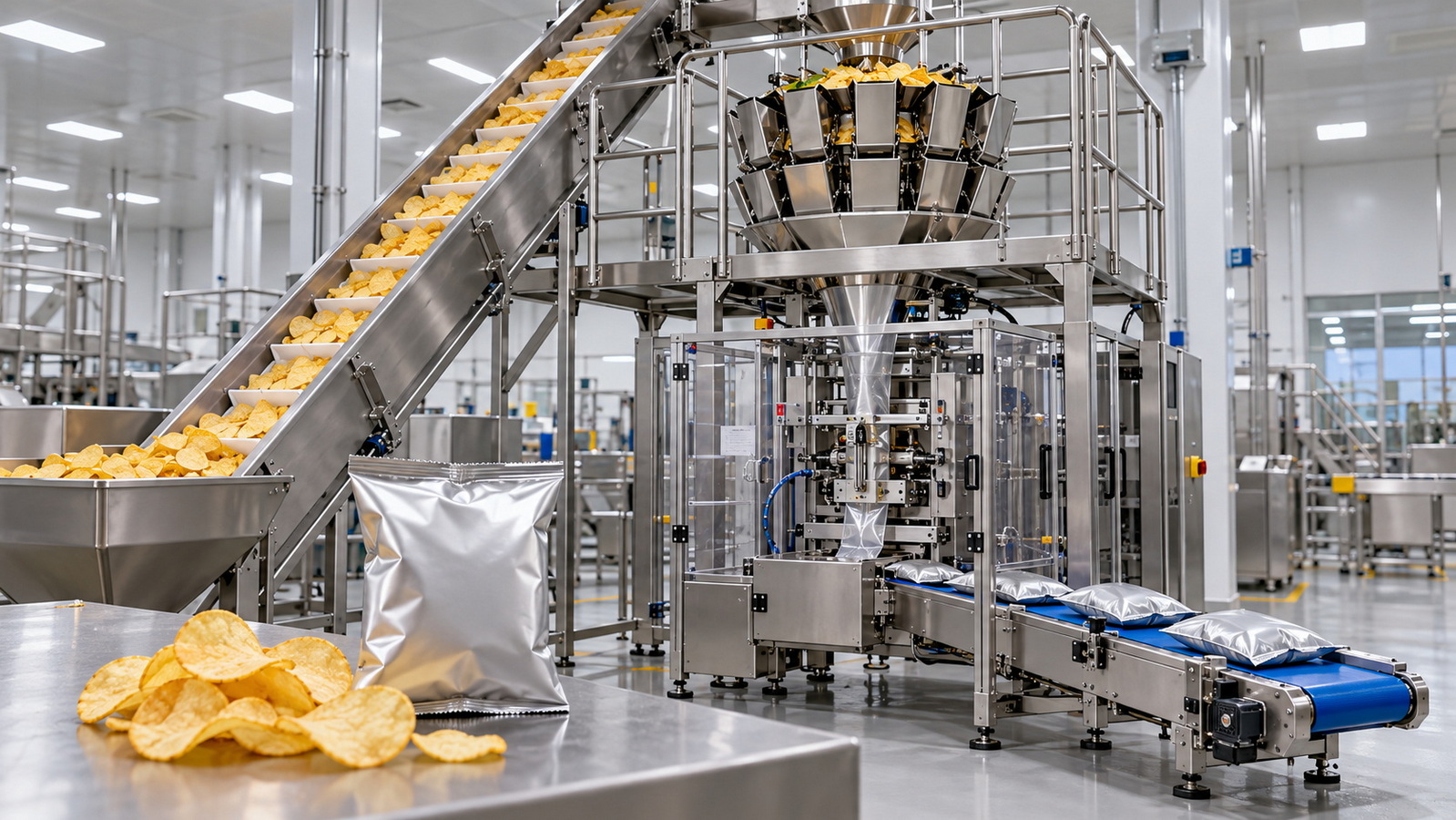
Three quality problems dominate snack packaging: moisture absorption, oil oxidation, and physical damage.
Moisture can soften chips and destroy their crisp texture. Oxygen and light can contribute to oil deterioration and unwanted flavors. Excessive drops, rough conveying, and compression can turn otherwise acceptable chips into fragments.
These problems require different controls:
- Moisture protection depends on film barrier performance and package integrity.
- Oxidation control depends on oxygen exposure, product formulation, storage conditions, and packaging atmosphere.
- Breakage control depends on product handling, package geometry, and transport protection.
Our recommendation is to define acceptable product quality first, then work backward to the film, package format, and equipment configuration. A faster machine is not a better investment if it produces more broken chips or unreliable seals.
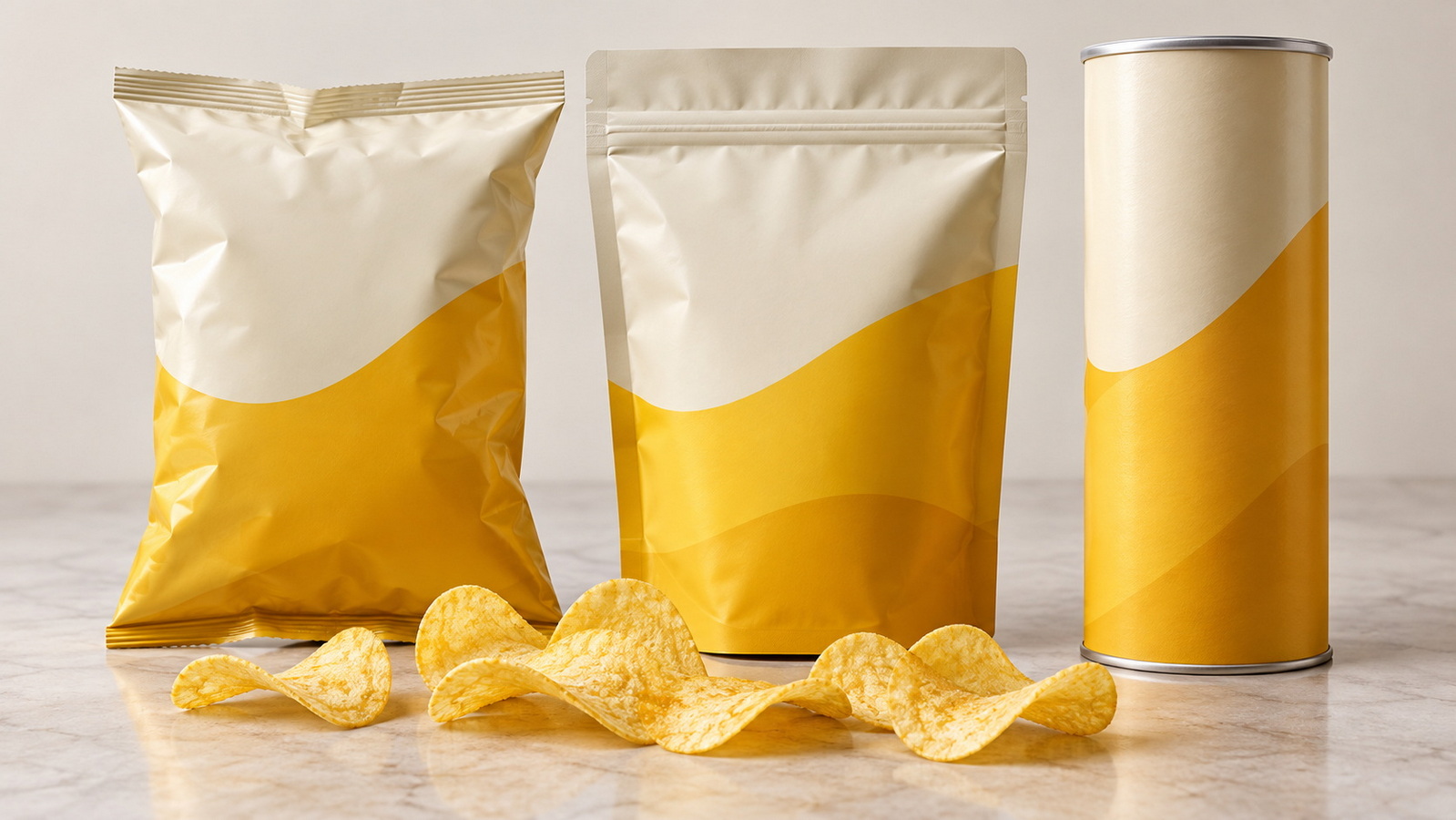
Pillow bags are a practical starting point for many snack manufacturers. A vertical form fill seal machine forms the bag from rollstock, receives a weighed portion, and seals the package.
They suit businesses prioritizing efficient production and consistent retail pack sizes. However, bag dimensions must accommodate the product's volume and allow sufficient clearance around the sealing area.
Stand-up pouches provide an upright presentation and can incorporate resealable closures. They may suit premium snacks, larger sharing packs, or brands seeking more distinctive shelf positioning.
Premade pouch filling equipment must reliably open the pouch, guide fragile chips inside, and keep the top seal clean. A zipper adds convenience after opening but does not replace the original protective seal.
Rigid canisters offer structural protection and a distinctive presentation. Their filling and closing requirements differ from flexible bag systems.
Cartons typically group individually sealed bags rather than provide the primary moisture and oxygen barrier themselves.
| Format | Main advantage | Important purchasing consideration |
|---|---|---|
| Pillow bag | Efficient rollstock production | Film tracking, seal quality, and product clearance |
| Stand-up pouch | Upright display and optional resealing | Opening reliability and filling access |
| Rigid canister | Structural protection | Filling method and closure integrity |
| Multipack carton | Bundling and distribution organization | Inner-pack protection and case configuration |
Choose the format around the product and sales channel—not appearance alone.
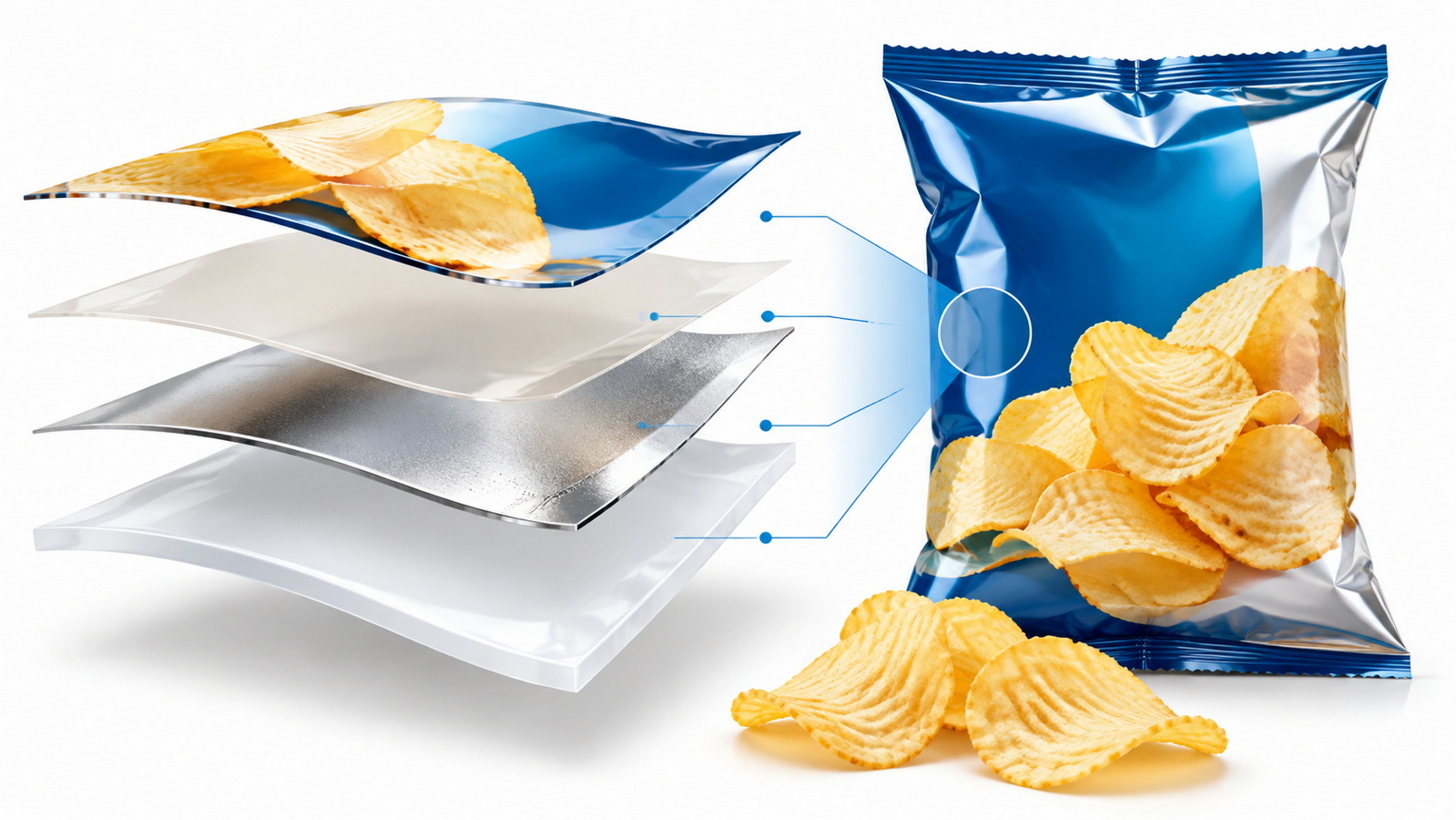
Flexible snack packaging may combine a printing layer, barrier layer, adhesive, and heat-sealable inner layer.
Possible materials include polypropylene, polyester, polyethylene, metallized films, and aluminum foil. These are not interchangeable, and every package does not require the same construction.
Metallized film contains a deposited metal layer. Aluminum foil is a distinct material. Treating both as identical can lead to incorrect assumptions about barrier properties, handling, and recycling compatibility.
Ask the converter to explain what each layer contributes and why the proposed structure fits your application.
Two essential specifications are:
- Oxygen transmission rate, or OTR: the rate at which oxygen passes through a material.
- Water vapor transmission rate, or WVTR: the rate at which water vapor passes through a material.
Lower transmission generally indicates a stronger barrier under the stated test conditions. However, values measured at different temperatures or humidity levels are not directly comparable.
Request the test method, conditions, units, and complete film construction. Also confirm thickness tolerance, puncture resistance, sealing behavior, and suitability for oily food contact.
The key purchasing principle is validation: a promising film datasheet must still translate into a reliable finished package.
Nitrogen flushing reduces oxygen in the package headspace. It does not compensate for a leaking seal or an unsuitable barrier film.
A 2024 study examining 108 commercially available snack chip products found modified atmosphere packaging in only 44 products. This illustrates why bag appearance should not be used to infer the packaging atmosphere.
Published research discusses low residual oxygen levels for limiting oxidation, but those findings should not become a universal machine guarantee. The appropriate target depends on the product and its validated storage performance.
A useful verification plan includes:
1. Measure residual oxygen after sealing.
2. Use a consistent sampling time and method.
3. Compare results across normal production speeds.
4. Check start-up, restart, and changeover conditions.
5. Reassess packages during storage.
Headspace also influences bag shape and protection, but an inflated bag is not proof of effective oxygen control. Measure both gas performance and transport damage.
Before requesting a quotation, prepare representative samples and describe:
- Chip dimensions, thickness, and fragility.
- Bulk density and target pack weight.
- Oiliness and seasoning characteristics.
- Required package sizes.
- Expected output and operating hours.
- Cleaning and product-change requirements.
Fragile chips should not automatically inherit equipment settings used for nuts, rice, or other free-flowing granules.
A multihead weigher combines portions from several weighing hoppers to approach the target pack weight. Its performance also depends on stable feeding and controlled discharge.
For chips, examine the entire transfer path. Long drops, abrupt changes in direction, and unsuitable vibration settings can increase damage.
The bagmaker must coordinate product arrival with the sealing cycle. Chips or seasoning trapped between the jaws can interfere with seal formation.
Industry equipment suppliers emphasize controlled handling and synchronized weighing and bagging. Buyers should assess these functions as an integrated system rather than compare isolated machine speeds.
Supplier speed figures describe particular configurations and operating conditions. They are not guaranteed results for every snack, film, and bag size.
Ask for a demonstration using your product and proposed packaging material. Record sustained acceptable output, not merely the highest displayed cycle rate.
A slower setting that produces clean seals and fewer damaged chips may deliver more saleable packages per shift.
This section turns packaging selection into a repeatable approval process.
Define the intended shelf life, distribution route, storage conditions, and acceptable quality limits.
Include sensory criteria such as crispness and flavor, alongside measurable limits for breakage and package defects. Avoid copying a competitor's date code without supporting tests.
Trial the actual printed film on the intended machine.
Evaluate temperature, jaw pressure, contact time, tracking stability, and contamination sensitivity. Establish a usable operating window rather than one setting that works only under ideal conditions.
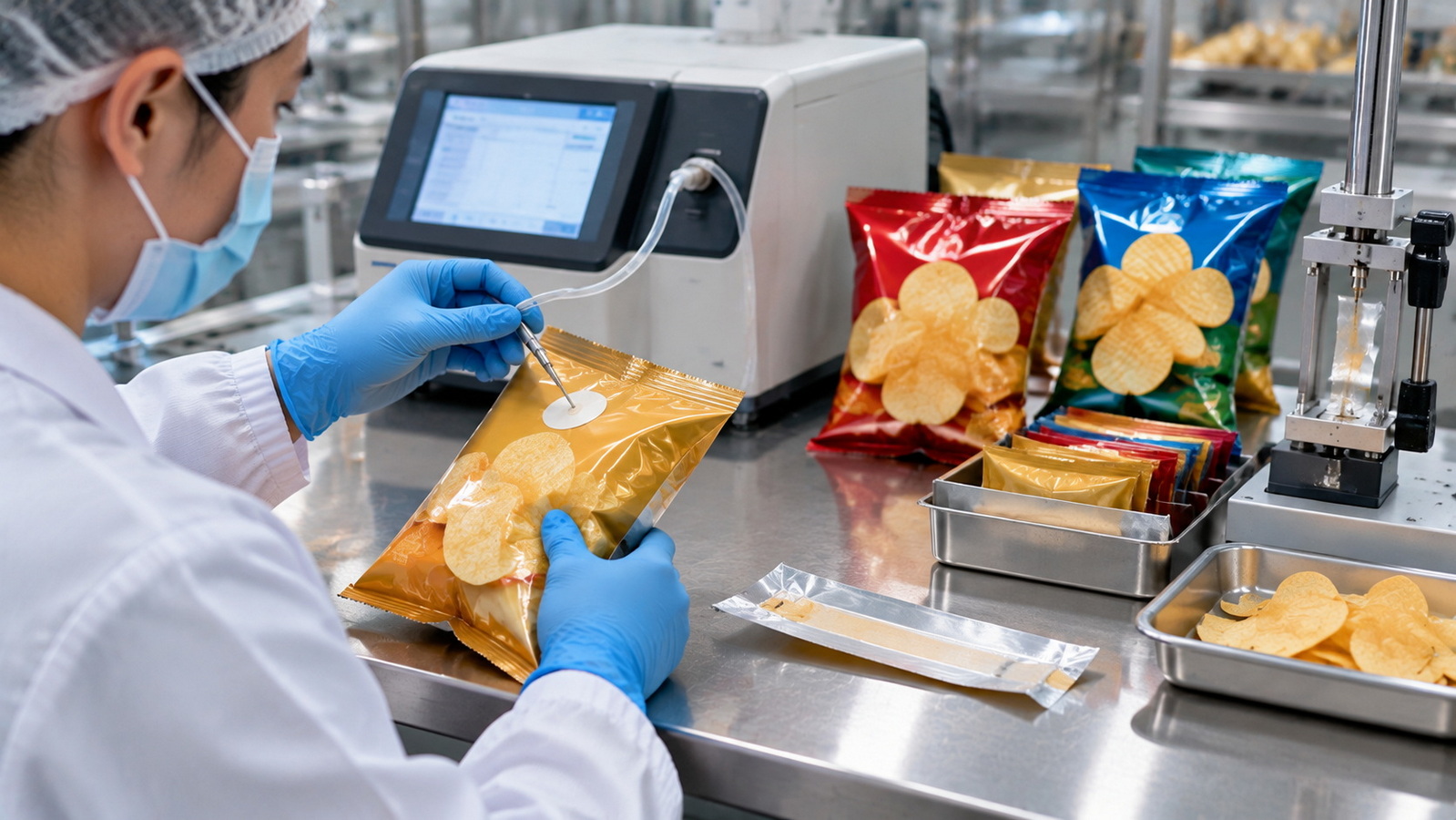
Select appropriate checks with your quality team:
- Residual oxygen testing.
- Leak detection.
- Seal-strength assessment.
- Net-weight verification.
- Breakage measurement.
- Print registration and code inspection.
Define sampling frequency and acceptance limits before the trial. Otherwise, suppliers and buyers may interpret "acceptable performance" differently.
Retain production samples for real-time shelf-life evaluation. Accelerated testing can support development, but its relationship to actual storage requires justification.
Assess filled packages after representative handling, vibration, stacking, or transport conditions.
There is no universal six- or twelve-month shelf life for chips packaging. Product composition, oxygen exposure, moisture ingress, temperature, and seal integrity all influence the result.
A factory acceptance test should reflect the intended production conditions as closely as practical.
Specify the product, film, bag dimensions, pack weight, and operating speed. Agree on how performance will be measured and how failures will be handled.
| Acceptance item | What to establish |
|---|---|
| Sustained output | Acceptable finished packs over an agreed test period |
| Fill weight | Average weight, variation, and underweight handling |
| Product damage | A consistent method for measuring broken chips |
| Seal quality | Approved integrity checks and defect limits |
| Gas performance | Residual oxygen target and sampling method |
| Changeovers | Tasks, tools, time, and restart requirements |
| Cleaning | Access, removable components, and documented procedures |
Also review utilities, available floor space, spare parts, operator training, and technical support.
Contaminant inspection requires its own application assessment. Packaging material and product characteristics can affect detection performance, so confirm inspection capability using the actual package rather than assume every detector suits every film.
Purchase price alone provides an incomplete comparison.
Packaging economics include film consumption, product giveaway, rejects, nitrogen, labor, maintenance, utilities, and downtime. Changeover losses also matter when a line handles several flavors or package sizes.
Use this working calculation:
Cost per acceptable pack = total relevant production cost ÷ number of acceptable finished packs.
Keep the comparison period and cost categories consistent.
For a useful supplier trial, compare two operating settings or film options under similar conditions. A cheaper film may lose its advantage if it causes more stoppages. Conversely, a premium specification needs a measurable benefit to justify its cost.
This approach connects engineering decisions directly to saleable output.
Mono-PE and mono-PP structures are important design directions for flexible packaging. However, "mono-material" does not automatically mean a package will be collected and recycled in every market.
Barrier coatings, metallization, inks, adhesives, and closures can influence compatibility. Local collection and sorting infrastructure also matter.
Updated industry design guidance evaluates the whole structure rather than relying solely on the name of the main polymer.
When testing a replacement film:
1. Review its complete construction and intended recycling stream.
2. Confirm food-contact suitability.
3. Recheck barrier performance.
4. Repeat sealing and production trials.
5. Validate storage performance before making claims.
Recycled-content food packaging introduces additional considerations. Contamination control, recycling-process suitability, and intended food-contact conditions require appropriate documentation.
Environmental improvements should preserve the protective function of the package. A material change that increases spoilage or production waste needs further development.
HLun Pack focuses on packaging equipment and integrated packaging solutions. For a chips project, the useful starting point is a shared technical brief covering the snack, package, production target, and quality requirements.
Send representative product samples, target fill weights, proposed bag dimensions, film specifications, and required output. Include your distribution conditions and intended shelf life.
Ask HLun Pack to review the weighing, transfer, filling, sealing, and inspection requirements together. The objective is a coordinated solution with clearly defined trial criteria—not simply a machine selected from a speed table.
The best option depends on product fragility, required protection, shelf presentation, and production volume. High-barrier flexible bags are a common choice, while rigid canisters offer structural protection. Validate the complete package before approval.
Chips occupy considerable volume relative to their weight. Headspace accommodates the product and can contribute to cushioning. It may also contain nitrogen, but visible inflation does not confirm low residual oxygen or leak-free sealing.
Some configurations can, but chips require application-specific evaluation. Feeding, weighing, discharge height, filling clearance, and sealing timing must suit a lightweight, fragile product.
Evaluate damage at each transfer point. Adjust feeding, reduce unnecessary drops, and coordinate discharge with bag filling. Compare samples before and after packing using the same measurement method.
No. It can reduce oxygen exposure, but results depend on residual oxygen, barrier performance, sealing, storage conditions, and the product itself. Shelf-life claims require supporting evaluation.
Some structures may fit particular recycling guidelines and systems. Others may not. Assess the complete package and the destination market's collection, sorting, and recycling arrangements before labeling it recyclable.
1. [Yundu — "The Ultimate Guide to Chips Packaging," July 11, 2025]. Original article used as the starting point for restructuring the coverage of formats, materials, machinery, and purchasing considerations. Its broad shelf-life and recycling claims have not been adopted as universal conclusions. [yundufillingmachine]
2. [Chemie Ingenieur Technik — "Evaluation of Market-Available Snack Chip Packaging: Modified Atmosphere Packaging," 2024]. Research covering 108 commercial snack chip products, including the finding that 44 used modified atmosphere packaging; supports the discussion of oxygen sensitivity and measured packaging atmosphere. [onlinelibrary.wiley]
3. [Packaging Technology and Science — "Effect of Nitrogen Flushing on Shelf-Life of Packaged Potato Chips"]. Experimental evidence showing why nitrogen use alone should not be treated as a guaranteed oxidation-control outcome. [onlinelibrary.wiley]
4. [Ishida — "iTPS: Integrated Total Packaging Solution"]. Equipment-manufacturer information supporting integrated weighing and bagmaking, controlled handling, and configuration-dependent production performance. Its published speeds are not represented as HLun Pack capabilities. [ishida]
5. [Ishida Europe — "Potato Chips: Weighing, Packaging and Quality Control"]. Application guidance supporting controlled product transfer and adequate separation between product discharge and sealing. [ishidaeurope]
6. [CEFLEX — "Design Principles," updated 2025 guidance]. Supports discussion of mono-PE and mono-PP, barrier layers, inks, adhesives, closures, and full-package recycling compatibility. [guidelines.ceflex]
7. [U.S. Food and Drug Administration — "Recycled Plastics in Food Packaging"]. Supports the discussion of contamination risks, recycling-process evaluation, and intended conditions of food-contact use. [fda]
8. HLun Pack company positioning supplied in the project brief: packaging and packaging-equipment manufacturing, granular packaging equipment, and integrated packaging solutions. No independent performance figures, customer testimonials, certifications, or completed project results were supplied. The procurement checklists and validation sequence above are editorial recommendations synthesized from the technical considerations, not quotations or claimed customer outcomes.


