


close
Choose Your Site
Global
Social Media
Views: 268 Author: HLun PACK Publish Time: 2026-10-10 Origin: Site


Content Menu
● What Should Rice Packaging Bag Specifications Include?
● Rice Packaging Bag Sizes: Use Dimensions as Starting Points
>> Reference Dimensions for Common Rice Pack Weights
>> How to Confirm the Correct Rice Bag Size
● Choose Rice Packaging Materials by Function
>> Compare Candidate Material Structures
>> White Rice and Brown Rice Need Different Assessments
● Specify Rice Bag Thickness Without Guesswork
● Set Moisture and Oxygen Barrier Requirements
>> Evaluate the Finished Package, Not Only the Film
● Match Rice Packaging Bags to the Packaging Machine
>> Premade Pouches Versus Rollstock
>> Measure Sustainable Production Output
● A Practical Five-Step Approval Process
>> 1: Define the Distribution Conditions
>> 2: Approve Filled Prototypes
>> 3: Test Seals and Package Integrity
>> 4: Run the Intended Packaging Process
>> 5: Assess Transport and Product Stability
● Food-Contact Documentation and Environmental Claims
● Build a Rice Packaging Specification That Works in Production
● Frequently Asked Questions About Rice Packaging Bags
>> 1. What size bag is suitable for 5 kg of rice?
>> 2. Which material is best for vacuum-packed rice?
>> 3. Does thicker packaging always provide better protection?
>> 4. Can one packaging machine handle several rice bag sizes?
>> 5. How should buyers confirm rice shelf life?
>> 6. What information should I send when requesting a quotation?
Rice packaging bag specifications should define more than capacity and thickness. They should explain how the bag protects the rice, supports its weight, seals reliably, and works with the intended packaging machine. For buyers sourcing custom rice packaging bags, the right specification connects product quality with dependable production.
At HLun Pack, our focus is packaging machinery and integrated packaging solutions. My recommendation is to evaluate the bag and the packaging process together, rather than approve a material sample first and investigate equipment compatibility later.
This guide covers dry, uncooked rice. Cooked rice and shelf-stable ready-to-eat products require a different assessment of processing conditions, packaging materials, and food safety.
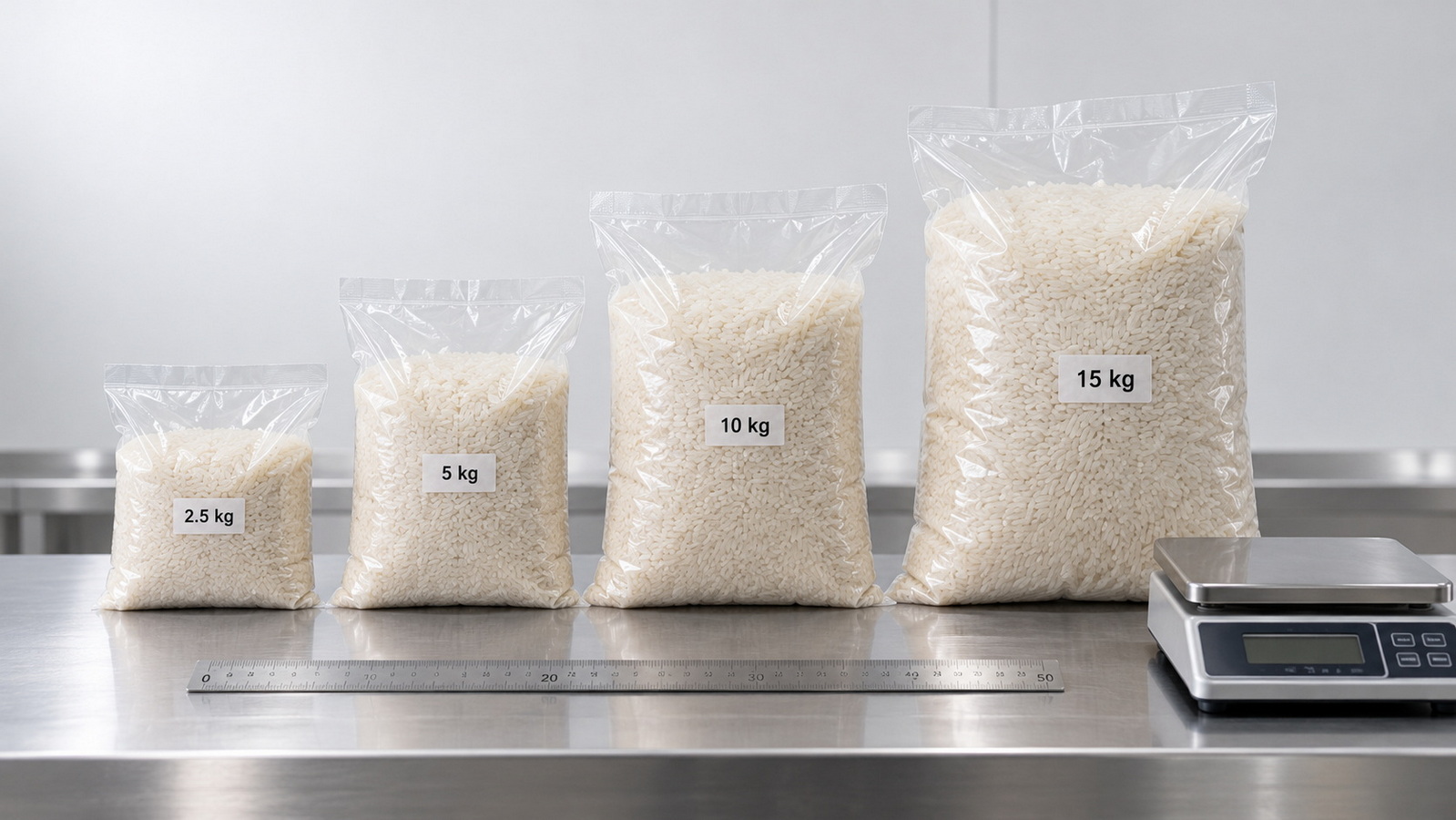
A useful specification is a shared agreement between the rice producer, packaging supplier, and equipment provider.
It should cover:
- Rice type, target fill weight, and intended shelf life.
- Bag format, dimensions, and measurement conventions.
- Material structure, total thickness, and tolerances.
- Moisture and oxygen barrier requirements.
- Seal design, opening features, and handle construction.
- Food-contact suitability for the destination market.
- Packaging machine requirements and acceptance tests.
The most important principle is validation: a proposed specification becomes production-ready only after filled samples and line trials demonstrate that it works.
A bag that looks excellent when empty may behave differently after filling, evacuation, stacking, or transport.
Pack weight alone does not determine bag dimensions. Rice variety, grain shape, bulk density, settling, and bag construction all affect the space required.
The following dimensions are preliminary references carried forward from the original article. They are not universal standards or confirmed machine settings.
| Nominal rice weight | Reference dimensions | Required confirmation |
|---|---|---|
| 2.5 kg | 260 × 420 mm | Bag format, usable capacity, and sealing clearance |
| 5 kg | 320 × 510 mm | Filled shape, headspace, and handling performance |
| 10 kg | 380 × 630 mm | Seal strength, support, and transport durability |
| 15 kg | 400 × 650 mm | Capacity, gusset requirements, and lifting performance |
Before requesting quotations, clarify whether dimensions mean external width and height, internal usable dimensions, or dimensions including gussets.
A 320 × 510 mm flat bag is not equivalent to a gusseted bag carrying the same width and height description.
Use actual production rice rather than estimating capacity from photographs.
1. Weigh the intended portion.
2. Fill a prototype in the proposed bag format.
3. Allow the rice to settle using the planned filling method.
4. Check clearance above the product for a clean seal.
5. Assess the filled shape and carton fit.
6. Repeat across representative rice batches.
For vacuum packaging, evaluate the dimensions after evacuation. The finished pack may become more compact, but grain contact and local stress can increase.
Do not reduce bag size simply to remove visible headspace. The filling nozzle and sealing jaws still need adequate working clearance.
Material selection should begin with protection and production requirements, not an attractive laminate name.
Each layer has a purpose. Structural layers support printing and mechanical performance, while the inner sealant layer must suit food contact and the sealing process.
| Candidate structure | Reason to consider it | What buyers should verify |
|---|---|---|
| PET/PE | Printed dry-rice packaging | Barrier performance, sealability, and filled-pack durability |
| PA/PE | Vacuum packs needing puncture resistance | Vacuum retention, grain-contact damage, and humidity effects |
| PET/AL/PE | Applications requiring strong light and gas protection | Foil durability, sealing performance, and recycling implications |
| PE-based structures | Projects considering material simplification | Required barrier, stiffness, machine handling, and local recovery options |
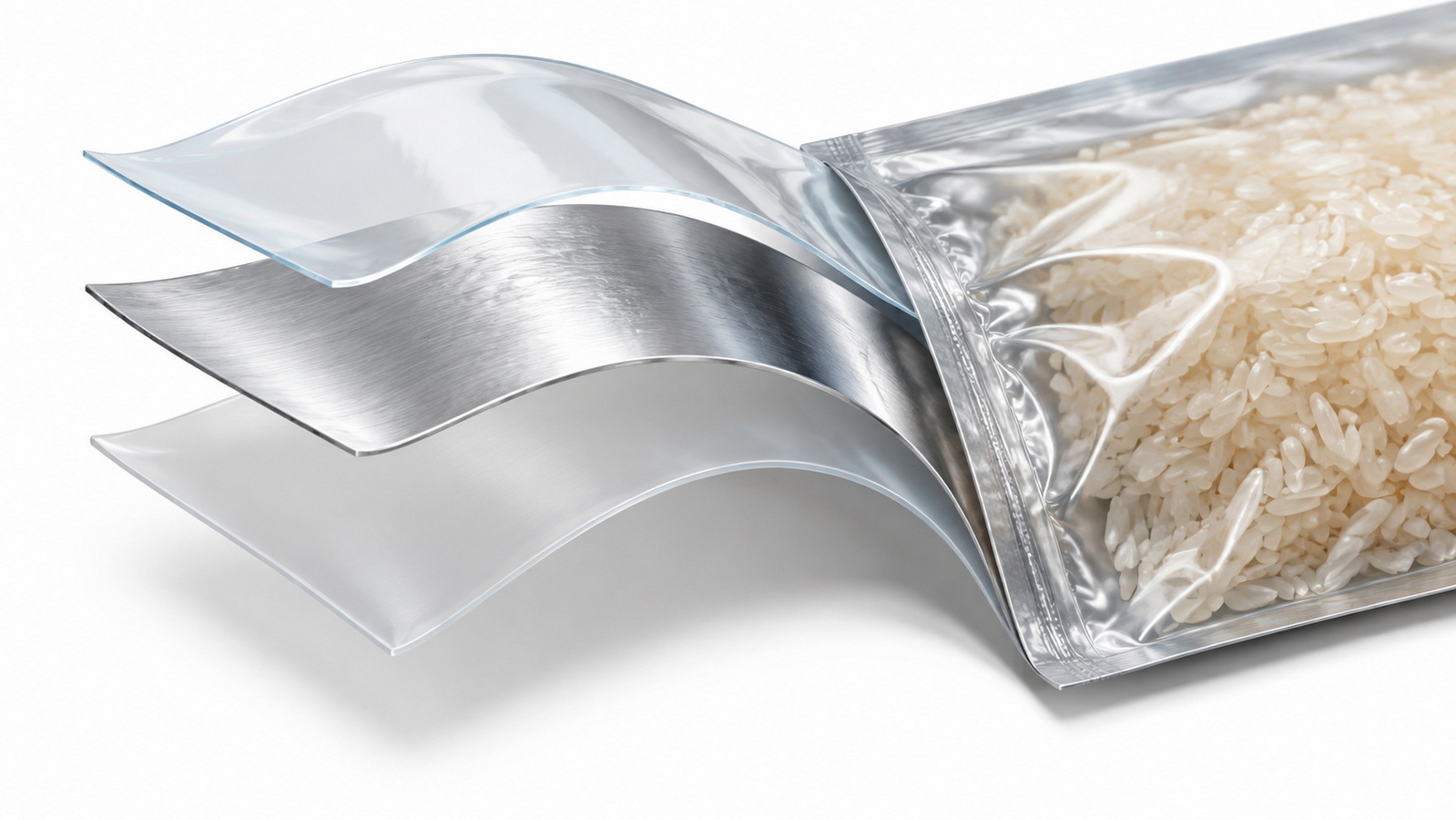
PET means polyethylene terephthalate. PA is polyamide, commonly called nylon. PE means polyethylene, and AL indicates aluminum foil.
These structures are candidates, not automatic recommendations. Layer thicknesses, resin grades, adhesives, and converting quality can change performance substantially.
A transparent window also needs consideration. It supports product visibility, but the window area must be included when assessing the finished package's protection.
Brown rice retains oil-containing bran components and is more susceptible to oxidation than white rice.
For brown rice, oxygen protection deserves particular attention. However, no material name alone establishes a shelf-life claim.
Assess the actual rice, starting condition, package integrity, storage temperature, and distribution environment together. A barrier film cannot reverse deterioration that occurred before packing.
Thickness contributes to performance, but it is not a complete measure of bag quality.
Two films with the same total thickness can have different puncture resistance, stiffness, seal strength, and oxygen transmission.
A purchasing specification should state:
- Total laminate thickness.
- Whether the value describes one bag wall.
- Individual layer thicknesses where required.
- Permitted thickness variation.
- The measurement method and sampling plan.
For example, 0.10 mm equals 100 micrometers. However, "100 micrometers" remains incomplete without a material structure and tolerance.
Avoid approving thicker film merely because the pack is heavier. Improve the structure, seal design, or handling arrangement where testing identifies the actual weakness.
An unnecessarily thick bag can increase material consumption without solving a poor seal or an unsuitable handle design.
Rice packaging must help prevent unwanted moisture exposure. Depending on the product and intended shelf life, oxygen protection may also be important.
Water vapor transmission rate, or WVTR, measures water vapor passing through a material under defined conditions.
Oxygen transmission rate, or OTR, measures oxygen passing through a material under defined conditions.
Lower values indicate less transmission when results are compared on an equivalent basis.
Ask suppliers to provide:
- Test method.
- Temperature and humidity.
- Sample structure and thickness.
- Reported units.
- Laboratory report or supporting test documentation.
ASTM F1249 is used for WVTR testing of flexible barrier materials. ASTM D3985 is used for oxygen transmission testing through plastic films and related structures.
Results obtained under different conditions should not be treated as directly interchangeable.
Film data does not prove that every finished bag will provide the same protection.
Seals, pinholes, folds, and handling damage can compromise the package. A strong barrier film with a leaking top seal remains a weak packaging solution.
Combine material testing with package-integrity checks and product shelf-life evaluation. Set acceptance limits around the actual product and distribution conditions rather than copying an unrelated supplier's figures.
Bag selection and machine selection should happen together.
An equipment quotation based only on "5 kg rice bags" leaves important production questions unanswered.
A premade-pouch machine handles already converted bags. Confirm pouch opening, gripping, filling clearance, sealing position, and discharge.
A vertical form-fill-seal machine forms bags from rollstock. Confirm film width, forming dimensions, print registration, seal geometry, and roll specifications.
Neither route is automatically better. The decision depends on pack formats, production volume, changeover requirements, and the intended presentation.
Vacuum packing introduces additional requirements, including evacuation time, chamber or system capacity, and controlled positioning of the filled bag.
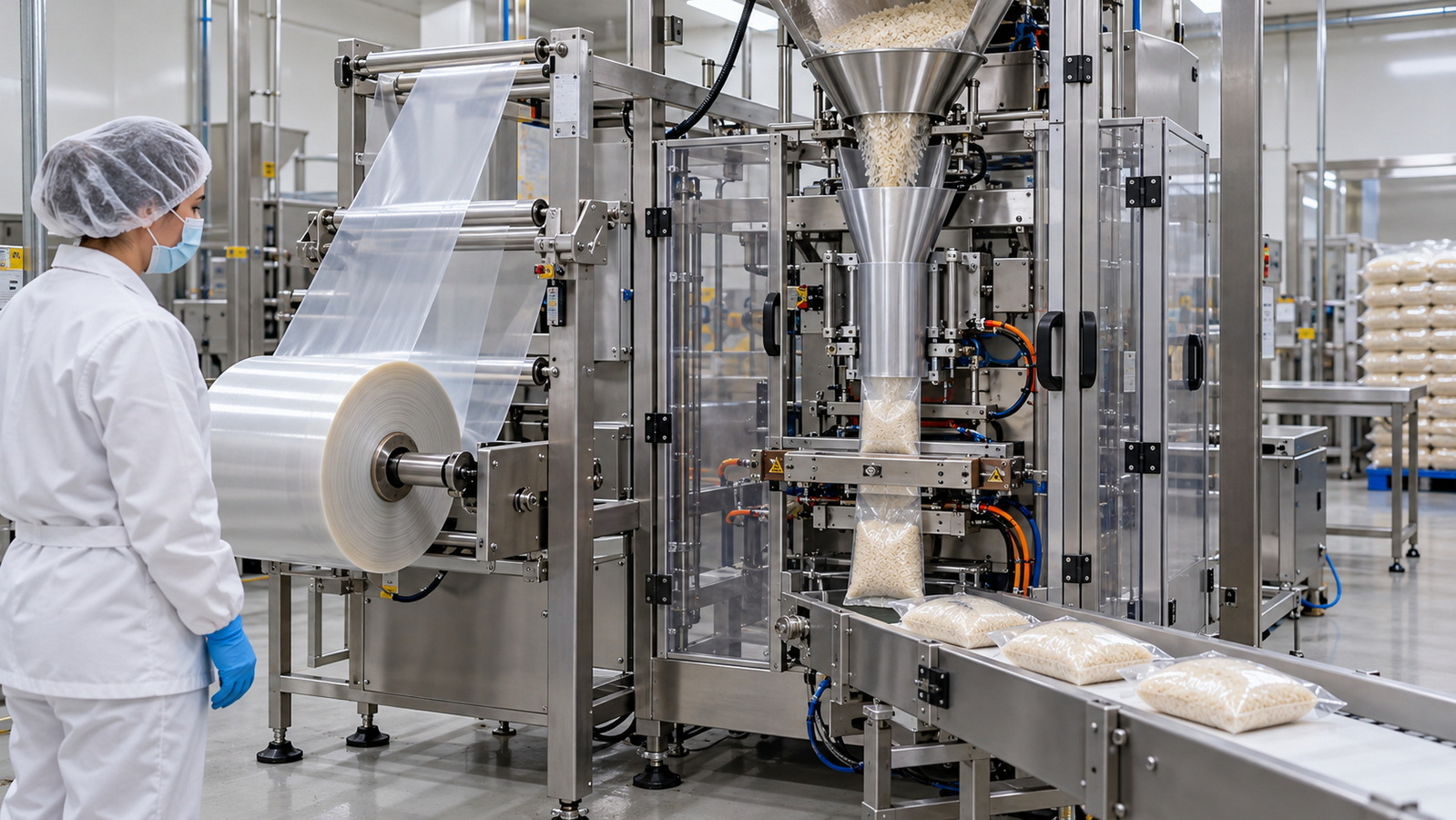
A reliable seal depends on temperature, pressure, and dwell time working together.
Ask the supplier and equipment provider to establish an operating range, not just one successful temperature setting.
Trials should investigate:
- Rice dust or grains entering the seal area.
- Wrinkles across the top seal.
- Seal consistency during speed changes.
- Performance after normal stopping and restarting.
- Pack handling before the seal has fully cooled.
ASTM F88 measures seal strength under specified test conditions. It can support process comparison, but seal strength alone does not establish leak-free performance.
Headline machine speed is less useful than sustained output with acceptable packs.
During trials, record good packs per minute, weight variation, rejected seals, stoppages, and changeover time.
Use the intended rice and packaging material wherever possible. An empty-bag demonstration cannot confirm filling accuracy, dust management, or loaded-pack handling.
This approval sequence turns a supplier proposal into a controlled purchasing decision.

Record storage conditions, transport route, stacking arrangement, and expected handling.
Include retailer or distributor requirements before choosing the bag.
Evaluate capacity, appearance, opening convenience, and sealing clearance.
For handled bags, assess the complete handle area under the intended load.
Use agreed methods for seal-strength and leak checks.
Document sample quantities, conditioning, and acceptance criteria. "Passed testing" is not meaningful without those details.
Test filling, sealing, coding, conveying, and discharge as a connected sequence.
Include normal production interruptions and changes between pack sizes.
Use handling and distribution tests appropriate to the actual route. Follow with product storage evaluation under representative conditions.
A short trial can expose mechanical problems, but it cannot establish a long shelf life by itself.
Retain approved samples and the final specification so repeat orders have a clear reference.
Food-contact suitability must cover the finished packaging composition and intended use.
For the United States, relevant substances must meet the applicable regulatory authorizations and limitations. Compliance depends on more than naming a familiar polymer.
Request documentation addressing:
- Food type and contact conditions.
- Applicable regulatory basis.
- Relevant material components.
- Traceability and manufacturing identification.
- Testing supporting the intended application.
Avoid relying on a vague "food-grade" statement as the entire compliance package.
Environmental claims also require evidence. A PE-based bag is not automatically recyclable everywhere, and a paper appearance does not prove that a laminate can enter a paper recycling stream.
Consider the complete package and the recovery systems available where it will be sold.
The right rice bag specification connects dimensions, material structure, barrier performance, sealing, and machine operation. None should be approved in isolation.
For a new pack or packaging-line upgrade, send HLun Pack your rice sample, target weights, preferred bag format, required output, and destination market. Request a coordinated review of packaging materials and equipment, supported by agreed sample tests and production-trial criteria.
This gives your team a clearer route from an initial packaging idea to a repeatable production specification.
A 320 × 510 mm bag can be a preliminary reference, but it is not a universal specification. Confirm capacity with the actual rice, bag construction, headspace, and filling equipment before placing an order.
PA/PE is a candidate when puncture resistance matters. The final choice should also satisfy oxygen protection, moisture protection, sealing, and vacuum-retention requirements. Approve filled packs through trials rather than selecting by laminate name alone.
No. Protection depends on structure, converting quality, seals, and handling conditions. A thicker film may still fail at a contaminated seal or poorly designed handle. Identify the failure mode before increasing thickness.
Possibly, within its supported operating range. Confirm the required parts, settings, changeover procedure, and attainable output for every proposed format. Do not assume that handling one bag size proves compatibility with all others.
Evaluate the packaged rice under representative storage conditions and assess the relevant quality and safety criteria. Film barrier reports support the assessment, but they cannot establish the finished product's shelf life alone.
Provide rice type, fill weights, bag format, target output, intended shelf life, destination market, and available equipment details. Include drawings, material samples, and photographs of the filled-pack appearance where available.
1. [YLT Packing — "The specifications of food rice packaging bags"]. Original article used for the topic and preliminary 2.5 kg, 5 kg, 10 kg, and 15 kg dimensions. Its size listings are not presented here as universal standards. [yltpacking]
2. [USA Rice Federation — "How To Store Rice"]. Supports the distinction between white and whole-grain rice, including brown rice's susceptibility to oxidation because of its retained oil-containing components. [usarice]
3. [Intertek — "Water Vapor Transmission Rate (WVTR) ASTM F1249"]. Explains WVTR measurement through flexible barrier materials and the importance of temperature, humidity, and thickness. [intertek]
4. [AMETEK MOCON — "View All Test Methods"]. Describes the scope of ASTM D3985 oxygen transmission testing and ASTM F1249 water vapor transmission testing. [ametekmocon]
5. [Intertek — "Seal Strength ASTM F88"]. Supports the discussion of seal-strength testing and the relationship between sealing conditions and measured seal performance. [intertek]
6. [U.S. Food and Drug Administration — "Determining the Regulatory Status of Components of a Food Contact Material"]. Explains component-level regulatory assessment and applicable identity, specification, and use limitations. [fda]
7. [U.S. Food and Drug Administration — "How FDA Regulates Substances that Come into Contact with Food"]. Explains authorization pathways and the intended-use limitations of food-contact notifications. [fda]
8. [Federal Trade Commission — "Green Guides"]. Provides guidance for substantiating and qualifying environmental marketing claims. [ftc]
9. [Federal Trade Commission — "Eco-Friendly and Green Marketing Claims"]. Explains why recyclability depends on available recovery options rather than a material description alone. [consumer.ftc]
10. [Beyin Packing — "Custom Plastic Heat Seal Vacuum Rice Bag with Handle 5kg 10kg"]. Commercial supplier reference for rice-bag layer functions and candidate PET, PA, and PE materials. Supplier-specific claims and thickness recommendations are not treated as universal requirements. [beyinpacking]


