


close
Choose Your Site
Global
Social Media
Views: 237 Author: Tom Publish Time: 2026-09-10 Origin: Hlunpack


Shisha tobacco is significantly more difficult to automate than conventional dry tobacco, granules or powders. Its moisture, glycerin, molasses and fibrous tobacco structure create a product that is wet, sticky, viscous and difficult to move reliably by gravity.
A customer approached HLunPACK with two very different automatic packaging requirements: a 500g large retail pack and a 50–100g sample pack. Rather than forcing both sizes onto one conventional filling system, we developed two separate feeding and packaging configurations around the actual behavior of the product.
Core engineering principle
For wet and sticky shisha, reliable automatic packaging starts with controlling how the product moves—not simply choosing a packaging machine.

Many standard packaging systems depend on gravity. Shisha behaves differently: tobacco fibers can bridge across an outlet, while glycerin and syrup-like ingredients can make the product adhere to product-contact surfaces.
· Bridging or hanging inside a hopper or filling outlet
· Irregular discharge and increasing product residue
· Weight fluctuation from incomplete discharge
· Blockage around narrow filling paths
· Seal-area contamination by tobacco fibers or sticky ingredients
The project therefore had to solve two questions at the same time: how to meter the correct portion, and how to positively move that portion into the package without relying on free flow.
Pack Size | Metering / Feeding | Discharge / Transfer | Packaging Machine |
500g | Screw-metered extrusion | Cut-off + horizontal transfer | Bottom-film HFFS / flow wrapper |
50–100g | Screw metering | Intermediate dosing chamber + push rod | Center back-seal VFFS |
Both solutions use positive mechanical movement, but the 500g and 50–100g formats require different ways of portioning and discharging the product.
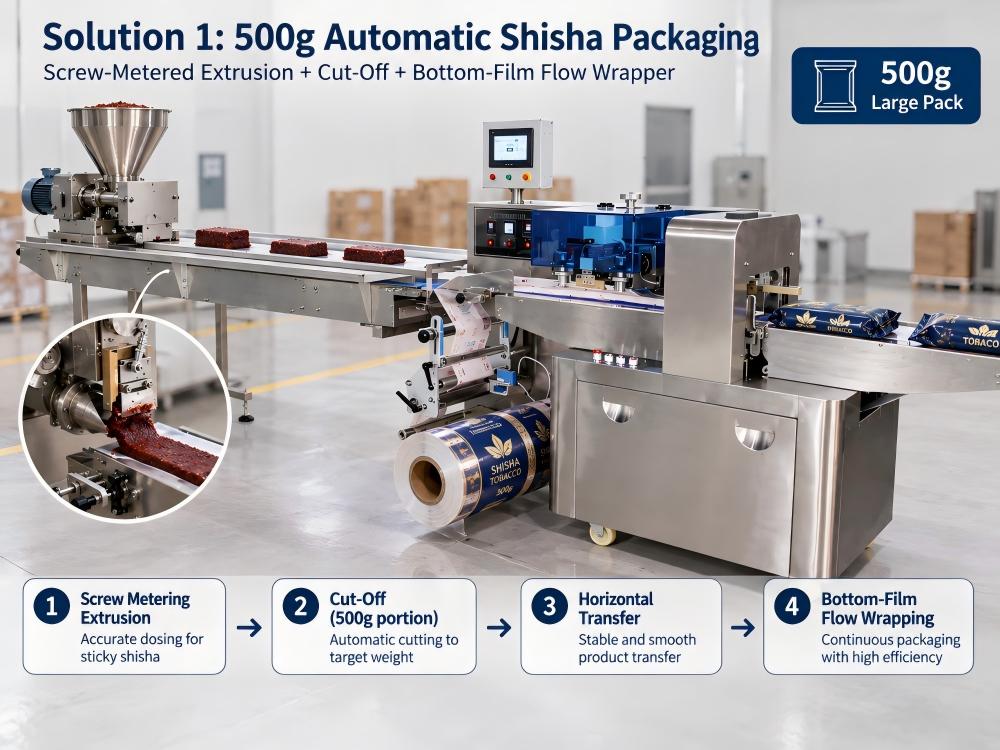
500g process: screw metering → extrusion → cut-off → horizontal transfer → bottom-film flow wrapping.
For the customer’s 500g retail pack, the shisha is actively moved by a screw-metered extrusion system. The screw controls the discharge cycle, while the extrusion section forms the sticky tobacco mass into a more manageable portion.
The screw provides positive product movement instead of waiting for the shisha to fall naturally. The dosing cycle is calibrated using the customer’s actual product so that the extruded quantity corresponds to the target pack weight.
After the required amount is extruded, a cut-off mechanism separates the 500g portion. This converts a continuous sticky mass into defined units that can be synchronized with the downstream wrapper.
500g dosing logic
Screw meters the extrusion cycle → product is extruded into a controlled portion → the cut-off mechanism separates the portion for packaging.
The extrusion outlet, product conveyor and wrapper infeed are arranged on a direct, level transfer path as far as practical. This helps reduce deformation, product sticking and unnecessary drop distance before the product enters the packaging section.
A 500g sticky shisha portion is not ideal for dropping through a long, narrow vertical filling tube. With a bottom-film horizontal wrapper, the portion is transferred into the wrapping section horizontally, while the film approaches and forms around the product from below.
The portion width and placement also need to keep sticky tobacco away from the longitudinal and cross-seal zones. Clean seal areas are critical because shisha fibers, glycerin or syrup contamination can reduce seal reliability and shorten aroma retention.
· Stable portion weight
· Controlled extrusion and clean cut-off
· Short, level product transfer
· Minimal product deformation
· Clean longitudinal and cross-seal areas
· Continuous bottom-film wrapping
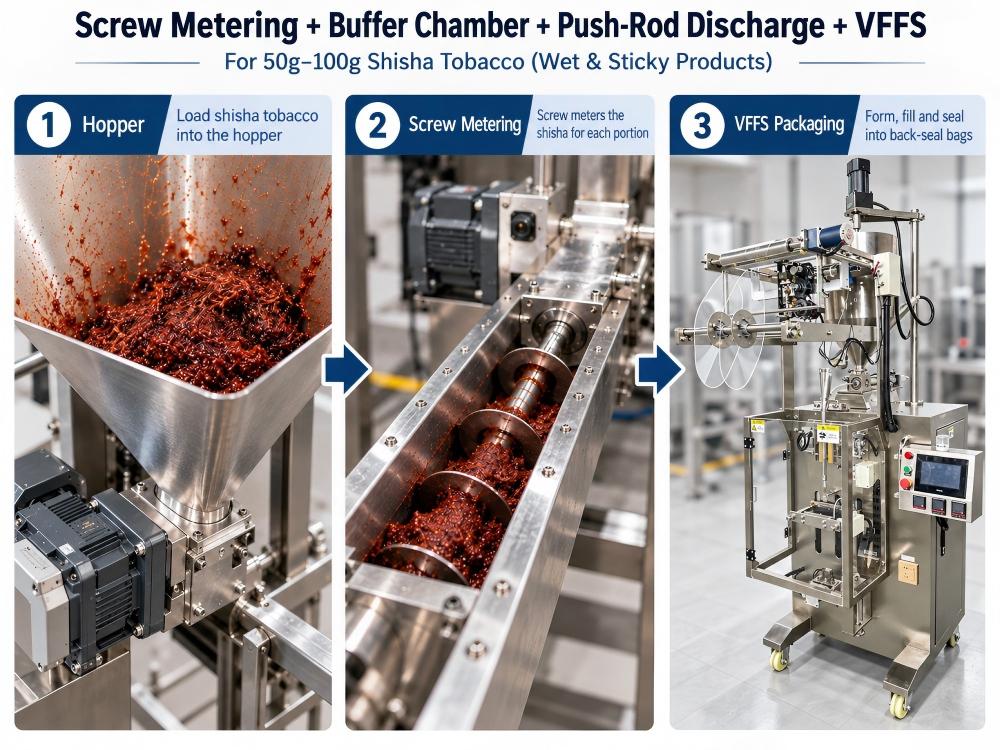
50–100g process: screw metering → dosing chamber → push-rod discharge → center back-seal VFFS.
The 50–100g sample format requires a smaller, more compact dosing system. For this application, HLunPACK separated the metering function from the final discharge function.
Small-pack design principle
The screw controls the portion; the push rod controls the discharge.
The screw meters each small portion and actively moves the wet shisha forward. This is more reliable than gravity for a material that tends to stick together and move inconsistently.
The measured portion enters an intermediate chamber before the packaging machine is ready to receive it. The chamber decouples the dosing cycle from the final discharge cycle and makes synchronization with the VFFS machine easier.
When the VFFS machine reaches the filling position, a push rod mechanically drives the measured shisha through the discharge outlet. Positive displacement helps reduce hanging, incomplete discharge and gradual product build-up inside the filling path.
For this project, the selected center back-seal VFFS layout gave sufficient space around the forming and longitudinal sealing area for the larger discharge outlet and push-rod mechanism. This is a project-specific machine design choice—not a claim that every back-seal VFFS automatically has a larger filling space.
The discharge path is especially important for fibrous shisha: long fibers can bridge across a narrow opening, while sticky residue can accumulate on the wall and progressively reduce the effective outlet area.
· Consistent small-portion metering
· Positive discharge rather than gravity-only filling
· Sufficient filling-outlet area
· Reduced material hold-up and blockage
· Stable synchronization with the VFFS cycle
· Compact back-seal sample packs
For a free-flowing product, one filling system may cover a broad weight range. Shisha creates different mechanical problems at 50g and 500g. The 500g format prioritizes large-volume movement, portion forming and horizontal transfer; the small sample format prioritizes compact dosing, positive discharge and filling-outlet space.
Project conclusion
Different pack sizes required different feeding principles—not simply a larger or smaller version of the same packaging machine.
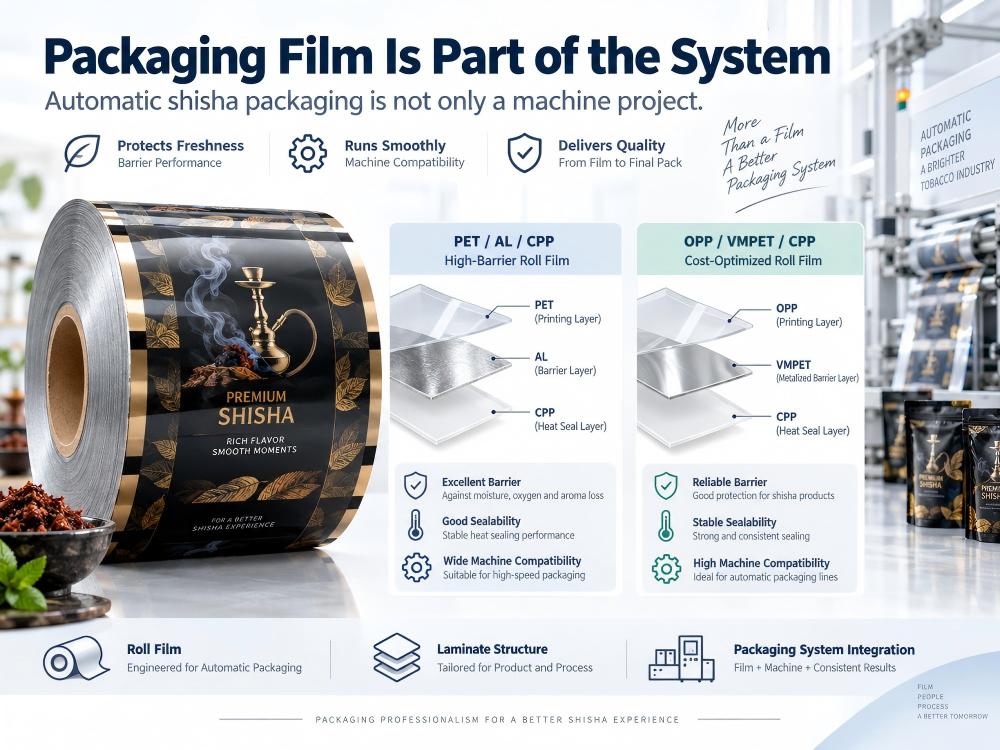
Automatic shisha packaging combines feeding, machine design and roll-film performance as one system.
Automatic shisha packaging is not only a machine project. The roll film must also match the forming method, sealing jaws, operating speed and the characteristics of the sticky product.
For automatic packaging, film properties should be evaluated together rather than in isolation:
· Barrier performance
· Seal initiation temperature
· Hot tack
· Film stiffness
· Coefficient of friction (COF)
· Web handling and forming
· Cutting behavior
· Seal contamination tolerance
Depending on the required barrier level and machine trial results, project-specific structures may include PET / AL / CPP as a high-barrier option or OPP / VMPET / CPP as a cost-optimized option. Final structure and thickness should be confirmed on the actual equipment with the customer’s real shisha formulation.
Wet shisha leaves more residue than dry products, so product-contact areas require practical access for cleaning. This is particularly important when the same line handles multiple flavors.
· Hopper
· Screw metering section
· Extrusion outlet and cutter
· Intermediate dosing chamber
· Push rod
· Filling outlet
· Product conveyor
Reducing product hold-up also helps minimize flavor carryover. Where practical, quick-release or tool-free disassembly can be considered to shorten cleaning time between flavor changes.
Different shisha recipes can behave differently even at the same target weight. Final parameters should therefore be tested with the customer’s actual product rather than relying only on theoretical machine capacity.
· Filling-weight consistency
· Screw-metering stability
· Extrusion consistency and cut-off
· Product spacing and transfer
· Push-rod discharge
· Residual product and blockage tendency
· Film feeding and forming
· Seal cleanliness and seal strength
· Packaging appearance and speed
· Cleaning convenience
Moisture level, glycerin content, molasses content, tobacco fiber length and product temperature can all influence feeding behavior and should be considered during final commissioning.
Pack Size | Metering / Feeding | Discharge / Transfer | Packaging Machine |
500g | Screw-metered extrusion | Cut-off + horizontal transfer | Bottom-film HFFS / flow wrapper |
50–100g | Screw metering | Intermediate dosing chamber + push rod | Center back-seal VFFS |
The complete solution was developed around four connected factors: Product Characteristics + Dosing Method + Packaging Format + Packaging Machine.
HLunPACK provides flexible packaging and automatic packaging equipment for shisha tobacco and other wet, sticky or difficult-to-flow products, including:
· Automatic shisha tobacco packaging machines
· 50g and 100g sample-pack systems
· 500g large-pack systems
· Screw metering and extrusion systems
· Automatic portion cut-off
· Push-rod positive-discharge systems
· Bottom-film horizontal flow wrappers
· Center back-seal VFFS machines
· High-barrier shisha packaging roll film
· Packaging material and machine compatibility support
Flexible Packaging + Feeding System + Packaging Machine — Developed as One Packaging Process.
1.Why is shisha tobacco difficult to package automatically?
Explain the wet, sticky, fibrous characteristics and why gravity-only feeding can cause bridging, residue and blockage.
2.How can 500g shisha tobacco be automatically packaged?
Summarize screw-metered extrusion, portion cut-off, horizontal transfer and bottom-film HFFS.
3.How can 50–100g shisha sample packs be filled automatically?
Summarize screw metering, the intermediate dosing chamber, push-rod discharge and center back-seal VFFS.
4.Why use a push rod for sticky shisha?
Explain positive displacement and reduced incomplete discharge compared with gravity-only feeding.
5.What packaging film is suitable for automatic shisha packaging?
Explain that barrier performance, hot tack, seal initiation temperature, COF and machine trials must be evaluated together.


