


close
Choose Your Site
Global
Social Media
Views: 287 Author: HLun PACK Publish Time: 2026-10-29 Origin: Site


Content Menu
● What Actually Seals Inside a Mylar Bag?
● Choose the Right Mylar Bag Sealing Machine
>> When Is an Impulse Sealer Suitable?
>> When Should You Consider a Continuous Band Sealer?
>> Can You Use a Household Iron?
● How to Seal Mylar Bags Step by Step
>> 1. Confirm Product and Packaging Compatibility
>> 3. Fill Without Contaminating the Seal Area
>> 4. Add Oxygen Absorbers Only When Appropriate
>> 5. Flatten and Align the Opening
>> 6. Apply the Established Sealing Recipe
>> 8. Inspect, Label, and Record
● Find the Right Mylar Bag Sealing Temperature
>> Build a Practical Sealing Trial
● Seal Strength and Leak Integrity Are Different
>> Use Tests That Answer the Right Question
● Troubleshoot Common Mylar Bag Sealing Problems
>> A Practical Powder-Packaging Example
● Oxygen Absorbers, Vacuum Packaging, and Food Safety
● Build a More Reliable Packaging Process With HLun Pack
● Frequently Asked Questions About Sealing Mylar Bags
>> Can You Seal Mylar Bags With a FoodSaver?
>> Does a Zipper Make a Mylar Bag Airtight?
>> Should You Double-Seal Mylar Bags?
>> Can You Reseal a Mylar Bag After Opening?
>> What Thickness Is Best for Long-Term Storage?
Knowing how to seal Mylar bags starts with three essentials: a compatible heat sealer, a clean sealing area, and settings matched to the pouch material. Flatten the opening, apply controlled heat and pressure, allow the seal to cool, and inspect it before storage or shipment.
For commercial packaging, however, a seal that looks closed is only the beginning. It must also withstand filling, handling, and distribution without developing leaks.
At HLun Pack, our approach to flexible packaging is to consider the pouch, product, and packaging equipment together. This guide explains how to heat seal Mylar bags, choose suitable machinery, troubleshoot defects, and build a repeatable process.
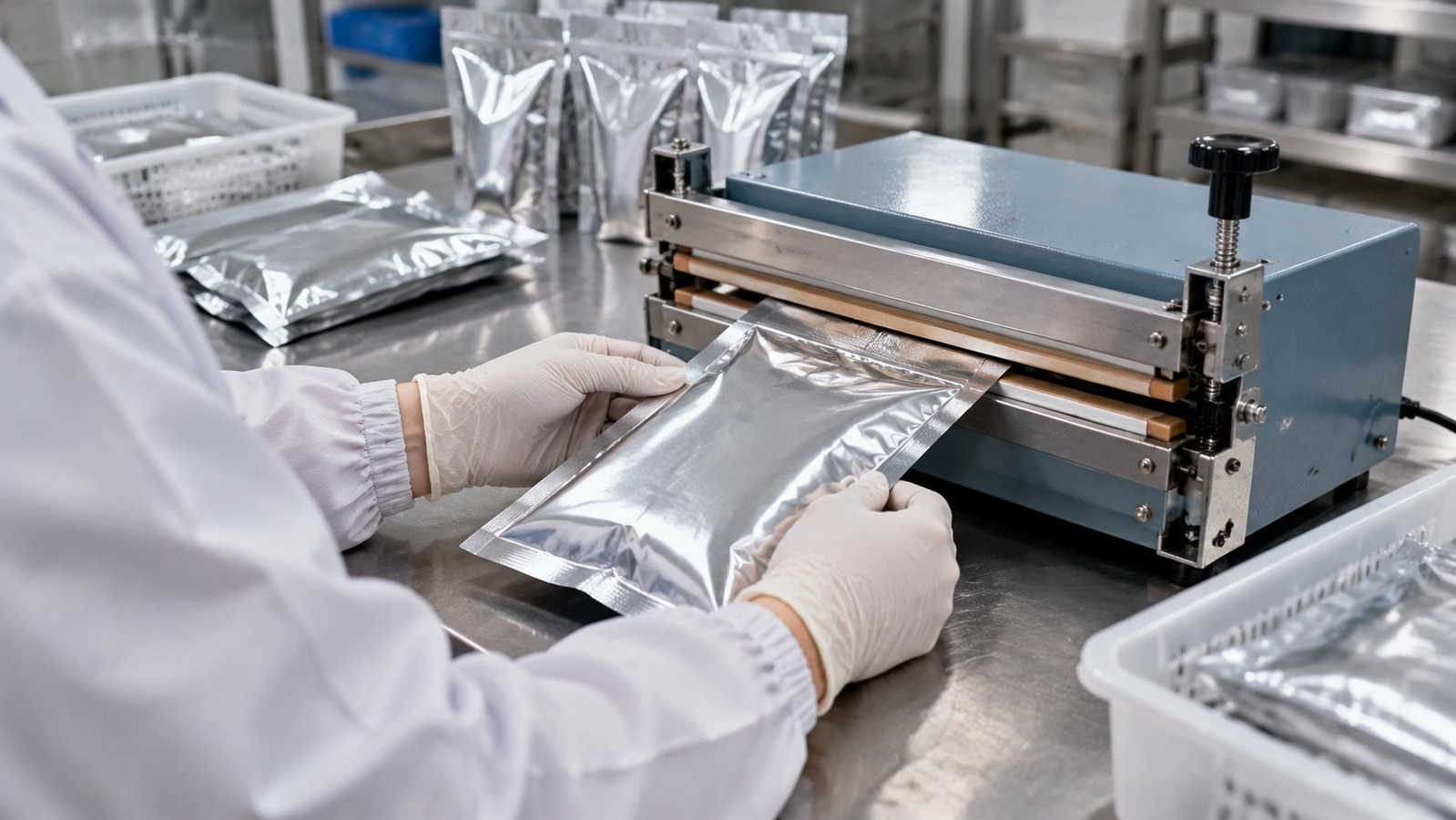
"Mylar bag" is commonly used to describe several types of high-barrier flexible pouches. The name alone does not identify the complete material structure.
A typical laminated pouch may combine:
- An outer polyester layer for strength and printing.
- Aluminum foil or a metallized layer for barrier performance.
- An inner heat-sealable layer, often polyethylene.
During sealing, the equipment transfers heat through the laminate so the opposing inner sealant surfaces bond under pressure. The goal is not to melt the entire pouch.
This distinction matters when choosing settings. Two bags with similar appearances or thicknesses may require different sealing conditions.
Request the laminate structure, recommended sealing range, food-contact suitability where applicable, and barrier specifications from your pouch supplier. Thickness alone cannot establish shelf life or sealing performance.
The best heat sealer for Mylar bags depends on material compatibility, pouch dimensions, product characteristics, and production requirements.
| Equipment | Suitable applications | What to verify |
|---|---|---|
| Impulse sealer | Trials and smaller production batches | Heating capacity, seal width, and cooling cycle |
| Constant-heat jaw sealer | Compatible laminates requiring controlled heated jaws | Temperature stability, pressure, and dwell time |
| Continuous band sealer | Repeated sealing of filled pouches | Belt speed, temperature, cooling, and bag support |
| Chamber vacuum sealer | Compatible vacuum-packaging applications | Chamber capacity, pouch compatibility, and sealing controls |
| Integrated filling and sealing system | Higher-volume production | Product dosing, contamination control, and process monitoring |
An impulse sealer applies heat during a timed cycle. It can be practical for smaller batches when its heating element and controls suit the laminate.
Do not assume every entry-level unit can seal every foil pouch. Test the actual material, including thicker gusset intersections where relevant.
A continuous band sealer moves the pouch opening through heating and cooling sections. It can support a more consistent workflow than repeated manual jaw operation.
However, conveyor support and operator presentation still matter. A heavy pouch pulling downward can distort an otherwise acceptable seal.
Some compatible pouches can be sealed with an iron or hair straightener, but these tools provide limited control over pressure, temperature uniformity, and cooling.
Treat them as a small-scale workaround, not a dependable commercial process. Never substitute an unspecified "high" setting for material-specific guidance.
Start with the product, not the machine.
Check whether the pouch needs protection against oxygen, moisture, light, puncture, or a combination of these risks. Confirm that the material is appropriate for its intended contents and conditions.
For food, packaging does not replace safe processing, refrigeration, or a validated preservation method.
Inspect the sealing jaws, belts, release coverings, and cooling surfaces as applicable. Remove residue and replace worn components according to the equipment instructions.
Prepare labels, filled-pouch supports, and any approved oxygen absorbers before production begins.
A clean workstation helps prevent inconsistent seals and unnecessary delays between filling and closing.
Leave enough unfilled material for the opening to lie flat across the sealing mechanism.
There is no universal headspace requirement. The necessary clearance depends on pouch design, fill volume, product movement, and equipment geometry.
For powders, use a suitable filling funnel or dust-control arrangement. For oily products, prevent splashes from reaching the inner sealing surfaces.
Oxygen absorbers can help protect suitable dry foods against oxidative deterioration. They are not appropriate for every product and do not remove moisture.
Follow product-specific safety guidance and the absorber supplier's instructions. Prepare the pouches first, then minimize absorber exposure to room air.
Do not assume that adding a larger packet can compensate for unsuitable food, poor barrier material, or a leaking seal.
Bring the inner sealant surfaces together without wrinkles, trapped product, or folded-over material.
Position zipper pouches so the heat seal sits in the intended sealing zone, usually above the zipper. Follow the pouch supplier's design instructions.
At gussets, check alignment carefully because the machine may need to accommodate changes in layer count.
Use the supplier's recommendations as a starting point, then confirm performance with actual pouches and equipment.
The essential variables are:
- Temperature or heating energy.
- Dwell time, or exposure time in the heated zone.
- Applied pressure.
- Cooling conditions.
On many impulse sealers, a numbered dial controls heating duration rather than a measured jaw temperature. Do not transfer settings between different machines.
A newly formed seal may be vulnerable while hot. Keep it supported and avoid pulling, bending, or loading it before it has stabilized.
For impulse equipment, follow the specified hold-and-cool cycle. For continuous machines, verify that the cooling section and pouch support work correctly.
Check the full seal width for wrinkles, contamination, gaps, burns, and inconsistent bonding.
Label the package with relevant product and batch information. For commercial runs, record the pouch lot, machine identification, settings, operator, and inspection results.
Traceable records make recurring problems easier to investigate.
There is no single correct sealing temperature for every Mylar pouch.
The workable range depends on the inner sealant, laminate construction, machine design, exposure time, pressure, and operating speed. A temperature copied from another application may underseal one pouch and damage another.
The objective is a repeatable operating window, not simply the hottest setting that produces a bond.
Use this sequence when developing a process:
1. Obtain the supplier's recommended starting conditions.
2. Prepare clean samples from the intended pouch batch.
3. Hold pressure and other conditions steady.
4. Adjust one variable at a time.
5. Let each seal cool before evaluation.
6. Compare seal appearance, strength, and leakage results.
7. Repeat with filled pouches at the intended production pace.
Record acceptable and unacceptable combinations. Choose conditions with a practical margin from weak bonding and heat damage.
This is especially important for continuous sealing. Increasing conveyor speed reduces heating exposure, so a successful slow-speed setting may not remain suitable at higher output.
A firm hand pull is a useful preliminary screen, but it cannot prove that a package is leak-free.
Seal strength describes resistance to separation. Seal integrity concerns defects that allow a leakage path. A strong-looking seal can still contain a narrow channel caused by powder or a wrinkle.
| Check or test | Main purpose | Important limitation |
|---|---|---|
| Visual inspection | Identify visible contamination, wrinkles, and heat damage | Cannot detect every leak |
| ASTM F88/F88M | Measure seal separation force | Not a leak test |
| ASTM F3039 | Detect leakage paths using dye penetration in nonporous materials | Destructive; method suitability matters |
| ASTM F2096 | Detect gross leaks using internal pressurization and bubbles | Not proof of detection of every microleak |
For commercial packaging, establish acceptance criteria based on product risk and distribution conditions. Do not assume one standard provides a universal pass limit for every pouch.
Destructive test samples must not return to saleable production.
When a seal fails, increasing heat immediately can make the problem worse. First identify whether the cause is material, contamination, alignment, equipment, or settings.
| Problem | Possible causes | First checks |
|---|---|---|
| Seal separates easily | Insufficient energy, short exposure, incompatible material | Confirm laminate and compare settings |
| Burned or distorted opening | Excessive heat or dwell time | Reduce energy and inspect contact surfaces |
| Narrow leak channel | Powder, oil, wrinkles, or uneven pressure | Clean and realign the sealing area |
| Failure near a gusset | Layer-count variation or poor presentation | Inspect folding and jaw contact |
| Seal opens during handling | Inadequate cooling or excessive load | Support the pouch and verify cooling |
| Intermittent failures | Worn components or unstable operating conditions | Inspect equipment and production records |
Imagine a powdered ingredient pouch passes visual inspection but occasionally leaks after transport.
Before increasing temperature, inspect how the powder enters the bag. Dust may settle across the sealing zone, creating a channel even when most of the seal bonds strongly.
A sensible investigation would compare filling methods, seal-area cleanliness, pouch alignment, and leak-test results.
This is an illustrative troubleshooting sequence, not a reported HLun Pack customer case.
Heat sealing closes the pouch. Vacuum packaging removes some air. Oxygen absorbers consume oxygen remaining inside a suitable closed package.
These functions are related, but they are not interchangeable.
Utah State University Extension recommends low-moisture foods, approximately 10% moisture or less, for its long-term dry-storage guidance involving oxygen absorbers. It also warns that reduced-oxygen storage of moist foods can create a botulism hazard.
That recommendation is not a complete commercial safety specification. Product formulation, water activity, processing, storage conditions, and applicable requirements still need assessment.
A pouch that remains slightly puffy has not necessarily failed. Oxygen absorption does not remove every gas, and appearance alone cannot verify residual oxygen or seal integrity.
Likewise, do not assign a shelf-life claim solely because a package uses foil or an absorber. Validate the complete product-and-package system.
Reliable Mylar bag sealing comes from matching the packaging material, product, equipment, and inspection method.
Share your pouch structure, dimensions, product characteristics, target output, and current sealing challenges with HLun Pack. Our packaging-machinery and integrated-solutions team can use those requirements to discuss suitable equipment and a practical material-trial plan before you commit to a production configuration.
Compatibility depends on the machine and pouch. Many external-suction vacuum sealers rely on textured bags to evacuate air, while smooth barrier pouches may not work as intended. Confirm vacuum and sealing compatibility separately with the equipment supplier.
A zipper provides convenient reclosure, but it should not automatically replace the initial heat seal. Where a dependable barrier closure is required, use the pouch's designated heat-sealing area and verify performance.
A second seal can provide additional protection when the pouch design allows it. However, it cannot correct contamination, incompatible materials, or poor settings. Establish one reliable seal before evaluating a second.
Often, yes, if sufficient clean, undamaged material remains and the pouch is suitable for resealing. Cut away damaged areas and confirm the new seal. Opening also changes the internal atmosphere and may affect remaining shelf life.
There is no universally best thickness. Evaluate barrier performance, puncture resistance, laminate quality, sealability, and storage conditions together. A thicker pouch does not automatically provide a better seal or justify a longer shelf-life claim.
1. OXO Packaging. "How to Seal Mylar Bags Properly: A Complete Step By Step Guide." Original article reviewed for topic coverage, procedural gaps, and restructuring opportunities. [oxopackaging]
2. Utah State University Extension. "Packaging Foods." Guidance on food-storage packaging, foil-laminate barriers, oxygen absorbers, and the limitations of vacuum packaging as a preservation method. [extension.usu]
3. Utah State University Extension. "How Can I Get the Most Out of My Food Storage." Guidance on dry-food moisture content, oxygen management, and botulism risks associated with reduced-oxygen storage of moist products. [extension.usu]
4. ASTM International. "Paper Standards and Packaging Standards." Listings and scopes for flexible-packaging seal strength, laboratory heat-seal preparation, hot tack, and gross-leak testing. [store.astm]
5. U.S. Food and Drug Administration. "Recognized Consensus Standards: ASTM F88/F88M-23." Scope describing seal-strength measurement and the force required to separate a test specimen containing a seal; used here for the test definition, not to imply food-packaging approval. [accessdata.fda]
6. ASTM International. "F3039: Standard Test Method for Detecting Leaks in Nonporous Packaging or Flexible Barrier Materials by Dye Penetration." Scope, qualitative interpretation, and destructive-test limitations. [astm]
7. IMPAK Corporation. "How to Choose a Heat Sealer." Equipment-selection context and the operating principles of heat-sealing machinery. [impakcorporation]
8. IMPAK Corporation. "Custom Heat Sealers." Technical context for controlling sealing time, temperature, pressure, and cooling. [impakcorporation]
9. Sorbent Systems. "Flexible Packaging, Desiccants, Heat Sealers." Background on barrier packaging, sealing-equipment configurations, and vacuum packaging. [sorbentsystems]
10. Sorbent Systems. "How to Use StayFresh Oxygen Absorbers." Practical preparation and handling guidance for oxygen-absorber packaging workflows. [sorbentsystems]


