


close
Choose Your Site
Global
Social Media
Views: 244 Author: Hlunpack Publish Time: 2026-07-20 Origin: Hlunpack


Content Menu
● Engineering Design Considerations
>> 1. Is aluminum foil necessary for every retort pouch?
>> 2. Can one laminate structure be used for every sauce?
>> 3. Is thicker packaging always better?
>> 4. Why do similar products sometimes use different laminate structures?
Retort Packaging Engineering Series · Chapter 2
In Chapter 1, we discussed why a product reformulation should trigger a new packaging evaluation.
A change in formulation does not automatically require a new package, but it often changes the environment in which the package is expected to perform throughout its commercial life cycle.
Once that evaluation has been completed, the next engineering decision becomes equally important.
How should the appropriate retort pouch laminate structure be selected?
This question is frequently raised during sauce packaging development, particularly for products processed under 121°C commercial retort sterilization.
Many customers begin by asking a simple question:
“Which laminate structure is the best?”
From an engineering perspective, the answer is different.
There is no universal retort pouch structure.
There is only the structure that best matches a specific product.
Across multiple retort packaging projects, one observation appears consistently.
Products manufactured using the same retort process often use different laminate structures.
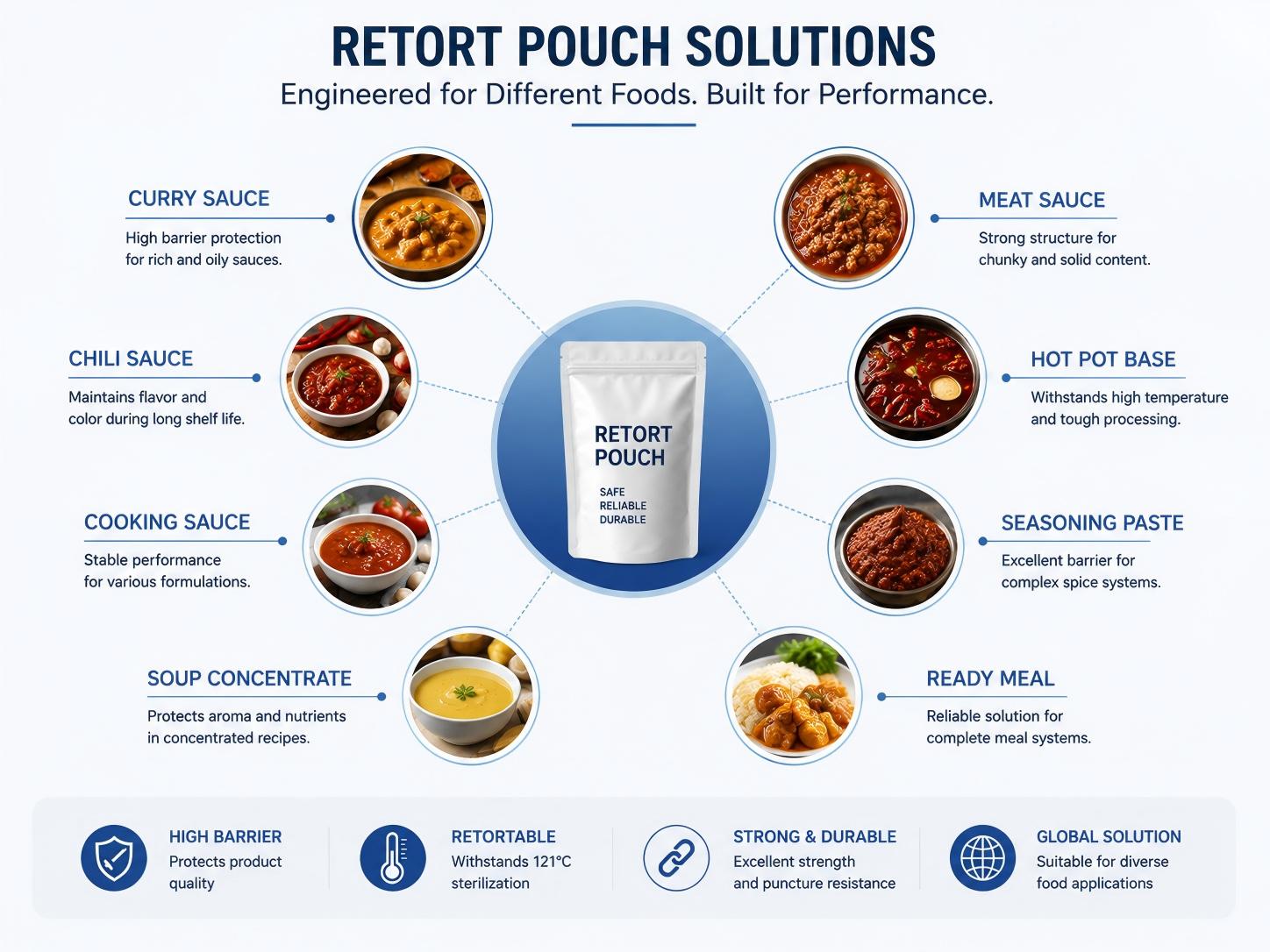
For example, curry sauces, chili sauces and cooking sauces may all be sterilized at 121°C, yet their packaging structures differ according to formulation, shelf-life objectives and distribution conditions.
The sterilization process defines how the package will be processed.
The product determines how the package should be engineered.
This distinction is fundamental to flexible packaging development.
Material selection begins with product evaluation rather than film selection.
Before a laminate structure is determined, packaging engineers typically review four engineering areas.
Product Characteristics
The formulation itself defines the functional requirements of the package.
Engineering review normally includes:
* Oil and fat content
* Spice and seasoning system
* Product acidity (pH)
* Water activity
* Presence of particulates
The manufacturing process determines the thermal and mechanical conditions experienced by the package.
Typical review items include:
* Filling temperature
* Vacuum level
* Retort temperature and holding time
* Cooling process
Packaging should perform throughout transportation, storage and retail display.
Engineering review therefore considers:
* Target shelf life
* Export destination
* Tropical transportation
* Warehouse conditions
* Retail environment
A packaging structure should perform reliably not only after production but also during production.
Evaluation therefore includes:
* Packaging machinery compatibility
* Heat-sealing window
* Production efficiency
* Converting performance
Only after these engineering reviews have been completed does laminate selection begin.
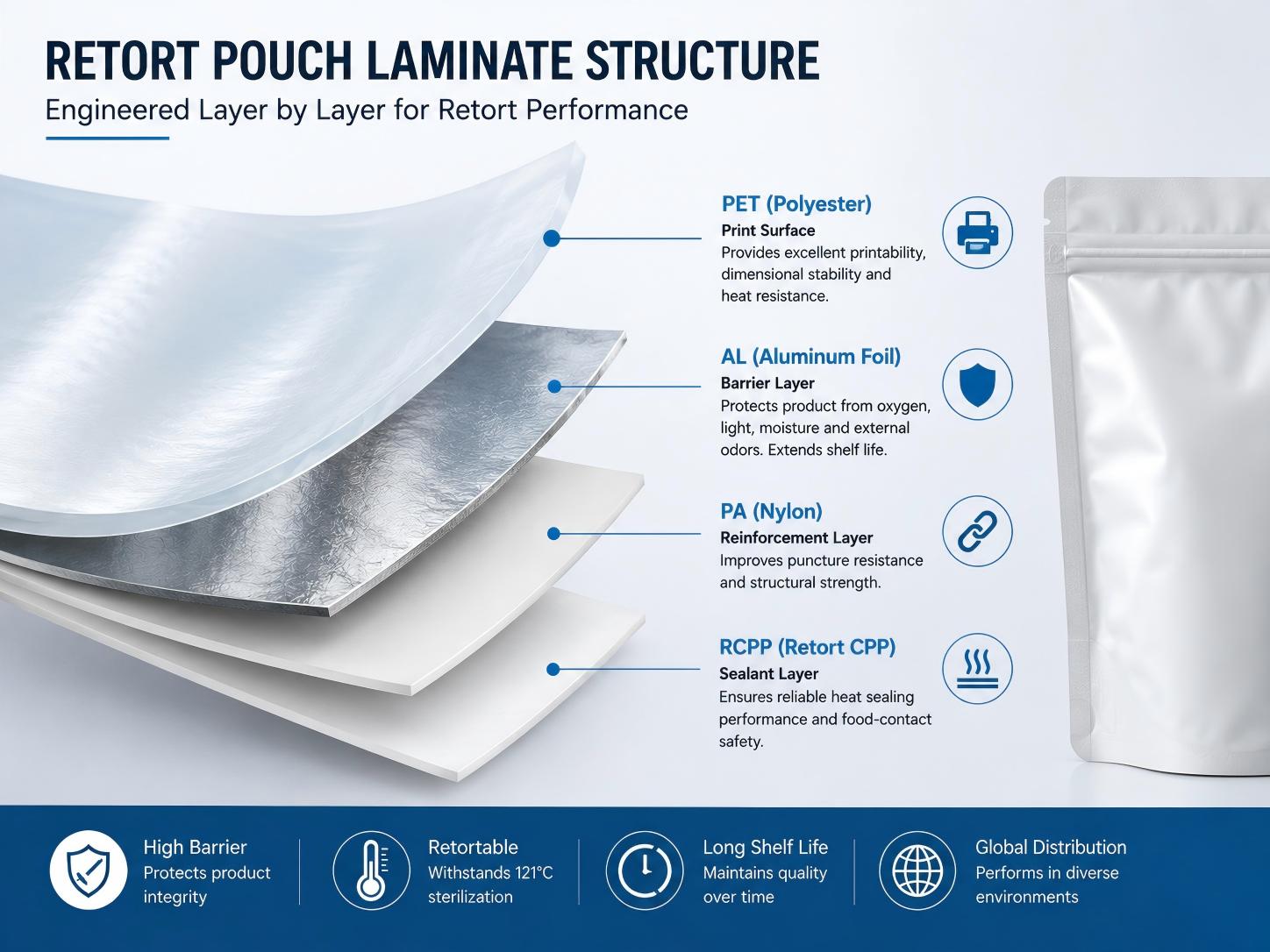
Rather than asking what material should be used, engineers first determine what each functional layer is expected to accomplish.
The outer PET layer provides dimensional stability, print quality and heat resistance throughout converting and retort processing.
Its role extends beyond graphics—it forms the structural foundation of the laminate.
Barrier performance is determined by the product rather than the material itself.
Products requiring extended shelf life, aroma retention and protection against oxygen or light frequently utilize aluminum foil.
Where product visibility is important, transparent high-barrier laminates may provide a suitable alternative.
The objective is always to achieve the required protection without introducing unnecessary complexity.
Polyamide (PA) improves puncture resistance and structural stability.
It helps maintain package integrity during retort sterilization, cooling, transportation and handling, particularly for products containing spices or solid ingredients.
The sealant layer performs two critical engineering functions.
It provides reliable heat sealing during production while remaining compatible with the product throughout storage.
For retort packaging, long-term seal retention is often more important than initial seal strength.
The films alone do not determine package performance.
Adhesive selection, lamination quality and curing conditions all contribute to long-term laminate stability.
A properly engineered lamination system allows every functional layer to perform as intended throughout the product life cycle.
The following laminate structures represent commonly used engineering references.
Product Typical Structure
Curry Sauce: PET / AL / PA / RCPP
Chili Sauce: PET / AL / PA / RCPP
Cooking Sauce: PET / AL / PA / RCPP
Meat Sauce: PET / AL / PA / RCPP
Soup Concentrate: PET / AL / PA / RCPP
Transparent Sauce: PET / PA / RCPP
These examples are engineering references rather than fixed specifications.
Final laminate selection should always be based on product characteristics, retort process, shelf-life objectives and distribution requirements.
Selecting the laminate structure represents only one stage of packaging development.
The proposed structure should then be validated using the actual product.
Typical engineering validation includes:
* Heat-seal evaluation
* Commercial retort validation
* Laminate adhesion testing
* Peel strength evaluation
* Vacuum leak testing
* Burst resistance testing
* Storage performance observation
Validation confirms whether the selected structure remains compatible with the product throughout its intended commercial shelf life.
Flexible packaging engineering is not about selecting the highest-performance material.
It is about selecting the most appropriate combination of materials for a specific product.
There is no standard retort pouch structure suitable for every food application.
Successful package design begins with understanding the product rather than the laminate.
This chapter focuses on:
* Retort pouch structure
* Flexible packaging engineering
* Commercial retort sterilization
* Laminate design
* Barrier performance
* Packaging compatibility
* Shelf-life engineering
* Sauce packaging
The engineering principles described in this chapter apply to:
* Curry Sauce
* Chili Sauce
* Cooking Sauce
* Meat Sauce
* BBQ Sauce
* Hot Pot Base
* Soup Concentrate
* Seasoning Paste
* Ready Meal Products
No.
Aluminum foil is selected when high barrier performance is required. Transparent high-barrier structures may also be suitable depending on formulation and shelf-life requirements.
Not necessarily.
Laminate structures should always be engineered according to formulation, processing conditions and distribution requirements.
No.
Engineering aims to achieve the required performance through balanced laminate design rather than simply increasing material thickness.
Because packaging requirements are determined by formulation, shelf-life targets, processing conditions and distribution environments—not by product name alone.
Once the laminate structure has been selected, another engineering question follows.
Even when identical materials are used, package performance can still vary depending on adhesive selection, lamination quality and curing conditions.
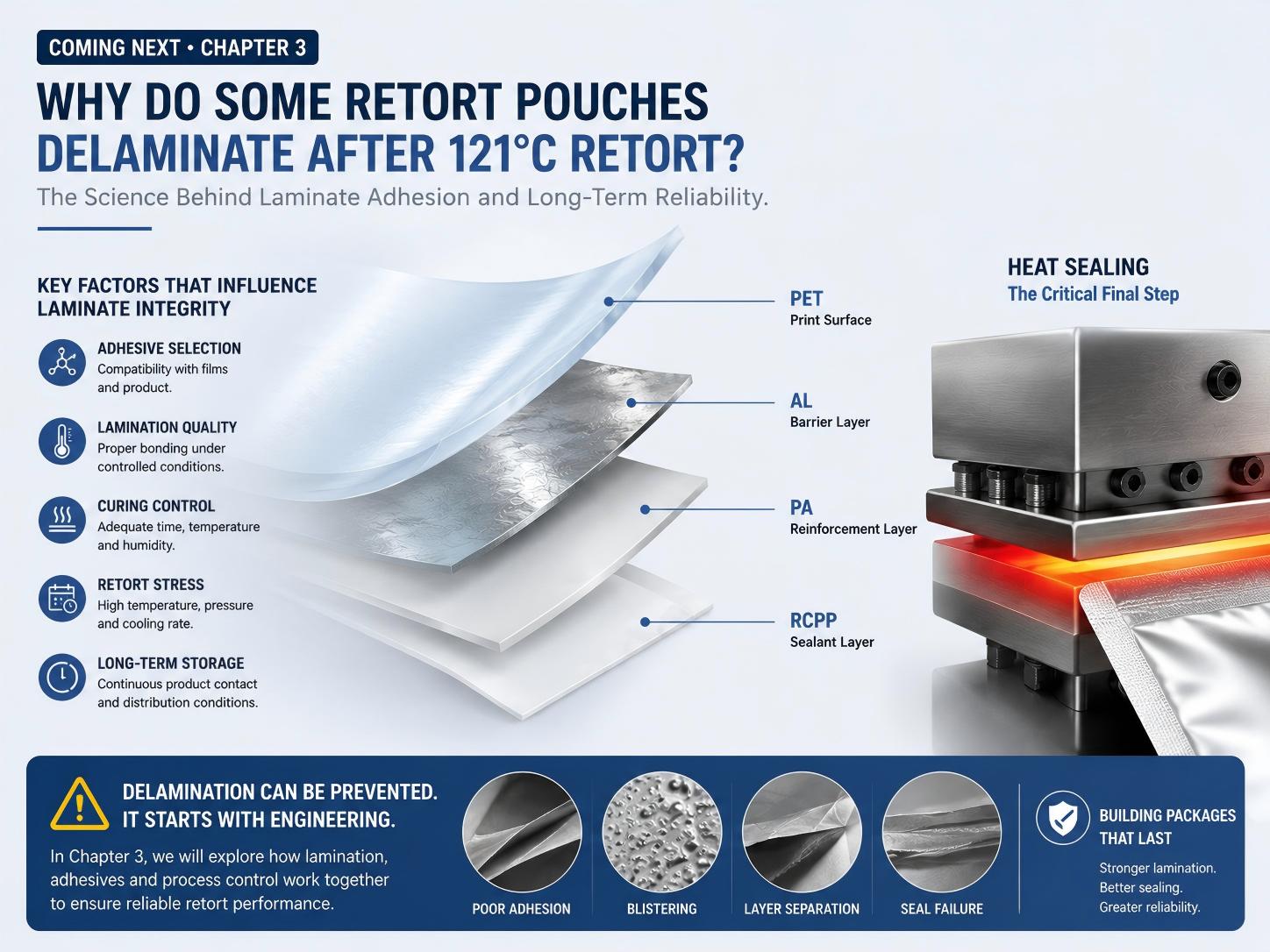
In Chapter 3, we will discuss:
Why Do Some Retort Pouches Delaminate After Commercial Retort Sterilization?
The next chapter will examine laminate adhesion, adhesive systems, curing control and engineering validation for long-term retort package reliability.
HLunPACK specializes in flexible packaging, paper packaging and packaging machinery for food, pharmaceutical and consumer product industries.
By combining material engineering, laminate design and manufacturing expertise, we help customers develop packaging systems that balance product protection, production efficiency and long-term commercial performance.


