


close
Choose Your Site
Global
Social Media
Views: 266 Author: HLun PACK Publish Time: 2026-08-31 Origin: Site


Content Menu
● What Is a Retort Packaging Pouch?
● How Retort Pouch Packaging Works
>> 1. Product Preparation and Filling
>> 2. Air Removal and Hermetic Sealing
>> 4. Controlled Cooling and Inspection
● Retort Pouch Material Structure Explained
>> Why Aluminum Foil Is Still Common
>> Clear Retort Pouches and High-Barrier Films
● Retort Pouches vs. Cans and Glass Jars
● Which Products Are Suitable for Retort Packaging?
>> Products That Need Extra Evaluation
● How to Choose a Retort Pouch
● Benefits and Limits of Retort Pouches
>> 1. What is the difference between a retort pouch and a regular food pouch?
>> 2. How long can food last in a retort pouch?
>> 3. Can retort pouches replace metal cans?
>> 4. Are retort pouches safe for food?
>> 5. Can retort pouches be recycled?
>> 6. What foods are best suited to retort pouch packaging?
>> 7. What equipment is needed for retort pouch packaging?
Retort packaging pouches are high-barrier flexible packages engineered to withstand commercial thermal sterilization after filling and sealing. They enable brands to pack shelf-stable soups, sauces, ready meals, pet food, seafood, curries, and similar products without relying on refrigeration before opening.
For food manufacturers, a retort pouch is not simply "a heat-resistant bag." It is a complete packaging system in which product formula, pouch structure, sealing performance, retort recipe, equipment controls, and validation must work together. At HLun Pack, we view retort packaging as an integrated solution: selecting the right flexible packaging material is only the starting point; the filling, sealing, sterilization, inspection, and secondary-packaging stages must also be aligned.
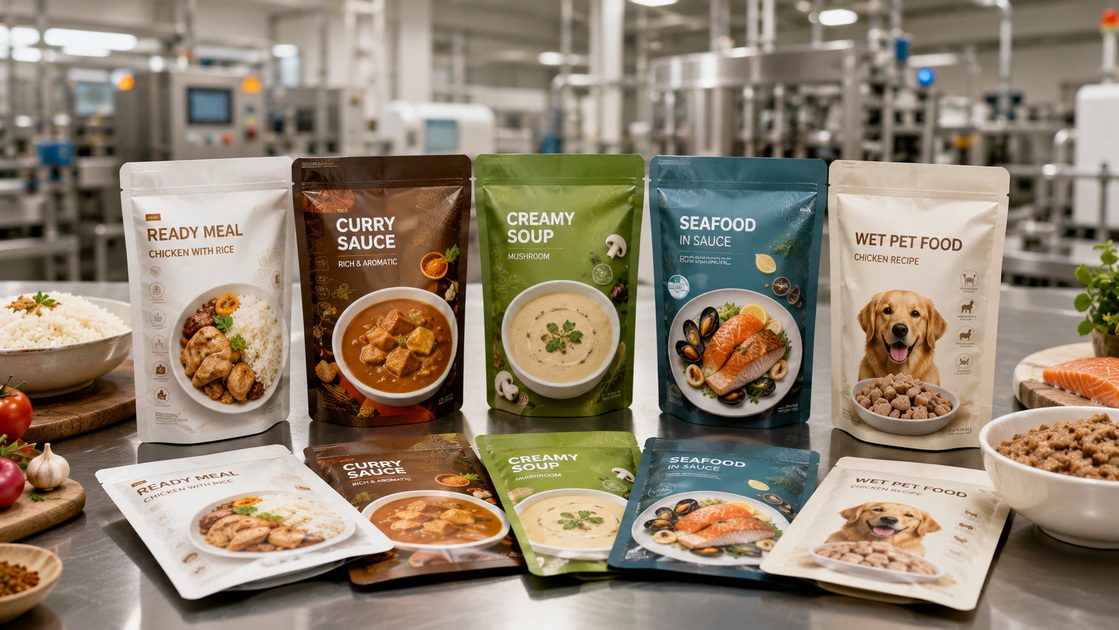
A retort packaging pouch is a laminated, food-contact package designed to tolerate elevated temperature and pressure in a retort vessel, also called an autoclave. Food is filled into the pouch, hermetically sealed, and then thermally processed to achieve commercial sterility.
The term retort pouch packaging refers to both the pouch itself and the post-sealing thermal process used to make shelf-stable food safer and longer-lasting.
Unlike ordinary stand-up pouches, retort pouches must maintain their:
- Seal integrity during heating, pressure changes, and cooling
- Barrier protection against oxygen, moisture, and light
- Mechanical strength during handling and transport
- Food-contact safety under the intended processing conditions
- Product appearance, including print durability and pouch shape
Retort processing is especially important for low-acid foods because thermal treatment is designed to control microorganisms of concern, including Clostridium botulinum. For commercially processed shelf-stable low-acid and acidified foods in hermetically sealed containers, U.S. requirements include facility registration and filing scheduled processes appropriate to the product, package size, package type, and processing method.
In practical terms, a retort pouch gives food brands the ability to create products that are portable, lightweight, convenient, and shelf-stable—provided the entire production process is professionally developed and validated.
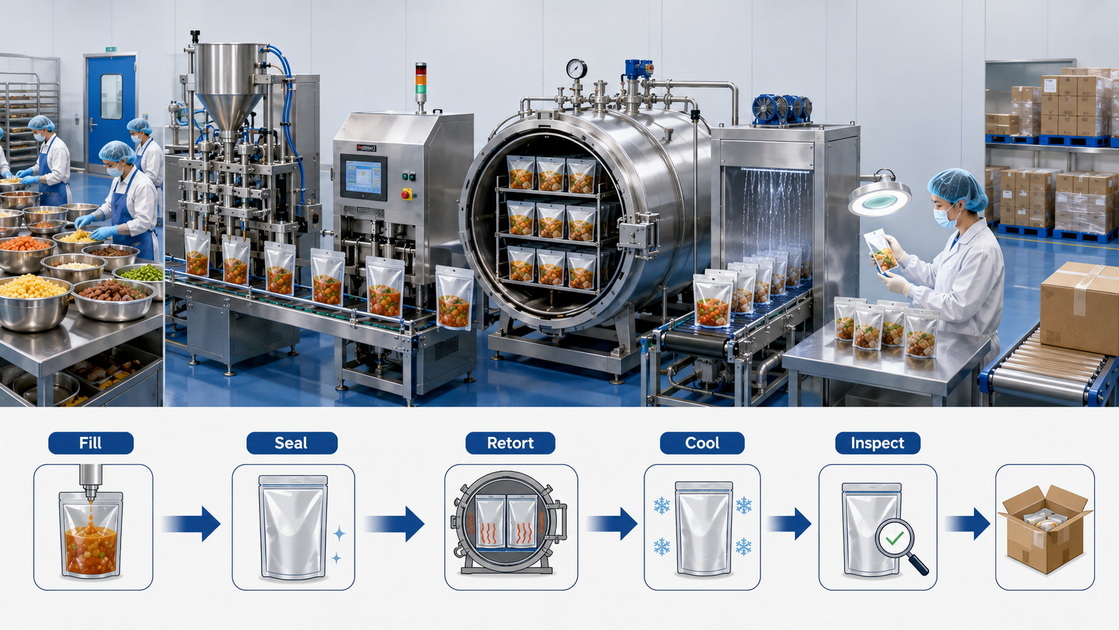
The retort packaging process combines flexible packaging technology with carefully controlled thermal processing. Although individual production lines vary, the fundamental workflow remains similar.
The food product is prepared according to its approved formulation and filled into pre-made retort pouches. Depending on the product, filling may occur hot or at a controlled temperature defined by the process authority and production specification.
Key variables include:
- Product viscosity
- Particle size and distribution
- Product pH and water activity
- Fill weight and headspace
- Initial product temperature
- Oxygen level inside the pouch
- Pouch orientation in the retort basket or tray
A thick curry with meat chunks, for example, heats differently from a smooth liquid sauce. This is why a retort process cannot be safely copied from one product to another simply because both products use the same pouch size.
Before sealing, manufacturers may use vacuum, steam flushing, or controlled headspace methods to minimize retained air. Excess air can affect heat transfer, package appearance, and seal performance.
The pouch is then sealed with controlled combinations of temperature, pressure, and dwell time. A strong seal must survive not only filling and shipping, but also the internal stresses created during the retort cycle.
For flexible packaging converters and machinery suppliers, this is a critical engineering point: the sealant layer must be compatible with the food product, contamination level, sealing equipment, and retort conditions.
Sealed pouches are loaded into a retort system and exposed to a validated heat process. Depending on the product and system, retorts may use saturated steam, steam-air, water spray, water immersion, or other processing media.
Common processing temperatures are often around 121°C to 130°C or higher, but there is no universal setting suitable for every product. The required time-temperature profile must be established through professional process development and validation. Retort processing is designed to achieve commercial sterility, and a historical reference value of \(F_0 = 3\) minutes has long been associated with the minimum "botulinum cook" for low-acid canned foods; the actual required process still depends on the specific food and container system.
After the heating phase, pouches are cooled under controlled conditions. Counterpressure during cooling can help prevent package swelling, delamination, seal disruption, or product leakage.
Post-retort quality checks should typically include:
- Visual inspection for leaks, wrinkles, swelling, and delamination
- Seal-strength and burst testing
- Pouch dimension and appearance checks
- Coding and traceability verification
- Microbiological and process-record review
- Secondary-packaging inspection
Most traditional retort pouches use multilayer laminates because no single film can usually provide every required property at high processing temperatures. The exact structure should be chosen according to the food, shelf-life target, retort conditions, distribution environment, and brand presentation requirements.
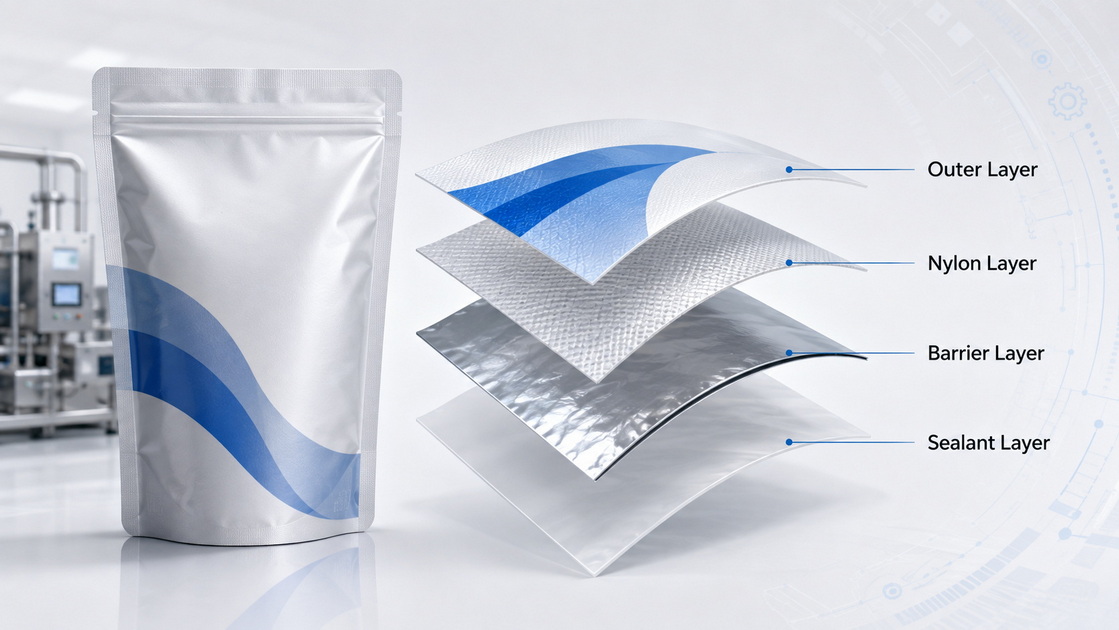
| Typical Layer | Common Material | Main Function |
|---|---|---|
| Outer layer | PET or other heat-resistant printable film | Surface protection, stiffness, printability, scuff resistance |
| Reinforcement layer | Nylon/PA | Puncture resistance, flex-crack resistance, toughness |
| Barrier layer | Aluminum foil or high-barrier alternative | Protection against oxygen, moisture, and light |
| Sealant/food-contact layer | Retort-grade CPP or PP-based film | Hermetic sealing, food contact, heat resistance |
A typical structure may include PET, nylon, aluminum foil, and cast polypropylene. However, material selection should never be treated as a fixed formula. A transparent retort pouch, for example, may need a high-barrier alternative to foil, while a highly acidic sauce may require different compatibility considerations than an oily meat-based product.
Aluminum foil provides excellent barrier performance against light, oxygen, and water vapor. That makes it suitable for products with long ambient shelf-life requirements or ingredients sensitive to oxidation.
However, foil-based pouches are not ideal for every brand. They are opaque, can develop flex-crack issues if poorly specified or handled, and are more challenging to recycle because they combine multiple material types.
For brands that want consumers to see the food inside, clear retort pouch structures may use transparent high-barrier materials instead of foil. These structures can improve shelf appeal, but they require careful assessment of:
- Oxygen barrier requirements
- Light sensitivity of the food
- Distribution temperature
- Shelf-life target
- Retort temperature and duration
- Product oils, acids, spices, and particulates
The correct answer is not "foil is always better" or "clear is always better." The right structure is the one that delivers validated performance for the actual product and supply chain.
Retort pouches are often compared with metal cans and glass jars because all three formats can support shelf-stable food applications. Yet they offer different operational, commercial, and environmental trade-offs.
| Factor | Retort Pouches | Metal Cans | Glass Jars |
|---|---|---|---|
| Package weight | Very low | Moderate to high | High |
| Empty-package storage | Compact and flat | Bulky | Bulky |
| Product visibility | Available with clear structures | No | Yes |
| Heat transfer potential | Often rapid because of thin profile | Generally slower with rigid walls | Generally slower with rigid walls |
| Consumer convenience | Easy-open, lightweight, portable | Durable but rigid | Premium feel but heavy and breakable |
| Recyclability | Often limited for multilayer structures | Widely recyclable in many markets | Widely recyclable in many markets |
| Product protection | Excellent when correctly engineered | Excellent | Excellent but breakage risk exists |
The major commercial advantages of retort pouch packaging include lower freight weight, reduced storage volume, modern pack formats, and strong convenience appeal. A thin pouch profile can also support efficient heat penetration compared with thicker rigid containers, although process performance must always be confirmed through validation.
For e-commerce-ready food brands, outdoor meal suppliers, export-oriented food manufacturers, and pet-food companies, these advantages can materially affect logistics costs and customer experience.
Retort pouches are widely used for foods requiring a long, ambient shelf life. Common applications include:
- Ready-to-eat meals and meal kits
- Soups, broths, and congee
- Sauces, gravies, curry pastes, and condiments
- Rice, grains, beans, and vegetable dishes
- Seafood, tuna, chicken, and meat products
- Baby food and puree products
- Wet pet food and pet treats
- Emergency food, camping meals, and military rations
The right pouch format depends on product behavior and consumer use. Flat pouches are common for tuna, seafood, and compact meal portions. Stand-up retort pouches can improve shelf presentation for sauces and meals. Spouted retort pouches may suit products such as purees, sauces, and some pet-food applications.
Some products require greater caution because they can challenge heat transfer, seal integrity, or material compatibility:
- Very high-viscosity foods
- Foods with large particles or bones
- High-fat or high-oil formulations
- Highly acidic products
- Products with sharp inclusions
- Dairy-heavy formulas
- Products requiring a transparent package and very long shelf life
A pouch may look acceptable after one trial run yet fail after repeated handling, shipping vibration, or long-term storage. That is why package qualification should include testing beyond the retort vessel itself.
A reliable retort pouch specification begins with the product—not with a catalog sample. Before choosing a structure, a food brand should define the following information.
- What is the final equilibrium pH?
- What is the water activity?
- Does the recipe contain oil, acid, salt, spices, or aggressive ingredients?
- What are the largest particulates and sharp edges?
- What shelf life is required?
- Will the product be stored at ambient temperature, chilled, or frozen before sale?
- Is a flat, stand-up, shaped, or spouted pouch needed?
- Is a foil barrier acceptable, or is product visibility essential?
- What are the target fill weight and headspace?
- Does the brand require tear notches, laser scoring, handles, zippers, or spouts?
- What distribution risks exist—export shipping, e-commerce, high heat, or rough handling?
- What retort system will be used?
- What process temperature, pressure, and duration are planned?
- Is the process established by a qualified process authority?
- What seal-window capability does the filling and sealing machine provide?
- How will seal strength, leakage, and post-retort integrity be verified?
For U.S. shelf-stable low-acid and acidified foods, a process authority should evaluate the product and process. The scheduled process is designed to deliver commercial sterility or shelf stability for the specific food-package system.
A successful retort packaging project requires more than high-quality pouch material. It depends on equipment compatibility across the entire production line.
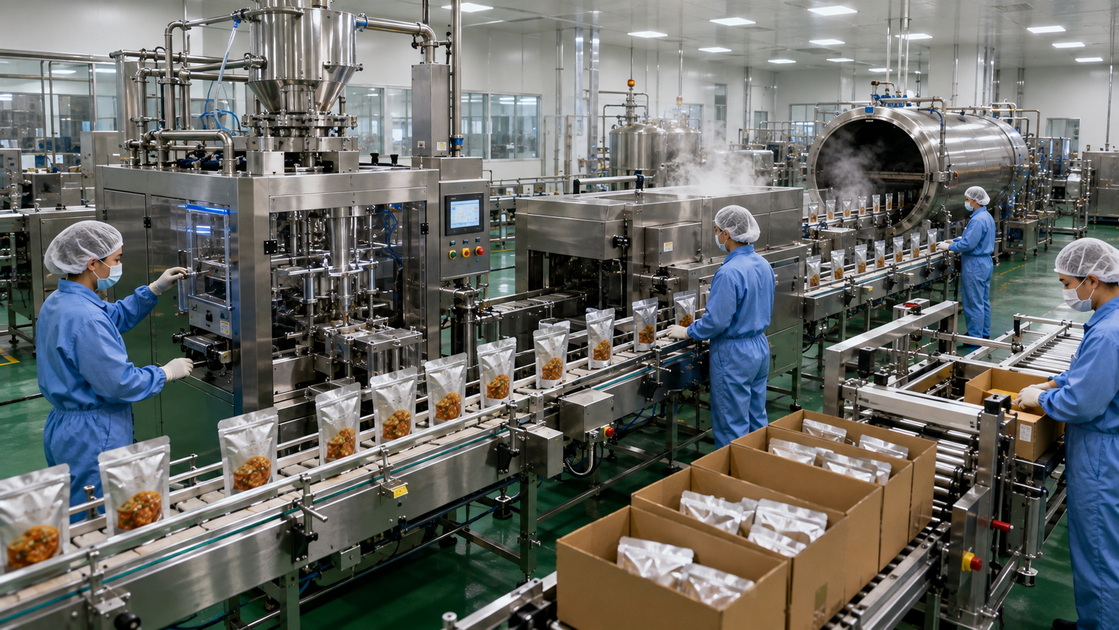
At HLun Pack, we recommend evaluating a complete retort packaging solution that can include:
1. Pouch selection and structure design
2. Product filling equipment
3. Vacuum or steam-flush systems
4. Heat-sealing equipment
5. Retort sterilization equipment
6. Cooling, drying, and inspection equipment
7. Labeling, cartoning, and palletizing systems
The packaging material, pouch dimensions, sealing jaws, fill level, retort basket loading pattern, and retort recipe influence one another. If one part of the system is not optimized, the brand may experience seal failures, pouch deformation, inconsistent processing, excessive rejects, or reduced shelf-life confidence.
For example, a manufacturer may choose a large stand-up pouch to improve retail visibility. But a larger pouch changes the food mass, heat penetration pattern, sealing-area stress, basket loading, and cooling requirements. An integrated packaging and machinery approach helps identify these risks before full-scale production.
Retort pouches can use substantially less material and weigh far less than many rigid formats, which can improve transportation efficiency. Flexible Packaging Association notes that flexible films are commonly engineered as multilayer structures, with inner layers designed for food contact and reliable heat sealing.
However, lightweight does not automatically mean easy to recycle.
Traditional retort pouches often contain multiple bonded materials, such as PET, nylon, foil, adhesives, and polypropylene. These layers provide high performance but can be difficult to separate and recycle in conventional systems. Sustainability claims should therefore be specific and supported by the collection, sorting, and recycling infrastructure available in the target market.
Newer recyclable retort pouch designs are emerging, including mono-material or predominantly polypropylene-based structures. Some commercial innovations aim to retain retort resistance while improving compatibility with established plastic-recycling streams in selected markets.
For brands, the most credible sustainability strategy is to balance:
- Food-waste prevention through strong barrier protection
- Material reduction and logistics efficiency
- Validated package performance
- Real-world recycling pathways
- Clear, accurate consumer disposal instructions
Avoid claiming that a pouch is "100% recyclable" unless that claim is supported by the pouch design, local collection access, and applicable certification or evidence.
HLun Pack supports brands that need more than flexible packaging supply. We help customers connect retort pouch design, packaging equipment, and end-to-end packaging workflow into a practical solution.
Our focus includes:
- Retort pouch material and format recommendations
- Custom flexible packaging for food and pet-food applications
- Packaging machinery selection and line integration
- Filling and sealing performance improvement
- Packaging-line troubleshooting and optimization
- Packaging solutions for export-oriented food brands
- Consultation on operational efficiency, product protection, and consumer convenience
Whether you are launching a shelf-stable sauce, upgrading a wet pet-food line, replacing a rigid package, or developing a ready-meal brand, the goal should be the same: build a package that works reliably from filling through final consumption.
Need a custom retort pouch and packaging machinery solution? Contact HLun Pack to discuss your product, pouch format, production capacity, retort process, and target market. Our team can help you develop a flexible packaging system designed for reliable processing, shelf appeal, and scalable production.
A retort pouch is specifically engineered to withstand high-temperature, high-pressure thermal processing after sealing. A regular food pouch may be suitable for dry food, frozen food, or chilled products but may not survive commercial retort sterilization.
Shelf life depends on the product formula, pouch barrier, thermal process, storage conditions, and validation results. Many retorted foods are designed for ambient shelf life measured in months or years, but brands should establish their own shelf-life specification through proper testing and process validation.
Yes, in many applications. Retort pouches can offer lower package weight, compact storage, modern branding options, and convenient consumer use. However, cans may remain preferable where recycling access, line compatibility, product protection, or market expectations favor rigid metal packaging.
Retort pouches can be safe for food when made from compliant food-contact materials, filled and sealed correctly, and processed under a validated thermal schedule. Safety depends on the complete food-package-process system, not on the pouch alone.
Traditional multilayer retort pouches can be difficult to recycle because they combine several materials. Recyclable retort pouch technologies are developing, but actual recyclability depends on the package structure and the waste-management infrastructure where the product is sold.
Soups, sauces, curries, ready meals, rice dishes, seafood, meat products, baby food, and wet pet food are common applications. Suitability should be evaluated based on product viscosity, acidity, particulate size, fat content, shelf-life target, and retort conditions.
A typical line includes pouch filling equipment, air-removal or vacuum systems, heat sealing equipment, retort sterilization equipment, cooling systems, inspection devices, and secondary-packaging machinery. The exact configuration depends on capacity, food type, pouch format, and automation requirements.
1. U.S. Food and Drug Administration. [Acidified & Low-Acid Canned Foods Guidance Documents & Regulatory Information](https://www.fda.gov/food/guidance-documents-regulatory-information-topic-food-and-dietary-supplements/acidified-low-acid-canned-foods-guidance-documents-regulatory-information). Requirements for U.S. processors of shelf-stable acidified and low-acid foods in hermetically sealed containers. [fda](https://www.fda.gov/food/guidance-documents-regulatory-information-topic-food-and-dietary-supplements/acidified-low-acid-canned-foods-guidance-documents-regulatory-information)
2. A. S. et al. [Understanding Retort Processing: A Review](https://pmc.ncbi.nlm.nih.gov/articles/PMC10916645/). *Comprehensive Reviews in Food Science and Food Safety*, 2023. Review of retort processing, commercial sterility, and thermal-process considerations. [pmc.ncbi.nlm.nih](https://pmc.ncbi.nlm.nih.gov/articles/PMC10916645/)
3. New Mexico State University Cooperative Extension Service. [How to Submit a Commercial Food Product for Process Review](https://pubs.nmsu.edu/_e/E325/). Guidance on process-authority review and scheduled-process development for shelf-stable acidified and low-acid foods. [pubs.nmsu](https://pubs.nmsu.edu/_e/E325/)
4. Flexible Packaging Association. [Sustainability and Flexible Packaging](https://www.flexpack.org/sustainability). Information on flexible packaging structures and resource-efficiency considerations. [flexpack](https://www.flexpack.org/sustainability)
5. Amcor. [World-First Flexible Recyclable Retort Pouch Packaging](https://www.amcor.com/insights/blogs/recyclable-retort-packaging). Industry example of recyclable retort-pouch development and retort performance considerations. [amcor](https://www.amcor.com/insights/blogs/recyclable-retort-packaging)
6. YLTPACK. [What Are Retort Packaging Pouches and How Do They Work](https://yltpacking.com/what-are-retort-packaging-pouches/). Original topic reference reviewed for structural coverage, package-material descriptions, process stages, applications, and common buyer questions. [yltpacking](https://yltpacking.com/what-are-retort-packaging-pouches/)


