


close
Choose Your Site
Global
Social Media
Views: 260 Author: HLun PACK Publish Time: 2026-09-22 Origin: Site


Content Menu
● Display Boxes vs. Other Packaging Types
● Display Boxes vs. Shipping Boxes
● Display Boxes vs. Standard Retail Boxes
>> Choose a standard retail box when:
● Why Display Packaging Can Improve Retail Performance
>> 1. It improves product visibility
>> 2. It creates easier product access
>> 3. It supports faster replenishment
>> 4. It gives brands more selling space
● How to Choose the Right Display Box Structure
● Material Selection for Paper Display Packaging
>> Recyclability requires design discipline
● A Practical Checklist Before Ordering Display Boxes
● Display Packaging Must Be Designed as a System
● When Should You Use Display Boxes?
● Build a Better Retail Display With HLun Pack
>> 1. Are display boxes primary or secondary packaging?
>> 2. What is the difference between a display box and retail-ready packaging?
>> 3. What material is best for a cardboard display box?
>> 4. Can display packaging be recyclable?
>> 5. How many products should a countertop display box hold?
>> 6. Do display boxes need to be tested before production?
>> 7. Can a shipping carton become a display box?
Display boxes are not simply containers—they are retail merchandising tools engineered to protect products, improve shelf visibility, and make purchasing easier. For brands using paper packaging, the right display box can bridge the gap between a warehouse-ready shipping case and a customer-ready point-of-purchase experience.
At HLun Pack, we design paper packaging equipment and integrated packaging solutions with a practical principle in mind: packaging must work across the entire journey—from production line and transport to retail shelf and customer interaction. This guide explains the key differences between display boxes vs. regular packaging, when each packaging type is appropriate, and how to develop a display packaging solution that balances structural strength, brand presentation, retail efficiency, and recyclability.
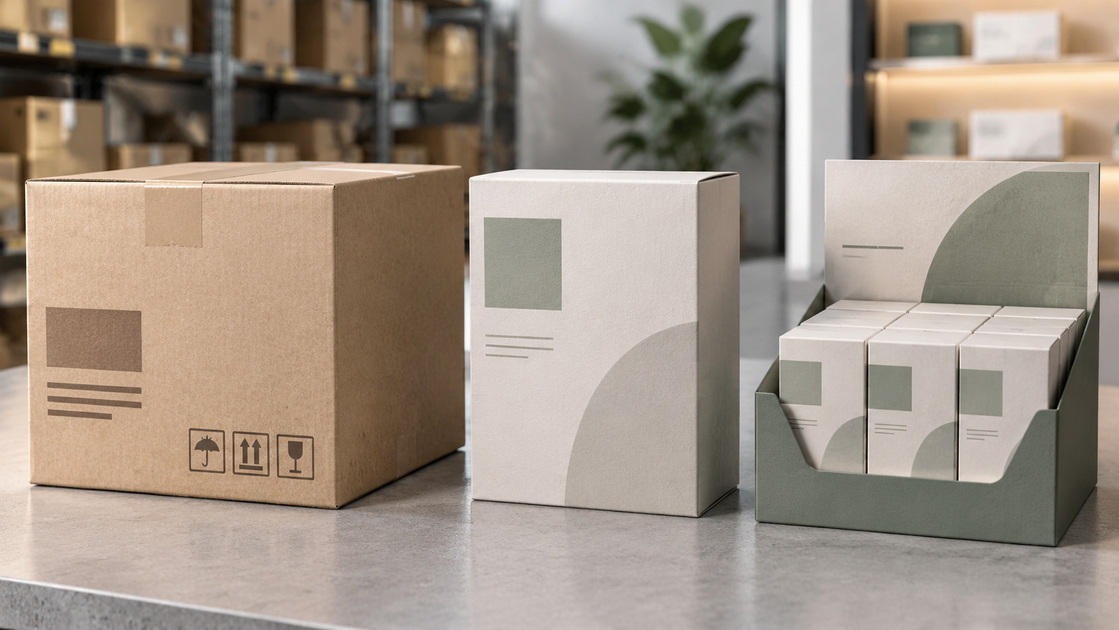
Display boxes are paper-based packaging structures designed to hold, organize, protect, and visibly present products in a retail environment. They may sit on a checkout counter, a shelf, a promotional end cap, a peg wall, or directly on the floor.
Unlike a conventional carton that is mainly designed to enclose a product, a display box is designed to help sell it. It typically combines the functions of:
- A product holder
- A retail presentation unit
- A branding surface
- A stock-replenishment solution
- A point-of-purchase marketing asset
In many retail programs, display packaging is also called retail-ready packaging (RRP) or shelf-ready packaging (SRP) when it can move from a delivered case directly to the shelf with minimal unpacking. Industry guidance commonly frames successful retail-ready packaging around being easy to identify, open, stock, shop, and dispose of or recycle.
For example, a brand selling small cosmetics, snack packs, batteries, stationery, accessories, or health products may ship multiple individually packaged units inside a corrugated countertop display. A store employee opens the perforated outer panel, places the unit on the counter, and the display is immediately ready for shoppers.
That is the fundamental difference: regular packaging contains a product; display packaging presents a product for purchase.
The phrase "other packaging" can refer to several very different packaging formats. The best choice depends on where the package will be used, how the product is handled, and whether visibility or protection is the primary objective.
| Packaging Type | Primary Function | Typical Structure | Best Location | Customer Interaction | Branding Opportunity |
|---|---|---|---|---|---|
| Display box | Promote, organize, and sell products | Open-front tray, header card, die-cut display, floor unit | Checkout, shelf, end cap, aisle, promotional zone | High | Very high |
| Shipping box | Protect and consolidate products in transit | Corrugated regular slotted carton or mailer | Warehouse, freight, distribution | None | Low to moderate |
| Retail box | Enclose and protect an individual product | Folding carton, rigid box, sleeve, tuck-end box | Retail shelf, e-commerce delivery | Moderate | High |
| Product tray | Hold products together | Paperboard or corrugated tray | Shelf or inside a master carton | Moderate | Moderate |
| Gift box | Create a premium unboxing experience | Rigid box, magnetic box, drawer box | Premium retail, gifting, direct-to-consumer | High | High |
| Flexible packaging | Protect lightweight goods with low material use | Pouch, bag, film wrap | Grocery, convenience, e-commerce | Moderate | Moderate |
A display box can also work alongside these packaging types rather than replacing them. A common system includes:
1. Primary packaging that touches or directly contains the product, such as a bottle, pouch, or wrapped item.
2. Individual retail packaging that protects and identifies one saleable unit.
3. Display packaging that groups saleable units for shelf presentation.
4. Transport packaging that protects multiple display units during distribution.
This layered approach is especially useful for brands that need a consistent presentation across retail, wholesale, and e-commerce channels.
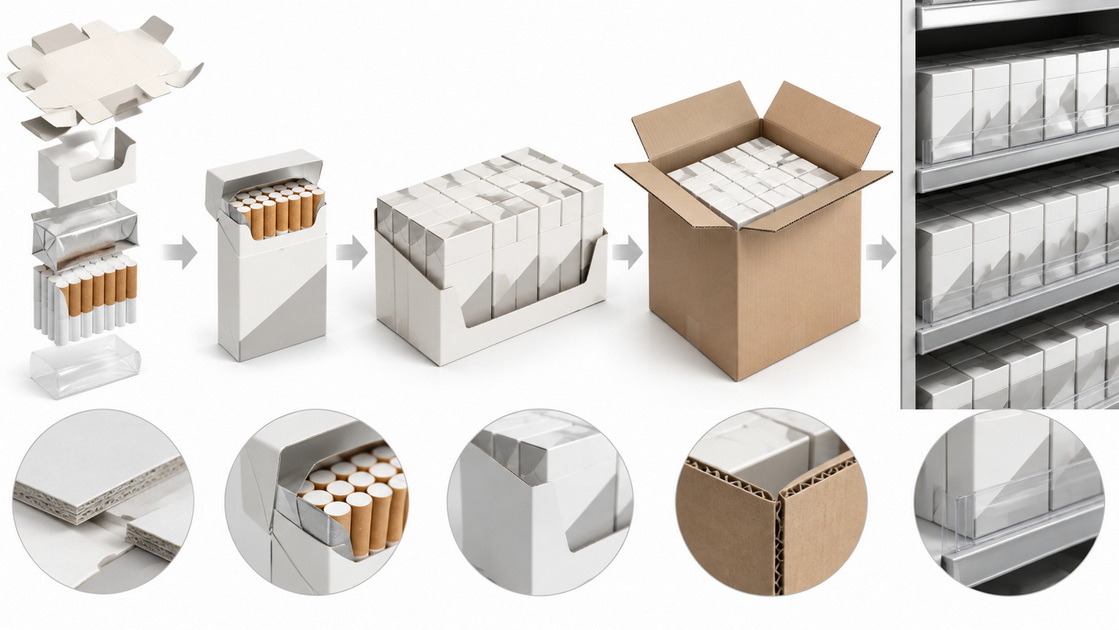
A shipping box is built primarily for logistics. Its role is to protect products from compression, vibration, puncture, dust, and handling damage while moving through warehouses, trucks, distribution centers, and delivery networks.
A display box, by contrast, is made for the retail floor. It must still be structurally reliable, but it is also expected to create an attractive, easy-to-shop presentation.
| Factor | Display Boxes | Shipping Boxes |
|---|---|---|
| Core objective | Visibility and conversion | Protection and transport efficiency |
| Appearance | Branded, printed, consumer-facing | Usually plain or minimally printed |
| Product access | Open front, tear-away panel, window, tray, or tiered layout | Fully enclosed |
| Retail placement | Countertops, shelves, end caps, promotional areas | Warehouse and back-of-store |
| Material choice | Paperboard, corrugated board, kraft board, mixed paper structures | Mainly corrugated fiberboard |
| Design priority | Product visibility, message hierarchy, shopper access | Stack strength, cube efficiency, load stability |
| End-of-life | Often remains visible until all items sell | Usually removed before products reach shoppers |
Shipping boxes are indispensable for transport, but they rarely do enough to support retail conversion. If a retailer must unpack every individual item and manually arrange it on the shelf, labor time rises and shelf presentation can become inconsistent.
A well-designed shelf-ready display box reduces this friction. It can arrive as a protective case, open cleanly, and become a retail unit without requiring staff to touch and arrange every product individually. Retail-ready packaging guidance emphasizes easy identification, opening, replenishment, shopper access, and post-use disposal or recycling as core operational considerations.
A standard retail box is usually designed around a single product. It can carry branding, product information, instructions, warning labels, barcode details, and visual graphics. However, it often remains closed until the shopper decides to purchase it.
A display box is more focused on the group presentation of multiple items. It creates a small branded destination on the shelf or counter.
- Your product needs complete enclosure.
- The product is fragile, premium, sensitive, or tamper-sensitive.
- Regulatory text, instructions, ingredients, or technical specifications need a large print area.
- The product is sold as one high-value unit.
- The unboxing experience is a major part of brand value.
- You sell multiple small, fast-moving products.
- Your product benefits from "grab-and-go" access.
- You need to launch a seasonal promotion or limited-time offer.
- You want to increase visibility at checkout or on an end cap.
- Retail staff need a faster way to replenish products.
- You are introducing a new product and need stronger shelf communication.
For many brands, the best solution is not an either-or decision. A small skincare item, for instance, may sit inside an individual folding carton while twelve cartons are arranged in a corrugated countertop display box. The individual carton communicates product details; the display unit tells the broader product story and attracts attention from a distance.
Display packaging creates value only when it makes shopping easier and presentation stronger. Attractive graphics alone are not enough.
A shopper cannot buy what they do not notice. Display boxes can raise products above surrounding shelf clutter with header cards, angled product rows, tiered structures, die-cut silhouettes, or high-contrast color blocks.
The most effective displays create a fast visual hierarchy:
- Brand name first
- Product category second
- Key benefit third
- Variant or flavor fourth
- Call to action last
For example, a countertop display for energy bars should not make shoppers read a paragraph. It should let them understand, within seconds, what the product is, who it is for, and why they should pick it up.
Customers should be able to remove one unit without collapsing the arrangement or disturbing neighboring products. The front opening must be large enough for the product size, but not so wide that products fall forward during transport or shelf handling.
This is where packaging engineering matters. A display structure needs the right balance among:
- Product retention
- Easy removal
- Front-panel visibility
- Unit stability
- Shipping protection
- Retail shelf fit
Retailers evaluate packaging through an operational lens. If a case takes too long to identify, open, arrange, or dispose of, it can create unnecessary labor costs.
Retail-ready packaging is often evaluated through a "five easies" framework: easy to identify, easy to open, easy to stock or replenish, easy to shop, and easy to dispose of.
For packaging teams, this means a display design should include practical details such as:
- Clear opening instructions
- Controlled perforation lines
- Easy-grip tear strips or opening tabs
- Product-facing orientation marks
- Barcode and case identification
- Minimal loose components
- Simple collapse and recycling instructions
A conventional product box has limited visible area on a crowded shelf. A display unit can add a header card, side panels, front lip, back panel, and internal tiering—all of which provide more opportunities for branding and product education.
Use this space selectively. Too much information can weaken the display's visual impact. The strongest messages are usually short, specific, and benefit-led.
Instead of:
"Our high-quality product is designed with excellent features for today's modern customers."
Use:
"Plant-Based Protein. 12g Per Bar."
The second message is quicker to scan, more credible, and easier to understand at the point of purchase.
The best display box depends on product dimensions, unit weight, sales channel, shelf position, printing needs, and distribution conditions. Before selecting a style, define the business problem the structure needs to solve.
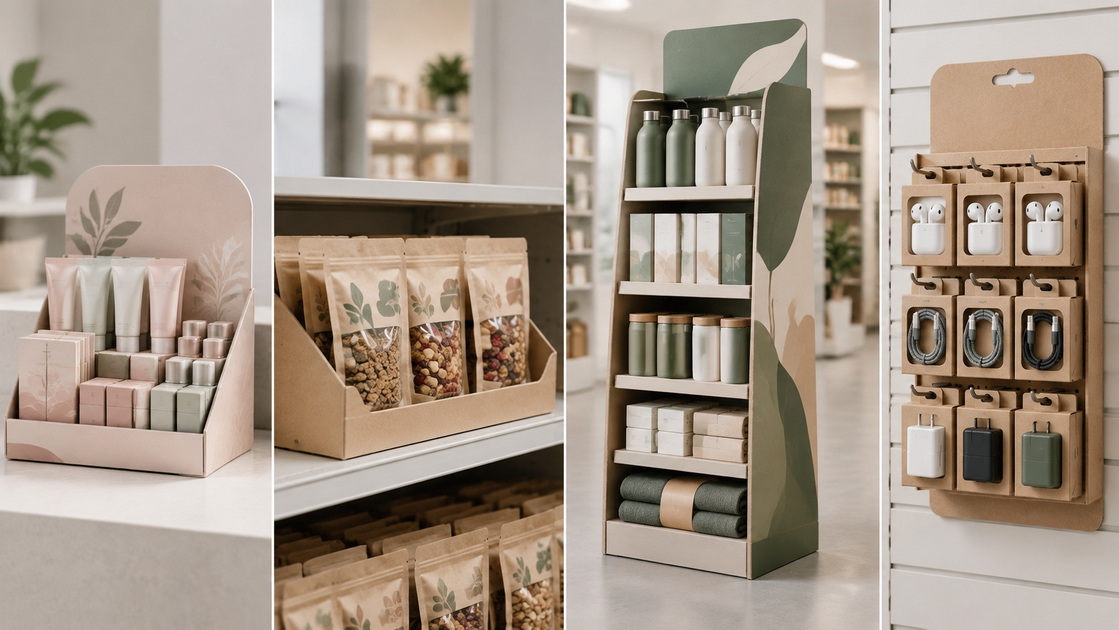
Countertop displays are compact units placed near checkout areas, reception desks, café counters, and convenience-store payment zones.
They work best for:
- Lip balms
- Candles
- Small snacks
- Supplements
- Cosmetics
- Phone accessories
- Stationery
- Trial-size products
A countertop display should be compact, stable, and easy to refill. A strong header card can make a small footprint more noticeable.
Floor display units, also called FSDUs, are freestanding paperboard or corrugated structures used in aisles, stores, and promotional zones.
They work best for:
- Seasonal collections
- Multipacks
- Beverages
- Household goods
- Toys
- Health and beauty products
- Larger packaged goods
Floor displays require more structural analysis because they must support product weight and maintain stability while shoppers remove units from different levels.
Shelf-ready trays hold products in rows and are designed to be placed directly on a retail shelf. They are often shipped inside an outer corrugated case or formed as a perforated case that converts into a display tray.
They work best for:
- Food and beverage multipacks
- Canned goods
- Small cartons
- Personal-care products
- Pharmacy products
- Consumer packaged goods
Peg displays include a hanging tab or structure that allows products to hang from retail hooks. They are suitable for lightweight products sold in narrow retail spaces.
They work best for:
- Small tools
- Accessories
- Craft supplies
- Batteries
- Small electronics
- Beauty accessories
Material selection affects more than appearance. It influences print quality, stacking performance, product protection, machine compatibility, assembly speed, shipping cost, and recyclability.
Solid bleached sulfate, commonly called SBS, provides a smooth and bright printable surface. It is appropriate for lightweight products and premium retail graphics.
Best for:
- Cosmetics
- Health and beauty products
- Confectionery
- Small consumer goods
- Branded countertop displays
Corrugated board includes fluted paper between linerboards. It is often the strongest paper-based option for display packaging, especially when products are heavier or when the display must travel through a distribution chain.
Best for:
- Shelf-ready cases
- Floor display units
- Heavier products
- E-commerce-compatible displays
- High-volume retail programs
Kraft paperboard provides a natural, tactile appearance that can support a minimalist or eco-conscious brand position. However, the final design still needs to meet the product's actual performance and print requirements.
Best for:
- Natural products
- Artisan brands
- Organic or eco-positioned goods
- Lightweight retail displays
Paper-based packaging can support recycling systems, but it should not be automatically described as recyclable without considering coatings, adhesives, films, metallic finishes, contamination, and local collection infrastructure.
The American Forest & Paper Association notes that non-fiber components, including certain barriers and adhesives, can affect the recyclability of paper-based packaging. Sustainable design should therefore consider the entire structure—not only the paper substrate.
A stronger approach is to ask:
- Can the display use fewer material types?
- Can plastic windows, laminations, or unnecessary overwrap be reduced?
- Are inks, coatings, labels, and adhesives compatible with the intended recovery stream?
- Can consumers and retail staff clearly identify how to separate or recycle components?
- Does the structure use only as much material as necessary to protect and present the product?
Consumer research on paper-based packaging has also highlighted expectations around the "3Rs"—reduce, reuse, and recycle—alongside product protection and attractive design.
A high-performing display should be validated before full production. Do not approve a design based on a digital rendering alone.
Use this checklist during development:
1. Confirm the retail channel. Is the display for supermarkets, pharmacies, specialty stores, convenience stores, warehouse clubs, or direct retail distribution?
2. Measure the real shelf or counter space. Obtain width, depth, height, shelf-lip, and clearance requirements from the retailer.
3. Define the product count. Determine how many units each display must hold and whether products will be removed evenly or from a single front row.
4. Assess product weight. Calculate the total loaded weight and test the display as products are progressively removed.
5. Choose the opening method. Use perforations, tear strips, or panels that retail staff can open quickly and safely.
6. Test product access. Confirm that shoppers can remove one unit without damaging the display or knocking over adjacent products.
7. Check visual hierarchy. Review the display from shopper distance, not only close-up. The brand and product category should be understood immediately.
8. Validate distribution performance. Test compression, vibration, drop risk, pallet configuration, and transport conditions where relevant.
9. Plan end-of-life handling. Reduce avoidable mixed materials and communicate recycling or disposal instructions clearly.
10. Run a physical prototype. A prototype reveals practical issues that artwork files cannot: weak corners, difficult openings, poor product retention, or unstable loading.
From a packaging-engineering standpoint, one of the most common mistakes is treating the display box as a print project rather than a supply-chain system.
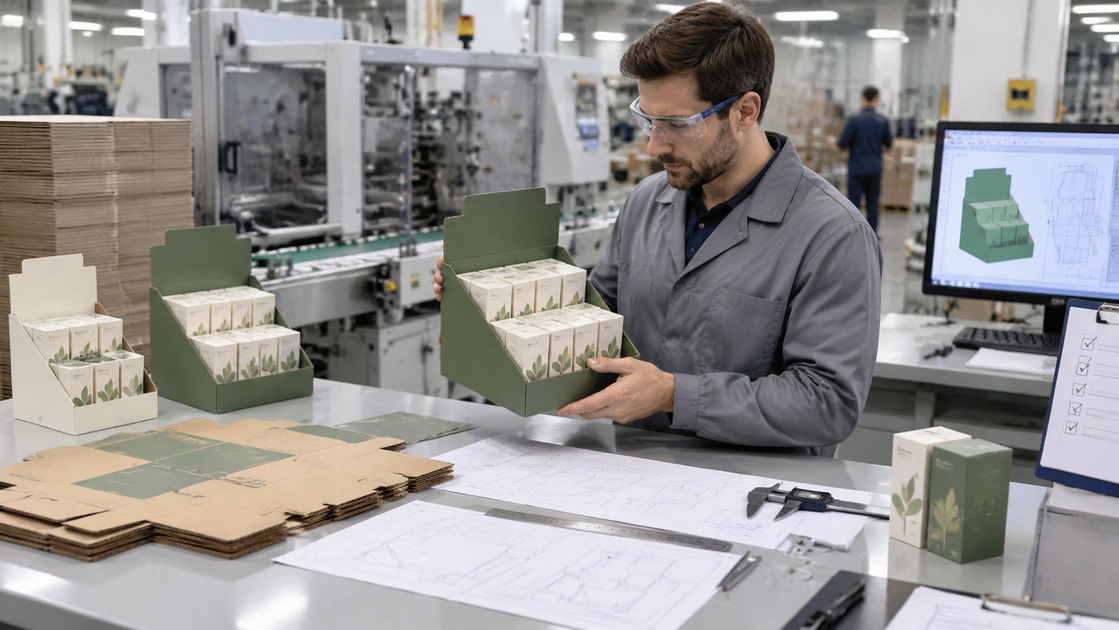
A visually impressive display can fail if it:
- Does not fit the retailer's shelf dimensions
- Requires excessive assembly time
- Cannot survive transport
- Uses a weak perforation that opens too early
- Makes products difficult to remove
- Becomes unstable as inventory decreases
- Creates unclear recycling outcomes
- Cannot run efficiently on the intended packaging equipment
At HLun Pack, we recommend starting with the product, retail environment, and operational constraints before finalizing the artwork. Packaging equipment, material selection, structural engineering, and production workflow should support one another.
Choose display boxes when visibility, promotion, and fast retail access are essential. They are particularly valuable for products that benefit from impulse purchasing, product sampling, promotional bundles, seasonal campaigns, or checkout placement.
Use a shipping box instead when the priority is transport protection and load efficiency. Use an individual retail box when the product requires full enclosure, detailed communication, premium presentation, or tamper resistance.
For many brands, the strongest approach is a combined packaging architecture:
- Individual retail carton for product protection and compliance information
- Display tray or counter unit for product visibility and grab-and-go access
- Corrugated master carton for transport protection and efficient distribution
The best display packaging does not only look good—it works reliably from packing line to retail shelf. HLun Pack can help you evaluate paperboard and corrugated display structures, packaging-machine compatibility, retail-ready formats, and integrated packaging workflows for your product.
Whether you need a countertop display, shelf-ready case, floor display unit, or fully customized paper packaging solution, our team can help you develop a structure that supports branding, retail execution, product protection, and scalable production.
Contact HLun Pack today to discuss your product dimensions, retail channel, display quantity, material requirements, and packaging-equipment needs.
Display boxes are commonly considered secondary packaging because they usually hold multiple individually packaged products. However, the classification can vary when the display structure directly contains the product or also functions as its saleable retail package.
A display box focuses on presenting products to shoppers. Retail-ready packaging is a broader term for packaging designed to move efficiently from distribution to shelf placement. A display box may qualify as retail-ready packaging when it is easy to identify, open, stock, shop, and recycle or dispose of.
The best material depends on the product and retail setting. SBS paperboard is suitable for lightweight premium displays with high-quality printing. Corrugated fiberboard is generally better for heavier products, shelf-ready cases, and floor displays that need stronger structural performance.
It can be, especially when it uses a simplified paper-based design. However, recyclability depends on the complete construction, including coatings, films, adhesives, inks, decorative elements, contamination, and local recycling acceptance. Non-fiber components can affect whether a paper-based package is recyclable in practice.
There is no universal number. The right capacity depends on product size, unit weight, expected sales velocity, counter space, restocking frequency, and the retailer's requirements. A practical display holds enough units to remain visually full while avoiding excess weight, crowding, or slow inventory turnover.
Yes. A physical prototype and distribution review are essential. Test the display for product retention, compression resistance, opening performance, shelf fit, shopper access, stability as units are removed, and compatibility with your packaging line or packaging equipment.
Yes. Many shelf-ready packaging solutions use a perforated corrugated case that protects goods during transport and converts into a retail tray or display once opened. The tear pattern, product orientation, print placement, and structural strength must be engineered carefully to avoid premature opening or poor shelf presentation.
1. OXO Packaging. "[How Do Display Boxes Differ from Other Types of Packaging?]" Accessed September 19, 2026. Original competitor article reviewed for topic coverage, core terminology, and information-gap analysis. [oxopackaging]
2. Jamestown Container. "[The Complete Guide to Retail Ready Packaging]." Accessed September 19, 2026. Referenced for retail-ready packaging principles, including easy identification, opening, replenishment, shopping, and removal or recycling. [jamestowncontainer]
3. Packwins. "[Ultimate Guide to Walmart SRP Shelf Ready Packaging]." March 28, 2025. Referenced for the "five easies" framework commonly used to evaluate shelf-ready packaging. [packwins]
4. American Forest & Paper Association. "[Design Guidance for Recyclability for Paper-Based Packaging]." 2021. Referenced for the effect of non-fiber components, including some barriers and adhesives, on paper-packaging recyclability. [afandpa]
5. Fotiou, V., et al. "[Sustainable Paper-Based Packaging: A Consumer's Perspective]." *Sustainability*, 2021. Referenced for consumer expectations related to reduced packaging, recycling, product protection, and visual appeal. [pmc.ncbi.nlm.nih]
6. Forest Stewardship Council. "[What Are Sustainable Packaging Solutions for Businesses?]." June 28, 2022. Referenced for lifecycle-oriented sustainable-packaging considerations, including responsible sourcing, simplified design, reuse, recycling, and end-of-life planning. [fsc]


