


close
Choose Your Site
Global
Social Media
Views: 289 Author: HLun PACK Publish Time: 2026-07-25 Origin: Site


Content Menu
● What Makes Cereal Bags and Cereal Boxes Different?
● Cost Factors Manufacturers Should Compare
● Shelf Appeal and Consumer Perception
● Sustainability Considerations
● Which Format Is Better for Manufacturing?
● Practical Decision Guide for Manufacturers
● Modern Packaging Trends That Affect the Choice
● When a Cereal Bag Makes More Sense
● When a Cereal Box Makes More Sense
● The Best Approach for Manufacturers
● FAQ
>> 1. Is a cereal bag cheaper than a cereal box?
>> 2. Which packaging format is better for retail shelves?
>> 3. Which option is better for freshness?
>> 4. Are cereal bags more sustainable?
>> 5. Can manufacturers switch between bag and box packaging?
In cereal packaging, the choice between a cereal bag and a cereal box affects far more than appearance. It influences material usage, shipping efficiency, shelf presence, production speed, and the overall economics of packaging. For manufacturers, the most cost-effective option is not always the cheapest package at first glance, but the one that performs best across the full supply chain.
As consumer expectations shift and packaging formats continue to evolve, manufacturers are paying closer attention to how packaging supports product freshness, logistics, branding, and sustainability. That is why the cereal bag vs box decision deserves a closer, more practical look.

A cereal bag is usually made from a flexible material structure such as plastic film, laminated film, or a paper-based flexible pack. It is lightweight, compact, and widely used in cost-sensitive or high-volume applications.
A cereal box is typically made from paperboard and often contains an inner liner or bag for added protection. It offers a more rigid shape, stronger shelf visibility, and a familiar retail appearance.
Although both formats serve the same basic purpose, they create very different results in packaging cost, logistics, branding, and customer experience.
When manufacturers compare cereal bag vs box packaging, the first consideration is often cost. However, packaging cost should be viewed in layers rather than as a single number.
Cereal bags usually require less packaging material than boxes. This can lower unit cost, especially in large production runs.
Cereal boxes often involve more raw material, especially when combined with printing, folding, gluing, and inner packaging components. That means the total material cost is usually higher.
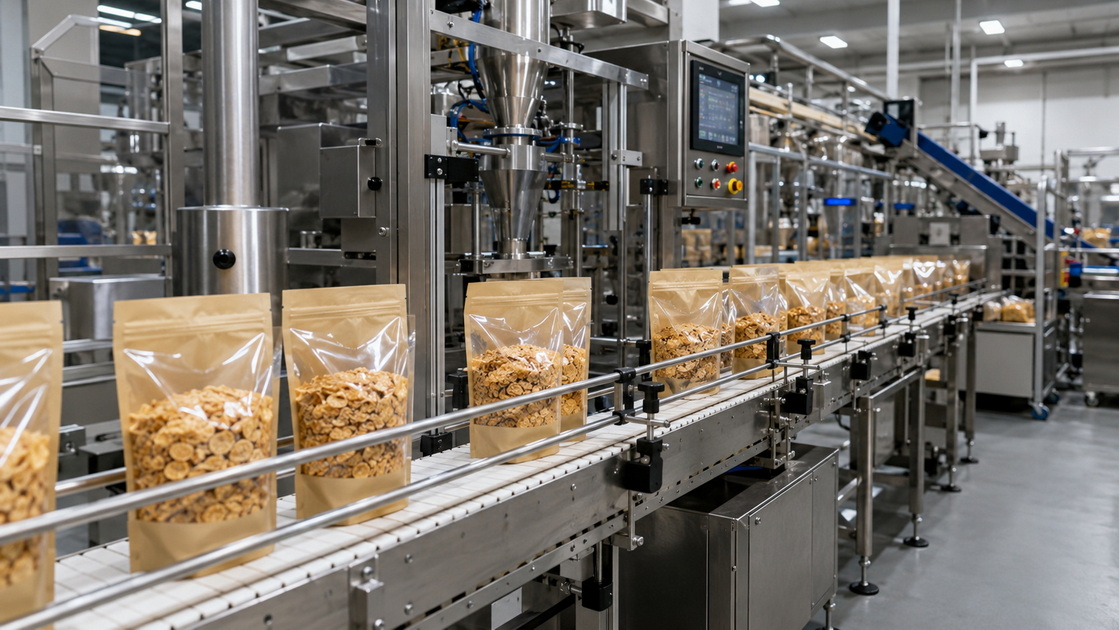
Flexible cereal bags are generally easier to produce at high speed. They often work well with form-fill-seal systems and require fewer steps during packaging.
Cereal boxes involve more complex converting and assembly processes. They may need more handling, more line space, and more production time.
One of the biggest advantages of cereal bags is their compact size. Because they take up less space, they can reduce warehouse storage needs and shipping cost.
Boxes are bulkier and more rigid. Even though they stack well on shelves, they usually consume more space during transportation and storage.
Cereal bags may reduce material usage, but the exact outcome depends on the film structure and recyclability. Cereal boxes are widely recognized and recyclable in many markets, but they often use more total material.
The best choice depends on whether the priority is lower material consumption, easier recycling, or a balance of both.
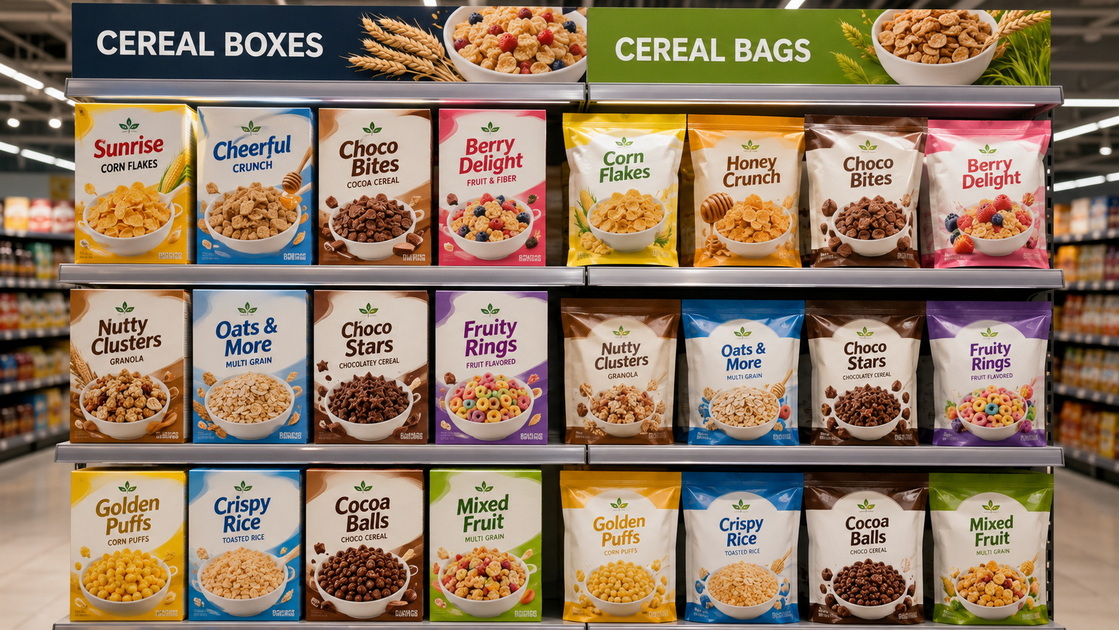
While cereal bags can be more economical, cereal boxes often perform better on shelves. Their rigid form gives brands more visual space for graphics, claims, nutritional information, and storytelling.
A cereal box is also more familiar to many retail shoppers. It communicates stability, quality, and a traditional breakfast product image. For premium brands, this can be a major advantage.
Cereal bags, on the other hand, are often associated with value, convenience, and efficiency. They may not dominate the shelf visually, but they can offer practical benefits that appeal to price-sensitive or logistics-focused buyers.
Cereal packaging must protect the product from moisture, crushing, and contamination. This is especially important for products that need to maintain crunch, flavor, and shelf life.
Cereal boxes provide a strong outer structure, which helps protect contents from compression during transport and retail handling. However, the actual freshness often depends on the inner liner rather than the box itself.
Cereal bags can also provide excellent protection when made from the right material structure. For many dry food applications, flexible packaging delivers an effective barrier against moisture and external damage.
In practice, the right packaging is the one that matches the product's sensitivity and distribution conditions.
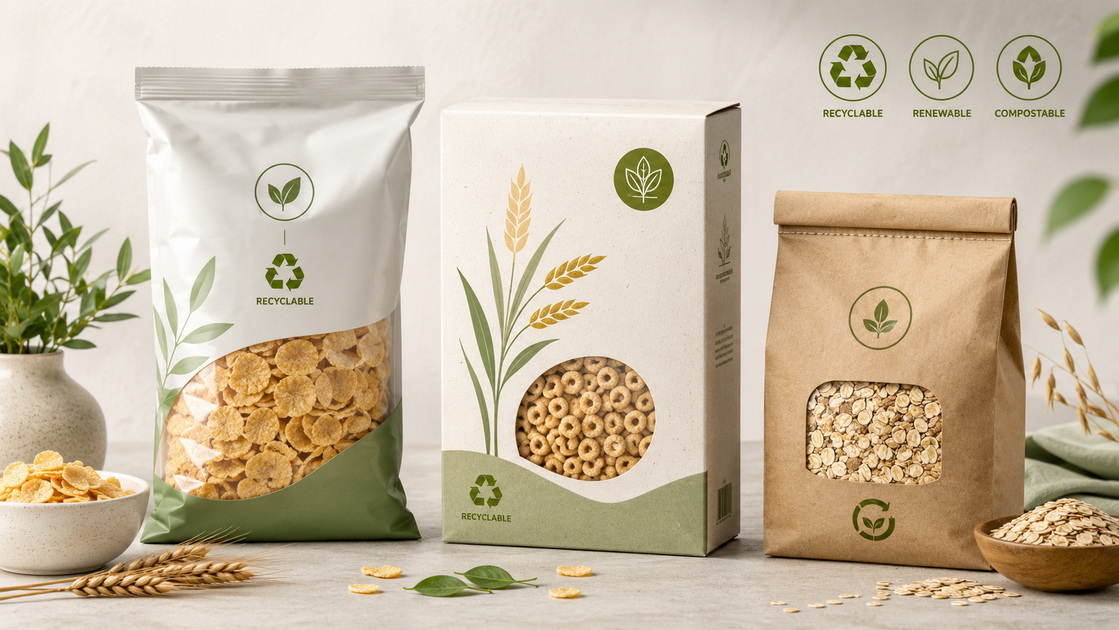
Sustainability has become a central factor in packaging decisions. Manufacturers now need to think about recyclability, material reduction, transportation efficiency, and the environmental impact of the full packaging system.
Cereal bags can support sustainability goals when they use less material and reduce shipping weight. Some modern flexible structures are also being developed with recyclability in mind.
Cereal boxes are often seen as environmentally friendly because they are paper-based and widely accepted in recycling systems. Still, their higher material use and larger transport footprint should also be considered.
The most sustainable option is not always the most familiar one. It is the format that uses the right amount of material while still protecting the product effectively.
From a production standpoint, cereal bags often win on speed, simplicity, and cost efficiency. They are especially useful for manufacturers that produce large volumes, target lower price points, or need to reduce logistics costs.
Cereal boxes are often better for brands that want stronger retail visibility and a more premium image. They can support marketing objectives more effectively, especially in supermarkets and mainstream retail channels.
The choice depends on whether the manufacturer is optimizing for:
- Lower packaging cost.
- Better shelf appeal.
- Faster line speed.
- Lower freight expense.
- Stronger brand presentation.
In many cases, the best strategy is to align the packaging format with the product's market position.
Before choosing between a cereal bag and a cereal box, manufacturers should ask a few practical questions:
1. What is the target retail price?
2. Is the product sold in bulk, retail, or e-commerce channels?
3. How important is shelf appearance?
4. Does the packaging line support bags, boxes, or both?
5. Is sustainability a branding priority or a regulatory requirement?
6. How much protection does the cereal need during shipping?
A product sold in discount retail may benefit more from a cereal bag. A premium cereal brand sold through supermarkets may achieve better results with a box. There is no universal winner, only the best fit for the specific business model.
Packaging decisions today are influenced by more than cost alone. Manufacturers are also responding to demand for lighter packaging, better material efficiency, and improved end-user convenience.
Flexible packaging continues to gain attention because it offers a compact format and can be adapted to different product requirements. At the same time, paperboard packaging remains strong in categories where presentation matters.
Another important trend is the growing interest in packaging formats that support better recovery and recycling outcomes. This is pushing manufacturers to examine not only what packaging looks like, but also how it performs after use.
A cereal bag is often the better choice when the priority is:
- Lower material cost.
- Faster production.
- Reduced freight volume.
- Efficient storage.
- Large-scale, cost-sensitive distribution.
It is especially suitable for private label brands, export-oriented products, and high-volume lines where packaging efficiency has a direct impact on margin.
A cereal box is often the better choice when the priority is:
- Strong shelf visibility.
- Premium brand positioning.
- More space for graphics and product information.
- A traditional retail image.
- Better outer protection during handling.
It is often favored by brands competing in supermarkets, family breakfast categories, and consumer-facing segments where presentation influences purchase decisions.
For many manufacturers, the smartest answer is not to choose one format forever. Instead, the packaging structure should match the product strategy, channel strategy, and cost structure.
Some brands use cereal boxes for retail visibility while using flexible formats for bulk packs, export shipments, or secondary packaging. Others combine a rigid outer package with a flexible inner liner to balance branding and protection.
This flexible thinking allows manufacturers to adapt packaging to different markets rather than forcing one solution into every use case.
The cereal bag vs box decision comes down to balancing cost, branding, protection, and operational efficiency. Cereal bags usually offer a lower-cost and more logistics-friendly solution, while cereal boxes often provide stronger shelf appeal and a more traditional retail presence.
For manufacturers, the right packaging format is the one that best supports product quality, business goals, and market expectations. In many cases, the most effective approach is to evaluate packaging as part of the full production and distribution system, not as a standalone item.
In most cases, yes. A cereal bag usually uses less material and can lower production and freight costs.
A cereal box usually performs better on shelves because it offers more branding space and a stronger visual presence.
Both can protect freshness well if the material structure is designed properly. The inner barrier layer often matters more than the outer shape.
They can be, especially when they reduce material use and shipping weight. However, sustainability depends on the exact structure and recovery system.
Yes. Many manufacturers choose formats based on product type, market segment, and packaging line capabilities.
1. Cereal Bag vs Box: Unveiling Cost-Effective Packaging Solutions for Manufacturers
2. Flexible Packaging Trends for 2026: From Momentum to Maturity
https://www.hbfuller.com/en/blog/thegluetalkblog/2026/march/flexible-packaging-trends-for-2026
3. Corrugated Box Pricing in 2026
https://packpricer.com/blog/corrugated-box-pricing-2026
4. US Producer Price Index: Corrugated and Solid Fiber Box Manufacturing
5. Flexible Packaging Market Size and Trends 2026-35
https://www.towardspackaging.com/insights/flexible-packaging-market
6. USA Flexible Plastic Packaging Market Size & Share 2026-2036
https://www.futuremarketinsights.com/reports/united-states-flexible-plastic-packaging-market
7. Cereal and Confectionary Packaging: Background and Product Protection Considerations
https://pmc.ncbi.nlm.nih.gov/articles/PMC8909407/
8. Granule & Powder Filling Machine
https://www.zonesuntech.com/collections/granule-powder-filling-machine


