


close
Choose Your Site
Global
Social Media
Views: 266 Author: HLun PACK Publish Time: 2026-11-03 Origin: Site


Content Menu
● How Is a Kraft Paper Pouch Constructed?
● Which Kraft Paper Pouch Format Should You Choose?
● What Are the Benefits and Limitations of Kraft Paper Pouches?
● How to Match Barrier Performance to Your Product
>> Build a Product-Specific Specification
● Are Kraft Paper Pouches Recyclable or Compostable?
>> Recyclable Does Not Mean Universally Accepted
>> Compostable Requires Whole-Package Evidence
>> New Materials Still Need Application Trials
● How to Match Kraft Paper Pouches with Packaging Machines
>> Premade-Pouch Filling and Sealing
>> Select the Filling System Around Product Behavior
● A Five-Step Trial Before You Place a Production Order
>> 1. Define Acceptance Criteria
>> 2. Use Representative Materials
>> 3. Establish a Sealing Window
>> 4. Check Strength and Integrity Separately
>> 5. Run at the Intended Operating Conditions
● How to Prevent Common Filling and Sealing Problems
● What Should You Ask a Kraft Pouch Supplier?
● Develop the Pouch and Packaging Process Together
● Frequently Asked Questions About Kraft Paper Pouches
>> Are kraft paper pouches waterproof?
>> Can kraft paper pouches package coffee?
>> Can kraft paper pouches hold liquids?
>> Can I use the same machine settings as plastic pouches?
>> Does a zipper replace the final heat seal?
>> What information does HLun Pack need to assess a project?
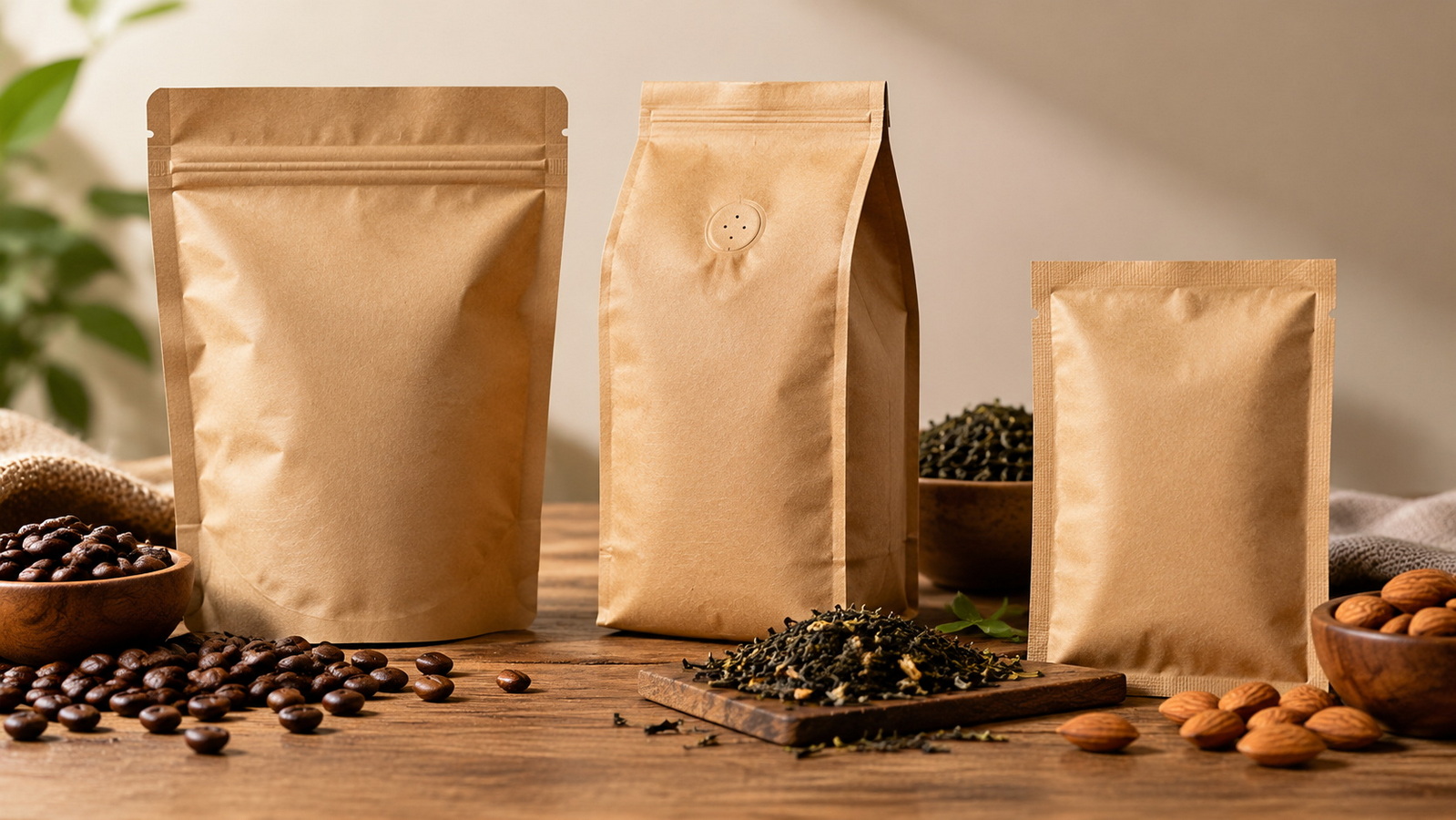
A kraft paper pouch is a flexible package that uses kraft paper as part of its structure, often combined with coatings or films for sealing and product protection. Common formats include stand-up pouches, flat-bottom bags, and resealable zipper pouches for coffee, tea, snacks, powders, and other products.
However, a natural brown appearance does not tell you whether a pouch is recyclable, moisture-resistant, or suitable for automated filling.
At HLun Pack, our approach to packaging and integrated packaging solutions starts with one principle: compatibility. The product, pouch structure, and filling equipment must work together. This guide explains how to evaluate all three before committing to production.
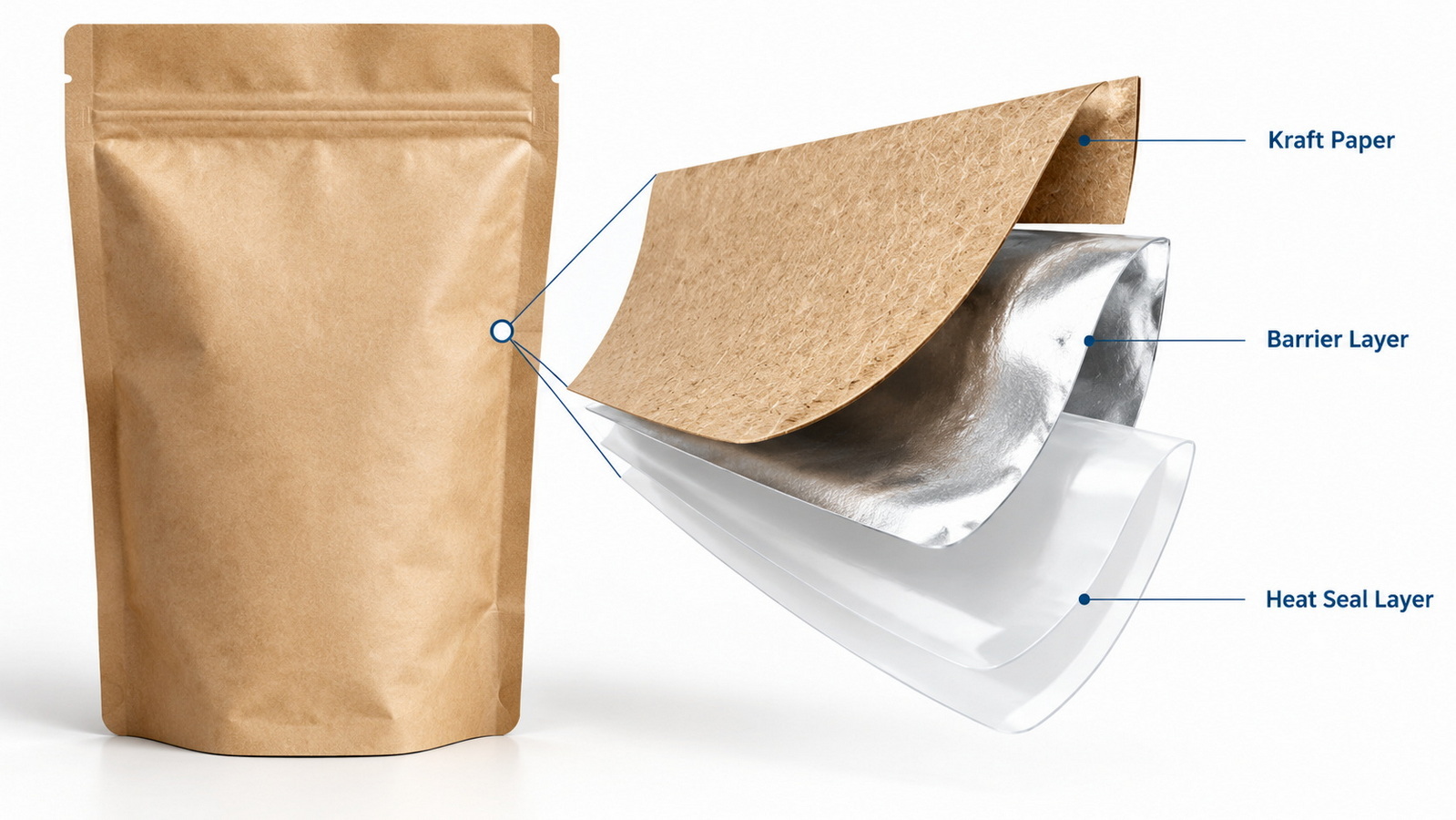
Kraft paper provides the recognizable paper surface. Depending on the application, the finished pouch may also contain adhesives, barrier coatings, plastic films, foil, zippers, or valves.
The outer paper layer contributes stiffness, tactile appeal, and a printable surface. Natural brown kraft creates a distinctive appearance, while bleached paper supports a lighter background.
Paper thickness alone does not determine package performance. Buyers should evaluate the complete structure rather than comparing only paper weight.
Additional layers can limit moisture, oxygen, grease, or light exposure. Options include polymer films, metallized films, aluminum foil, and specialized coatings.
These materials serve different purposes. A structure suitable for dry grains may not protect roasted nuts or a moisture-sensitive powder adequately.
Many kraft paper pouches rely on an inner heat-sealable layer to form the final closure.
Its compatibility with the sealing equipment is critical. The paper exterior does not establish the correct sealing temperature, pressure, or dwell time. Those settings must be developed for the actual material.
Pouch shape, closure, and barrier structure are separate decisions. For example, a stand-up pouch can also include a zipper and a transparent window.
| Format or feature | Typical application | Main purchasing consideration |
|---|---|---|
| Stand-up pouch | Snacks, tea, powders | Stability at the intended fill weight |
| Flat-bottom pouch | Coffee, premium dry goods | Base formation and filling-line handling |
| Three-side-seal pouch | Samples, small portions | Opening size and filling access |
| Resealable zipper | Multi-use products | Zipper operation and clearance above the fill |
| Transparent window | Products benefiting from visibility | Barrier performance across the window |
| Spout fitment | Suitable liquids or refills | Leak resistance and fitment compatibility |
Flat-bottom pouches are not simply another name for flat pouches. Their formed base creates a different shape and handling requirement.
Likewise, a zipper is a reclosure feature, not proof of an airtight package. Many retail pouches still require a heat seal above the zipper before sale.
Kraft paper pouches can combine a distinctive presentation with convenient flexible packaging formats. Their value depends on how well the finished structure meets the application.
Potential benefits include:
- A textured surface suited to natural or craft-oriented branding.
- Resealable formats for repeated consumer use.
- Multiple shapes, sizes, and printing options.
- Integration into suitable premade-pouch filling systems.
- Opportunities to incorporate responsibly sourced paper.
These advantages should support the product strategy, not replace technical evaluation.
Paper appearance can create expectations that the structure cannot support.
A kraft pouch may contain substantial non-paper components. It may require a specialized recycling route, and it may not be compostable.
It can also cost more than an alternative flexible structure once printing, closures, barrier requirements, and conversion are included. Compare complete specifications rather than assuming that paper is automatically cheaper or environmentally preferable.
Start with the product's failure risks. Does it become stale, absorb moisture, lose aroma, oxidize, or leak oil?
Then translate those risks into measurable packaging requirements.
Oxygen transmission rate, or OTR, describes oxygen passing through a material under specified conditions.
Water vapor transmission rate, or WVTR, describes water vapor passing through it.
Lower values generally indicate greater resistance to the relevant transmission, but comparisons are meaningful only when test conditions and units are consistent.
Ask suppliers to identify the tested structure, temperature, humidity, and method. A barrier claim without this context offers limited purchasing value.
| Product | Main concern | What to evaluate |
|---|---|---|
| Roasted coffee | Oxygen, aroma, gas release | Barrier structure and valve suitability |
| Nuts and oily snacks | Oxidation and grease | Oxygen resistance and material compatibility |
| Tea and herbs | Moisture and aroma changes | Moisture protection and storage conditions |
| Protein or seasoning powder | Moisture and seal contamination | Barrier performance and powder control |
| Liquid refill | Leakage and chemical interaction | Laminate, spout, and filled-package integrity |
Do not promise shelf life from a material description alone. Validate it with the actual product, package, and intended distribution conditions.
Some are designed for particular recovery systems. Others are not. The correct answer depends on the entire finished package and the facilities available where it is sold.
A paper-based pouch may include layers or components that affect collection, sorting, and reprocessing.
Before making a recycling claim, request evidence covering the finished structure and relevant market. Confirm whether consumers need disposal instructions or whether access to suitable facilities is limited.
Paper sourcing certification is a different issue. It does not establish that the complete pouch is recyclable.
A compostable film does not automatically make the finished pouch compostable.
Evidence must address the relevant components, including coatings, adhesives, inks, and closures. Claims should distinguish home composting from industrial composting and explain important disposal limitations.
Similarly, "bio-based" describes feedstock origin; it does not independently prove compostability.
Newer paper-based barrier platforms offer additional possibilities for selected products. However, a supplier's product-specific recycling or barrier claim should not be extended to every kraft pouch.
Treat innovation as a starting point for qualification, not a substitute for testing.
A pouch that looks excellent in a sample presentation may behave differently during automatic feeding, opening, filling, and sealing.
For that reason, material selection and equipment evaluation should happen together.
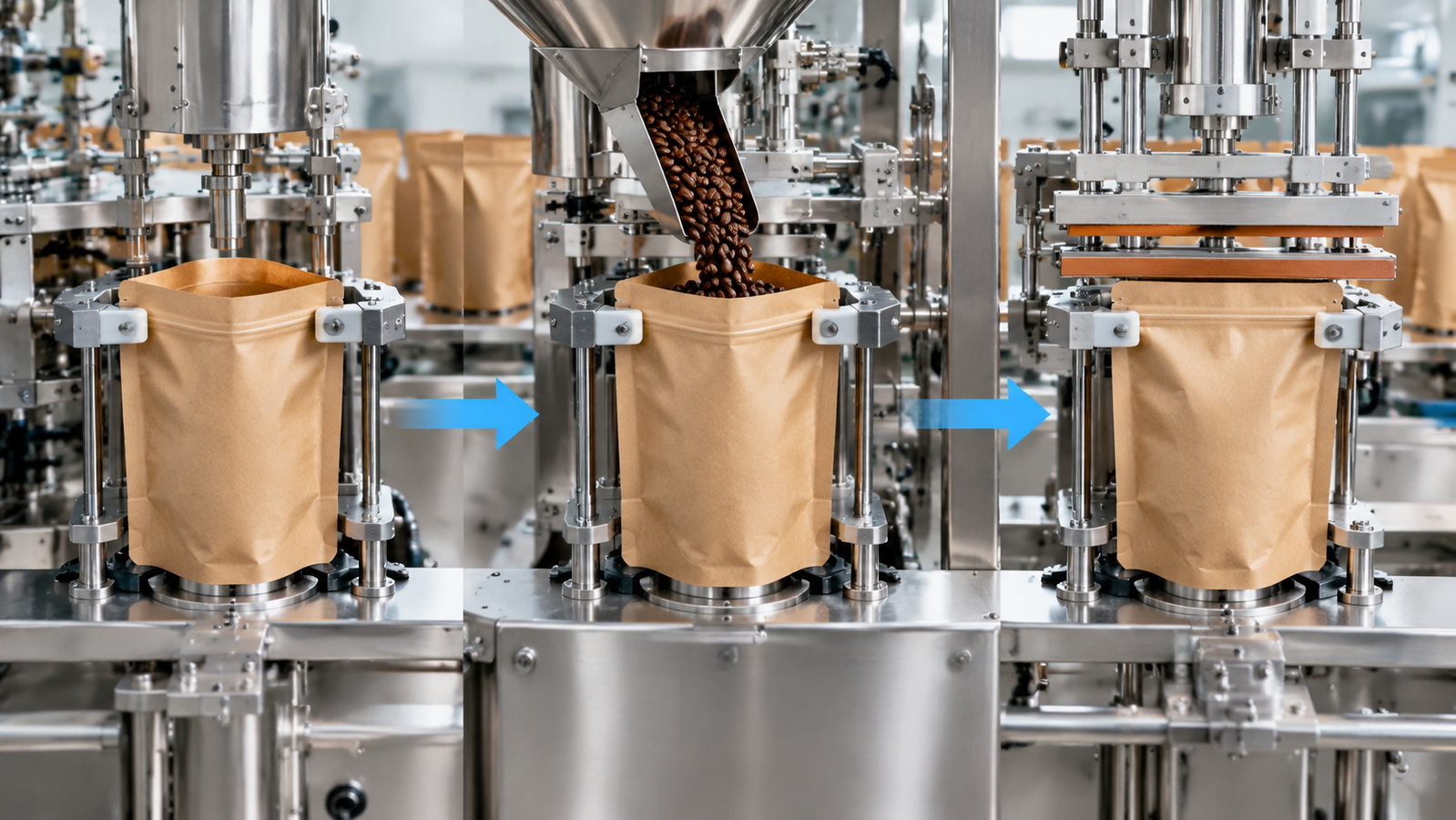
A premade-pouch system handles already manufactured bags. Depending on its configuration, it may pick up, open, fill, seal, and discharge the pouch.
Confirm:
- Minimum and maximum pouch dimensions.
- Gripper access and handling stability.
- Reliable opening around zippers or gussets.
- Filling-nozzle clearance.
- Seal-area accessibility.
- Compatibility with valves, windows, and other features.
Do not approve a pouch solely because its width falls within a machine specification.
Form-fill-seal equipment makes packages from rollstock before filling and sealing them.
A material suitable for premade pouches is not automatically suitable for this process. Stiffness, friction, forming behavior, sealing response, and print registration all require evaluation.
For projects involving rollstock, involve the material converter and equipment supplier before finalizing the structure.
Free-flowing granules, fine powders, and viscous liquids require different dosing approaches.
Possible configurations include weighing systems, auger fillers, and liquid dosing systems. Selection should consider accuracy, dust, foaming, dripping, cleaning, and product variability—not just target output.
The following workflow is a proposed qualification process, not a report of a completed HLun Pack customer trial.
Document fill weight, allowable variation, target output, pouch dimensions, seal requirements, and intended storage conditions.
Agree on what constitutes a rejected package before testing begins.
Test the proposed commercial structure, including printing, zipper, valve, or window where applicable.
Use the actual product whenever practical. Substitute materials may not reproduce dust, oil, flow, or contamination behavior.
Evaluate combinations of temperature, pressure, and dwell time.
Look for repeatable results across a workable operating range rather than a single successful setting. Excessive heat can damage a structure instead of improving its seal.
Seal-strength testing measures the force required to separate a sealed specimen.
It does not, by itself, establish that every package is leak-free. Combine suitable strength testing with integrity checks selected for the package and application.
Record the test method and acceptance criteria.
A few successful bags do not demonstrate sustained performance.
Observe feeding, opening, dosing, sealing, and discharge over a representative run. Include planned operating speeds and relevant product variations.
Track rejects, stoppages, adjustments, and cleaning requirements.
Powder contamination deserves particular attention. Product trapped between sealing surfaces can prevent consistent bonding.
Potential controls include better nozzle positioning, suitable dust extraction, controlled product discharge, and sufficient settling time.
| Problem | Possible contributors | Practical next check |
|---|---|---|
| Weak or inconsistent seal | Contamination or unsuitable settings | Inspect seal area and review the sealing window |
| Wrinkled top seal | Poor alignment or uneven filling | Check handling and product distribution |
| Unreliable opening | Material stiffness or closure geometry | Trial production-representative pouches |
| Product in the seal | Dust or insufficient headspace | Review dosing, settling, and extraction |
| Damage during handling | Structure or transport stresses | Test filled packs under expected conditions |
Avoid solving every sealing problem by increasing temperature. First identify whether the cause is material, contamination, alignment, or machine setup.
A useful quotation request should include more than dimensions and artwork.
Request:
1. The complete material structure and thicknesses.
2. Barrier data with test conditions.
3. Food-contact documentation for the intended use.
4. Recommended sealing conditions.
5. Dimensional tolerances and production samples.
6. Evidence supporting environmental claims.
7. Minimum order quantity, tooling costs, and delivery terms.
8. A clear process for handling specification changes.
For food packaging, "food-grade" alone is insufficient. Documentation should address the materials, food type, contact time, temperature, and destination-market requirements.
Compare total production cost as well as pouch price. Rejects, downtime, product loss, and changeovers can outweigh a small unit-price saving.
Choosing a kraft paper pouch is a system decision. Appearance matters, but protection, sealing, filling performance, and disposal claims determine whether the package works beyond the shelf.
Contact HLun Pack with your product details, preferred pouch format, and production requirements to discuss a coordinated packaging and equipment solution. Make representative pouch-and-product trials part of the purchasing plan before approving commercial production.
Not inherently. Water resistance depends on coatings, laminates, seals, and closures. Confirm suitability through application-specific testing rather than relying on the paper surface.
Yes, with an appropriate structure. Evaluate oxygen and moisture protection, aroma retention, sealing, and whether the coffee requires a degassing valve.
Some engineered structures can. An ordinary dry-goods pouch should not be assumed suitable. Validate liquid compatibility, seals, fitments, and transport performance.
Not without validation. Different structures can transfer heat and respond to pressure differently. Establish settings using the proposed pouch and actual production conditions.
Usually not for an unopened retail pack designed with a top seal. The zipper supports reclosure; the initial heat seal performs a separate packaging function.
Provide the product, fill weight, pouch dimensions, target output, shelf-life objective, destination market, and available material specifications. Existing equipment details and representative samples also help define the evaluation.
1. YLTPACK. "What Is Kraft Paper Pouch? Ultimate Guide 2026." Original article reviewed for topic coverage, terminology, and claims requiring qualification. Its company history and promotional claims have not been transferred to HLun Pack. [yltpacking]
2. U.S. Federal Trade Commission. "Environmental Claims: Summary of the Green Guides." Basis for the discussion of recyclable and compostable claims, supporting evidence, and limitations related to facility availability. [ftc]
3. U.S. Federal Trade Commission. "Guides for the Use of Environmental Marketing Claims," 16 CFR Part 260. Detailed guidance on substantiating whole-package compostability and qualifying recycling claims. [ftc]
4. U.S. Food and Drug Administration. "Understanding How the FDA Regulates Substances that Come into Contact with Food." Basis for the discussion of applicable authorizations, specifications, and intended-use limitations. [fda]
5. ASTM International. "ASTM F88/F88M-23: Standard Test Method for Seal Strength of Flexible Barrier Materials." Basis for distinguishing seal-strength measurement from broader package-integrity evaluation. [store.astm]
6. Viking Masek. "8 Ways to Combat Dust in Your Powder & Coffee Packaging Process." Equipment-manufacturer guidance supporting the discussion of powder contamination, dust extraction, and sealing problems. [vikingmasek]
7. ProAmpac. "ProActive Recyclable Paper RP-1000." A manufacturer-specific example of heat-sealable paper-based packaging offered in rollstock and pouch formats; not evidence that all kraft pouches share its properties. [proampac]
8. ProAmpac. "ProAmpac Pushes the Limits of Fiber Packaging with New High-Barrier Packaging Innovation Platform." Published February 17, 2026. Context for newer paper-based barrier developments; performance and recovery claims remain specific to the described platform. [proampac]


