


close
Choose Your Site
Global
Social Media
Views: 222 Author: HLun PACK Publish Time: 2026-05-15 Origin: Site


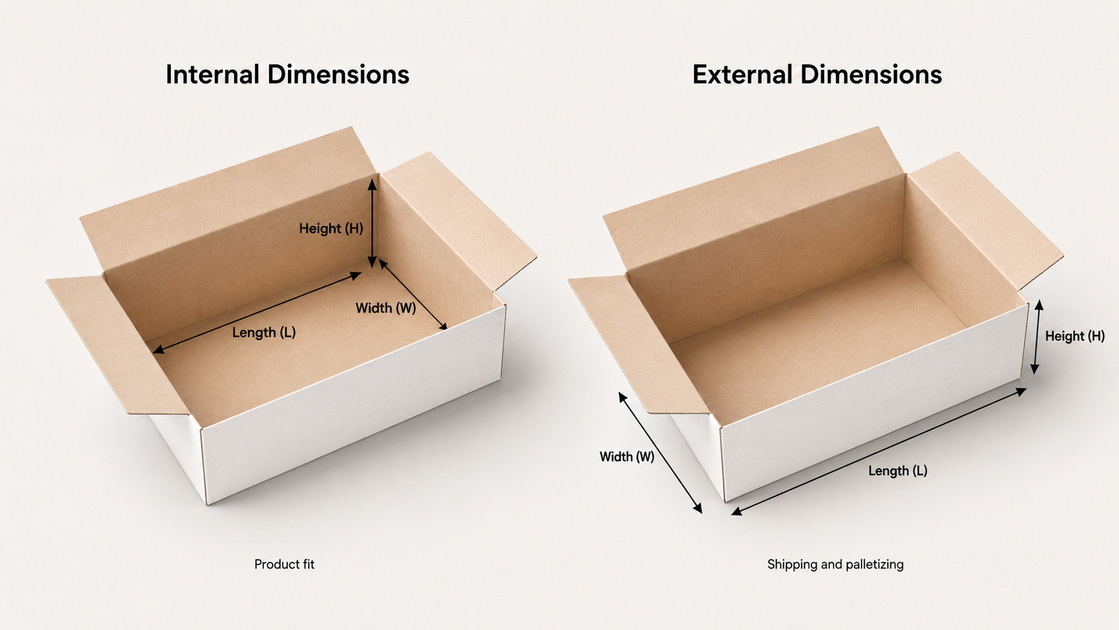
When packaging professionals talk about "box dimensions", they almost always mean internal dimensions: the usable space inside the box where your product and inserts sit. External dimensions matter for palletization, shelf fit, and shipping, but they come second in packaging design and machinery setup. [pakfactory]
In the paper packaging industry, misreading dimensions is one of the most common reasons for:
- Products that do not fit as designed
- Over-sized packaging that wastes material and shipping cost
- Packaging machines that jam or require unnecessary changeovers
- Returns, reprints, and line downtime
In our work with brands across e‑commerce, FMCG, and premium rigid boxes, the projects that go smoothly always start with clear, consistent box measurements, shared across design, procurement, and production.
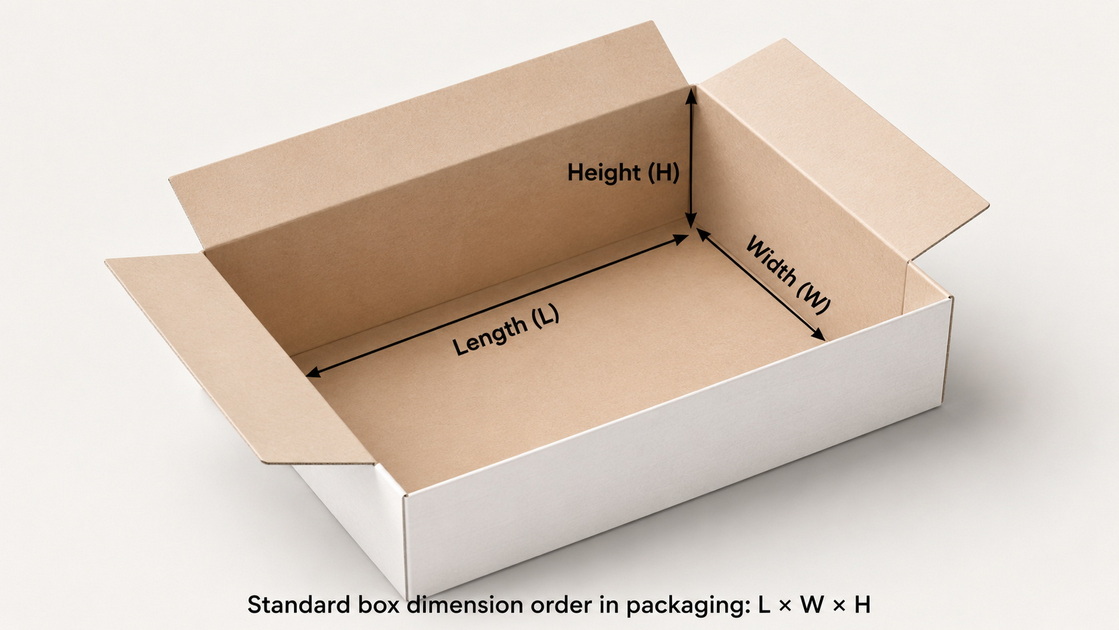
In packaging, the standard convention for box size is:
Length × Width × Height (often written as L × W × H). [boxlark]
Most corrugated and paper box converters follow this order when quoting, designing dies, and setting up packaging equipment. [pakfactory]
Standing at the top of an open box:
- Length – The longest side of the top opening. [boxlark]
- Width – The shorter side of the top opening. [pakfactory]
- Height (Depth) – The side perpendicular to length and width, running from the base to the top opening. [boxlark]
Some companies use "depth" and "height" interchangeably, but the industry still keeps the same order: L × W × H (or D). [pakfactory]
One of the most serious sources of error is confusing internal and external dimensions.
Internal dimensions are measured from the inside edges of the box. This is what determines whether the product, inserts, and accessories actually fit. [epackprinting]
You should use internal dimensions when:
- Designing custom paper boxes for a specific product
- Creating CAD drawings or dielines
- Confirming fit with foam, card, or paperboard inserts
- Communicating requirements to a packaging supplier
External dimensions are measured from the outside edges of the box. These matter when:
- Calculating pallet patterns and container loading
- Checking shelf or display fit
- Estimating shipping charges (especially for dimensional weight)
- Verifying clearance on conveyors and in automatic/cartoning equipment
Because paper and corrugated materials have thickness, external dimensions are always larger than internal dimensions. The thicker your board, the bigger that difference becomes. [epackprinting]
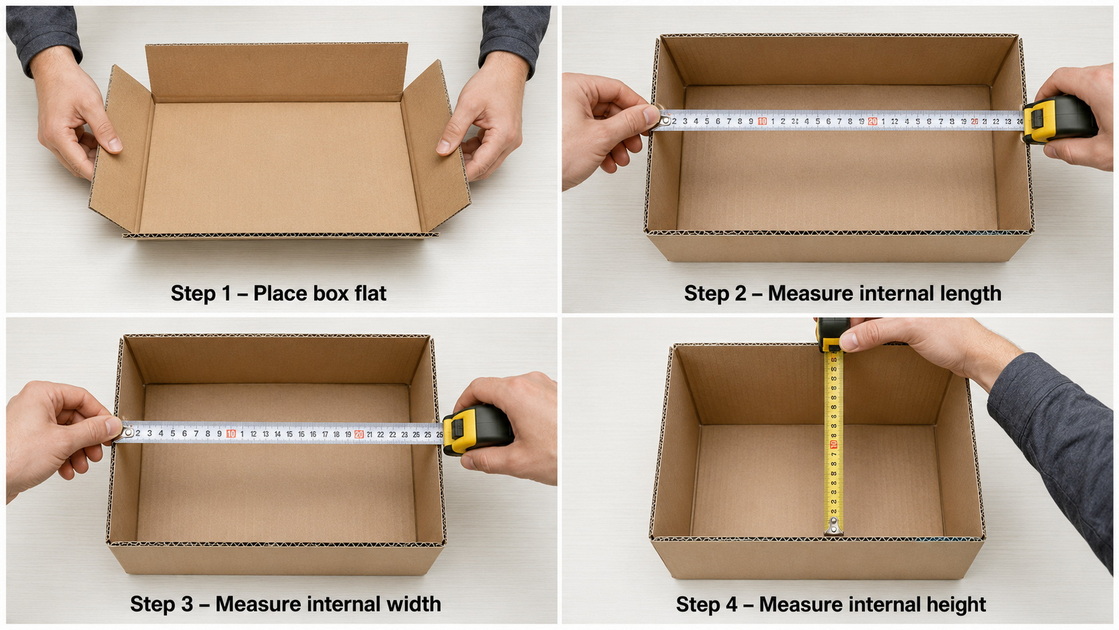
As a packaging equipment supplier, we regularly see teams measure boxes "by eye" on a cluttered table—and then wonder why their first production run fails. Below is a simple, expert workflow you can standardize in your SOPs.
- Steel ruler or rigid measuring scale for small paper boxes
- Tape measure for larger corrugated cartons
- Digital caliper (optional) for precision work and board thickness
- Flat, stable surface (critical for accuracy) [epackprinting]
1. Place the box on a flat surface
A level surface prevents distortions that can affect volume and dimensional weight calculations. [epackprinting]
2. Open all flaps fully
This makes it easier to see the true opening and measure the internal space.
3. Measure the internal length
Measure the longest inside edge of the opening, reading from inner wall to inner wall. [pakfactory]
4. Measure the internal width
Measure the shorter inside edge of the opening.
5. Measure the internal height/depth
Measure from the inside base of the box up to the top edge.
6. Confirm standard order and notation
Record your result as L × W × H, and clearly state "internal dimensions". [boxlark]
7. Measure external dimensions if needed
Repeat from the outside to capture external L, W, and H for shipping and pallet planning.
As a best practice, measure twice before sending dimensions to artwork, procurement, or a packaging equipment vendor. Many production errors come from a single mistyped digit. [epackprinting]
Even experienced teams fall into a few predictable traps. Understanding them helps you avoid costly rework.
Designers or buyers sometimes swap width and length, especially on nearly square boxes. This may not matter for a simple mailer, but it can be critical if:
- Your artwork relies on a specific panel orientation
- Your automatic case packer is configured to grip the long side
- Shelf-facing panels must match planogram drawings
Quoting with external dimensions while the product team is designing to internal dimensions almost guarantees fit issues. For corrugated or specialty paper packaging, board thickness and coatings can shift internal space enough to damage product or compress inserts. [epackprinting]
Heavier grades of corrugated or multi-layer specialty boards introduce more difference between internal and external dimensions. If you ignore this: [epackprinting]
- Fragile products may be squeezed
- Tight-fitting items may not fit at all
- Machinery may need unplanned adjustments
Writing "H × L × W" without specifying the order causes confusion, especially in global supply chains. Always state both the order and whether dimensions are internal or external in your drawings and RFQs. [boxlark]
To make this practical, here is how you might see box dimensions expressed in typical paper packaging projects:
| Application | Dimension Format | Notes |
|---|---|---|
| E‑commerce mailer box | 260 × 190 × 80 mm | Internal dimensions; fit for product + filler. epackprinting |
| Rigid paper gift box | 210 × 210 × 120 mm | Internal; board thickness and lid depth crucial. |
| Master shipping carton | 600 × 400 × 300 mm | External dimensions for pallet layout. pakfactory |
| Shelf display carton | 300 × 150 × 200 mm | External front height tailored to shelf visibility. |
These measurements then flow into CAD/dieline files, box-making equipment setup, and automated case packing and palletizing systems.
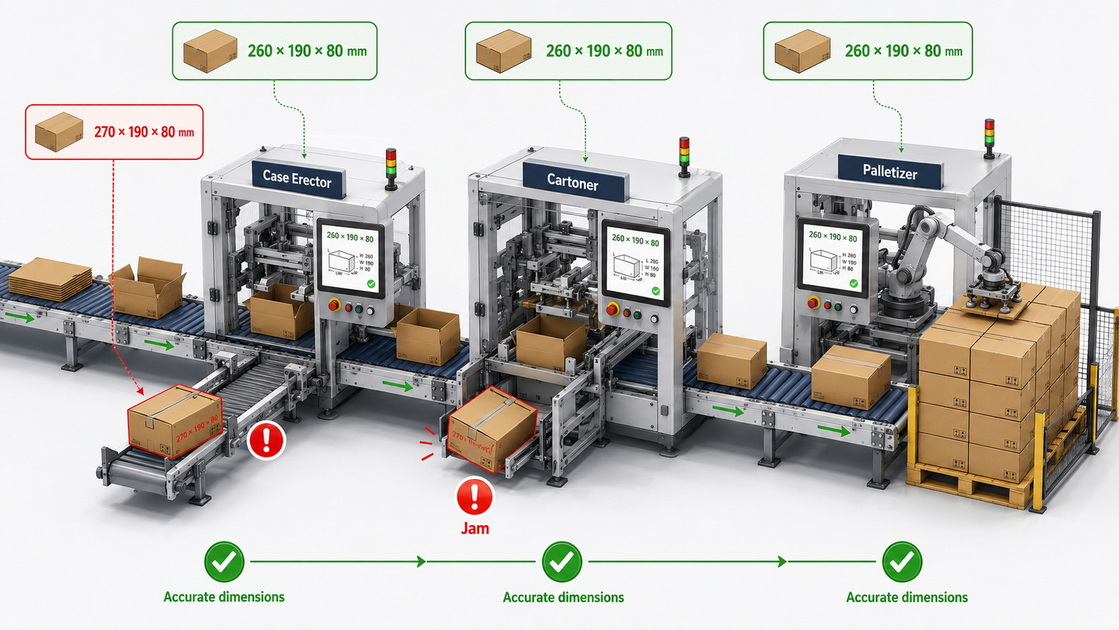
As packaging lines move toward more automation and multi‑SKU flexibility, dimension accuracy directly impacts OEE (Overall Equipment Effectiveness). [tawi]
When we help customers integrate paper packaging equipment into their production lines, we consistently see three dimension-related issues:
- Unplanned changeovers because multiple SKUs share similar but not identical box sizes
- Higher jam rates in case erectors and packers due to boxes at the edge of tolerance
- Inefficient material usage, especially in high-volume folding carton runs
The global packaging machinery market is forecast to grow from around USD 55.98 billion in 2026 to USD 87.59 billion by 2035, driven heavily by automation and robotics. In such an environment, precise and standardized dimension data is not a nice-to-have—it is fundamental infrastructure for smart manufacturing. [towardspackaging]
Brand owners increasingly run:
- Seasonal or limited-edition packaging
- Multiple language or region-specific versions
- Rapid design iterations for DTC brands
In these scenarios, small errors in dimensions can cascade into:
- Incorrect case counts per SKU
- Out-of-date packaging specs in ERP or MES systems
- Unexpected retooling costs
Standardized dimension practices (L × W × H, internal vs external clearly labeled, tolerances documented) solve many of these problems before they reach the production floor.
Drawing from on-site audits and commissioning work, here are field-tested practices you can adopt immediately.
Before approving any new box, run through a simple checklist:
- Are dimensions clearly labeled as internal or external?
- Is the order (L × W × H) stated on all drawings and RFQs?
- Have you confirmed board grade and thickness?
- Is the box size validated on the actual product, not just CAD?
Operators, engineers, designers, and buyers often use different terminology. Standardize language across:
- Operator SOPs at case erectors and cartoners
- CAD library naming conventions
- ERP or PLM item descriptions
Even a brief internal training on "how to read box dimensions" reduces miscommunication and rework dramatically. [boxlark]
For high-volume or regulated sectors, reading box dimensions correctly also means understanding tolerances and logistics rules.
Paper and corrugated packaging are subject to:
- Cutting and creasing tolerances
- Board swelling or shrinkage under humidity
- Slight variations between production batches
When you specify 200 × 150 × 100 mm, your packaging partner will work within an acceptable range. Explicitly aligning on tolerances for critical projects—electronics, luxury goods, medical products—can prevent disputes later.
Carriers increasingly charge based on dimensional weight, which uses external dimensions to calculate a "volume weight". Over-sized boxes: [pakfactory]
- Increase shipping cost without adding value
- Reduce the number of units per carton and per pallet
- Raise environmental impact through excess material and air
By optimizing box dimensions to match your product more precisely, you can often lower logistics cost while improving unboxing experience.
As a dedicated paper packaging equipment and solutions provider, HLun Pack's goal is to help you connect accurate box dimensions with stable, scalable production.
Our teams typically help customers:
- Translate product and marketing requirements into manufacturable L × W × H
- Verify internal and external dimensions against real products and inserts
- Align box sizes with machine capabilities and changeover targets
- Document dimension standards for future SKUs and line upgrades

When integrating new paper packaging equipment, we encourage customers to:
- Centralize box dimension data in a single source of truth (ERP/PLM)
- Map that data directly to machine recipes and format parts
- Use trial runs to confirm that dimension tolerances are acceptable at speed
If you need support, HLun Pack can review your current packaging specs, identify risks, and recommend dimension ranges that work reliably on your lines.
If you are planning a new packaging project—or struggling with misfits, jams, or rising shipping cost—start by standardizing your box dimensions.
HLun Pack can help you:
- Review and optimize your existing paper box sizes
- Align dimensions with packaging machinery capabilities
- Develop dimension standards for future SKUs
Reach out to our team with your current L × W × H specs and product details, and we will recommend a packaging and equipment approach tailored to your operation.
Q1. Why is the order always Length × Width × Height?
Industry standards use L × W × H so designers, converters, and logistics teams can communicate consistently. Changing the order creates confusion and increases error risk. [pakfactory]
Q2. Should I give my supplier internal or external dimensions?
For custom packaging, always start with internal dimensions to ensure product fit, then confirm external dimensions for shipping, palletization, and equipment checks. Make sure you explicitly label which is which. [epackprinting]
Q3. How precise do my measurements need to be?
Use millimeters or at least one decimal place in centimeters for anything beyond basic shipping cartons. For tight-fit or premium packaging, consider board thickness and tolerance with your packaging partner. [pakfactory]
Q4. What happens if I misread height and depth?
Many companies treat height and depth as the same, but mixing this up without noting the order can lead to incorrect artwork panels and automation issues. The safest approach is to use L × W × H and show a diagram on your drawings. [boxlark]
Q5. How do box dimensions affect automation investments?
Automation systems rely on accurate, standardized dimensions to run multiple SKUs efficiently. Clean dimension data reduces changeovers, jams, and rework, improving the long-term return on your packaging machinery. [tawi]
1- Epack Printing – *The Ultimate Guide to Measuring Your Box Dimensions Accurately*
[https://www.epackprinting.com/the-ultimate-guide-to-measuring-your-box-dimensions-accurately/] [epackprinting]
2- PakFactory – *How to Correctly Measure the Dimensions of a Box*
[https://pakfactory.com/blog/how-to-measure-a-box-dimension/] [pakfactory]
3- BoxLark – *How to Accurately Measure Box Dimension for Custom Packaging*
[https://boxlark.com/how-to-accurately-measure-box-dimension-for-custom-packaging/] [boxlark]
4- TAWI – *Packaging Trends 2026*
[https://www.tawi.com/lifting-insights/packaging-trends-20262] [tawi]
5- Towards Packaging – *Packaging Machinery Market Trends and Size 2026–35*
[https://www.towardspackaging.com/insights/packaging-machinery-market-sizing] [towardspackaging]


