


close
Choose Your Site
Global
Social Media
Views: 288 Author: HLun PACK Publish Time: 2026-10-22 Origin: Site


Content Menu
● What Are the Main Components of Cereal Packaging?
● Which Paperboard Materials Are Used for Cereal Boxes?
>> Solid Bleached Sulfate Paperboard
>> Kraft and Unbleached Paperboard
● What Is the Bag Inside a Cereal Box Made Of?
>> Moisture Protection Supports Crispness
>> Oxygen Protection Depends on the Recipe
>> Seal Quality Is Part of Barrier Performance
● Paperboard vs. Corrugated Cardboard: What Is the Difference?
● How Thick Should Cereal Box Paperboard Be?
>> Grammage, Caliper, and Stiffness Are Different
● How Cereal Box Materials Affect Packaging Equipment
>> Carton Feeding and Erection
>> Closing and End-of-Line Packing
● A Six-Step Process for Selecting Cereal Packaging Materials
>> 2. Define the Distribution Environment
>> 3. Specify Each Packaging Layer
>> 4. Run Representative Equipment Trials
>> 6. Compare Total Operating Cost
● Food-Contact Compliance: What Should Buyers Request?
● Are Cereal Boxes Recyclable?
>> Avoid Unsupported Environmental Claims
>> Can Paper Replace the Plastic Liner?
● Plan Your Cereal Packaging Project With HLun Pack
>> Are cereal boxes made of cardboard or paperboard?
>> Why do cereal boxes have an inner bag?
>> Can recycled paperboard be used for cereal packaging?
>> Does thicker paperboard always make a better cereal box?
>> Are cereal box liners recyclable?
>> Can one packaging machine run every cereal box material?
What are cereal boxes made of? Most conventional cereal boxes use paperboard for the outer carton and a separate, sealed liner to protect the cereal inside. Corrugated cases typically provide additional protection during distribution.
However, identifying these materials is only the starting point. For cereal manufacturers, the real challenge is choosing a packaging combination that preserves texture, presents the product clearly, and runs consistently on production equipment.
At HLun Pack, our approach to paper packaging and integrated packaging solutions starts with the complete package—not the carton alone. Board selection, liner performance, filling accuracy, and carton handling need to work together.
A conventional bag-in-box cereal package separates protection into three layers.
| Packaging component | Common material | Main function |
|---|---|---|
| Retail carton | Folding paperboard | Shape, graphics, handling, and shelf presentation |
| Inner liner | Food-contact flexible film | Moisture protection, containment, and product freshness |
| Shipping case | Corrugated board | Grouping, stacking, and distribution protection |
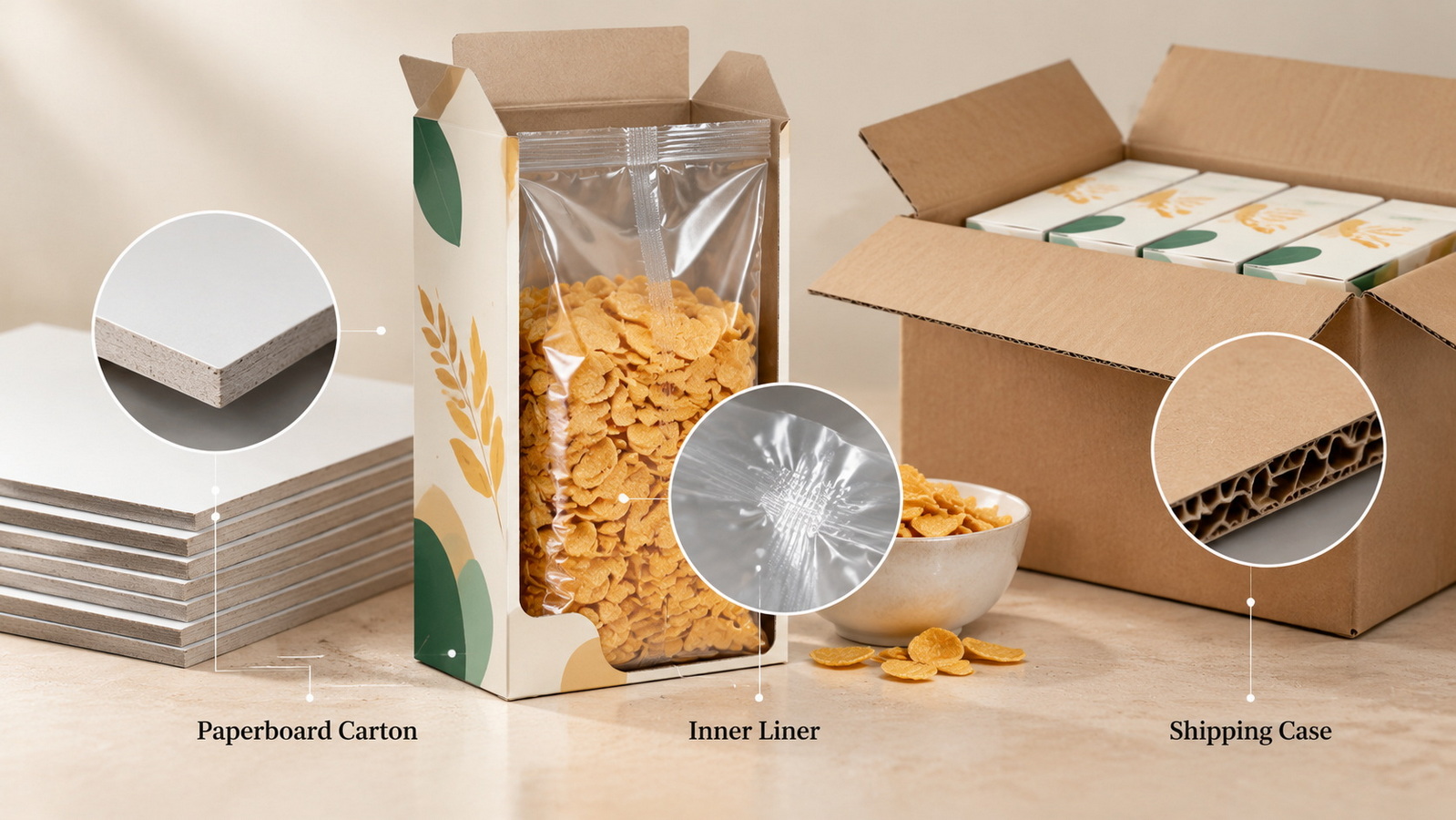
These layers should not be treated as interchangeable.
A stronger shipping case cannot compensate for an inadequately sealed liner. Likewise, an effective moisture barrier does not prevent a poorly specified carton from collapsing.
The practical question is therefore not simply, "Which paper is best?" It is, "Which packaging system meets this cereal's protection, retail, and production requirements?"
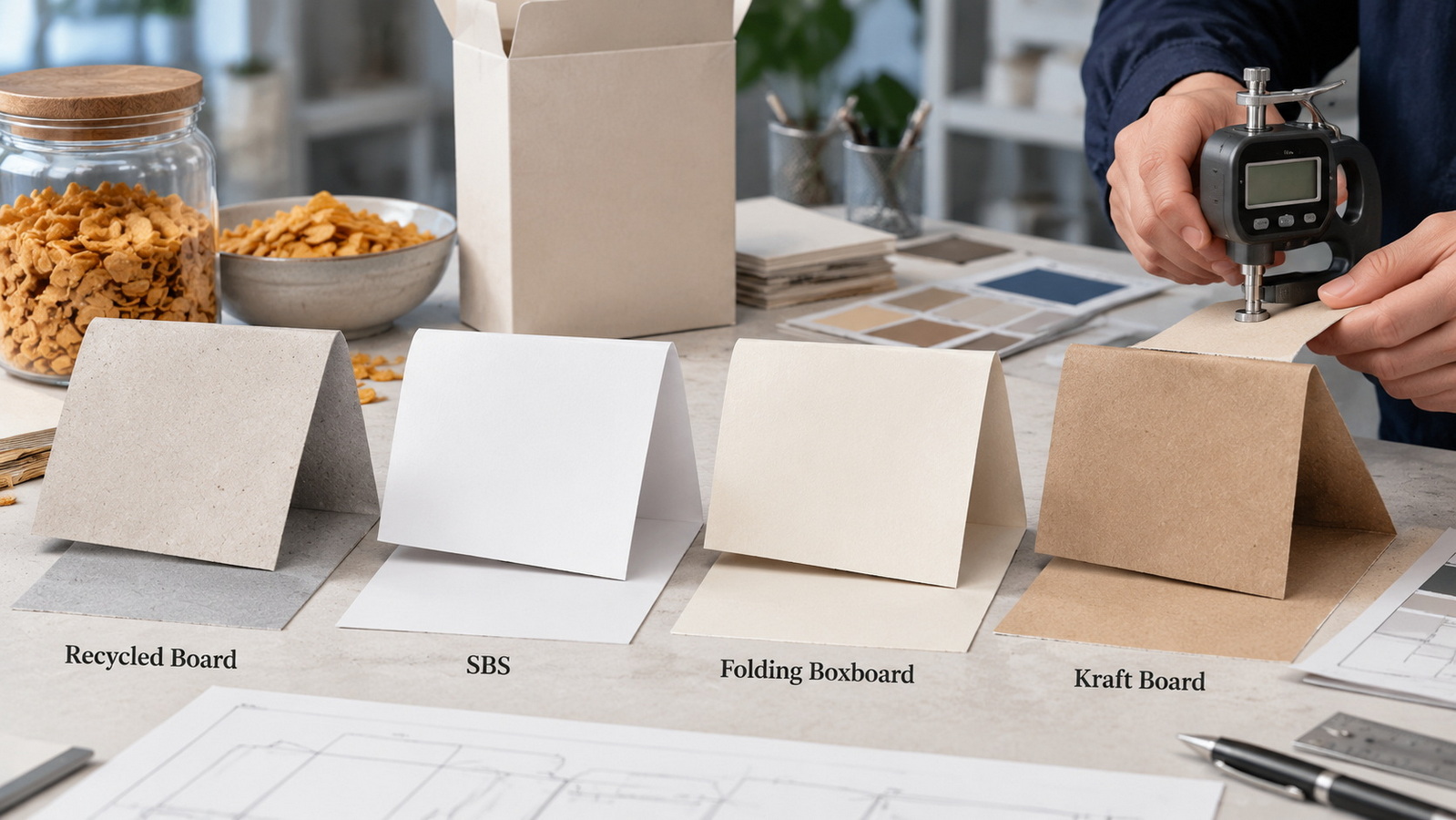
"Cardboard" is a broad commercial term. When requesting quotations, identify the actual paperboard grade rather than relying on that description alone.
Recycled paperboard is an established option for folding cartons, including cereal packaging. Depending on the grade, it may have a coated printing surface and a gray or brown reverse.
Its suitability depends on factors such as:
- Carton dimensions and filled weight.
- Stiffness and dimensional consistency.
- Printing and finishing requirements.
- Odor control and intended food-packaging use.
- Compatibility with the inner liner.
Recycled content does not automatically make a board unsuitable for cereal packaging. However, it also does not establish food-contact suitability by itself.
Evaluate the complete structure and obtain documentation appropriate to the intended application.
Solid bleached sulfate, commonly called SBS, is made from bleached chemical pulp. Its white appearance can support clean graphics and a bright presentation.
It may be worth evaluating when appearance, print reproduction, and finishing are important purchasing criteria.
Nevertheless, a premium-looking board is not automatically the most economical or technically appropriate choice. Compare its performance against the package requirements rather than selecting it solely for whiteness.
Folding boxboard, or FBB, generally combines mechanical pulp in its middle layers with chemical pulp on its outer layers.
This construction can offer useful bulk and stiffness for folding-carton applications.
When comparing FBB with other grades, evaluate actual stiffness and converting behavior. Two boards with similar grammage may not perform identically during carton erection or stacking.
Kraft and other unbleached paperboards can provide a brown, natural-looking presentation.
That appearance may suit particular brand identities, but it affects artwork reproduction. Light colors, photographic images, and white areas may need different printing arrangements.
A brown surface is not proof of recyclability, compostability, or lower environmental impact. Those claims require evidence about the finished package.
Cereal liners commonly use polyethylene-based films or other flexible structures selected for the product.
Some applications require more complex constructions to achieve the necessary balance of moisture resistance, oxygen protection, sealing performance, and mechanical strength.
Dry cereal can absorb moisture from its surroundings, changing its texture.
The liner therefore performs a critical protection function that ordinary folding paperboard cannot provide independently.
When comparing films, request water vapor transmission rate information, including the test temperature and humidity. Results measured under different conditions should not be treated as directly equivalent.
Cereals containing nuts, seeds, or other fat-containing ingredients may require particular attention to oxidation.
Ask whether the proposed liner provides suitable oxygen protection for the formulation and intended shelf life.
There is no universal barrier specification for every cereal. Product composition, storage conditions, and distribution duration all influence the decision.
A suitable film can still fail if the finished bag leaks.
Crumbs in the sealing area, unsuitable settings, or inconsistent film handling can compromise closure integrity.
Evaluate the film and sealing process together. Supplier data alone cannot demonstrate how a filled package will perform on your production line.
Paperboard is generally used for the printed retail carton. Corrugated board contains a fluted layer between liner sheets and commonly serves as the shipping case.
The distinction matters when discussing protection.
Corrugated cases help protect grouped cereal cartons against handling and stacking loads. They do not inherently provide the sealed moisture and oxygen barrier required by the food.
For direct-to-consumer distribution, evaluate the retail carton inside its actual shipping configuration. Parcel delivery may expose the package to different handling conditions than palletized retail distribution.
There is no single correct thickness for every cereal box.
The appropriate specification depends on carton geometry, product weight, distribution conditions, and equipment requirements.
These measurements describe different properties:
- Grammage measures mass per unit area, usually in grams per square meter.
- Caliper measures physical thickness.
- Bending stiffness describes resistance to bending.
- Grain direction affects directional stiffness and folding behavior.
Do not convert grammage into thickness using a universal rule. Board density and construction vary.
A purchasing specification should identify the selected grade and its relevant performance properties, not just a nominal weight.
Flat-sheet specifications do not capture every production risk.
Printing, creasing, die-cutting, and gluing influence the finished carton. Request converted samples and inspect them for:
- Cracked folds.
- Bowed panels.
- Poor squareness.
- Inconsistent opening.
- Weak adhesive joints.
- Distortion after filling.
A carton that looks acceptable by hand may behave differently at production speed.
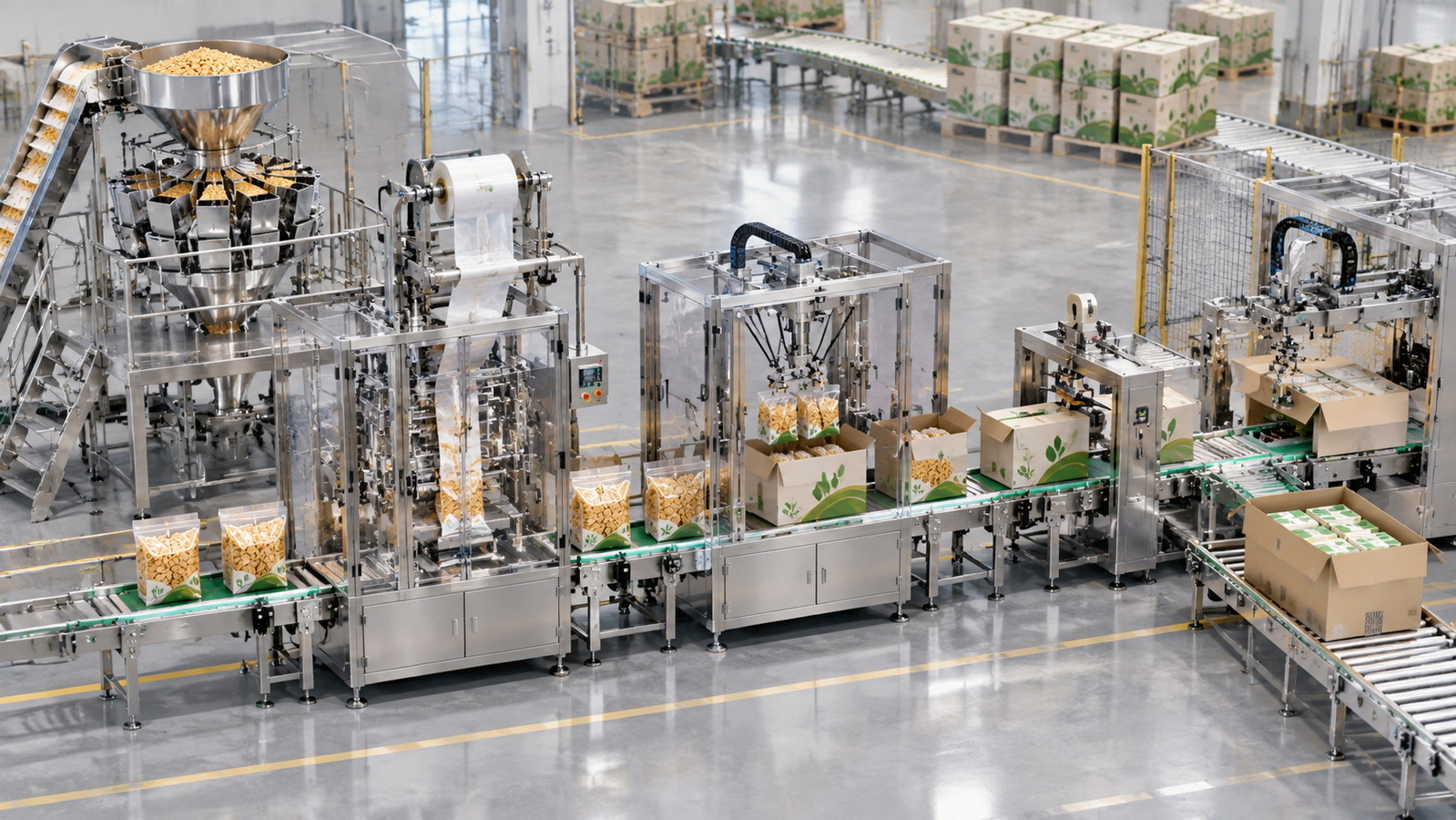
Material selection and machinery selection should happen together.
The lowest-priced carton or film may increase operating costs if it causes frequent stoppages, rejects, or difficult changeovers.
Automatic cartoners need blanks that separate, feed, and open reliably.
Board stiffness, flatness, crease quality, and dimensional consistency all influence this process.
Before approving a new material, trial production-representative blanks. Include the intended printing, coatings, and adhesive arrangements rather than testing only unprinted samples.
Cereal characteristics affect filling performance.
Flakes, puffed products, and granola differ in bulk density, shape, flow behavior, and susceptibility to breakage.
Bag dimensions must accommodate the intended fill while allowing reliable insertion and closure. A bag that is too bulky can interfere with carton loading; an overly tight arrangement can complicate handling.
Carton closure must suit the dieline, board, adhesive, and machine settings.
Case packing then introduces another set of requirements, including carton orientation and loading pattern.
We recommend evaluating the complete sequence—from filling through shipping-case closure—rather than approving each material in isolation.
A structured qualification process makes supplier comparisons more useful and reduces avoidable uncertainty.
Document the cereal type, fill weight, bulk density, fragile inclusions, and intended shelf life.
Record the product characteristics that could affect flow, breakage, or barrier requirements.
Identify expected storage conditions, sales markets, transport routes, and distribution format.
A package intended for a short domestic supply chain may face different demands from one shipped internationally or through parcel networks.
Create separate specifications for the carton, liner, and shipping case.
Include dimensions, tolerances, material identification, and relevant documentation. This prevents a quotation from appearing equivalent while substituting a different structure.
Test the proposed materials under realistic operating conditions.
Record:
- Sustained production speed.
- Rejects and stoppages.
- Fill-weight consistency.
- Seal quality.
- Carton damage.
- Changeover requirements.
Agree on acceptance criteria before the trial begins.
Assess finished-package integrity and product condition over the intended storage period.
Where appropriate, include distribution testing and sensory evaluation. Accelerated screening can support development, but it should not be presented as automatic proof of commercial shelf life.
Consider material purchases alongside waste, labor, downtime, transport, and product losses.
For illustration, a cheaper carton that feeds inconsistently may cost more per saleable pack. This is a decision framework, not a guaranteed outcome.
"Food-grade" is not enough detail for a purchasing specification.
For the United States, regulatory suitability depends on the substances involved and their intended conditions of use.
Ask suppliers to identify:
- The material or finished structure supplied.
- Its intended food-contact application.
- Applicable regulatory support.
- Relevant restrictions or limitations.
- Batch traceability and change-control arrangements.
Review inks, coatings, adhesives, and liner components as appropriate to the package.
A statement about one raw material does not establish the suitability of every finished packaging configuration. Export projects also require review against destination-market requirements.
Conventional paperboard cereal cartons are commonly accepted in recycling programs, subject to local rules.
Consumers should generally empty the carton, remove the separate liner, and keep the paperboard clean and dry.
The liner requires separate disposal guidance. Flexible films should not automatically be placed in a household paper-recycling bin.
Recycled content, recyclability, and compostability mean different things.
A package can contain recycled fiber without being accepted everywhere for recycling. Similarly, paper-based construction does not establish that every coating, adhesive, or liner is compostable.
Use specific, supportable claims that identify the relevant packaging component.
Barrier papers are available for certain packaging applications, but ordinary paper is not a direct substitute for a cereal liner.
Any replacement must demonstrate suitable barrier performance, seal integrity, food-contact suitability, and equipment compatibility.
Evaluate the finished structure and its actual disposal pathway before making environmental promises.
Successful cereal packaging connects material performance with production reliability.
HLun Pack focuses on paper packaging, packaging machinery, and integrated packaging solutions. Start your project with a clear technical brief so material and equipment requirements can be assessed together.
Send HLun Pack your cereal type, fill weight, proposed carton dimensions, target output, shelf-life requirements, and destination market. Include packaging samples and existing equipment details where available.
These inputs provide a practical basis for discussing material options, equipment configuration, and the trials needed before production approval.
Most conventional retail cereal boxes use folding paperboard. "Cardboard" is a broader term that can also describe corrugated shipping materials, so procurement documents should specify the actual grade.
The liner contains the cereal and provides important protection against moisture. Depending on its construction, it may also provide oxygen protection. The carton supplies shape, graphics, and handling support.
Yes, recycled paperboard is an established carton option. Suitability depends on the grade, package construction, intended use, and supporting documentation—not recycled content alone.
No. Thickness is only one variable. Stiffness, grain direction, crease quality, carton dimensions, and converting consistency also affect performance.
It depends on the film structure and available collection programs. Check local requirements and package-specific instructions rather than assuming the liner belongs in curbside recycling.
Not necessarily. Equipment has operating limits for carton dimensions, board properties, films, and closure arrangements. Confirm compatibility through technical review and representative trials.
1. [OXO Packaging — "What Are Cereal Boxes Made Of? Check Out The Best Materials"]. Original article reviewed for topic coverage and content gaps; not relied upon for its unsupported environmental claims. [oxopackaging]
2. [American Forest & Paper Association — "Can You Recycle Cereal Boxes?"]. Guidance on paperboard carton recycling, liner separation, and local collection requirements. [afandpa]
3. [American Forest & Paper Association — "Design Guidance for Recyclability"]. Technical context on paper-based packaging and recycling challenges associated with non-fiber components. [afandpa]
4. [U.S. Food and Drug Administration — "Determining the Regulatory Status of Components of a Food Contact Material"]. Regulatory guidance on component identity, specifications, intended use, and applicable limitations. [fda]
5. [Holmen Iggesund — "General Technical Information About Paperboard"]. Technical definitions of grammage, thickness, grain direction, and directional stiffness. [iggesund]
6. [Syntegon — "Cereal Packaging Solutions"]. Industry reference for bag-in-box systems, cartoning, and case packing; not evidence of HLun Pack's specific equipment capabilities. [syntegon]
7. [Syntegon — "Sustainable Food Packaging Technology"]. Industry context on barrier papers, mono-material films, and material–equipment compatibility. [syntegon]
8. [U.S. Federal Trade Commission — "Guides for the Use of Environmental Marketing Claims"]. Guidance on substantiating and qualifying recyclable, compostable, and recycled-content claims. [ftc]


