


close
Choose Your Site
Global
Social Media
Views: 245 Author: HLun PACK Publish Time: 2026-11-18 Origin: Site


Content Menu
● How to Choose a Tea Packaging Machine
● Types of Tea Packaging Equipment and Their Applications
>> Automatic Tea Bag Packing Machines
>> Loose Leaf Tea Pouch Packing Machines
>> Semi-Automatic Tea Filling Equipment
● Match the Filling System to Your Tea
>> Whole Leaves: Evaluate Handling as Well as Accuracy
>> Herbal Blends: Check What Enters Each Package
>> Tea Powders: Treat Them as a Separate Application
● Choose Packaging Materials Together With the Machine
>> Distinguish Brewing Bags From Protective Pouches
>> Confirm Sealing Compatibility
>> Validate Nitrogen Flushing Before Making Claims
● Calculate Real Output, Not Just Machine Speed
● Use a Factory Acceptance Test to Verify Performance
>> A Practical Tea Packaging Machine FAT Checklist
● Hygiene, Cleaning, and Line Integration
>> Look Beyond Stainless Steel
>> Define Responsibility Across the Complete Line
● Compare Tea Packaging Machine Price Through Total Cost
>> Use a Transparent Payback Calculation
● Plan Your Tea Packaging Solution With HLun Pack
>> What is the difference between a tea bag machine and a tea pouch packing machine?
>> Which tea packaging machine is suitable for a small business?
>> Can one machine package loose tea and matcha?
>> How accurate is an automatic tea packaging machine?
>> Do all tea packaging machines support nitrogen flushing?
>> How much does a tea packaging machine cost?
>> What should I send before requesting a quotation?
Choosing a tea packaging machine starts with understanding your tea, not comparing advertised speeds. Whole leaves, fine particles, herbal blends, and tea powders behave differently during filling. The right equipment must handle those differences while producing consistent weights and reliable seals.
At HLun Pack, our approach to packaging machinery and integrated packaging solutions starts with the product, package, and production target. For tea businesses, that means evaluating the filling system, packaging material, and downstream equipment together.
This guide explains how to compare tea packaging equipment, prepare meaningful trials, and select a system that supports your production goals.
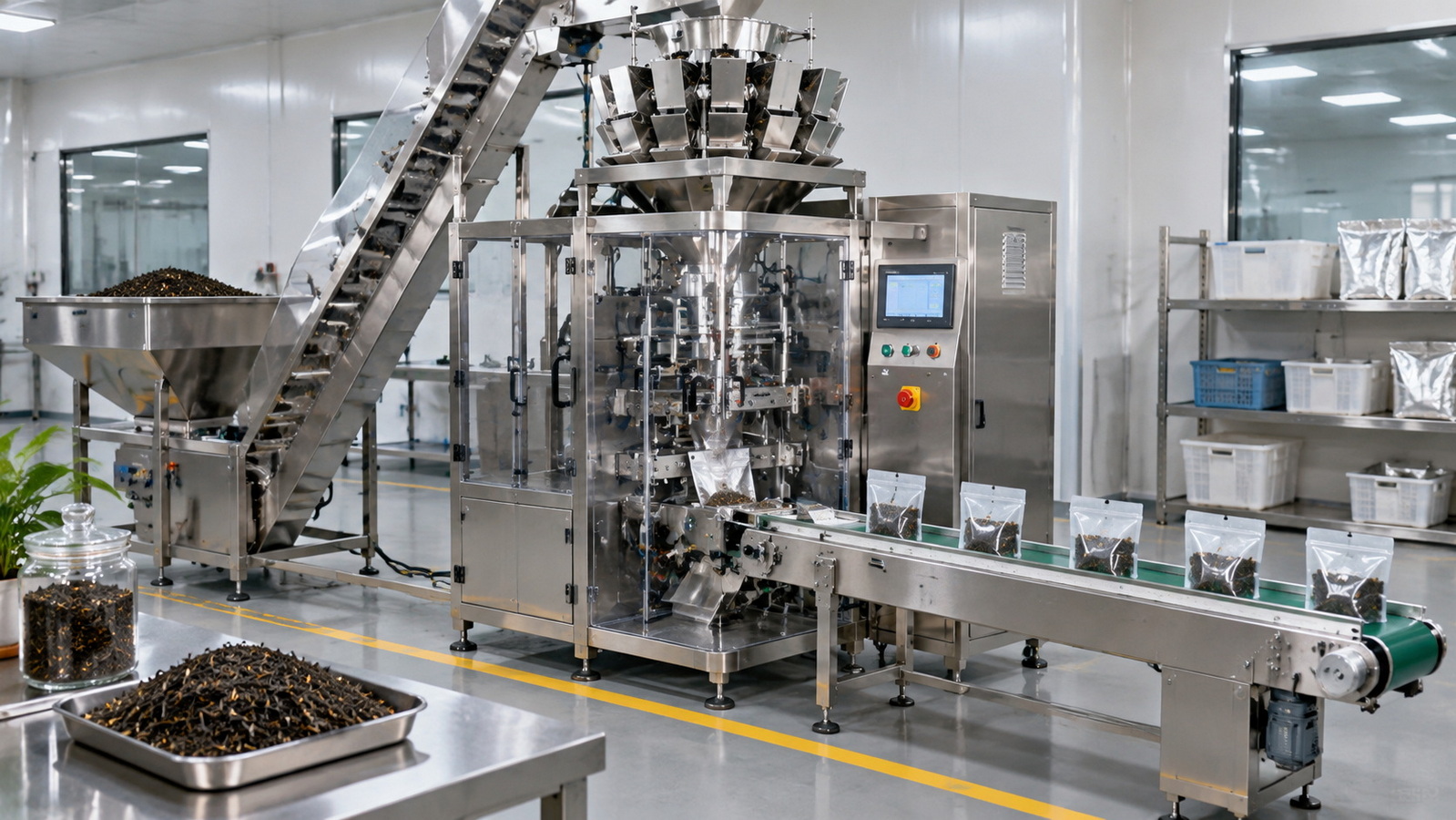
Before requesting quotations, prepare a clear application brief. A machine recommendation is only useful when the supplier understands what it must package.
Record these requirements:
- Tea type, particle size, and blend composition.
- Target fill weight and acceptable variation.
- Package dimensions and material specifications.
- Required saleable output per shift.
- Number of products and daily changeovers.
- Available space, utilities, and staffing.
- Destination-market requirements.
I would prioritize a successful trial with representative tea and packaging materials over a higher brochure speed. That trial reveals whether the proposed configuration works for your application.
An automatic tea bag packing machine doses tea into brewing bags and closes them. Depending on its configuration, it may also attach string and tags or place finished bags into individual outer envelopes.
Flat and pyramid bags require suitable forming and sealing systems. Do not assume one machine supports both formats without tooling changes.
Also distinguish brewing bags from retail pouches: a machine that makes filter bags does not necessarily produce protective outer packaging.
A loose leaf tea packing machine fills retail packages rather than brewing bags.
Two common configurations are:
- Vertical form-fill-seal equipment, which forms packages from rollstock.
- Premade pouch equipment, which opens, fills, and seals purchased pouches.
The choice depends on package presentation, material compatibility, changeover needs, and production economics.
Semi-automatic systems combine powered dosing with manual activities such as positioning pouches or transferring filled packages.
They deserve consideration when production volumes are modest or the product range changes frequently. However, assess the complete workflow. A fast filler offers limited benefit if manual sealing becomes the bottleneck.
Tea is not one uniform granular product. Different leaf shapes and particle distributions require different handling methods.
| Tea product | Filling approach to evaluate | Main trial priority |
|---|---|---|
| Whole-leaf tea | Gentle vibratory or net-weight filling | Leaf breakage and bridging |
| Broken-leaf tea | Weighing or validated volumetric dosing | Fill consistency |
| Herbal blends | Controlled feeding with weighing | Ingredient distribution |
| Matcha and fine powders | Appropriately configured auger filling | Dust and powder behavior |
| Dense tea granules | Weighing or volumetric dosing | Flow consistency |
These are starting points for testing, not universal equipment prescriptions.
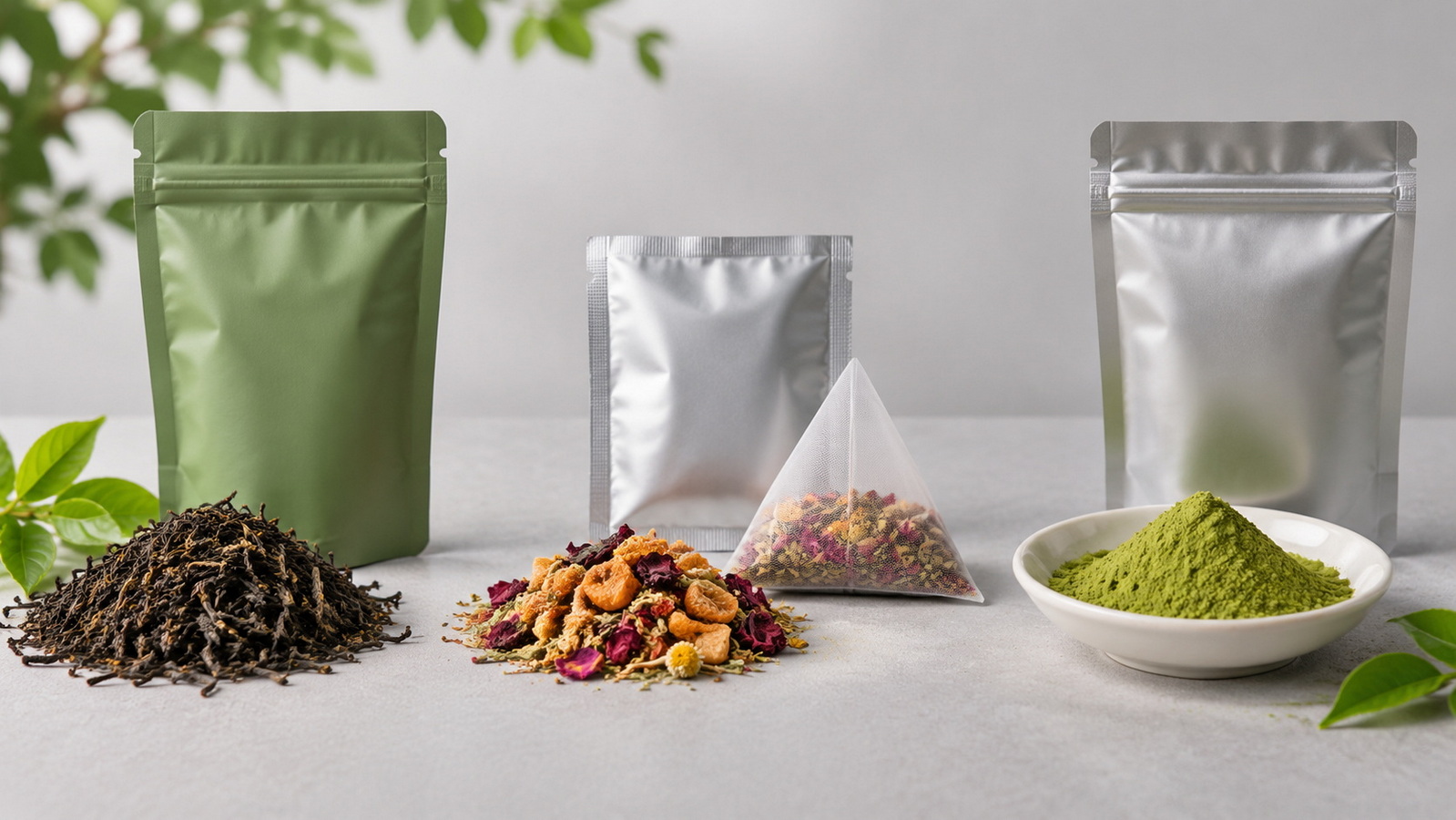
Long or irregular leaves may bridge across narrow openings. Excessive agitation or unsuitable transfer geometry can also damage delicate products.
During trials, inspect both the packaged tea and material remaining inside the equipment. Ask the supplier to explain the hopper, feeder, transfer path, and discharge opening.
A correct average weight does not establish acceptable product handling.
A blend containing leaves, flowers, and dried fruit may separate during handling.
Correct total weight alone does not prove that every package contains the intended ingredient balance. Collect samples throughout the trial and compare their composition, especially after hopper replenishment.
Fine tea powders require different evaluation from loose leaves. Discuss dust control, product buildup, hopper feeding, and cleaning access.
Do not assume equipment selected for granular tea will also package matcha effectively.
Packaging materials affect machine operation and product protection. They should be specified before the equipment configuration is finalized.
A brewing bag allows water to reach the tea during preparation. An outer envelope or retail pouch serves a different purpose.
Define each packaging layer separately:
- Brewing material and bag dimensions.
- Individual envelope, if required.
- Retail pouch or carton.
- Shipping case.
This prevents quotations from covering different scopes under the same description of "tea packaging line."
Ask the packaging-material supplier and equipment supplier to review the proposed structure together.
Confirm:
- Material construction and thickness.
- Suitable sealing method.
- Operating temperature range where relevant.
- Seal-area cleanliness requirements.
- Roll dimensions or premade pouch tolerances.
A material change should trigger another compatibility review rather than an assumption that existing settings will work.
If nitrogen flushing is proposed, define how performance will be measured. Gas injection alone does not establish a particular residual oxygen level or shelf life.
Agree on testing methods, sampling points, and acceptance limits. Any shelf-life statement should be supported by validation of the finished product and package.
Advertised cycles per minute are not the same as saleable packages leaving the line.
Cleaning, refilling, format changes, stoppages, and rejects reduce available output.
Consider this hypothetical planning example:
| Planning input | Assumption |
|---|---|
| Nominal machine speed | 40 packages/minute |
| Scheduled shift | 480 minutes |
| Combined allowance for operating losses and rejects | 70% |
| Estimated saleable output | 13,440 packages/shift |
The calculation is:
40 × 480 × 0.70 = 13,440 saleable packages.
The 70% factor is an illustrative assumption, not an industry benchmark or an HLun Pack performance claim.
For purchasing decisions, ask suppliers to demonstrate saleable output with the specified tea, fill weight, and package. Include the entire line: coding, inspection, and case packing may constrain throughput.
Also request changeover times between your actual products and formats, not simply confirmation that changeovers are possible.
A factory acceptance test, or FAT, turns general promises into measurable acceptance criteria.
Agree on the protocol before placing the order. Use representative production samples and the intended packaging materials wherever possible.
1. Verify materials. Record the tea batch, packaging specification, and target weight.
2. Run continuously. Choose a duration sufficient to expose feeding instability and recurring stoppages.
3. Sample across the run. Include startup, steady operation, and hopper replenishment.
4. Measure fill performance. Record individual results, averages, and variation.
5. Inspect product condition. Check leaf breakage, blend distribution, and buildup.
6. Assess packages. Inspect seals, appearance, coding, and any agreed integrity tests.
7. Reconcile output. Compare total cycles with accepted packages and rejects.
8. Perform a changeover. Record elapsed time, adjustments, and startup waste.
The acceptance report should identify settings, operating conditions, and unresolved issues. Retain approved package samples as a reference for installation and commissioning.
Avoid accepting only a short demonstration video. It may show that a machine can run without establishing repeatable performance.
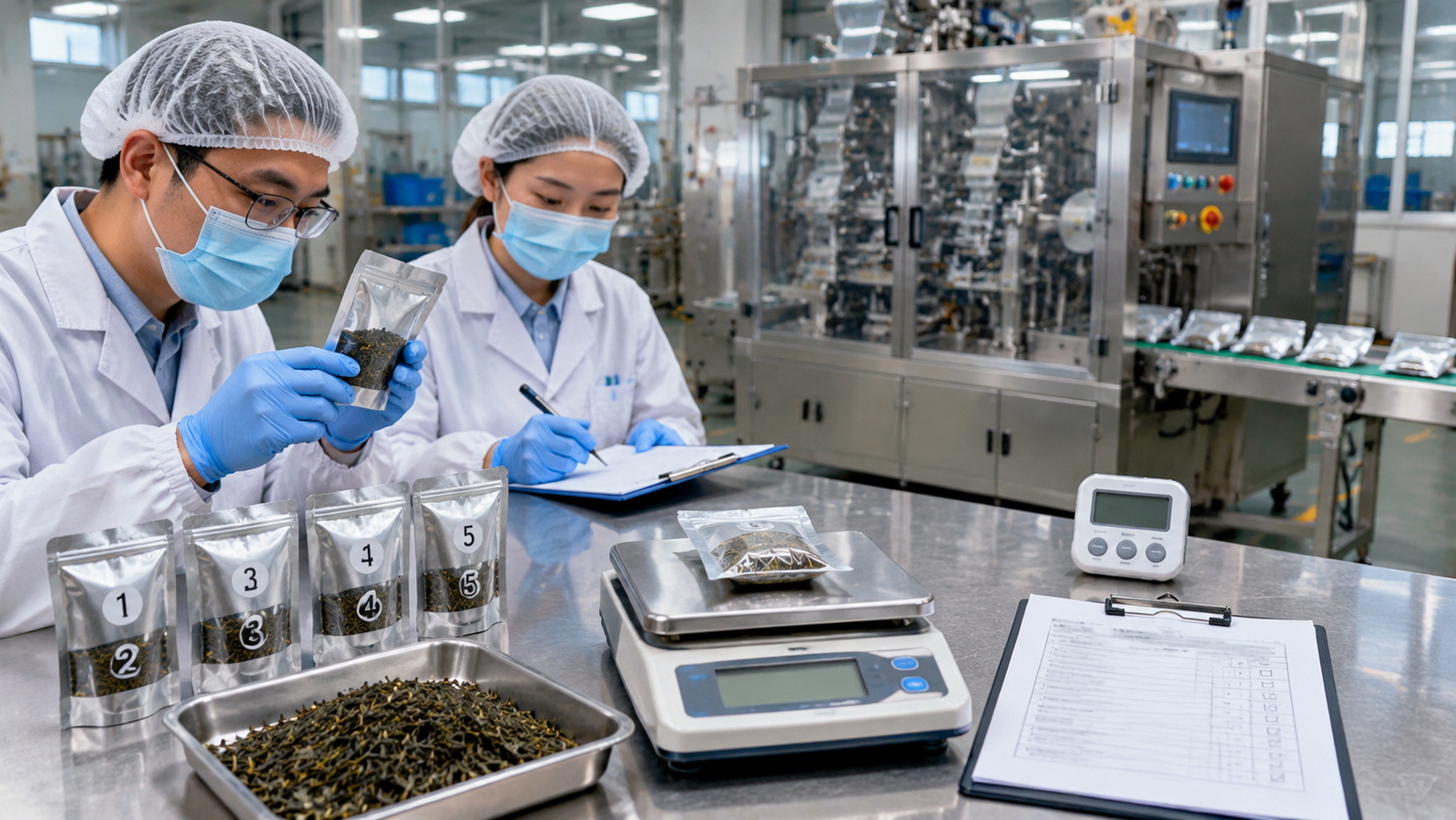
Stainless steel construction alone does not establish hygienic suitability.
For equipment used in U.S. food operations, applicable requirements address adequate cleanability, maintenance, corrosion resistance, and protection against contamination.
Inspect practical details:
- Access to hoppers, funnels, and contact surfaces.
- Areas where tea or powder can accumulate.
- Removal and reassembly of product-contact components.
- Access around installed equipment.
- Compatibility with the intended cleaning procedure.
Ask for a cleaning demonstration. A machine that is difficult to clean may lose valuable production time between products.
An integrated tea packaging line may include feeding, weighing, bagging, coding, inspection, and case packing.
Assign responsibility for the interfaces between these systems. Clarify what happens when a downstream machine stops, how rejects are handled, and how operators restart safely.
Inspection equipment should suit the package and identified hazards. Ask the supplier to demonstrate the proposed inspection method using the actual packaging structure.
A purchase price is meaningful only when the quotation scope is clear.
Compare equivalent configurations, including feeders, tooling, coding, inspection, installation, training, and required utilities. Confirm exclusions before evaluating competing offers.
A practical total-cost comparison should include:
- Equipment and tooling.
- Freight, duties, and commissioning.
- Packaging materials and startup waste.
- Labor and utilities.
- Maintenance and spare parts.
- Product giveaway and rejected packages.
- Changeover and cleaning downtime.
Consider a second hypothetical example: an installed system costs $60,000 and produces $2,500 in verified monthly net savings.
Simple payback is:
$60,000 ÷ $2,500 = 24 months.
This is an illustration, not a machine quotation. Net savings must account for additional operating costs. Do not count extra production as profit unless there is demand for those additional packages.
For specialty tea, reducing product giveaway may matter alongside labor savings. Include both when building the investment case.
The most useful starting point is a complete application brief, not a request for the lowest machine price.
Contact HLun Pack with your tea samples, target weights, preferred package formats, packaging specifications, and required shift output.
Request a proposal that defines the machinery scope, material compatibility, trial requirements, utilities, and acceptance criteria. This creates a clearer basis for selecting granular packaging equipment and an integrated packaging solution suited to your operation.
A tea bag machine produces brewing bags. A tea pouch packing machine fills retail pouches with loose tea or other specified contents. Some lines combine inner and outer packaging, but this must be included explicitly in the equipment scope.
A semi-automatic weighing and sealing setup may suit modest volumes and frequent product changes. Compare its actual labor requirements and saleable output against compact automatic options before deciding.
Possibly, but they require different filling and dust-control considerations. Confirm whether the proposed system needs separate dosing equipment, tooling, or cleaning procedures. Test both products rather than relying on a general compatibility statement.
Accuracy depends on the product, target weight, feeder, settings, and operating conditions. Request documented trial results across a continuous run, including variation and reject rates, rather than accepting one universal accuracy figure.
No. Nitrogen flushing is configuration-dependent. If required, include gas-supply specifications, residual oxygen testing, and agreed acceptance criteria in the project scope.
Cost depends on package format, filling technology, automation, inspection, and installation scope. Obtain an application-specific quotation and compare total ownership costs instead of treating marketplace listing prices as complete project budgets.
Provide representative tea samples, fill weights, package drawings, material specifications, output targets, destination market, and available utilities. Also identify planned product changes and any inspection or individual overwrapping requirements.
1. Yundu — "Tea Packaging Machines: Automate and Optimize Your Tea Production," published May 28, 2025. [yundufillingmachine]
2. All-Fill — "Tea Packaging Machines." 。 [all-fill]
3. All-Fill — "Test Lab." [all-fill]
4. All-Fill — "E/Series Vibratory Fillers." [all-fill]
5. All-Fill — "Fill-To-Weight Auger Fillers & Weight Filling Machines." [all-fill]
6. Electronic Code of Federal Regulations — Title 21, §117.40, "Equipment and utensils." [ecfr]
7. Electronic Code of Federal Regulations — Title 21, §117.35, "Sanitary operations." [ecfr]
8. All-Fill — "A/1200 | Tea Bags." [all-fill]


