


close
Choose Your Site
Global
Social Media
Views: 298 Author: HLun PACK Publish Time: 2026-09-20 Origin: Site


Content Menu
● Why Granular Sugar Needs a Tailored Packaging Line
>> Brown Sugar
>> Sugar Cubes
● Common Sugar Packaging Formats
>> Sachets and Stick Packs for Foodservice
● Choosing the Right Granular Sugar Filling System
>> Linear Weighers and Multihead Weighers
>> Net Weighers for Large Bags
● Packaging Materials for Sugar
>> Flexible Plastic Films and Laminates
>> Paper Bags and Paper-Based Packaging
● How a Sugar Packaging Line Works
● Common Sugar Packaging Problems and Fixes
>> Sugar Dust in the Seal Area
● A Buyer's Checklist for Sugar Packaging Equipment
>> Always Run a Real Product Trial
● Why Integrated Sugar Packaging Solutions Matter
● Build Your Granular Sugar Packaging Line With HLun Pack
● FAQ
>> 1. What is the best machine for packing granulated sugar?
>> 2. Can a VFFS machine package sugar?
>> 3. What packaging is best for 1 kg sugar?
>> 4. How do you prevent sugar dust from affecting package seals?
>> 5. Is volumetric filling accurate enough for sugar?
>> 6. What packaging material should be used for sugar?
>> 7. What should I test before buying a sugar packaging machine?
Selecting the right granular sugar packaging equipment is not simply a matter of buying a filling machine. A reliable sugar packaging line must match the product's flow behavior, target pack weight, packaging format, material, hygiene requirements, dust-control needs, and sustainable production speed.
For HLun Pack, the most effective solution starts with an engineering question: What must this sugar product do from hopper to pallet without losing accuracy, seal quality, or line efficiency? This guide explains how to build that answer for retail, foodservice, and industrial sugar applications.
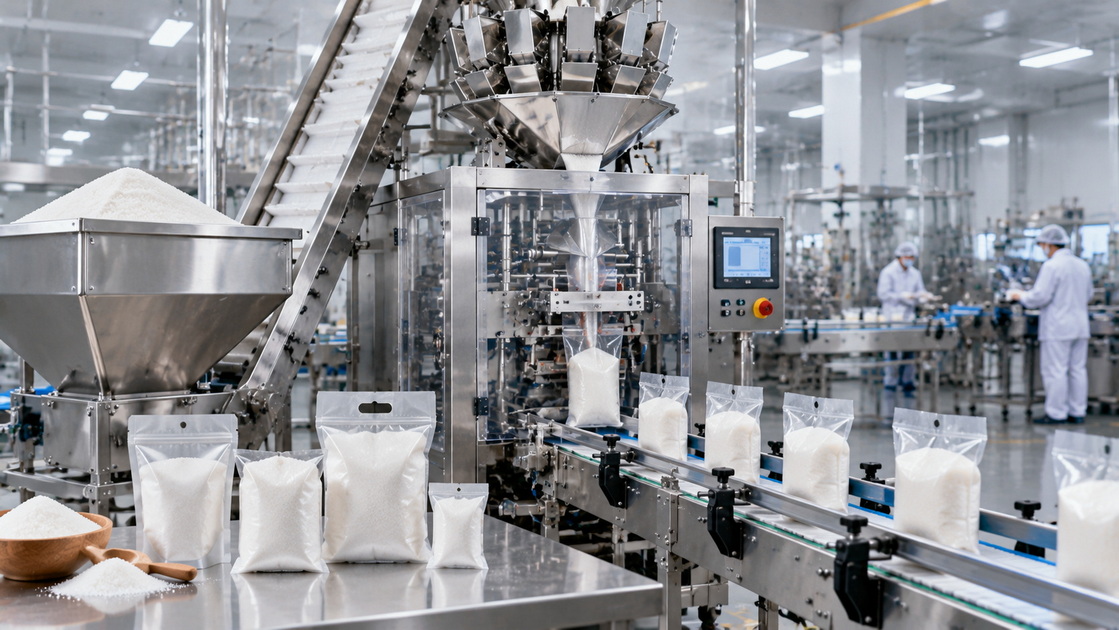
Sugar packaging is the controlled process of feeding, measuring, filling, sealing, coding, inspecting, and preparing sugar for distribution. Depending on the business model, the final product may be a 5 g café stick pack, a 1 kg retail pillow bag, a 10 kg foodservice bag, or a 25 kg industrial sack.
The basic process sounds simple. In practice, sugar packaging is affected by several variables:
- Sugar particle size and uniformity
- Bulk density stability
- Moisture exposure
- Product flow through hoppers and feeders
- Dust generation during filling
- Required net-weight accuracy
- Packaging film or bag sealability
- Target output per minute or per hour
- Retail presentation and downstream logistics
Granulated sugar is generally easier to handle than powdered sugar because it is more free-flowing. However, even granular sugar can bridge, vary in density, generate fine dust, or become inconsistent when storage conditions, feed design, vibration, or packaging material are not properly controlled. The best sugar packaging solution treats the filler, packaging machine, film, inspection equipment, and conveying system as one connected production system.
Not all sugar behaves the same way. A packaging machine designed for a free-flowing white granulated sugar may need different feeding controls when handling coarse sugar, caster sugar, brown sugar, icing sugar, or sugar cubes.
Granulated sugar is commonly packed in sachets, stick packs, pillow bags, gusseted bags, stand-up pouches, and large sacks. It is usually suitable for volumetric cup dosing, linear weighing, multihead weighing, or net weighing, depending on the required pack size, output, and accuracy.
For high-volume retail production, a vertical form fill seal machine combined with a suitable sugar dosing system is often an efficient configuration. The VFFS machine forms a bag from rollstock film, fills it with the measured product dose, seals it, and cuts it into individual packs. The dosing unit and VFFS machine perform different functions, so both must be selected together.
Powdered sugar creates a very different production challenge. Fine particles can generate dust, settle around the sealing zone, interfere with heat sealing, and reduce filling consistency. Auger fillers are frequently used for fine powder products because they move material through controlled screw rotation rather than relying only on gravity flow.
A powder packaging line should give special attention to:
- Dust extraction or containment around the filling area
- Product settling time before sealing
- Hopper and auger design
- Seal-jaw cleanliness
- Package headspace
- Regular cleaning access
- Explosion and combustible-dust risk assessment where applicable
OSHA notes that fine particles can become explosible when suspended in air under certain conditions, and its combustible-dust guidance specifically identifies sugar among materials that may present this type of risk. Equipment selection should therefore form part of a wider site-specific process-safety review, rather than being treated as a standalone machine purchase.
Brown sugar may be more moisture-sensitive and less free-flowing because of its texture and molasses content. It can compact, bridge in hoppers, or show variable feeding behavior. In these applications, the packaging material should help maintain the desired moisture balance, while the hopper, agitator, feeder, and dosing device should be validated using the customer's actual product.
Sugar cubes are not primarily a weighing challenge. They are a product-protection challenge. Excessive drop height, harsh conveyor transfers, or uncontrolled vibration can cause chipping and breakage. Gentle handling, controlled feeding, suitable carton or pouch design, and inspection of finished-package appearance are especially important.
The right package format depends on consumer use, channel requirements, filling weight, shelf-life expectations, transportation conditions, and brand positioning.
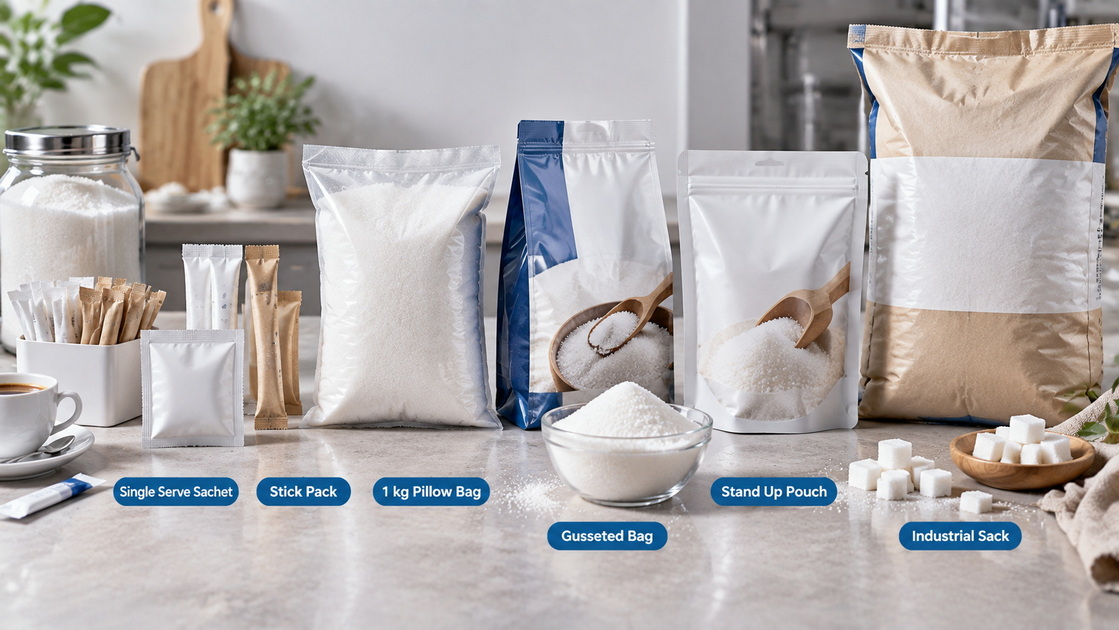
| Packaging Format | Typical Fill Range | Common Application | Main Benefit | Recommended Equipment |
|---|---|---|---|---|
| Sachet | 2–10 g | Hotels, cafés, restaurants | Portion control | Multi-lane sachet machine |
| Stick pack | 3–15 g | Coffee shops and foodservice | Compact, easy-pour format | Stick pack machine |
| Pillow bag | 250 g–2 kg | Retail granulated sugar | Efficient and economical | VFFS machine |
| Gusseted bag | 500 g–5 kg | Retail and wholesale sugar | Improved bag volume | VFFS machine |
| Stand-up pouch | 250 g–2 kg | Premium retail sugar | Strong shelf presence | Premade pouch machine or VFFS |
| Jar or rigid container | 100 g–1 kg | Specialty or powdered sugar | Reclosable and protective | Container filler and capper |
| Open-mouth sack | 5–50 kg | Foodservice and industrial supply | Heavy-duty bulk packaging | Net weigher and bagging system |
| Bulk bag | 500–1,000 kg | Industrial processing | Efficient bulk handling | Bulk bag filling system |
Single-serve sugar sachets and stick packs are popular in hospitality, beverage service, travel, institutional dining, and coffee retail. These formats support portion control, hygiene, and convenient dispensing.
A multi-lane sugar sachet packaging machine can produce several packs per cycle, making it suitable for operations that require high output. However, higher lane counts also increase the importance of accurate distribution, film tracking, sealing consistency, and downstream counting or cartoning.
Pillow bags remain one of the most practical formats for 500 g, 1 kg, and 2 kg retail sugar packs. They use rollstock film efficiently and work well with vertical form fill seal equipment.
Gusseted bags offer more usable package volume and a familiar retail appearance. Stand-up pouches can support premium branding, printed graphics, and optional resealable closures, but they may require more complex material selection and machine setup.
For 10 kg, 25 kg, and 50 kg sugar bags, the focus shifts from shelf appearance to stable high-weight filling, bag handling, closure quality, dust management, pallet stability, and labor efficiency.
A complete industrial sugar bagging system may include:
- Bulk product storage and transfer equipment
- Hopper and surge bin
- Gross or net weighing system
- Open-mouth bag placer
- Bag filling station
- Bag closing equipment
- Belt or roller conveyor
- Checkweigher or metal detector
- Bag flattening or conditioning station
- Palletizer and stretch wrapper
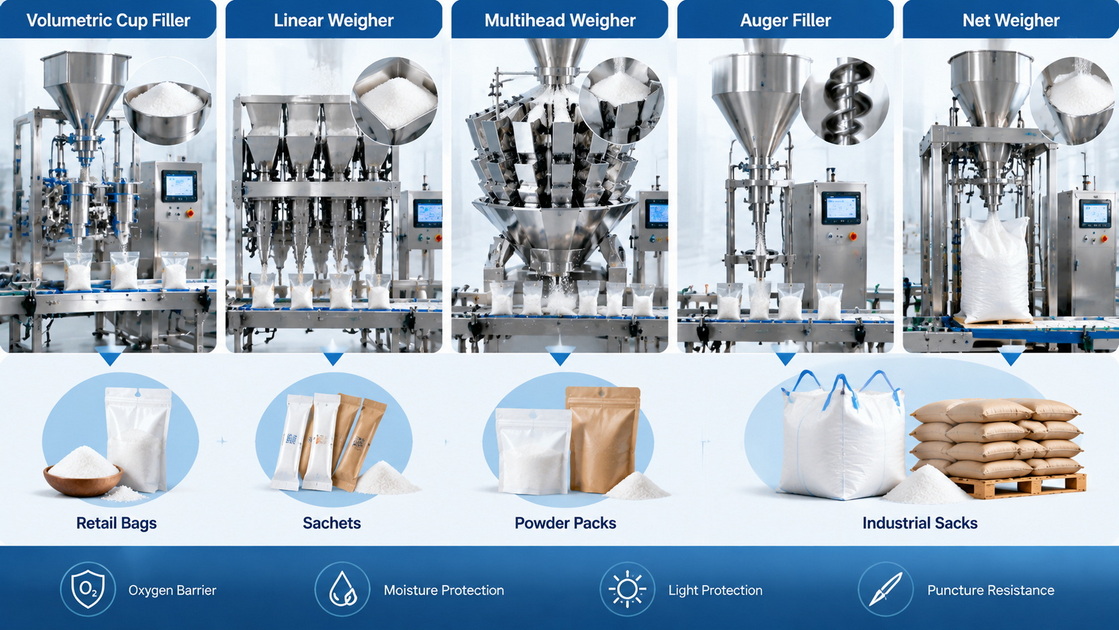
The dosing system determines how accurately and consistently sugar enters each pack. This is one of the most important decisions in a sugar packaging project.
| Dosing System | Best Application | Key Strength | Main Limitation |
|---|---|---|---|
| Volumetric cup filler | Free-flowing granulated sugar | Cost-effective, simple, fast | Fill weight can vary with density changes |
| Linear weigher | Granulated sugar, medium speeds | Weight-based measurement | May not achieve the highest speeds |
| Multihead weigher | High-speed granular sugar packaging | Strong balance of speed and accuracy | Higher initial investment |
| Auger filler | Powdered or fine sugar | Controlled powder feeding | Requires dust-management attention |
| Net weigher | Large sugar sacks | Suitable for heavy fills | Not intended for small retail packs |
| Counting system | Sugar cubes | Helps protect unit presentation | Not suited to loose granular sugar |
Volumetric cup fillers measure a fixed volume of sugar. They can be highly practical for free-flowing granulated sugar when bulk density remains stable and the acceptable fill tolerance allows volume-based dosing.
Their advantages include simple construction, reliable operation, and cost efficiency. However, because they measure volume rather than directly weighing every dose, changes in sugar density, product level, particle characteristics, or feeding behavior may affect final pack weight.
A volumetric system is often a good choice when:
- The sugar is consistently free-flowing
- The target pack weight is stable
- Production speed is important
- Fill tolerances are appropriate for the application
- The operation has quality-control procedures for weight verification
Weight-based dosing is often preferred when the customer needs tighter net-weight control. Linear weighers are suitable for many medium-speed granular applications. Multihead weighers are commonly selected for higher-speed packaging lines because they combine multiple weighed portions to achieve a target dose efficiently.
For a 1 kg retail sugar bag, for example, the correct choice depends on more than the desired rate. It should also reflect acceptable overfill, target accuracy, machine uptime, cleaning requirements, sugar flow behavior, package dimensions, and the production schedule.
Large-format sugar packaging typically requires a net-weighing solution. The system weighs the required sugar dose before releasing it into the sack, supporting controlled filling for 10–50 kg industrial bags.
The final performance depends on integrated line design. A high-capacity net weigher alone cannot guarantee line output if bag placement, bag closing, conveying, palletizing, or material supply creates bottlenecks.
Sugar packaging materials must protect the product, support dependable sealing, and run consistently on the selected equipment. The best material is not always the thickest or the most expensive; it is the material that performs reliably for the required product, route to market, and equipment configuration.
Flexible films used for sugar packaging may include PE, PP, PET, and multi-layer laminates. Each layer can provide a specific functional role, such as sealing, stiffness, puncture resistance, print performance, moisture barrier, or machine-running stability.
When selecting film, evaluate:
- Moisture protection
- Heat-seal window
- Coefficient of friction
- Film stiffness and machinability
- Print and branding requirements
- Static behavior
- Puncture resistance
- Seal contamination tolerance
- Recyclability goals
- Compatibility with destination-market requirements
Paper packaging can communicate a natural, traditional, or sustainability-oriented brand image. It is widely used in some retail and industrial sugar applications. However, paper alone may not provide the moisture resistance, strength, or seal performance required for all sugar products.
Coatings, liners, or multi-layer structures may be needed. These should be tested on the actual packaging line rather than selected based only on a material datasheet.
For products sold in the United States, food-contact packaging materials and components must be suitable for their intended use. The U.S. Food and Drug Administration defines food-contact substances broadly to include packaging materials, components, processing equipment, and related articles that contact food. Where such substances are food additives, the intended use must be appropriately authorized before marketing.
This does not mean every sugar packaging project follows the same compliance route. It means buyers should request appropriate documentation from their packaging-material suppliers and confirm that the proposed structure fits the product, food-contact conditions, and destination market.
A complete sugar packaging line transforms bulk sugar into finished, traceable, distribution-ready packs through a connected sequence.
1. Product feeding: Sugar is transferred from bulk storage, a silo, or a manual loading point to the machine hopper.
2. Buffering and flow control: A hopper, vibration system, agitator, feeder, or elevator helps deliver product consistently to the dosing equipment.
3. Dosing or weighing: The filling system measures the required quantity by volume, weight, auger rotation, or counting.
4. Package forming or positioning: Rollstock film becomes a bag on a VFFS machine, or a premade bag, pouch, container, or sack is positioned for filling.
5. Product filling: The measured sugar enters the package in a controlled sequence.
6. Settling and dust control: The system allows product to settle and helps reduce sugar contamination in the seal area.
7. Sealing or closing: The package is heat sealed, stitched, folded, capped, or otherwise closed according to its format.
8. Coding and inspection: Date codes, batch numbers, checkweighing, seal checks, metal detection, and vision inspection may be added.
9. Secondary packaging: Finished packs move into cartons, cases, trays, or pallets for shipment.
10. Data and quality review: Operators monitor weights, rejects, downtime, material usage, and machine performance to identify continuous-improvement opportunities.
The most persistent sugar-packaging issues normally come from the interaction between the product, the packaging material, and the line setup.
Likely causes:
- Unstable bulk density
- Inconsistent product feed
- Incorrect filler settings
- Excessive line speed
- Poor calibration
- Hopper bridging or erratic flow
- An unsuitable volumetric dosing method
Practical response:
- Validate sugar bulk density during normal production
- Inspect hopper flow and refill behavior
- Calibrate weighing equipment on schedule
- Review the target speed against actual stable output
- Consider a weighing solution if volume-based filling cannot meet tolerance requirements
- Use checkweigher data to identify trends before product is released
Likely causes:
- Filling too close to the sealing cycle
- Excessive product drop height
- Poor settling time
- Incorrect bag length
- Inadequate dust extraction
- Fine sugar distribution around the hopper and forming tube
Practical response:
- Optimize dosing and sealing timing
- Reduce product drop distance where feasible
- Add dust extraction or containment
- Confirm the material's sealing window
- Keep seal jaws and film path clean
- Test changes at realistic production speeds
Avoid simply increasing heat-seal temperature. Excessive heat can distort the film, weaken some structures, or create poor package appearance.
Sugar can absorb or lose moisture depending on storage conditions and product characteristics. This may cause clumping, bridging, irregular flow, and inconsistent dosing.
Practical response:
- Review raw-material storage conditions
- Confirm that packaging provides the necessary barrier
- Evaluate hopper angle and surface finish
- Use appropriate flow aids only after product and regulatory review
- Test the actual sugar in the selected machine
- Establish cleaning and preventive-maintenance routines
Leaks can result from sugar trapped in the seal area, weak sealing parameters, damaged film, poor bag formation, or handling damage after the bag leaves the machine.
A systematic investigation should check the entire process: film condition, forming set, product drop, sealing temperature, pressure, dwell time, cooling, conveyors, and finished-pack handling.
Before requesting a proposal for a sugar packaging machine, prepare a clear product and production brief. This reduces design risk and helps suppliers recommend equipment that fits the real application.
| Information to Prepare | Why It Matters |
|---|---|
| Sugar type and particle size | Determines flow behavior and filler design |
| Bulk density | Influences volumetric filling consistency |
| Moisture behavior | Affects material and hopper requirements |
| Target pack weights | Determines dosing and bagging configuration |
| Packaging format | Defines machine architecture |
| Packaging material samples | Required for seal and film-running trials |
| Required speed | Helps size the complete line, not only one machine |
| Fill-weight tolerance | Determines whether volumetric or weighing technology is appropriate |
| Available factory space | Affects layout, access, and maintenance planning |
| Utility information | Supports electrical, pneumatic, and dust-control design |
| Downstream needs | Determines requirements for coding, inspection, cartoning, and palletizing |
| Destination market | Helps address food-contact and labeling requirements |
The strongest equipment specification is not a brochure claim. It is a documented trial using the customer's real sugar, target fill weight, packaging material, package size, and intended operating speed.
During a product trial, evaluate:
- Dose accuracy and repeatability
- Sustainable output, not only peak speed
- Sugar flow through hopper and feeder
- Dust generation and seal-area cleanliness
- Film tracking and bag formation
- Seal appearance and leak resistance
- Changeover time between bag sizes
- Machine accessibility for cleaning
- Operator workload
- Finished-pack appearance
- Reject rate and inspection performance
This trial-based approach is especially valuable when the project involves brown sugar, powdered sugar, premium pouches, recycled-content films, paper-based structures, high-speed sachet production, or large industrial sacks.
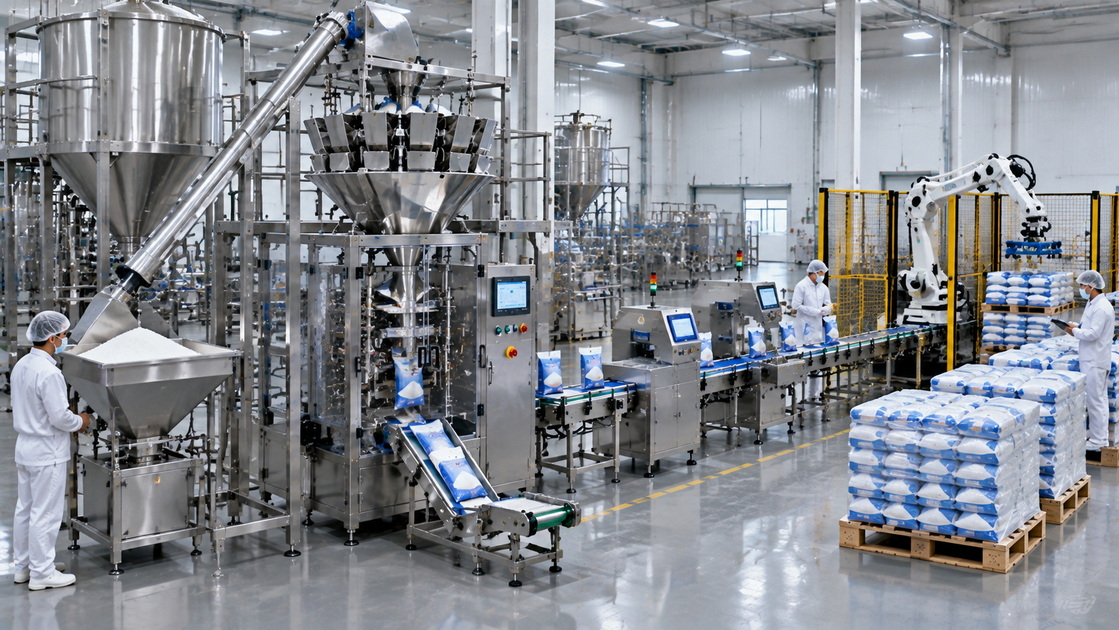
A packaging line may contain excellent individual machines and still underperform if the overall system is not integrated. For example, a high-speed VFFS machine cannot deliver consistent output if the feeder starves the weigher. A precise weigher cannot solve leakage caused by powder in the seal area. And a well-sealed bag cannot protect brand reputation if its final weight is outside specification.
An integrated solution should connect:
- Product feeding and storage
- Dosing accuracy
- Bag or pouch formation
- Filling and sealing
- Dust management
- Food-contact material compatibility
- Date and lot coding
- Weight inspection
- Secondary packaging
- Conveying and palletizing
- Operator access and maintenance planning
For sugar processors, co-packers, and food manufacturers, the goal is not merely to purchase a machine. The goal is to create a repeatable process that protects product quality, meets packaging requirements, and supports reliable commercial output.
HLun Pack provides granular packaging equipment, sugar filling machinery, and integrated packaging solutions for businesses that need dependable performance from product infeed to finished pack.
Whether you need a compact sugar sachet packaging machine, an automated 1 kg sugar bagging line, a multihead-weigher VFFS system, or a high-capacity industrial sack packaging solution, the right configuration begins with your real production conditions.
Contact HLun Pack to discuss your sugar type, pack size, output target, packaging material, and factory requirements. Our team can help you evaluate the appropriate dosing system, packaging equipment, inspection devices, and integrated line layout for a more stable and scalable sugar packaging operation.
The best machine depends on pack size, required output, fill tolerance, and packaging format. Volumetric cup fillers can suit stable, free-flowing granulated sugar. Linear weighers and multihead weighers are often better when weight-based dosing and tighter accuracy control are required. These dosing systems are frequently paired with VFFS machines for retail sugar bags.
Yes. A vertical form fill seal machine is widely used for sugar packaging because it forms bags from rollstock film, fills them through a dosing system, seals them, and cuts them into finished packages. The VFFS machine should be matched with the correct filler, such as a volumetric cup filler, linear weigher, multihead weigher, or auger filler.
A pillow bag or gusseted bag is often a practical choice for 1 kg retail sugar because it is efficient, familiar to consumers, and suitable for VFFS production. The final choice should consider moisture protection, retail display requirements, print design, material cost, sealing performance, and the product's distribution conditions.
Use a combination of controlled filling, sufficient product-settling time, reduced drop height, seal-area cleaning, suitable bag length, and dust extraction or containment. Powdered sugar requires additional attention because fine particles can contaminate the sealing zone and may create workplace dust hazards.
Volumetric filling can be suitable for free-flowing granular sugar when bulk density is stable and the application allows reasonable weight variation. Because volumetric systems measure volume rather than weight, changes in sugar density can affect net pack weight. When tighter control is required, use a weight-based dosing system and verify performance through checkweighing.
Common options include PE, PP, PET-based films, laminates, paper bags with coatings or liners, and rigid containers for specialty products. The material should provide suitable moisture protection, sealability, strength, print performance, food-contact suitability, and compatibility with the selected packaging equipment.
Test your actual sugar product, packaging material, target fill weight, bag format, and desired line speed. Review filling consistency, seal integrity, dust generation, film tracking, cleaning access, changeover time, reject rate, and sustained output. A real production trial is more useful than evaluating a machine only by its advertised maximum speed.
1. Pallas. "[Sugar Packaging Guide: Materials, Bags and Machines 2026]." Accessed September 2026. The source article informed the foundational comparison of sugar types, common package formats, dosing technologies, VFFS applications, and typical sugar-packaging problems. [pallasmt]
2. U.S. Food and Drug Administration. "[Food Packaging and Other Substances That Come into Contact with Food]." Updated June 9, 2024. Used for the explanation of food-contact substances and the FDA's general food-contact safety framework. [fda]
3. U.S. Food and Drug Administration. "[Packaging and Food Contact Substances (FCS)]." Updated March 10, 2024. Used for material-compliance considerations related to food packaging and food-contact substances. [fda]
4. Occupational Safety and Health Administration. "[Combustible Dust: An Explosion Hazard—Overview]." Accessed September 2026. Used for the general safety context concerning combustible dusts in manufacturing environments. [osha]
5. Occupational Safety and Health Administration. "[Combustible Dust Poster and Guidance]." Accessed September 2026. Used for the observation that sugar is included among materials that can present combustible-dust hazards under certain conditions. [obis.osha]


