


close
Choose Your Site
Global
Social Media
Views: 277 Author: HLun PACK Publish Time: 2026-09-13 Origin: Site


Content Menu
● What Is a Single Packaging Machine?
>> Why manufacturers choose standalone packaging equipment
● What Is an Integrated Packaging Line?
>> Why integrated packaging lines improve production flow
● Single Machine vs. Packaging Line: Core Differences
>> Automation: one task versus connected flow
>> Output: focus on good product, not nameplate speed
>> Flexibility versus consistency
>> Investment: calculate lifecycle cost, not purchase price
● When Should You Choose a Single Packaging Machine?
>> A growing specialty food producer
● When Should You Choose a Packaging Line?
>> Safety and compliance must be engineered early
● A Practical Framework for Choosing Packaging Equipment
>> 1: Define the product and packaging format
>> 2: Measure current production reality
>> 3: Set a realistic target capacity
>> 4: Design around the bottleneck
>> 5: Review service and lifecycle support
● Common Misconceptions About Packaging Automation
>> "A packaging line is always better than a single machine."
>> "Higher speed automatically means higher productivity."
>> "Automation eliminates the need for operators."
>> "A standard machine will fit every product."
>> "Maintenance can be addressed after installation."
● Build a Packaging System That Can Grow With You
>> 1. What is the main difference between a single packaging machine and a packaging line?
>> 2. Is a packaging line always more cost-effective than separate machines?
>> 3. How do I calculate whether packaging automation is worth the investment?
>> 4. Can I start with one packaging machine and upgrade later?
>> 5. What information should I provide to a packaging equipment supplier?
>> 6. How important is packaging line safety?
>> 7. What causes packaging line downtime?
Choosing between a single packaging machine and a fully integrated packaging line is not simply a question of budget. It is a production-strategy decision that affects throughput, labor requirements, product quality, factory layout, maintenance planning, and the speed at which your business can scale.
At HLun Pack, we work with manufacturers that need practical packaging machinery—not unnecessarily complex automation. In many projects, the best answer is not "buy the most automated line." It is to select the packaging solution that matches the product, current order profile, expected growth, available operators, and long-term return on investment.
This guide explains the difference between a standalone packaging machine and an automated packaging line, compares their operational trade-offs, and provides a step-by-step framework for selecting the right configuration.
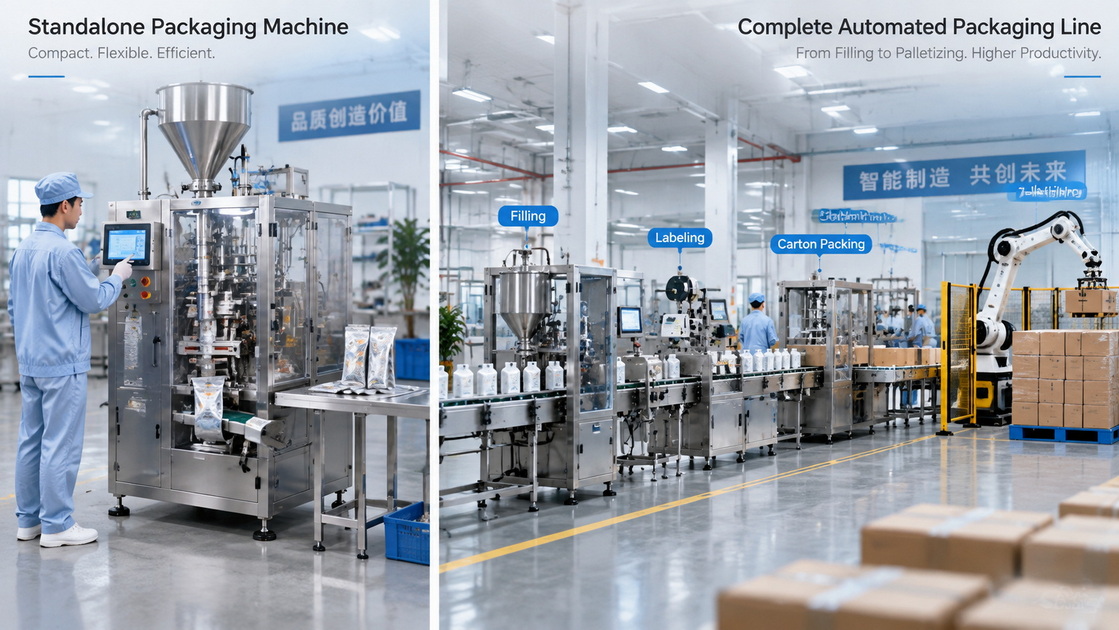
A single packaging machine is a standalone unit built to perform one defined packaging process. Depending on the application, that process may include:
- Filling bottles, pouches, jars, bags, or containers
- Capping or sealing packaging
- Labeling products
- Coding dates, batch numbers, or QR codes
- Shrink wrapping or stretch wrapping
- Cartoning, case sealing, or strapping
- Weighing, inspecting, or metal detecting
For example, a small food manufacturer may use a semi-automatic liquid filling machine to fill bottles, then use separate manual or semi-automatic equipment for capping, labeling, and carton packing.
A single machine is often the right choice when production volumes are moderate, packaging formats change frequently, or a factory wants to automate one critical bottleneck before investing in a complete automated packaging line.
The core advantages of a single packaging machine are lower capital investment, simpler operation, modular expansion, and flexibility.
A factory can begin with one machine, validate market demand, and add equipment as order volumes grow. This phased approach is particularly useful for startups, contract packers, regional manufacturers, seasonal businesses, and companies launching multiple SKUs.
However, a standalone machine does not eliminate the work between packaging steps. Products may still need to be transferred manually from filling to capping, from labeling to cartoning, or from case packing to palletizing. That increases handling time and can create inconsistency if the process is not carefully managed.
A packaging line is a coordinated system of multiple packaging machines, conveyors, controls, inspection devices, and end-of-line equipment. It moves products through a planned sequence of packaging operations with limited manual handling.
A typical automated packaging line may include:
1. Product feeding or infeed handling
2. Filling, dosing, or weighing
3. Capping, sealing, or pouch closing
4. Labeling and date coding
5. Checkweighing, vision inspection, or metal detection
6. Cartoning, case packing, or tray packing
7. Case sealing and print-and-apply labeling
8. Palletizing or pallet wrapping
Rather than viewing each machine as an isolated purchase, the line is designed as one production system. Machine speeds, buffer zones, conveyors, sensors, reject mechanisms, utilities, and controls must work together.
The main purpose is to deliver continuous, repeatable, higher-volume output.
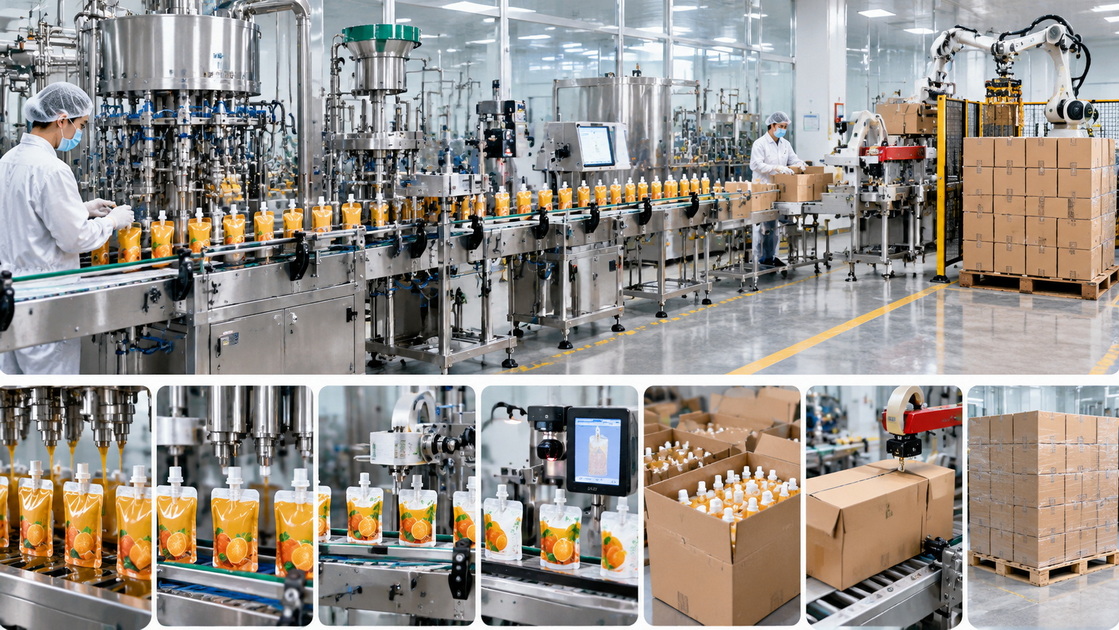
A packaging line reduces the number of manual handoffs between processes. This can help manufacturers achieve more consistent packaging quality, higher output per shift, clearer process control, and lower dependence on repetitive manual labor.
Industry reports have identified labor and skills shortages as major drivers of automation investment. In PMMI-related industry research, manufacturers and OEMs highlighted automating changeovers, app-based troubleshooting, and greater use of digital technologies as key responses to workforce limitations.
That said, automation is not the same as "set it and forget it." A packaging line still needs trained operators, preventive maintenance, quality checks, material replenishment, line clearance, and troubleshooting support.
The best packaging equipment is the system that serves your operational reality—not the system with the largest number of machines.
| Decision Factor | Single Packaging Machine | Integrated Packaging Line |
|---|---|---|
| Primary function | Performs one packaging task | Connects multiple tasks into one workflow |
| Automation level | Manual, semi-automatic, or limited automatic operation | Semi-automatic to fully automated, synchronized operation |
| Production output | Best for low to medium production volume | Best for stable, high-volume or multi-shift production |
| Initial investment | Lower upfront equipment cost | Higher investment in machines, integration, controls, and installation |
| Labor requirement | More manual transfers and operators between steps | Fewer repetitive handling tasks, but skilled monitoring remains necessary |
| Product flexibility | Usually easier for small batches and frequent format changes | Best when SKUs, containers, and pack formats are relatively stable |
| Factory footprint | Compact and easier to reposition | Requires a planned layout, utility connections, and material flow design |
| Maintenance | Simpler machine-by-machine maintenance | Requires coordinated maintenance across the whole system |
| Scalability | Can be expanded gradually | Can deliver higher output but needs early design planning |
| Process consistency | Depends more heavily on operators and procedures | Stronger process consistency when designed, commissioned, and maintained correctly |
A single machine automates a specific point in the process. For instance, an automatic capper may tighten caps consistently, but operators may still need to load bottles, move them to labeling, and pack finished products into cartons.
An integrated packaging line connects these stages. Conveyors and controls coordinate product movement, and sensors help manage jams, reject nonconforming packs, and synchronize downstream equipment.
A fast filling machine does not automatically create a fast packaging line. If the labeler, cartoner, case packer, or palletizing station cannot match the flow, the slowest point becomes the line bottleneck.
Buyers often compare machinery based only on the stated speed, such as "120 bottles per minute" or "40 cases per minute." But nameplate speed is not the same as usable output.
A more practical measurement is good packs produced per shift. This considers:
- Changeover time
- Cleaning and sanitation
- Material replenishment
- Unplanned stops
- Product or packaging rejects
- Label errors
- Sealing defects
- Operator availability
- Maintenance time
For a factory assessing automation, monitoring downtime reasons, reject categories, changeover duration, material waste, and current labor usage provides a more realistic baseline than speed alone.
Standalone packaging machines are generally easier to adapt when a manufacturer runs many container sizes, bag formats, labels, flavors, or private-label orders.
Packaging lines tend to be strongest when products are standardized and demand is predictable. Frequent changeovers can reduce the financial benefit of a high-speed line unless the equipment is designed for quick format changes, recipe management, and repeatable settings.
The operational question is not, "Do we have many SKUs?" It is:
How often do we change formats, how long does each changeover take, and how much output do we lose while doing it?
A single packaging machine usually costs less to purchase, install, and commission. This lowers financial risk and can make automation achievable for growing manufacturers.
A packaging line requires a larger initial investment because it includes more than equipment. Buyers may need to budget for:
- Engineering and layout planning
- Conveyors and product accumulation
- Electrical and pneumatic connections
- Guards and safety systems
- Controls integration
- Factory acceptance testing and site acceptance testing
- Installation and operator training
- Spare parts and service planning
- Ongoing maintenance resources
Yet, a line can create stronger long-term value if production demand is stable enough to use its capacity.
A standalone machine is often a smart choice when the factory needs to solve a clear operational bottleneck without committing to a complete line.
Choose a single packaging machine when the following conditions apply:
- Your production volume is low to moderate.
- You are testing a new product or entering a new market.
- Your packaging formats change frequently.
- You have limited floor space.
- Your capital budget is controlled or phased.
- You want to improve one critical process, such as filling, sealing, capping, or labeling.
- Your team needs a simpler system with shorter training requirements.
- You expect to add packaging modules over time.
Consider a specialty sauce manufacturer producing several bottle sizes for retail, foodservice, and private-label customers.
The manufacturer may start with a semi-automatic or automatic bottle filler and capper. Operators can manually handle labeling and case packing while the company learns which bottle formats and order volumes generate the highest demand.
Once output becomes consistent, the manufacturer may add a conveyor, automatic labeler, date coder, and case sealer. This modular expansion reduces early risk while building toward an integrated packaging system.
This model works best when the supplier designs the initial machine with future integration in mind.
An integrated packaging line is usually the better option when manual handling, inconsistent quality, labor availability, or output limits are holding back business growth.
Choose a packaging line when your operation has:
- High and relatively stable production demand
- Multi-shift or near-continuous manufacturing schedules
- Repetitive manual handling between packaging stages
- Significant labor constraints
- Consistent packaging formats and container types
- Strict quality, traceability, or inspection requirements
- Increasing retailer, distributor, or export fulfillment volumes
- Enough floor space and utilities for a planned installation
A line can be especially valuable in food, beverage, household chemical, personal care, pharmaceutical, and industrial product applications where packaging consistency is commercially important.
Packaging automation should not be selected on speed and price alone. Safety measures, machine guards, emergency stops, access points, interlocks, control logic, and safe cleaning procedures must be considered during system design.
ISO 12100 provides principles and a methodology for machinery safety, including risk assessment and risk reduction. The standard emphasizes identifying hazards, estimating risk, evaluating whether risk reduction is necessary, and applying protective measures throughout the machinery lifecycle.
For food, pharmaceutical, or other regulated applications, manufacturers should also discuss cleanability, material compatibility, documentation, traceability, and qualification requirements before equipment is built. In regulated packaging environments, installation, operational, and performance qualification—commonly referred to as IQ, OQ, and PQ—may be required to demonstrate that a system is properly installed, operates within intended parameters, and performs consistently in real production conditions.
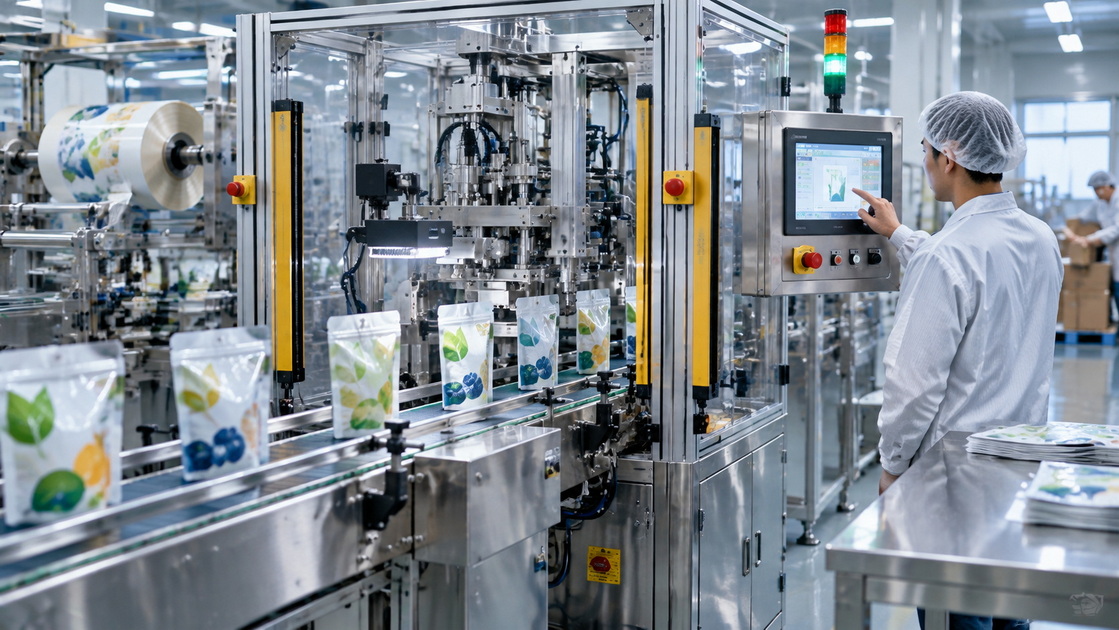
Before requesting a quotation, collect production information. A clear requirement brief helps HLun Pack or any qualified packaging equipment manufacturer recommend a solution that fits the actual operation.
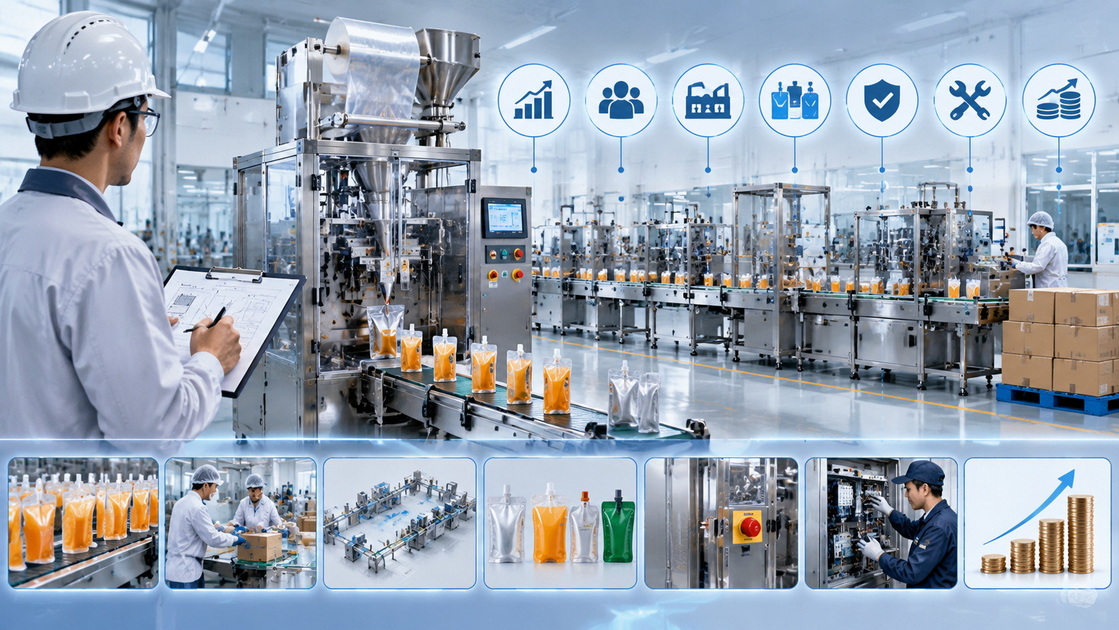
Document the product's characteristics:
- Product type: liquid, powder, granule, solid, paste, fragile item, or irregular product
- Viscosity, temperature, dust, moisture, or corrosiveness
- Container type: bottle, jar, pouch, bag, carton, tray, can, or drum
- Package dimensions and material
- Closure or sealing method
- Label size, code requirements, and inspection needs
Do not rely on estimates alone. Track at least several representative production runs.
Record:
- Good units produced per hour or shift
- Number of operators per process
- Changeover time by SKU
- Downtime reasons
- Rejects and rework
- Packaging material waste
- Current bottlenecks
- Available factory floor space
A line should be sized for a realistic future requirement, not only today's output and not an overly optimistic forecast.
Ask:
- What is the required output per shift?
- How many shifts will we run?
- What percentage growth is expected in the next two to three years?
- Is demand stable or seasonal?
- What product formats will remain in the portfolio?
Every packaging line has a constraint. It may be filling, cooling, labeling, manual carton loading, or pallet movement.
Select equipment based on the complete flow. Installing a high-speed machine upstream of a slower downstream process can create accumulation, stoppages, damaged packs, and operator frustration.
Ask equipment suppliers specific questions:
1. What performance assumptions are included in the quotation?
2. Which product and packaging samples are needed for testing?
3. What is included in factory acceptance testing?
4. What spare parts should be stocked locally?
5. How are remote diagnostics and after-sales service handled?
6. What operator and maintenance training is provided?
7. How can the system be expanded in the future?
A technically capable machine without installation support, spare-parts planning, or training can become an expensive production risk.
Not necessarily. A packaging line is valuable only when its output, labor savings, quality benefits, and operational consistency justify the greater investment and complexity.
Not always. Real productivity is limited by downtime, format changes, material availability, rejects, maintenance, and downstream constraints.
Automation changes the work. Operators may spend less time on repetitive handling, but skilled people are still needed for setup, quality checks, material loading, maintenance coordination, and troubleshooting.
Packaging equipment must be matched to product behavior, packaging materials, dimensions, hygienic needs, and target speed. Customization is often essential for reliable performance.
Maintenance planning should begin during equipment selection. Access for cleaning, lubrication points, wear parts, sensor replacement, spare-parts availability, and technical support all affect long-term uptime.
The right choice between a single packaging machine and a packaging line depends on your current production needs, but it should also support your next stage of growth.
For smaller operations, a standalone machine can provide targeted automation, lower entry cost, and the flexibility to handle changing products. For established high-volume manufacturers, an integrated packaging line can reduce manual transfers, improve consistency, and create a more controlled production flow.
HLun Pack can help you evaluate your product, packaging format, target capacity, factory layout, and expansion plan. Whether you need a single filling, sealing, labeling, wrapping, or cartoning machine—or a customized end-to-end packaging line—we can develop a practical packaging solution around your production goals.
Contact HLun Pack today to discuss your packaging project and receive a tailored equipment recommendation.
A single packaging machine performs one specific task, such as filling, capping, sealing, or labeling. A packaging line links multiple machines and conveyors into one coordinated process that handles several packaging stages automatically or semi-automatically.
No. A packaging line can become cost-effective when output demand is stable, labor costs are significant, and the line will operate at a high enough utilization level. For low-volume or frequently changing production, separate machines may offer better flexibility and lower financial risk.
Start by measuring current good output per shift, labor used, downtime, reject rates, changeover duration, material waste, and maintenance costs. Then compare those baseline figures against realistic capacity, operating-cost, and quality assumptions for the proposed equipment.
Yes. Many manufacturers use a phased automation strategy. You can begin with a standalone machine, then add conveyors, labeling, coding, inspection, cartoning, case packing, or palletizing modules as production requirements increase. Discuss future integration requirements before purchasing the first machine.
Provide product samples, packaging samples, container dimensions, target speed, batch sizes, product characteristics, available utilities, layout drawings, cleaning requirements, quality standards, and expected future expansion needs. More complete information leads to a more accurate equipment proposal.
It is essential. A packaging system should be assessed for hazards during design, installation, operation, cleaning, maintenance, and modification. ISO 12100 outlines machinery safety principles for risk assessment and risk reduction.
Common causes include material shortages, incorrectly adjusted settings, product jams, sensor issues, changeovers, poor synchronization between machines, worn components, inadequate preventive maintenance, and lack of operator training.
1. Pallas Manufacturing Technology. "[Single Machine vs Packaging Line Explained Guide 2026]." Original article reviewed and expanded for this HLun Pack content strategy. [pallasmt]
2. International Organization for Standardization. "[ISO 12100:2010—Safety of Machinery: General Principles for Design, Risk Assessment and Risk Reduction]." Guidance on machinery-safety terminology, risk assessment, and risk-reduction methodology. [iso]
3. Packaging Strategies. "[PMMI White Paper: Smart Technologies Help Address Skills Gap and Labor Shortages]." Industry perspective on automation, changeovers, troubleshooting, and digital technology in packaging operations. [packagingstrategies]
4. IDEC. "[Basic Safety Standard: ISO 12100]." Overview of machine-risk assessment, machinery limits, hazard identification, and risk evaluation. [idec]
5. Reer Safety. "[Risk Assessment for Industrial Safety]." Practical discussion of risk assessment and risk-reduction steps for industrial machinery. [reersafety]
6. Wolf-Packing Machine Company. "[FDA-Compliant Food Packaging Machines: What Manufacturers Need to Know]." Overview of food packaging equipment documentation and IQ/OQ/PQ qualification concepts. [wolf-packing]
7. Premade Pouch Machines. "[Packaging Line OEE and Downtime Guide]." Operational metrics for evaluating packaging-line output, downtime, changeovers, rejects, and material waste. [premadepouchmachines]


