


close
Choose Your Site
Global
Social Media
Views: 233 Author: HLun PACK Publish Time: 2026-10-02 Origin: Site


Content Menu
● Side Spout vs Center Spout Pouch: The Core Difference
>> Quick Comparison for Packaging Buyers
● How Spout Position Changes the User Experience
>> Pouring and Product Recovery
>> Squeezing, Sipping, and Handling
● Which Format Fits Each Product?
● Filling Equipment Can Decide the Outcome
>> Check the Entire Machine Path
>> Through-Spout Filling vs Open-Edge Filling
● Specify the Whole Pouch, Not Just the Spout
>> Seal Integrity and Closure Checks
● Three Tests That Improve the Decision
>> 1. Run a Matched Dispensing Trial
>> 2. Map the Machine Changeover
>> 3. Test the Filled Pack After Handling
● Materials and Sustainability Considerations
● How to Choose With Confidence
>> 1. Is a Side Spout the Same as a Corner Spout?
>> 2. Which Spout Is Better for a Refill Pouch?
>> 3. Is a Center Spout Always Better for Baby Food?
>> 4. Can One Filling Machine Handle Both Designs?
>> 5. Does Spout Position Determine Whether a Pouch Stands Up?
>> 6. Which Design Is Cheaper?
>> 7. Can Both Formats Be Used for Hot-Filled Food?
>> 8. How Do I Check Whether the Finished Pouch Leaks?
Choosing between a side spout pouch and a center spout pouch is not just a design decision. Spout position changes how customers pour or squeeze the product, how the pouch sits on a shelf, and how a filling and capping machine handles it. For packaging buyers, the better choice is the one that works across the entire system: product, pouch, fitment, equipment, and end use.
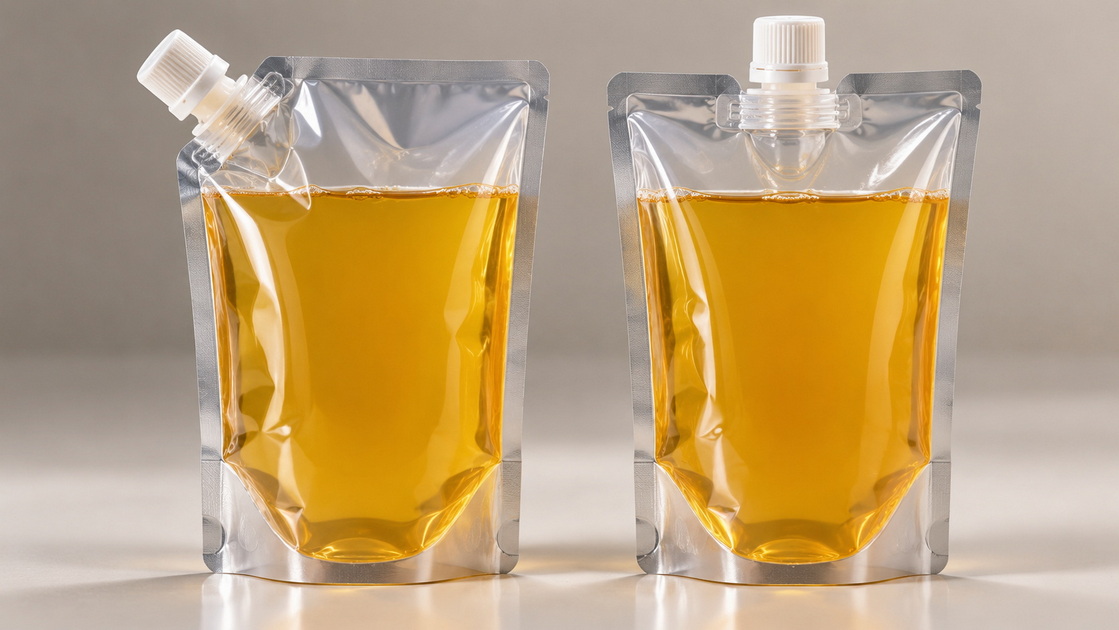
A center spout pouch places the fitment near the middle of the top edge. This creates a symmetrical pack that is often convenient for direct sipping or squeezing. Fruit purées, drinkable products, and gels are common candidates.
A side spout pouch is less precisely defined in supplier catalogs. It may mean a spout near a top corner or a fitment attached to a side panel. Those are different constructions. A top-corner spout can help a user tilt the pack and pour into another container. A true side-panel spout may serve a pouch designed to hang or lie flat, but it can require different machine handling. Before requesting a quote, mark the exact fitment location and angle on a drawing.
For most buyers comparing "side" and "center," the practical question is this: Will the customer pour from an offset spout, or squeeze or drink from a centered one? That question is a useful starting point, not a substitute for testing the filled pouch.
| Decision factor | Side or corner spout pouch | Center spout pouch |
|---|---|---|
| Typical user action | Tilt and pour into another container; configuration depends on the exact side-spout design. | Hold, squeeze, or drink directly from the pouch. |
| Visual layout | Asymmetrical; may leave more uninterrupted space elsewhere on the top edge. | Symmetrical; the fitment occupies central top artwork space. |
| Common applications | Liquid refills, oils, sauces, detergents; specialized dispensing for some side-panel designs. | Purées, smoothies, gels, and other squeeze or sip formats. |
| Machine question | Can the line locate and hold an offset fitment at the required angle? | Can the line accept the centered fitment, pouch width, and cap? |
| Main trial | Observe pouring control, residual product, and handling when full. | Observe squeezing, direct-use comfort, and handling when full. |
| Important limitation | “Side” does not specify corner versus side panel. | Center placement alone does not guarantee stable standing or easy emptying. |
These are selection tendencies, not universal performance rankings. Pouch dimensions, gusset design, product weight, spout bore, and machine tooling can change the outcome. Equipment suppliers offer systems for both corner and center spouts, so neither layout is inherently compatible with every existing line.
Think about the last action a customer takes with the pack. A person refilling a soap bottle usually tilts the pouch toward a narrow opening. An offset spout can make that movement feel natural because the outlet approaches the receiving container first. This is why corner-spouted designs are frequently considered for refill products, oils, and pourable sauces.
A centered spout can also pour. It may, however, require a different grip and tilt angle. With either layout, the amount left behind depends on the pouch's shape and flexibility as well as the product's viscosity. Do not promise better product evacuation from spout location alone. Fill both samples with the real product, dispense them in the intended way, and weigh what remains.
For a thick lotion or sauce, the fitment's opening may matter more than its position. Particles or pulp can obstruct a narrow opening. If the product must flow through the spout during filling as well as during consumer use, check both operations when selecting the bore.
A top-center spout gives users an obvious point of contact when squeezing a small pouch or drinking directly from it. It also creates a balanced visual presentation. Those qualities can suit single-serve purées, smoothies, and gels.
The centered cap still needs to work with real hands. Check whether a consumer can grip the full pouch, open the closure, and squeeze without covering essential instructions. If the product is intended for children, specify the closure requirements with the relevant safety and regulatory teams rather than assuming that an ordinary screw cap is suitable.
For an offset design, test one-handed handling at both full and nearly empty fill levels. A pouch that pours neatly when full may become awkward as its body collapses. The filled sample—not an empty mockup—is the meaningful usability test.
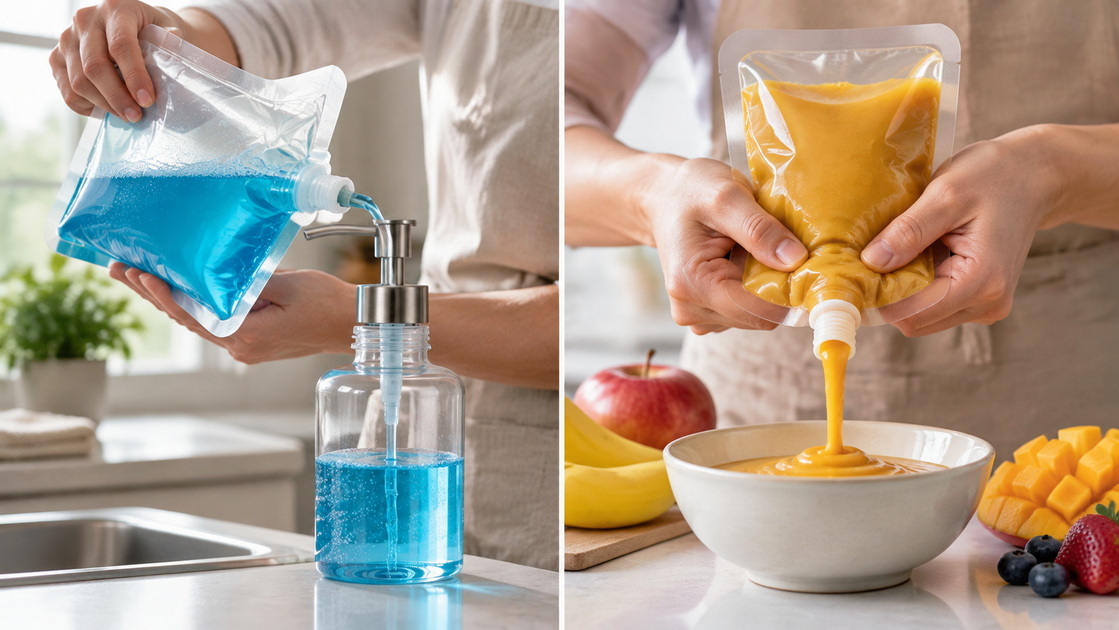
Spout placement should follow the product's use pattern. It should not be selected from a catalog image alone.
| Product or use case | Strong starting option | What to verify before approval |
|---|---|---|
| Baby-food purée or drinkable fruit blend | Top-center spout | Direct-use comfort, closure specification, product flow, and processing requirements. |
| Shampoo or detergent refill | Top-corner or other offset spout | Pour into the target bottle, cap clearance, pouch grip, and leak resistance. |
| Cooking oil or pourable sauce | Top-corner spout | Flow control, drips, product compatibility, and residual product. |
| Energy gel | Top-center spout | Squeezing force and dispensing consistency. |
| Specialized hanging dispenser | Purpose-designed side-panel spout | Hanging orientation, fitment weld, dispensing connection, and custom tooling. |
| Thick or particulate sauce | Either, subject to a trial | Spout bore, clogging, filling method, and final seal quality. |
These examples are design hypotheses, not claims that one position always outperforms the other. Suppliers describe center-top formats as common for squeeze or sip uses and corner formats as common for controlled pouring. They also distinguish true side-panel fitments from corner fitments.
Imagine a brand replacing a rigid bottle refill with a flexible pouch of liquid hand soap. Its customer will pour the soap into an existing dispenser. A top-corner spout is a reasonable first prototype because the customer can bring the outlet toward the bottle opening while supporting the pouch body.
The prototype is not finished when it looks good. The brand should fill it with its actual soap, test the pour into the dispenser, lay closed samples on their sides, and run them on the intended filling line. If an offset fitment requires substantial machine changes, a center spout may prove the better overall choice. That is a product-specific decision, not a general rule about cost or performance.
A pouch design that works in a consumer's hand still has to work at production speed. Premade spouted pouches may be handled by their fitments, filled through the spout, and then capped. Other configurations can use an open pouch edge for filling before the final seal. Waldner describes separate approaches for center-spout filling and corner-spouted pouches filled through a top opening. LINAPACK lists equipment that handles both corner- and center-spouted premade pouches, with change parts available for different caps and spouts.

Before ordering printed pouches, ask the equipment team to review each step:
1. Loading: Can the infeed present the pouch in the correct orientation every time?
2. Holding: Can the carrier grip the fitment without twisting the pouch or stressing its weld?
3. Filling: Does the nozzle match the spout opening, or will the product enter through an open edge?
4. Cleaning: Could foam or product residue remain on the spout before capping?
5. Capping: Is there clearance for the closure and capping head, including an offset cap?
6. Discharge: Will the filled pouch transfer without tipping, snagging, or damaging the seal?
LINAPACK's published process, for example, includes pouch loading, filling, optional spout cleaning, cap placement, controlled cap tightening, and discharge. Its published speeds vary with pouch volume and spout inside diameter. Do not use a brochure's maximum rate as your expected rate without a trial using your product and package.
Through-spout filling can avoid depositing product on an edge that must later be heat-sealed. It requires a suitable nozzle and enough flow through the selected opening. The line must then apply the cap correctly.
Open-edge filling allows product to enter before the final edge seal is made. It may be worth evaluating for products that are difficult to deliver through a small fitment. The sealing area must remain clean, and the finished edge must pass the package's integrity tests. The chosen sequence depends on the pouch construction and available machinery.
A successful spouted pouch combines a flexible body, a welded fitment, a compatible cap, and reliable seals. The spout's position matters, but its diameter, flange, closure, film, and processing conditions also affect performance. A useful supplier specification starts with the product and filling process rather than the artwork.
Send the same brief to your pouch converter, machinery supplier, and filling partner:
- Product type, viscosity, and any pulp or particles.
- Target fill volume, pouch dimensions, and expected headspace.
- Exact spout position, angle, bore, fitment drawing, and cap specification.
- Intended consumer action: pour, squeeze, sip, refill, or connect.
- Filling route, fill temperature, and any later thermal process.
- Shelf-life, barrier, storage, and distribution requirements.
- Artwork areas that must remain readable on the filled pouch.
- Target line rate, available tooling, and required test results.
For food products, do not treat "food-grade" as a complete specification. The U.S. FDA distinguishes food types and conditions of use, including ambient filling, refrigerated storage, hot filling, and high-temperature processing. Confirm the materials and fitment are appropriate for the specific food and intended conditions in the destination market.
The fitment-to-film joint deserves particular attention because it combines a relatively rigid part with a flexible pouch. Include it in your inspection and validation plan, along with the pouch's edge seals and cap. ASTM F88/F88M-23 describes a method for measuring seal strength and identifying failure mode. ASTM F2096 describes an internal-pressurization bubble method for detecting gross leaks; it is not a complete substitute for every package-integrity or shelf-life test.
Set acceptance criteria for your actual application. A hot-filled food pouch, an ambient-filled cosmetic refill, and a specialized dispensing pouch do not share one universal test plan. Ask for evidence from filled samples after the intended processing and handling conditions, not only from empty pouches.
The most useful comparison is a controlled trial in which spout position is the main variable. If you change the film, cap, volume, and equipment at the same time, you may not know what caused the difference.
Produce center and offset prototypes with the same product, nominal fill, and—where feasible—comparable pouch and fitment specifications. Give users the actual receiving container if the pouch is a refill.
Observe where they grip the pouch, whether they spill, and how much product remains after normal use. For a squeeze pouch, observe the force and control needed to dispense a typical serving. Record observations rather than relying on comments such as "this one feels better."
Ask the machinery supplier to identify what changes between the prototypes: infeed orientation, carriers, nozzle positioning, cap feeding, or capping-head access. Then run a short trial at a realistic operating rate.
Record stoppages, misfeeds, rejected caps, leaks, and the time needed to change formats. This converts "machine compatible" from a sales phrase into something the purchasing team can assess.
Inspect samples after the process and distribution conditions they are meant to encounter. Include seal strength and a suitable leak-detection method, plus checks of cap fit and dispensing. If the pack will be displayed upright, evaluate its filled standing behavior rather than assuming a centered spout will make it stable.
These three trials address consumer use, production, and package integrity separately. Together, they provide a better basis for approval than an appearance-only comparison. Testing and line trials are also part of the technical review recommended in spouted-pouch specification guidance.

Neither side nor center placement makes a pouch recyclable by itself. Material selection involves the complete structure, including the film, fitment, and cap, as well as the ability of local systems to collect, sort, and recycle it. CEFLEX favors mono-material flexible packaging streams where they can be collected and processed, while stressing that packaging still has to protect its contents.
Ask whether a proposed film-and-fitment combination meets the product's barrier and sealing requirements before making an environmental claim. The same principle applies to cost: compare usable output, tooling, rejects, and the finished pack—not only the quoted price of an empty pouch.
For buyers developing multiple products, one fitment location might simplify a packaging range, but that benefit needs to be weighed against the way each product is actually used. A single format is not automatically the best solution for a drinkable purée and a bottle-refill detergent.
Start with the customer's action. If the product is mainly poured into another container, prototype a top-corner or other appropriate offset spout. If it is mainly squeezed or consumed directly, prototype a top-center spout. If "side spout" means a fitment on the side panel, request a separate construction and machinery review.
Then let real-product dispensing tests, filling-line trials, and package-integrity results decide. HLun Pack can review the pouch and machinery as one system. Share your product details, target fill volume, spout drawing, processing conditions, and line requirements with our team to discuss suitable prototypes and a practical trial plan.
Not always. Some buyers use "side spout" to describe an offset top-corner fitment, while suppliers may use it for a true side-panel fitment. Specify the position and angle on a technical drawing before ordering.
A top-corner or other offset spout is often a useful starting point when the customer pours into a bottle. Test the actual receiving opening, the filled pouch's grip, and the amount left behind before deciding.
No. Center-top spouts are common for purées because they can suit direct squeezing or sipping. The final choice must also account for the closure, product flow, processing method, and filling equipment.
Some machines can handle corner and center spouts, but compatibility depends on the machine configuration and change parts. Confirm pouch handling, nozzle fit, cap clearance, and achievable performance with the equipment supplier.
No. A filled pouch's stability also depends on its base or gusset, dimensions, product weight, and fill level. Evaluate both candidates as filled packages rather than judging empty samples.
There is no reliable universal winner. Compare the quoted pouch, fitment and cap, necessary tooling, line changeover, rejects, and distribution performance for the same product specification.
Potentially, if the complete pouch, fitment, closure, and process are designed and validated for the intended conditions. Spout position does not, by itself, establish material suitability for hot filling.
Use an application-appropriate test plan covering the edge seals, fitment weld, and closure. ASTM F2096 addresses gross-leak detection by internal pressurization; ASTM F88/F88M addresses seal strength. Neither alone proves every aspect of finished-pack performance.
1. [Flexible Pouches, "Custom Spouted Pouches: Formats, Spouts & Filling Methods"] — Supplier guide distinguishing corner, center-top, and side-panel positions; applications, filling routes, and specification considerations. [flexiblepouches]
2. [Red Dot Packaging, "How Spouted Pouches Work"] — Industry discussion of fitments, closure selection, spout placement, and package construction. [reddotpackaging]
3. [Waldner, "DOSOMAT Spouted Pouch Filling & Capping Technology"] — Equipment manufacturer's descriptions of center-spout and corner-spout filling approaches. [wnapt]
4. [LINAPACK, "Filling and Capping Machines for Pouches … With Pre-Welded Spout"] — Machine handling steps, corner/center compatibility, change parts, and application-dependent specifications. [linapack]
5. [P&M Packaging, "Spouted Pouch Specification Guide"] — Product-first specification checklist and preproduction testing considerations. [pmpackaging-usa]
6. [CEFLEX, "Design Principles"] — Circular-design principles for flexible packaging and material selection. [guidelines.ceflex]
7. [U.S. FDA, "Food Types & Conditions of Use for Food Contact Substances"] — Food-type and processing-condition categories relevant to material evaluation. [fda]
8. [U.S. FDA, "Determining the Regulatory Status of Components of a Food Contact Material"] — Guidance on evaluating substance identity and conditions of use. [fda]
9. [U.S. FDA standards database, "ASTM F88/F88M-23: Seal Strength of Flexible Barrier Materials"] — Description of the seal-strength test method and its scope. [accessdata.fda]
10. [ASTM International, "ASTM F2096-11(2019): Detecting Gross Leaks in Packaging"] — Scope and limitations of the internal-pressurization bubble test. [store.astm]


