


close
Choose Your Site
Global
Social Media
Views: 266 Author: HLun PACK Publish Time: 2026-10-04 Origin: Site


Content Menu
● Why Powder Packaging Needs a System-Level Approach
● Match the Filler to the Powder
>> Start With Real Product Samples
>> Compare Dosing Methods by Risk
● Choose the Pouch and Machine Together
>> Premade Pouches or Form-Fill-Seal?
>> Specify Changeovers, Not Just Formats
● Protect the Seal From Powder Dust
● Plan Hygiene and Dust Safety Early
>> Design for the Intended Product
>> Assess Combustible Dust Hazards
● Define a Factory Acceptance Test That Answers Buyer Questions
● Compare Total Line Cost, Not Machine Price Alone
>> What is the best powder pouch packaging machine for a fine, dusty product?
>> Should I choose premade pouches or form-fill-seal?
>> Can one line package several different powders?
>> How can I prevent powder from weakening a pouch seal?
>> What does "bags per minute" tell me?
>> What should be included in a powder packaging FAT?
>> Does a food-grade machine automatically meet my plant's requirements?
Choosing powder pouch packaging equipment is not simply a matter of selecting a machine that reaches a stated number of bags per minute. Powder must move consistently from storage to filler, enter the pouch without excessive dust, and leave a clean area for sealing. The finished pack must then meet its weight, appearance, and handling requirements. For buyers, the right solution is a tested combination of powder filling equipment, pouch packaging machinery, compatible packaging materials, inspection, and line support.
At HLun Pack, we approach a powder packaging project as a complete packaging-system decision. This guide explains the questions production, engineering, and procurement teams should resolve before requesting a quotation. It also shows what to test before approving a machine.
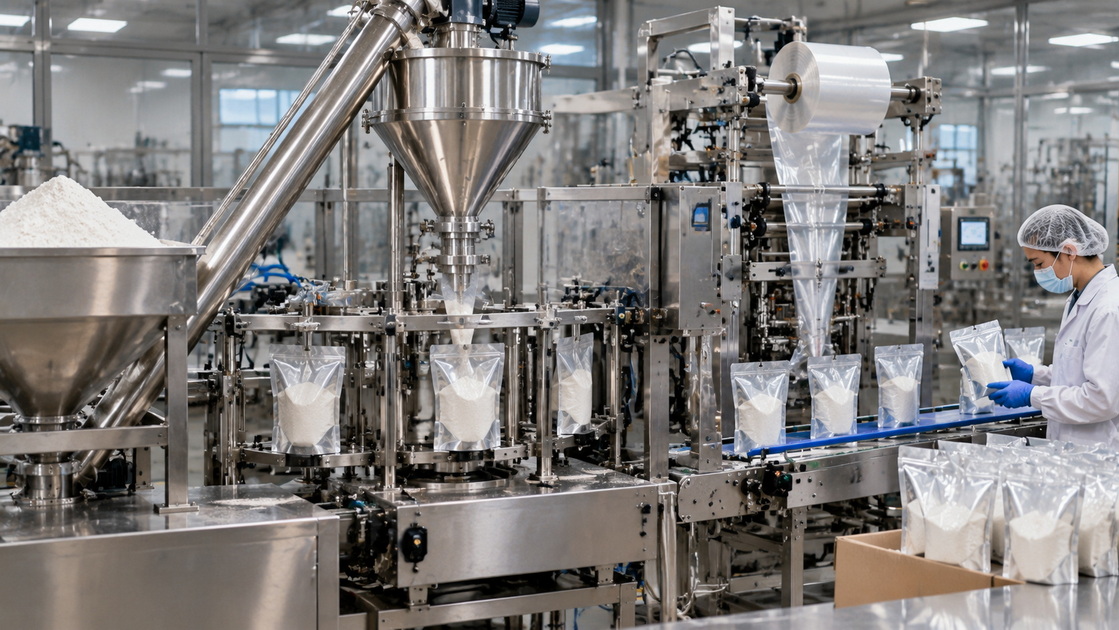
Two powders with the same target fill weight may run very differently. One may flow easily into a narrow pouch. Another may bridge in the hopper, cling to equipment, or rise into the sealing area as dust. A successful trial with one powder does not establish performance with another. Flow behavior, bulk density, moisture sensitivity, and static charge all matter when specifying a filling system.
The pouch adds another set of variables. Its opening must suit the filling nozzle. Its film must seal reliably under actual production conditions. Its size must leave enough room for the powder and a clean top seal. If the product is sensitive to moisture or oxygen, the packaging specification must reflect the intended shelf life—not just its appearance.
Think of the line as a sequence: product feeding → dosing → pouch handling → filling → dust control → sealing → inspection → downstream packing. A weak connection between any two stages can limit output, even when the main machine runs well.
Before comparing equipment quotations, provide representative samples from normal production. Include the easiest and hardest-to-run batches when possible. Tell the supplier whether the material changes after storage, transport, or exposure to humidity.
A practical powder profile should record:
- Flow behavior: Does the product pour freely, form lumps, or bridge above an outlet?
- Bulk density: Does the weight of a fixed volume vary between batches or as the hopper empties?
- Particle characteristics: Is the material fine, dusty, fragile, abrasive, or prone to segregation?
- Environmental sensitivity: Does it absorb moisture or build static charge?
- Cleaning requirements: Are allergens, flavors, colors, or incompatible chemicals involved?
Do not rely on a generic label such as "protein powder" or "detergent powder." A blended formulation may behave differently from another product in the same category. Ask the equipment supplier to test your actual product in your intended pouch.
| Filling method | Consider it when | Confirm during testing |
|---|---|---|
| Auger filling | The product is fine or cohesive and needs controlled screw dosing | Bridging, dust release, fill-weight consistency, and cleaning access |
| Net-weight filling | Weight control is a priority or bulk density varies | Cycle time, scale stability, product transfer, and final pack weight |
| Volumetric cup filling | The product flows consistently and its bulk density is stable | Weight drift across batches and throughout a production run |
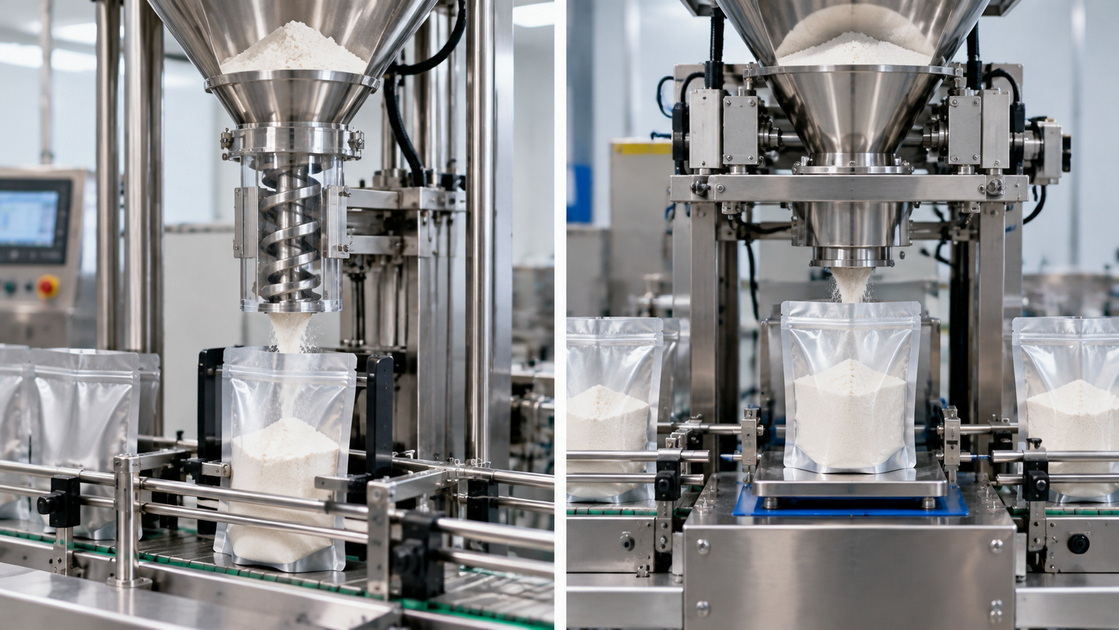
An auger meters material through a rotating screw; a net-weight system measures a dose by weight. A fixed-volume method can be more sensitive to changes in bulk density. No method guarantees a particular accuracy across every powder, fill weight, and speed. Request measured results under agreed trial conditions, including how many packs were weighed and when samples were taken.
A premade pouch machine opens, fills, and seals a pouch supplied as a finished package. It may suit a project where the chosen retail format, artwork, or closure is central to the product specification. A form-fill-seal system makes the pouch from rollstock before filling and sealing it. Both approaches can package powders, but the available formats, material handling, machine layout, and changeover work must be evaluated together. Industry equipment listings show powder applications across horizontal form-fill-seal and other pouching configurations.
Ask the supplier to demonstrate the exact format you intend to buy. A standard flat sachet, stand-up pouch, and zippered pouch do not pose identical opening or sealing challenges. If a zipper or other fitment is required, establish how it affects the filling path, seal area, usable pack volume, and inspection plan.
Do not select film based on appearance alone. Work with your packaging-material supplier to define the intended moisture and oxygen protection, heat-seal behavior, storage conditions, and shelf-life testing plan. Confirm that the proposed machine can handle the approved material consistently; changing film late in the project may change the sealing results.
A brochure may state that a machine "supports multiple pouch sizes." That does not tell you how long an operator needs to change guides, tooling, recipes, and film or pouch supplies. Request a witnessed changeover between your two most important products.
Record the elapsed time from the last acceptable pack of Product A to the first acceptable pack of Product B. Include cleaning and verification steps where required. This provides a more useful planning figure than an adjustment time measured with the product path empty. PMMI's acceptance-testing guidance recommends testing changeovers with the operators and technicians who will use the equipment.
Powder in the sealing area can compromise pouch integrity, even when a pack initially looks acceptable. Dust can escape during the product drop, rise as air leaves the pouch, or cling to film through static effects. In practice, sealing is a filling-system issue as much as a sealing-jaw issue.
Ask the supplier to assess the full transfer path rather than adding a dust collector as an afterthought. Depending on the powder and line design, potential measures include an enclosed transfer path, appropriate nozzle position, controlled filling timing, extraction near the release point, and access for routine cleaning. Test any proposed solution with actual product; an extraction setting that helps one material may disturb another.
During the trial, inspect pouches at startup, normal speed, after a pause, and as the hopper level changes. Examine the sealing zone before and after a sustained run. Record visible contamination and rejected packs rather than accepting a general claim that the line is "dust-free."
A clean-looking seal is a useful first check, not a complete test. Agree in advance which tests suit the pouch and product. Options may include visual inspection, a suitable leak test, and a measured seal-strength test. ASTM F88 is a method for measuring flexible-package seal strength; it should not be presented as proof, by itself, that a finished powder pouch is leak-free.
Establish acceptance limits with your packaging and quality teams. Then test samples made with the real film and powder at the proposed production settings. If seal failures appear, investigate the filling drop, dust, pouch handling, and sealing conditions together before increasing temperature alone.
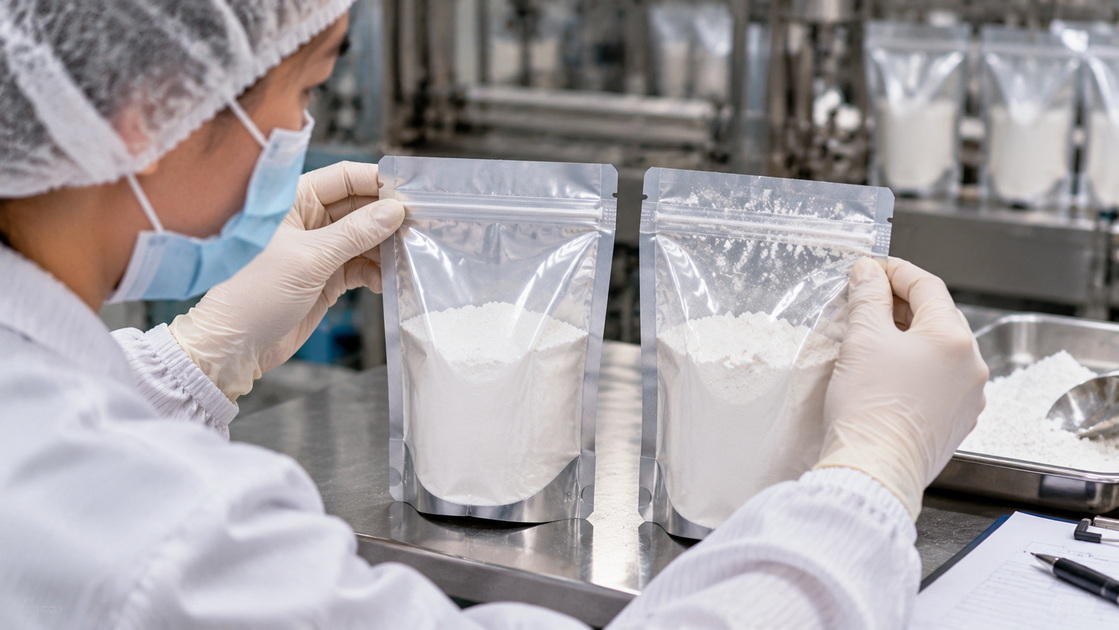
For food applications in the United States, equipment used to pack food must be adequately cleanable and maintained to protect against contamination and allergen cross-contact. Food-contact surfaces must also be suitable for their intended use. That makes access to product-contact areas, hopper design, seams, and the cleaning procedure important specification questions—not optional details to settle after installation.
Request drawings or photographs showing how operators reach the filler, product-contact parts, pouch-transfer area, and sealing zone. Define who will remove parts, which tools are needed, and how the equipment will be checked before restarting after cleaning.
Some powdered materials can present a combustible dust hazard when dispersed in air under certain conditions. OSHA identifies examples that include flour and sugar and notes that dust properties can vary with particle size and moisture. Do not assume a powder is safe—or hazardous to the same degree as another material—based solely on its product name.
If a combustible-dust hazard may exist, involve qualified site safety personnel before finalizing the system. Assess the material, conveying path, dust collection, ignition sources, housekeeping, and applicable equipment requirements as one installation. A supplier's standard dust-extraction option is not, on its own, a complete site safety assessment.
A factory acceptance test (FAT) should show whether the agreed machine performs its defined functions before shipment. A site acceptance test (SAT) then checks performance in the operating environment. PMMI advises buyers to set measurable FAT criteria early and use production-representative materials; a short demonstration with substitute material can miss important issues.
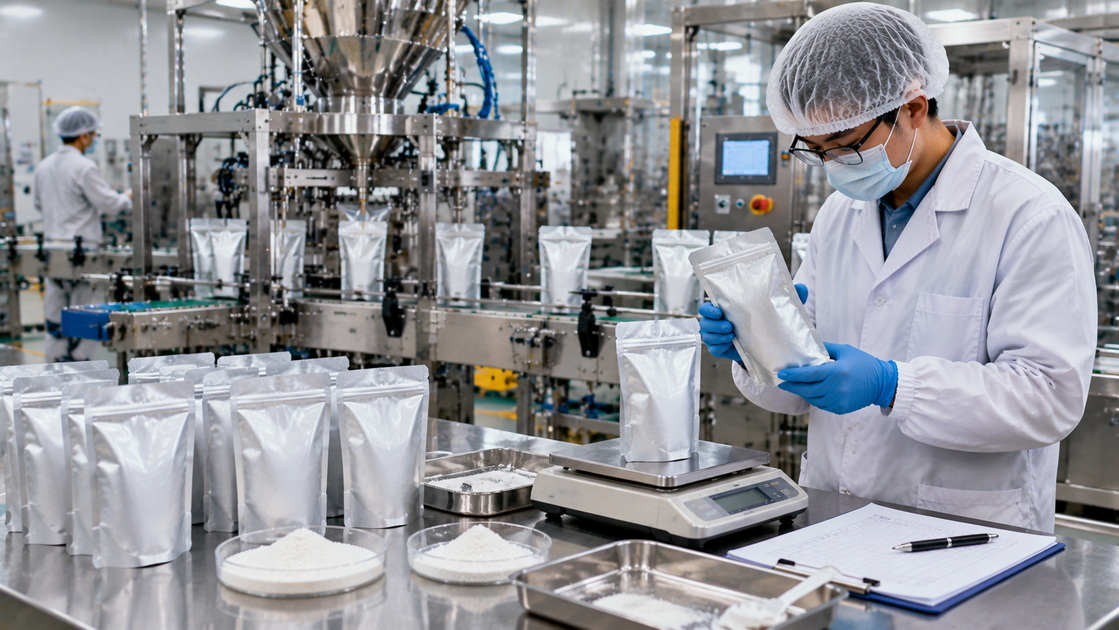
Include the following in the request for quotation and the agreed test protocol:
1. Products and formats: Name the powder batches, pouch dimensions, materials, closures, and fill weights to be tested.
2. Output: Define the number of acceptable finished packs required during a stated run time—not merely the machine's empty-cycle rate.
3. Weight performance: Specify sampling frequency, measurement method, and acceptable results for each tested product.
4. Seal and appearance: State how the team will check contamination, seal quality, pouch presentation, and rejected packs.
5. Operating interruptions: Test a planned stop, restart, low-product condition, and relevant alarms or interlocks.
6. Changeover and cleaning: Have operators demonstrate the agreed procedures and record the time required.
7. Handover: Confirm manuals, drawings, recipes, spare-parts information, and unresolved actions before sign-off.
This protocol addresses three concerns often raised in equipment reviews: whether customization works in production, whether support and documentation are usable, and whether an integrated line operates as promised. The Pallas page includes testimonials about these topics, but they describe Pallas customers—not HLun Pack installations.
A lower purchase price may not produce a lower cost per acceptable pouch. Compare alternatives using the same production assumptions and a simple decision worksheet.
Start with the number of saleable packs per shift. Account for planned cleaning, changeovers, rejects, and stoppages. Then add recurring costs: pouch or rollstock material, product overfill, labor, wear parts, utilities, and maintenance. Keep one-time expenses—installation, training, line integration, and additional inspection equipment—visible rather than hiding them in a headline machine price.
For example, a quoted machine rate of 60 pouches per minute does not mean 60 saleable pouches per minute across a shift. If a powder requires frequent seal-area cleaning or a long flavor changeover, the effective output will be lower. The point is not to assume a standard discount from rated speed. Measure the losses with your material and operating schedule, then compare proposals on that basis.
Also identify responsibility at each interface. Who supplies and sizes the feeder? Who verifies the pouch material? Who integrates the checkweigher, reject system, coder, and downstream packing equipment? Who responds if the combined line misses the agreed acceptance criteria? Written answers reduce the risk that individually functioning machines fail as a system.
To discuss a powder packaging solution, send HLun Pack the information that determines equipment fit:
- Product description, representative samples, and any known flow or dust issues.
- Target fill weights, required pack weights, and expected production schedule.
- Pouch samples or drawings, material specifications, and closure requirements.
- Cleaning, allergen, safety, and site requirements.
- Available floor space, utilities, upstream feeding method, and downstream equipment.
- Your proposed FAT criteria and target commissioning date.
Ask HLun Pack for a product-and-pouch trial plan before choosing a configuration. A useful proposal should identify the proposed filling method, pouch-handling approach, dust-control concept, inspection points, responsibilities at line interfaces, and the performance conditions to verify. This is a stronger basis for a purchasing decision than an unsupported promise of speed.
There is no universal best machine. Start by testing the actual powder and pouch. An auger filler is often considered for fine or cohesive powders, but nozzle design, dust management, pack weight, and sealing performance must be checked as a complete process.
Choose after defining your pouch design, material, production volume, and changeover needs. A premade system handles supplied pouches; a form-fill-seal system makes them from rollstock. Request trials of the exact format and material rather than selecting solely from a category description.
Potentially, but compatibility is not guaranteed. Compare the products' flow behavior, dust, cleaning requirements, fill weights, and pouch formats. Include the most difficult product changeover in the acceptance test.
Reduce uncontrolled powder release near the pouch opening and verify that the sealing area stays clean during a sustained run. Evaluate the filling path, dust control, pouch transfer, and seal settings together. Use agreed inspection and testing methods to confirm the result.
It describes a rate under particular conditions, not necessarily the number of acceptable packs you will make across a shift. Ask for the tested powder, pouch, fill weight, run duration, and reject count. Compare saleable output after cleaning and changeovers.
Use representative powder and pouches. Agree on run time, output, fill-weight checks, seal checks, stops and restarts, changeovers, safety functions, and documentation before the test begins. Record results and open issues for sign-off.
No. Equipment selection and installation must be assessed for the intended food, cleaning process, contamination risks, and applicable requirements. For U.S. food operations, 21 CFR § 117.40 addresses equipment cleanability, maintenance, and food-contact surfaces.
1. [Pallasmt, "Pouch Packaging Machines"] — Source page reviewed for its product categories, claims, FAQs, and customer-review themes. Its testimonials are not attributed to HLun Pack. [pallasmt]
2. [H&H Design Manufacturing, "How to Choose the Right Powder Filling Machine"] — Background on powder properties and filling-method selection; any supplier-specific performance claims require independent testing. [hhdesignmfg]
3. [PMMI ProSource, "Horizontal Form/Fill/Seal"] — Industry equipment listings and examples of powder pouching applications. [prosource]
4. [NOMATECH, "How to Deal With Packaging Powdery Products"] — Practical discussion of dust generation, seal contamination, and product trials. [nomatech]
5. [21 CFR § 117.40, "Equipment and Utensils"] — U.S. food-equipment requirements concerning cleanability, maintenance, and food-contact surfaces. [law.cornell]
6. [OSHA, "Hazard Communication Guidance for Combustible Dusts"] — Guidance on identifying combustible-dust hazards and considering dust-control measures; the publication states that it is advisory, not a regulation. [osha]
7. [Instron, "ASTM F88 Seal Strength of Flexible Barrier Materials"] — Explanation of what the seal-strength method measures and its limits. [instron]
8. [PMMI ProSource, "Roadmap for a Successful Factory Acceptance Test"] — Guidance on measurable FAT plans, representative materials, operator participation, and FAT versus SAT. [prosource]


