


close
Choose Your Site
Global
Social Media
Views: 278 Author: HLun PACK Publish Time: 2026-09-11 Origin: Site


Content Menu
● Juice Spout Pouch vs PET Bottle at a Glance
● What Is a Juice Spout Pouch?
>> Common Juice Spout Pouch Structures
● Juice Spout Pouch vs PET Bottle: Detailed Comparison
>> 1. Material Use and Package Weight
>> 2. Freight, Warehousing, and Total Delivered Cost
>> 3. Product Protection and Shelf Life
>> 4. Filling Equipment and Production Efficiency
>> 5. Consumer Convenience and Brand Experience
>> Where Juice Spout Pouches Can Perform Well
>> Where PET Bottles Can Perform Well
● Decision Framework for Beverage Brands
● Expert Checklist Before You Switch Formats
● FAQ
>> 1. Are juice spout pouches better than PET bottles?
>> 2. Can juice be hot-filled into a spout pouch?
>> 3. Are spout pouches recyclable?
>> 4. Why do juice brands still use PET bottles?
>> 5. Which package is cheaper: a juice spout pouch or a PET bottle?
>> 6. What juice products are best suited to spout pouches?
>> 7. Does a spout pouch provide enough barrier for shelf-stable juice?
When beverage brands compare a juice spout pouch vs PET bottle, the right answer is rarely "one format wins in every situation." A juice spout pouch can reduce material use, improve freight efficiency, and create a distinctive on-shelf experience. A PET bottle, meanwhile, offers excellent rigidity, familiar consumer handling, strong filling-line compatibility, and a more established recycling stream in many markets.
For juice, smoothies, fruit purées, functional drinks, dairy alternatives, and liquid nutritional products, the best packaging choice depends on the product formula, shelf-life target, distribution channel, consumer segment, filling process, sustainability goals, and total delivered cost—not simply the unit price of the package.
At HLun Pack, we work with flexible packaging and packaging-equipment applications. From an industry perspective, the most effective packaging projects begin by matching the package structure, spout system, and machinery configuration to the real product and supply-chain conditions.
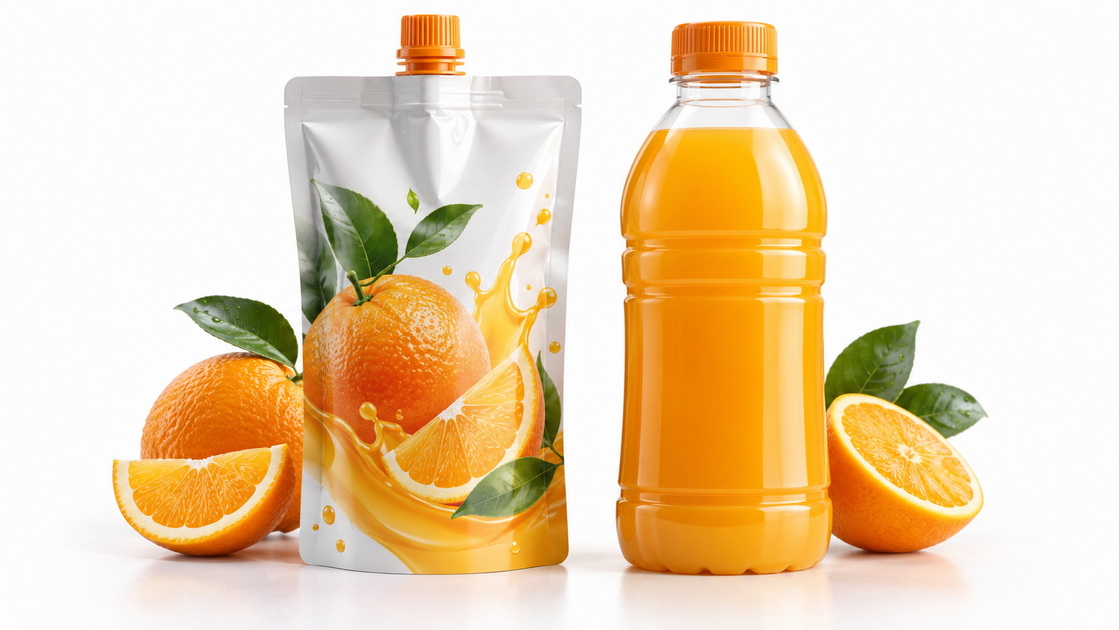
A juice spout pouch is a flexible package made from one or more films, usually with a fitment and cap that allow filling, pouring, drinking, and resealing. It may be produced as a stand-up pouch, shaped pouch, corner-spout pouch, or center-spout pouch.
A PET bottle is a rigid container made primarily from polyethylene terephthalate. PET is widely used for water, juice, carbonated beverages, edible oils, and other liquid products because it is lightweight compared with glass, transparent, and compatible with many established bottling processes.
| Comparison Factor | Juice Spout Pouch | PET Bottle |
|---|---|---|
| Package type | Flexible packaging | Rigid packaging |
| Typical materials | PE, PET, PP, EVOH, aluminum foil, or multilayer laminates | PET bottle, closure, label, and sometimes shrink sleeve |
| Product protection | Strong when barrier films are correctly specified | Strong physical protection and stable form |
| Shipping efficiency | Excellent; empty pouches ship flat | Lower; empty bottles occupy significant volume |
| Consumer experience | Lightweight, squeezable, portable, resealable | Familiar, stable, easy to pour and hold |
| Shelf appearance | Large printable surface and custom shape options | Transparent display, molded shapes, label flexibility |
| Recycling profile | Depends strongly on the material structure and local collection infrastructure | More established recycling stream in many regions |
| Machinery needs | Spout pouch filling and capping equipment | Bottle blowing, rinsing, filling, capping, labeling, and packing systems |
| Best-fit products | Purées, kids’ drinks, concentrates, refill packs, sauces, functional liquids | Ready-to-drink juice, premium beverages, carbonated products, large-volume drinks |
A juice spout pouch combines flexible laminated packaging with a plastic spout and cap. The pouch can be made in many formats, including stand-up, flat-bottom, shaped, and refill pouches. The spout may sit at the top center, in a corner, or on the front panel depending on filling equipment, pouring behavior, and visual design.
For many brands, the key value is that the pouch performs multiple jobs at once:
- Protects the product from moisture, oxygen, light, and contamination when designed correctly
- Communicates the brand through high-impact printed panels
- Improves portability for consumers
- Reduces empty-package storage volume
- Supports resealability through screw caps or specialty closures
- Allows custom formats that can stand out in crowded beverage categories
However, not every pouch is appropriate for every juice product. A low-acid beverage, a heat-processed juice, a product with pulp, or a product requiring a long ambient shelf life may need a more sophisticated material structure and carefully validated filling process.
The material structure should be selected based on the product's oxygen sensitivity, acidity, filling temperature, shelf-life objective, and distribution environment.
| Typical Structure | Common Benefit | Suitable Product Considerations |
|---|---|---|
| PET/PE | Good printability and basic moisture resistance | Shorter shelf-life beverages and chilled products |
| PET/Metallized film/PE | Improved light and oxygen barrier | Light-sensitive juices, concentrates, and purées |
| PET/AL/PE | Very high barrier against oxygen, moisture, and light | Shelf-stable products requiring maximum protection |
| Mono-PE or mono-PP designs | Improved recyclability potential in specific systems | Must be validated for barrier, sealing, and local recycling conditions |
| Retort-compatible structures | Withstands retort processing | Heat-processed foods, sauces, and selected beverage applications |
PET bottles remain one of the most common beverage packaging formats globally. They are lightweight compared with glass, transparent, moldable, and familiar to consumers. A brand can use the bottle's shape, label, closure, and color to create visual differentiation.
For juice brands, PET bottles work especially well when the product needs:
- A stable upright display
- Clear product visibility
- A familiar pouring experience
- High-speed production
- Strong top-load resistance during distribution
- Compatibility with existing bottle filling lines
- A recognized recycling pathway in the target market
PET also enables various bottle formats, from small single-serve drinks to large family-size juice bottles. Depending on the application, bottles may use hot-fill PET, aseptic PET, standard cold-fill PET, multilayer PET, or recycled PET content.
In the United States, the Environmental Protection Agency reported that PET bottles and jars had a recycling rate of 29.1% in 2018. That rate is far from ideal, but it illustrates an important practical advantage: PET bottles generally have more established collection and recycling systems than many multilayer flexible packages.
A major advantage of flexible packaging is material efficiency. A spout pouch uses thin films instead of a rigid wall, so it typically requires substantially less packaging material for the same product volume.
This does not automatically make every pouch "more sustainable." A pouch containing several inseparable material layers may be difficult to recycle in conventional systems. Still, reducing source material and transportation weight can be meaningful when evaluated across large production volumes.
PET bottles use more resin per unit because the package must maintain its shape independently. The bottle must also tolerate handling, stacking, capping pressure, and distribution loads.
Choose a spout pouch if:
- Your brand ships long distances
- You need to reduce warehouse space for empty packaging
- You sell in e-commerce or direct-to-consumer channels
- You want refill or concentrate packaging
- You need a lightweight kids' beverage format
Choose a PET bottle if:
- The product needs a rigid, premium presentation
- Consumers expect a bottle in the category
- You rely on top-load strength and rigid secondary packing
- Your supply chain already uses bottle-oriented machinery
Empty PET bottles are bulky. They must be transported, stored, handled, and protected in their final shape. Even when bottles are produced close to the filling location through blow-molding systems, they still require substantial space after formation.
Empty spout pouches are normally delivered flat. This can significantly reduce inbound freight volume and warehouse footprint. For an exporter, co-packer, or brand operating across multiple markets, that difference may be commercially important.
When assessing cost, do not compare only the price per pouch or price per bottle. Use a total delivered cost model:
Total Delivered Cost=Packaging Cost+Freight+Warehousing+Labor+Equipment Cost+Damage and Returns+End-of-Life Fees
A pouch can cost more per individual unit in some specifications—especially with custom spouts, high-barrier films, or low order quantities—but still reduce overall supply-chain cost through better cube efficiency.
Both formats can protect juice effectively, but the design strategy differs.
A PET bottle provides strong physical protection. It resists crushing better than a pouch and can be suitable for conventional retail distribution. It also offers transparency, which can help brands showcase juice color, fruit particles, or premium ingredients.
A spout pouch can offer exceptional barrier performance when it uses appropriate films, coatings, or foil layers. A high-barrier pouch can protect products from oxygen, moisture, and light. This is particularly useful for products where oxidation, flavor loss, vitamin degradation, or light exposure are major concerns.
However, pouch projects demand careful validation:
1. Define the juice formulation, pH, viscosity, pulp content, and preservatives.
2. Confirm the intended filling method: cold fill, hot fill, aseptic fill, or retort.
3. Select a barrier structure based on shelf-life requirements.
4. Test seal strength, leak resistance, drop performance, and cap torque.
5. Conduct shelf-life and migration validation before commercial launch.
PET bottle production usually involves a familiar sequence: bottle supply or blow molding, rinsing, filling, capping, labeling, secondary packaging, and palletizing. This can be highly efficient at large scale.
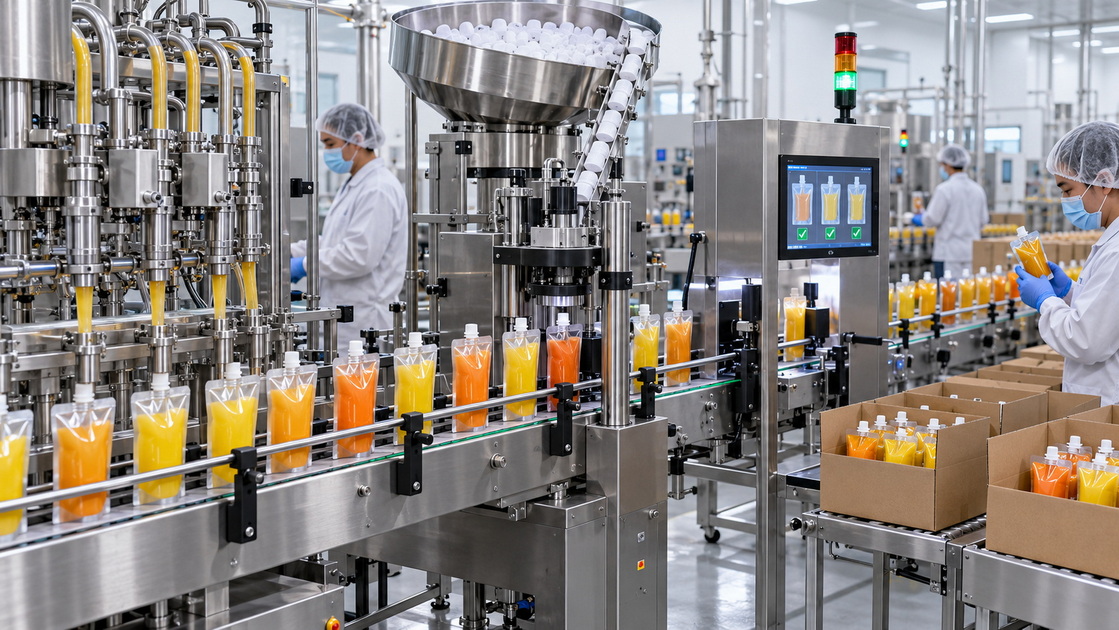
Juice spout pouch production uses a different workflow. Depending on the equipment configuration, it may involve premade spout pouch filling and capping, form-fill-seal processes, spout insertion, sealing, coding, inspection, and case packing.
For brands considering a switch, machinery should be evaluated early—not after pouch artwork has been finalized.
Key equipment questions include:
- What fill volume range is required?
- Does the juice contain pulp, fiber, or particulates?
- Is hot filling required?
- What are the target output speeds?
- Is automatic cap feeding needed?
- What leak-detection standard is required?
- Will the package be packed upright, flat, or in display cartons?
- Does the line need quick changeovers for multiple pouch sizes?
At HLun Pack, an integrated approach can reduce risk because packaging design and packaging machinery must work together. The pouch dimensions, spout diameter, cap type, film stiffness, and filling temperature should all be compatible with the selected line configuration.
Consumer expectations differ by category.
A PET bottle feels familiar. It is easy to grip, stable on a table, and practical for pouring into a cup. Its rigid structure may also communicate quality in premium juice, cold-pressed beverage, and family-size product segments.
A juice spout pouch is especially strong for portability. It can be squeezed, packed into lunch boxes, carried outdoors, and resealed. For children's fruit purées and on-the-go nutrition products, the pouch format can improve convenience while reducing the risk of breakage.
Spout pouch advantages for consumers include:
- Lower carry weight
- Easy opening and resealing
- Less breakage risk
- Potentially lower product waste
- Large area for instructions and brand storytelling
- Comfortable use for children and active consumers
PET bottle advantages for consumers include:
- Rigid and familiar handling
- Easy product visibility
- Reliable upright storage
- Simple pouring
- Perceived premium quality in many beverage categories
The decision should reflect the intended consumption moment. A 200 ml children's fruit drink, a 500 ml sports nutrition beverage, and a 1 L family juice carton replacement may each require a different answer.
The sustainability discussion should be balanced. A juice spout pouch may use less material and require less transport space. A PET bottle may be easier for consumers to recognize and place into available recycling systems.
The U.S. FDA regulates substances that come into contact with food, including packaging materials. For food-contact packaging, each relevant component must be suitable for its intended use, including conditions such as product type, contact time, and temperature.
- Lower package weight per filled unit
- Flat shipping and storage before filling
- Potentially reduced transportation burden
- Opportunities for mono-material PE or PP pouch development
- Potential for refill-pack models
- Widely recognized as recyclable by consumers
- Better-developed recycling collection in many markets
- Recycled PET content can reduce virgin resin demand
- Durable format that may support refill or reuse systems in certain models
The key is to avoid unsupported claims. A multilayer pouch is not automatically recyclable just because it uses less plastic. A PET bottle is not automatically circular simply because PET is recyclable. Actual environmental performance depends on package design, recycled content, local collection, sorting capability, consumer behavior, transport distance, and end-of-life infrastructure.
Best practice for packaging claims: State specific, verifiable facts. For example, use "designed for recycling in applicable PE film collection streams" only when the actual structure and market infrastructure support that claim. Avoid broad statements such as "100% eco-friendly."
Use this practical selection framework before choosing between a juice spout pouch and a PET bottle.
| Your Priority | Better Starting Option | Why |
|---|---|---|
| Lowest empty-package freight volume | Juice spout pouch | Ships flat and uses less storage space |
| Familiar beverage presentation | PET bottle | Consumers already understand the format |
| Kids’ fruit purée or snack drink | Juice spout pouch | Lightweight, squeezable, portable, and resealable |
| Premium visible juice product | PET bottle | Transparency and rigid form support shelf appeal |
| Light-sensitive or oxygen-sensitive formula | High-barrier spout pouch | Can use metallized or foil barrier structures |
| Existing high-speed bottling line | PET bottle | May require less production-line change |
| New flexible-packaging product launch | Juice spout pouch | Enables differentiation and custom graphics |
| Strong local PET recycling system | PET bottle | More established collection route in many regions |
| Export-oriented packaging efficiency | Juice spout pouch | Better shipping cube and lower empty-pack volume |
Before converting from PET bottles to juice spout pouches—or the other way around—validate the following points.
1. Product compatibility: Confirm the package material works with juice acidity, oil content, pulp, vitamins, and additives.
2. Filling method: Identify whether the product requires cold filling, hot filling, aseptic filling, or retort processing.
3. Shelf-life validation: Run real-time and accelerated testing for flavor, color, microbial safety, leakage, and seal integrity.
4. Distribution testing: Test drops, compression, vibration, puncture risk, and temperature exposure throughout transport.
5. Consumer usability: Evaluate opening force, cap ergonomics, pouring control, resealability, and product evacuation.
6. Recycling reality: Assess local collection and sorting systems before making recyclability claims.
7. Machinery integration: Confirm the pouch or bottle design matches the filling, capping, inspection, coding, and packing equipment.
8. Commercial feasibility: Compare total delivered cost, not only package purchase price.
The debate over juice spout pouch vs PET bottle is really a product-and-system design decision.
A juice spout pouch is often the better choice for portable drinks, fruit purées, concentrates, children's products, export programs, e-commerce, and brands that want to reduce package weight while maximizing visual print area. It is also a strong option when a brand wants flexible, modern packaging that creates shelf differentiation.
A PET bottle is often the better choice for mainstream ready-to-drink juice, transparent premium beverages, high-speed bottling environments, rigid shelf presentation, and markets with strong PET recycling access.
The strongest strategy is not to choose based on trends. Choose based on product protection, operational capability, consumer behavior, logistics, and measurable sustainability outcomes.
Ready to develop a better juice packaging system? Contact HLun Pack to evaluate your juice formulation, pouch or bottle requirements, filling process, target output, material structure, spout design, and integrated packaging machinery solution. A feasibility review before mass production can prevent costly leakage, shelf-life, and equipment-compatibility problems later.
Not in every case. Juice spout pouches are usually better for lightweight transport, portable use, custom graphics, and flexible packaging efficiency. PET bottles are often better for rigid presentation, transparent product display, conventional bottling operations, and established recycling collection.
Yes, but only when the pouch structure, spout, cap, seals, and filling equipment are designed and validated for the required hot-fill temperature. Brands should conduct seal, leakage, migration, and shelf-life testing before commercial production.
It depends on the material construction and the recycling infrastructure where the pouch is sold. Mono-material PE or PP designs may have better recycling potential than multilayer laminate structures, but local collection and sorting capability remain essential.
PET bottles provide rigidity, visual clarity, easy pouring, high-speed filling compatibility, and a familiar consumer experience. They also benefit from more established recycling systems in many markets.
The answer depends on volume, material structure, filling method, freight, warehouse space, machinery, secondary packaging, and damage rates. A pouch may reduce logistics costs even when its per-unit purchase price is not lower.
Spout pouches are commonly used for fruit purées, children's drinks, smoothie bases, concentrated juice, functional shots, dairy alternatives, sauces, and other liquid or semi-liquid foods.
Yes, when the pouch uses the right barrier materials and is paired with an appropriate filling or thermal-processing method. The required structure depends on the product formula, desired shelf life, light sensitivity, oxygen sensitivity, and storage conditions.
1. U.S. Food and Drug Administration. [Food Ingredients & Packaging]. The FDA explains that it regulates food ingredients and substances that contact food, including packaging materials. [fda]
2. U.S. Food and Drug Administration. [How FDA Regulates Substances That Come into Contact with Food]. Details authorization pathways and safety requirements for food-contact substances. [fda]
3. U.S. Food and Drug Administration. [Regulatory Status of Components of a Food Contact Material]. Explains that food-contact packaging compliance must be assessed component by component. [fda]
4. U.S. Environmental Protection Agency. [Plastics: Material-Specific Data]. Reports a 29.1% recycling rate for PET bottles and jars in 2018. [epa]
5. U.S. Environmental Protection Agency. [Containers and Packaging: Product-Specific Data]. Provides U.S. container and packaging recycling data, including PET bottle and jar figures. [epa]
6. ScienceDirect. [Findings from a Streamlined Life Cycle Assessment of PET Bottles for Beverage Packaging Applications]. Discusses life-cycle assessment approaches for PET beverage packaging. [sciencedirect]
7. Glenroy, Inc. [Spouted Pouch LCA Study]. Provides a packaging-industry comparison of spouted pouches and rigid PET bottles through a life-cycle-assessment lens. [glenroy]


