


close
Choose Your Site
Global
Social Media
Views: 278 Author: HLun PACK Publish Time: 2026-08-04 Origin: Site


Content Menu
● 6: Sterilize or Process the Pouch
● Home Sealing vs Commercial Sealing
● Why Professional Equipment Wins
● FAQs
>> 1. Can you seal a retort pouch at home?
>> 2. Do retort pouches need a pressure cooker after sealing?
>> 3. What is the best tool for home sealing?
>> 4. How do I know if the seal is bad?
>> 5. Why do retort pouches fail after processing?
>> 6. Are retort pouches suitable for commercial food brands?
Retort pouch sealing at home is possible for small-batch, short-term use, but it requires strict attention to pouch quality, seal cleanliness, heat settings, and food safety. Retort pouches are engineered to withstand high-temperature sterilization, so the sealing process must be handled carefully to avoid leaks, contamination, and failure during processing.
For manufacturers, startups, and food brands, this topic matters for a bigger reason: the same sealing principles used at home also shape industrial packaging performance. Understanding them helps you choose the right equipment, reduce seal defects, and decide when a professional retort pouch machine is the safer investment.
A retort pouch is a multilayer flexible package designed to survive heat sterilization, pressure, and long storage life. Typical structures combine outer PET or nylon for durability, an aluminum foil or high-barrier layer for oxygen protection, and an inner polypropylene sealant layer for heat sealing.
Unlike ordinary vacuum bags, retort pouches are made for thermal processing, not just storage. That is why they are used for ready meals, soups, sauces, pet food, and military rations. When properly sealed and processed, they can support shelf-stable products without refrigeration.
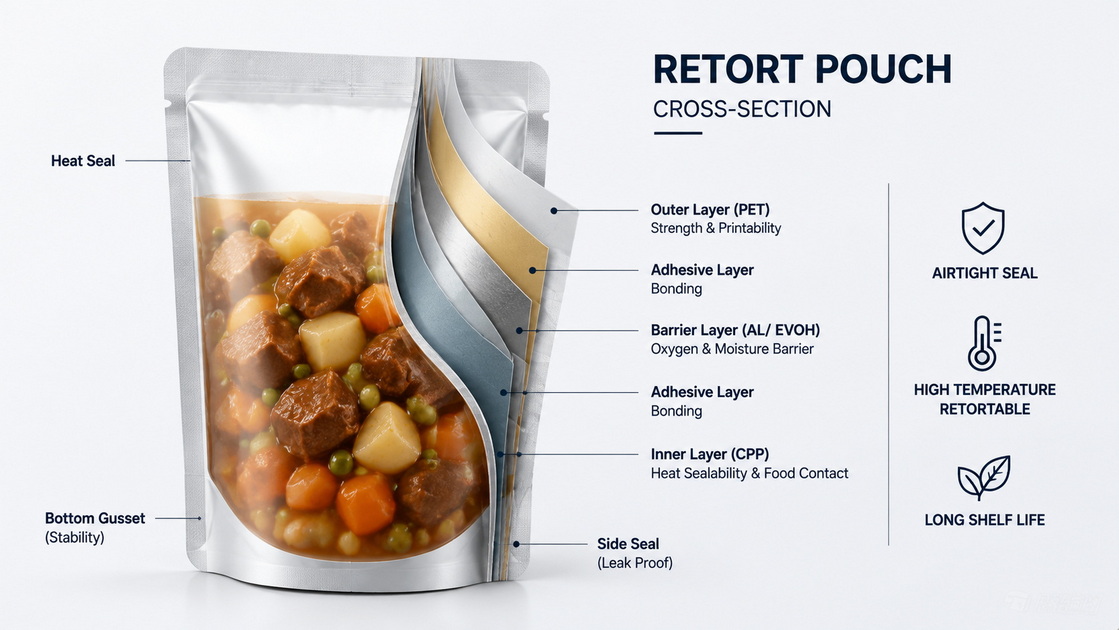
A strong seal is not just about preventing spills. It is the barrier that keeps microorganisms, oxygen, moisture, and contaminants out of the pouch. If the seal area contains product residue, oil, or wrinkles, the seal can develop channels or weak bonds that fail later during retorting.
This is especially important because thermal processing puts extra stress on the package. Heat, pressure, and cooling cycles can weaken marginal seals that seemed fine before processing. In other words, a pouch that looks acceptable before the retort may still fail afterward.
Before sealing, gather the right tools and make sure your pouches are truly retort-grade. A retort-grade pouch should be heat-resistant, food-safe, and designed for sterilization conditions, not just room-temperature packaging.
Recommended tools include:
- Impulse heat sealer. This is the best home-use option for consistent heat sealing.
- Vacuum sealer. Helpful for air removal, though it should be paired with a proper heat seal.
- Household iron. A budget alternative, but it is less precise and should only be used carefully.
- Flat cutting board or table. The sealing area must be clean, dry, and level.
- Clean cloth or parchment paper. Useful as a barrier when using an iron.
- Scissors and ruler. These help keep pouch edges even and sealing margins consistent.
For commercial packaging, a dedicated sealing system is far more reliable because it controls temperature, pressure, and dwell time more precisely than household tools.
Food preparation is the foundation of safe pouch sealing. Start with fully cooked or properly pre-processed ingredients, especially if you are working with low-acid foods such as meat, poultry, beans, or vegetables.
Keep these points in mind:
- Use fresh ingredients.
- Pre-cook where needed.
- Avoid overfilling.
- Keep the food away from the seal zone.
- Work in a clean, sanitized space.
Low-acid foods require more careful heat processing because they pose a greater food safety risk if sealing or sterilization is incomplete. Acidic foods are generally easier to handle at home, but they still need a reliable seal.
Filling is often where seal failure begins. The pouch should have enough headspace at the top so the seal area stays clean and flat. A common practical target is 1.5 to 2 inches of headspace, though exact requirements depend on pouch size and product type.
Best practices include:
- Leave enough space above the product.
- Wipe away any oil, sauce, or crumbs near the top edge.
- Flatten wrinkles before sealing.
- Keep liquid or particles out of the seal zone.
- Do not trap air unnecessarily.
Too much product in the pouch can distort the seal area and raise the risk of weak bonding. For manufacturers, this is where accurate filling systems create major quality advantages.
Air inside the pouch can reduce heat transfer efficiency and create pressure stress during processing. Removing excess air improves both seal quality and thermal stability.
At home, you can:
1. Press out air gently by hand.
2. Use a vacuum sealer if available.
3. Flatten the opening before applying heat.
Industrial systems often use vacuum chambers or inert gas flushing to improve consistency. That level of control is one reason commercial retort equipment performs better than home methods.
This is the most important step. A true retort pouch seal must fuse the inner sealant layers together cleanly and evenly. The seal area should be flat, smooth, and free of contamination.
Set the machine to a medium-high setting and test on sample pouches first. In general, the seal should be long enough to create a complete bond, with no gaps or burn marks. Press and hold for the recommended dwell time, then let the pouch cool before handling.
If you do not have a sealer, place parchment paper or a thin protective cloth over the seal zone. Apply firm pressure across the top edge for a few seconds, then repeat if needed. This method is less reliable, so test it carefully before using it for food storage.
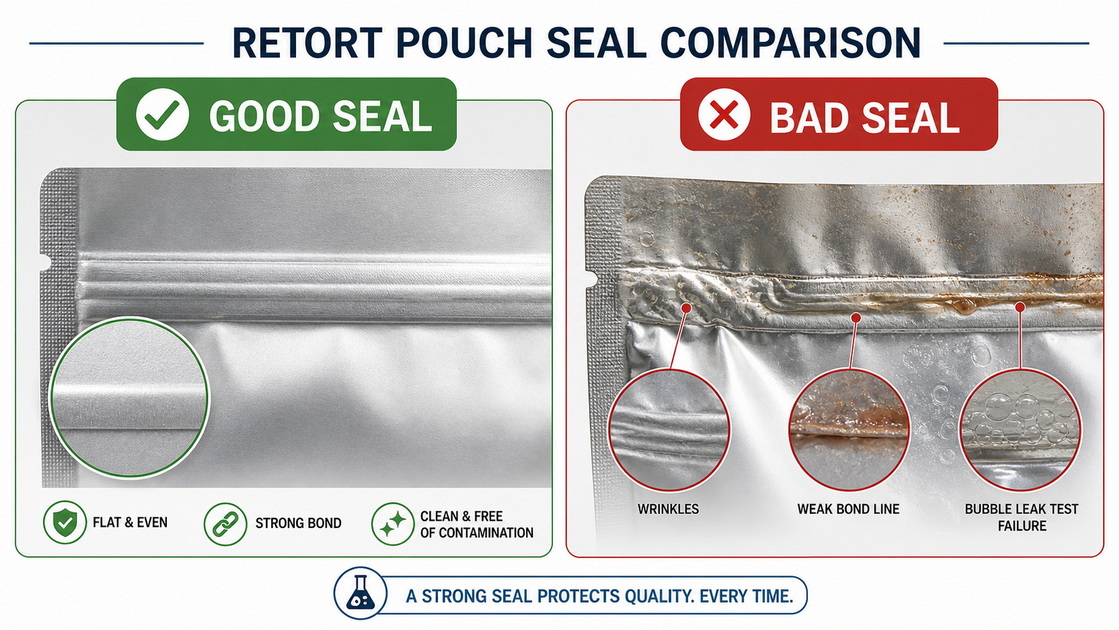
A proper seal should be uniform in width and free of wrinkles, food particles, or edge contamination. For safety, many manufacturers use double seals to add redundancy.
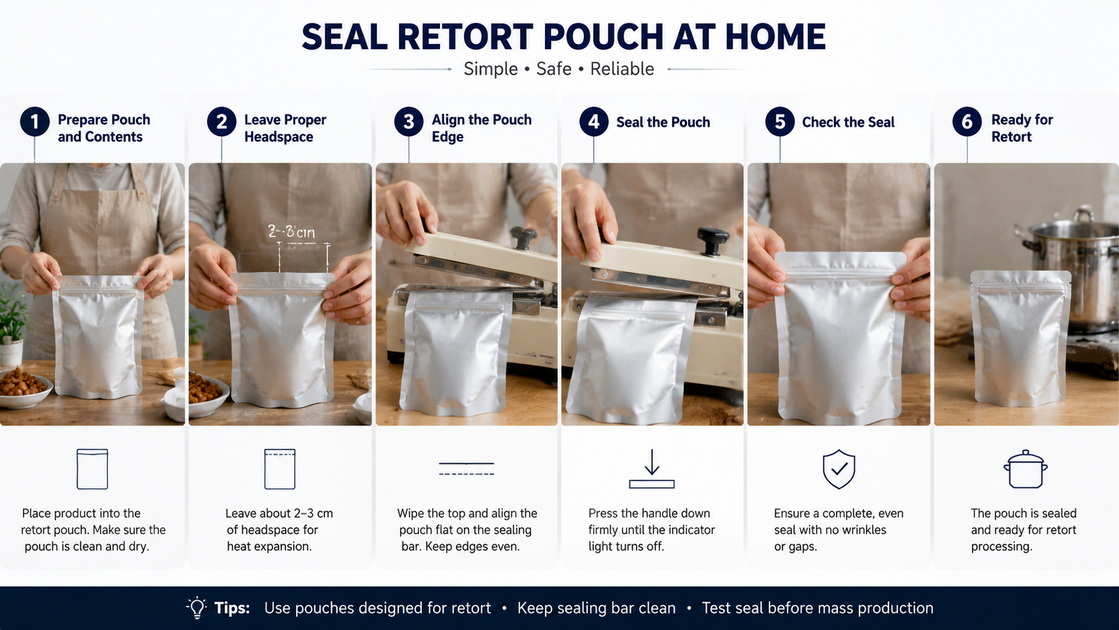
Once sealed, inspect the pouch immediately. Do not assume the seal is good just because it looks closed.
Check for:
- Uniform seal width.
- No trapped particles.
- No wrinkles across the seal.
- No partial bonding.
- No swelling or air leaks.
You can also perform a simple water immersion test by gently pressing the pouch underwater and watching for bubbles. If bubbles appear, the pouch is not sealed properly.
Sealing alone does not make the pouch shelf-stable. Retort pouches are designed for thermal processing, and proper sterilization is essential for safety. For low-acid foods, this is especially critical because botulism risk becomes a serious concern if processing is inadequate.
At home, a pressure cooker or canner may be used for small-batch testing, but it cannot fully replicate industrial retort precision. Processing time and temperature must always match trusted food safety guidance for the specific product.
Even a well-made pouch can fail if the process is inconsistent. Most defects come from filling, sealing, or handling mistakes.
| Problem | Likely Cause | Practical Fix |
|---|---|---|
| Leaking seal | Food residue or moisture in seal zone | Clean and dry the seal area before closing |
| Wrinkled seal | Uneven pouch alignment | Flatten the top edge carefully |
| Weak seal | Low heat, short dwell time, or poor pressure | Adjust settings and test again |
| Bubble leaks after processing | Thermal stress or micro-channels | Improve seal width and reduce residual air |
| Delamination | Material quality or excessive heat stress | Use proper retort-grade materials |
For professional users, repeated seal defects often indicate the need for better equipment, not just better operator technique.
Home sealing can work for experimentation, product tests, or very small batches. However, it does not offer the repeatability needed for commercial food production.
| Factor | Home Sealing | Commercial Sealing |
|---|---|---|
| Seal consistency | Variable | High |
| Temperature control | Limited | Precise |
| Production speed | Slow | Fast |
| Quality assurance | Basic | Standardized |
| Shelf-life reliability | Short-term use only | Long-term stability |
| Best use case | DIY, samples, testing | Market-ready products |
This is where HLun Pack can add value. If the goal is safe, scalable, and repeatable retort pouch production, professional packaging machinery and integrated sealing systems are the smarter long-term solution.
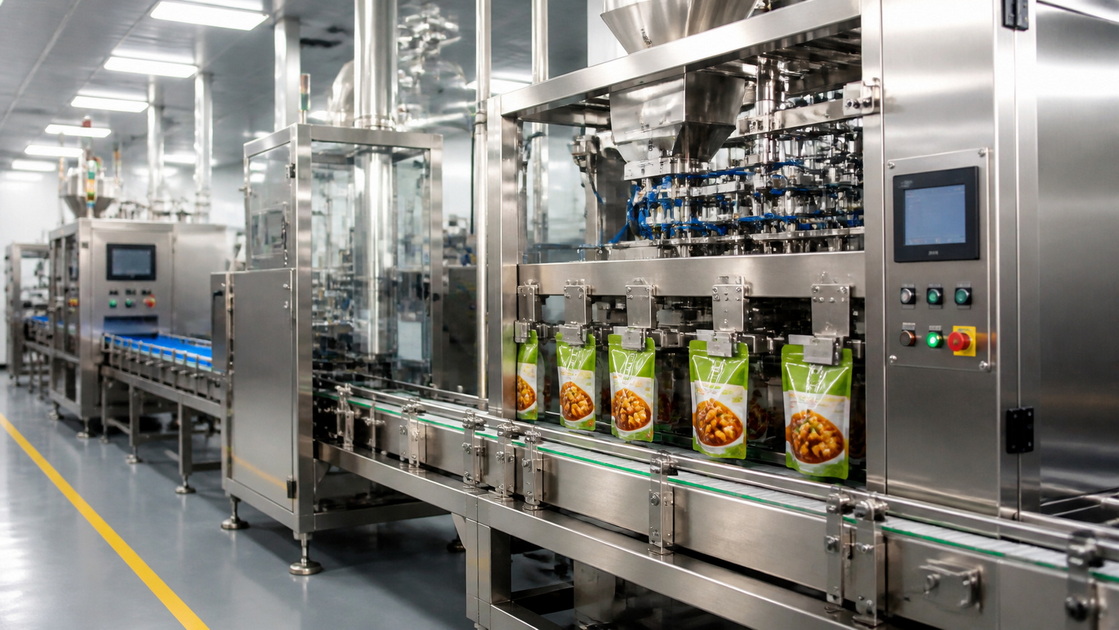
Industrial retort pouch lines are built to control the variables that matter most: seal temperature, pressure, dwell time, pouch alignment, contamination control, and post-process verification. That control reduces spoilage risk and improves consistency across production runs.
For manufacturers, the benefits include:
- Better seal repeatability.
- Higher output.
- Lower defect rates.
- Stronger process control.
- Easier compliance documentation.
In many cases, the right investment is not just a sealer. It is a complete packaging solution that includes filling, sealing, and quality inspection.
If you are moving beyond home use and need reliable retort pouch sealing for commercial production, HLun Pack can support you with packaging machinery and integrated flexible packaging solutions. That is the right path for brands that need consistent seals, higher throughput, and safer shelf-stable packaging.
Yes, but only for small-scale, short-term use. Home methods can create a basic seal, but they do not match the precision or reliability of commercial equipment.
Yes, if you want shelf-stable food. Sealing alone is not enough; the pouch must also be properly processed with heat and pressure.
An impulse heat sealer is the most reliable home option. A household iron can work in an emergency, but it is less consistent.
Look for wrinkles, food residue, incomplete bonding, or bubbles during a water test. Any of these may indicate a leak.
Thermal stress can create weak spots, micro-channels, or delamination that were not visible before processing. That is why post-process testing matters.
Yes, but only when sealed and processed with proper equipment and validated procedures. Commercial retort systems are far more reliable than home methods.
1- [YLTPACK article source].
2- [Canadian Food Inspection Agency: Flexible Retort Pouch Defects Manual].
3- [Huasu Packaging: How to Seal a Retort Pouch at Home? A Comprehensive Guide].
4- [YLTPACK: The Complete Guide to Retort Pouches for Food Manufacturers].
5- [FlexPak: Retort Pouch Leak Testing: Post-Process Seal Verification].
6- [YLTPACK: An Introduction to Automatic Flexible Packaging Machines].


