


close
Choose Your Site
Global
Social Media
Views: 279 Author: HLun PACK Publish Time: 2026-07-28 Origin: Site


Content Menu
● Why Tea Packaging Size Matters
● Tea Packaging Formats Compared
● Material Choices That Protect Aroma
● FAQ
>> 1. What is the best tea packaging bag size for 100 g tea?
>> 2. Which tea packaging format is best for freshness?
>> 3. Are recyclable tea pouches always the best choice?
>> 4. Why does headspace matter in tea packaging?
>> 5. What should tea brands check before choosing packaging?
>> 6. Can tea packaging size improve brand perception?
Tea is sensitive to oxygen, moisture, light, and odor transfer, so the right tea packaging bag size and material structure can directly affect aroma retention, shelf life, and customer experience. For tea brands and packaging buyers, the best packaging decision is not just about holding product weight; it is about matching the pouch format, barrier level, sealing method, and use case to the tea's real storage needs.
Tea packaging size influences more than presentation. A properly sized bag reduces headspace, helps preserve freshness, improves filling efficiency, and supports stronger shelf appeal. When the package is too large, excess air can increase oxidation risk; when it is too small, the tea may be compressed, difficult to seal, or awkward for consumers to use.
For tea brands, size also affects logistics and cost. Smaller pouches can lower material use and shipping volume, while larger formats may be better for wholesale, subscriptions, or family-size retail packs. In short, the best size is the one that balances product protection, consumer convenience, and commercial efficiency.
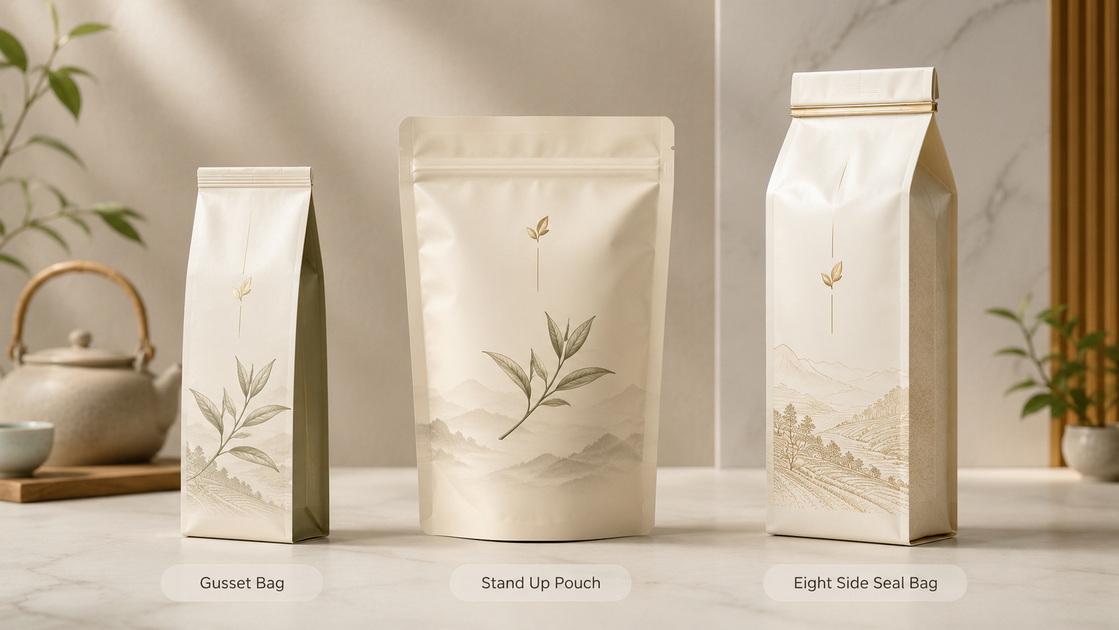
Different tea formats serve different business goals. Gusset bags, stand-up pouches, and eight-side seal bags are all common flexible packaging choices, but each performs differently in display, stability, and freshness protection.
| Format | Best For | Main Advantage | Consideration |
|---|---|---|---|
| Gusset bag | Sample packs, retail, medium volumes | Flexible and cost-effective | Less shelf-stable than some premium formats |
| Stand-up pouch | Premium retail, daily-use tea | Strong shelf presence and reseal convenience | Needs good barrier structure |
| Eight-side seal bag | Premium teas, gift packs, bulk retail | Excellent stability and upscale appearance | Usually higher packaging cost |
This format-first approach helps buyers choose packaging more strategically than size alone. It is especially useful for export-oriented tea brands that need packaging suited to both retail branding and long-distance shipping.
The original article already provides useful size tables for gusset bags, stand-up pouches, and eight-side seal bags. That data is valuable, but it becomes more practical when tied to product positioning and consumer behavior. The table below keeps the original sizing logic while making it easier for buyers to apply in real projects.
| Tea Weight | Gusset Bag Size | Stand-Up Pouch Size | Eight-Side Seal Bag Size | Typical Use |
|---|---|---|---|---|
| 50 g | 10 x 15 + 6 cm | 12 x 20 + 6 cm | — | Sample packs, gifts |
| 100 g | 12 x 20 + 8 cm | 14 x 22 + 8 cm | 15 x 22 + 5 cm | Retail and daily-use packs |
| 250 g | 16 x 23 + 8 cm | 18 x 25 + 8 cm | 18 x 25 + 6 cm | Premium blends, small wholesale |
| 500 g | 22 x 30 + 10 cm | 22 x 30 + 10 cm | 22 x 30 + 7 cm | Family packs, bulk sales |
| 1 kg | — | — | 28 x 35 + 9 cm | Subscription boxes, wholesale |
These dimensions should be treated as starting points, not fixed rules. Actual pouch selection should also consider tea leaf density, fill tolerance, closure type, and whether the product is loose leaf, bagged tea, or flavored tea.
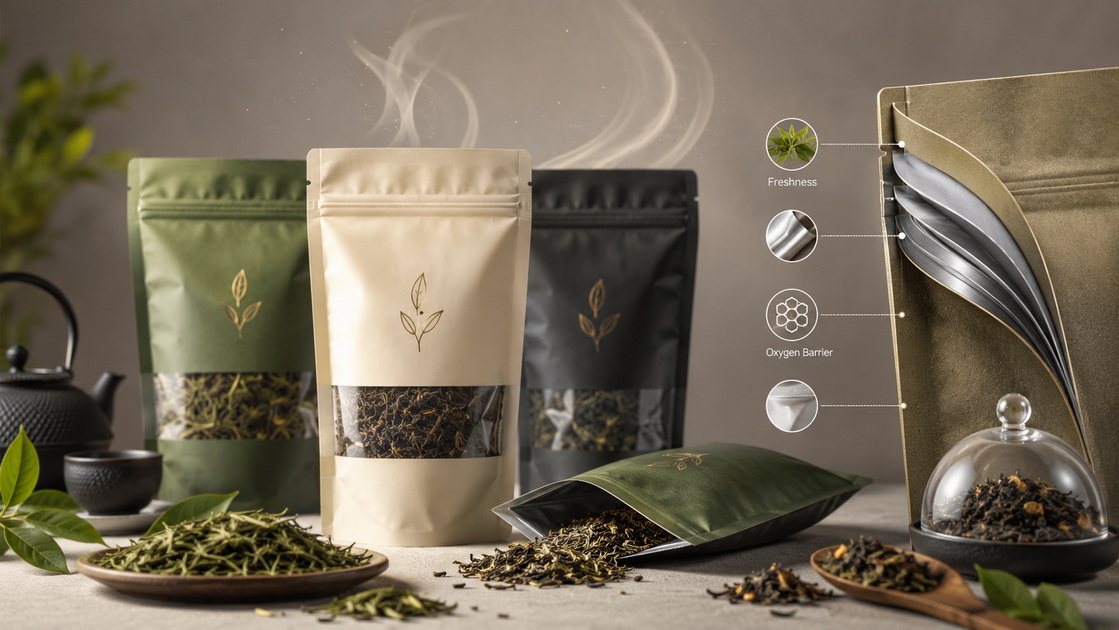
Tea freshness depends heavily on barrier performance. High-barrier structures help reduce oxygen and moisture transfer, while also limiting odor contamination and light exposure. That is why foil laminates, metallized films, and multi-layer flexible structures are widely used in tea packaging.
For brands that want a sustainability message, recyclable or compostable options may also be suitable, but only if they still meet freshness and seal integrity requirements. In many cases, the smartest approach is not to choose the "greenest" material by default, but to choose the lowest-impact material that still protects product quality.
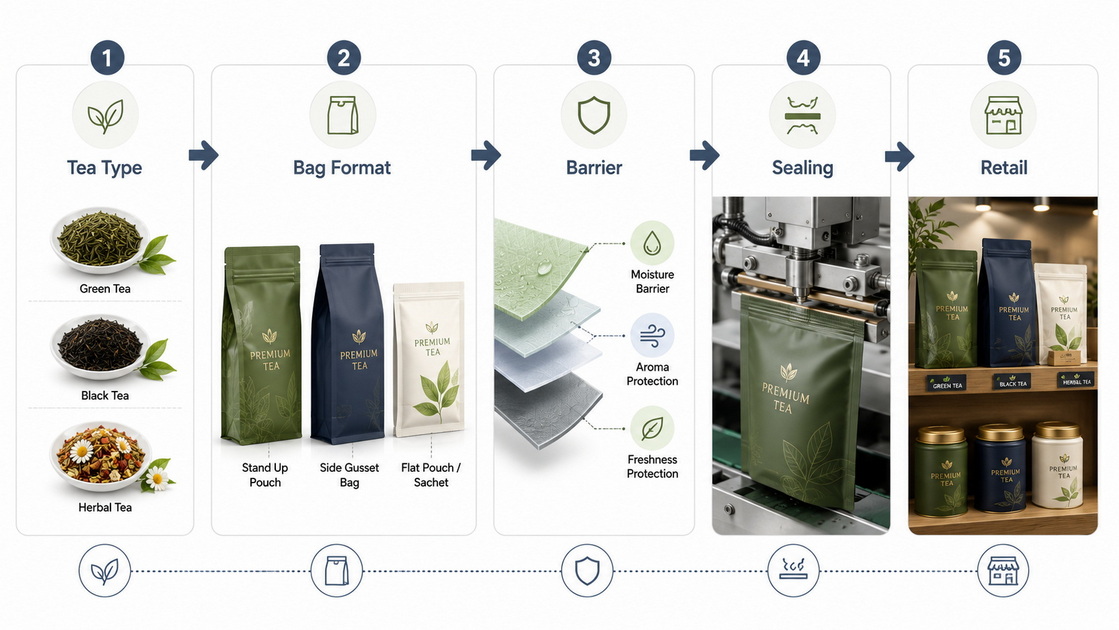
A useful tea packaging guide should tell readers how to choose, not only what sizes exist. The following workflow is simple enough for buyers and detailed enough for procurement teams.
1. Define your tea type: loose leaf, herbal blend, green tea, black tea, or instant tea.
2. Decide your market channel: retail, wholesale, e-commerce, or gifting.
3. Choose the format: gusset bag, stand-up pouch, or eight-side seal bag.
4. Match the barrier level to the tea's sensitivity to oxygen, light, and moisture.
5. Confirm food-contact compliance and material suitability for the target market.
6. Test the package with real product fills, seal checks, and shipping trials.
This step-by-step structure is especially helpful for B2B buyers who need a repeatable sourcing process rather than a generic packaging overview.
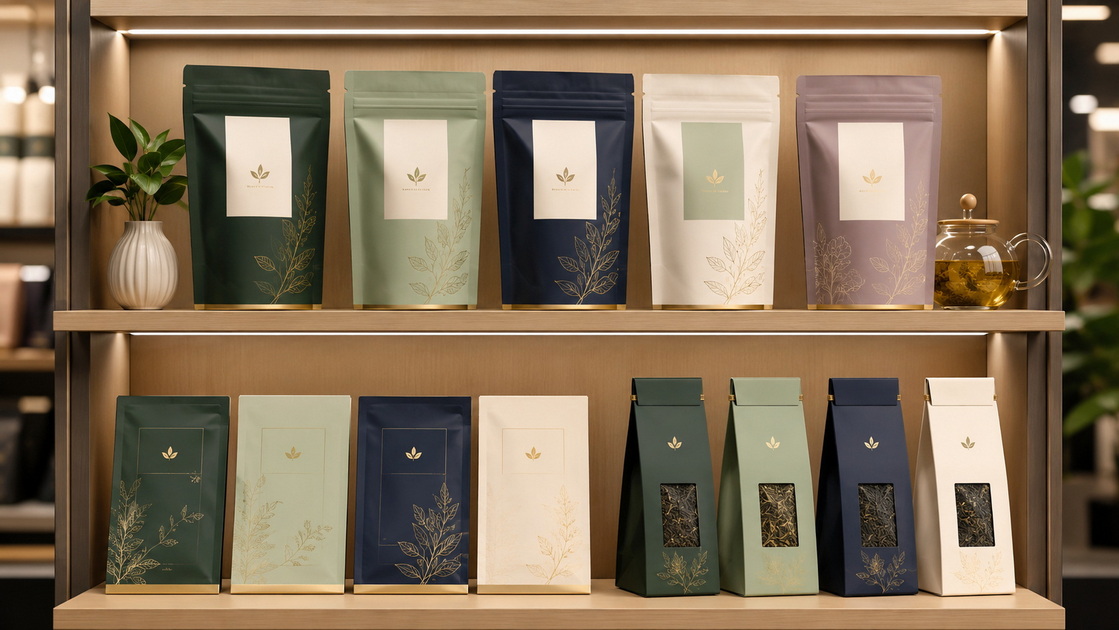
Tea packaging should reflect the product's use case and market positioning. For example, premium loose-leaf tea often performs best in stand-up pouches or eight-side seal bags because these formats combine better shelf presence with stronger perceived value. By contrast, sample packs and entry-level retail SKUs often do better in smaller gusset bags because they lower cost and simplify distribution.
For export-focused manufacturers, packaging also needs to travel well. That means the pouch should tolerate warehouse storage, shipping vibration, and retail handling without losing seal quality or visual appeal. A good tea bag size guide should therefore connect packaging dimensions with real supply-chain conditions, not just product weight.
If your goal is to improve tea shelf life, reduce packaging waste, and create stronger retail appeal, the next step is to choose a flexible packaging format that fits both the product and the market. HLun Pack can support custom tea packaging bags, format selection, material matching, and production-oriented packaging solutions for export and domestic tea brands.
A 100 g tea pack often works well in a 12 x 20 + 8 cm gusset bag, a 14 x 22 + 8 cm stand-up pouch, or a 15 x 22 + 5 cm eight-side seal bag, depending on brand positioning and fill density.
Stand-up pouches and eight-side seal bags are strong options when paired with high-barrier materials and airtight sealing, because they help protect tea from oxygen and moisture.
Not always. Recyclable or compostable materials can support sustainability goals, but they still need to provide enough barrier protection and seal performance for tea quality.
Too much empty space leaves more air inside the pouch, which can accelerate oxidation and aroma loss. Proper sizing reduces this risk and helps maintain product quality.
They should check food-contact suitability, barrier performance, resealability, shipping durability, and the target customer's usage habits.
Yes. Well-proportioned packaging looks more premium, stores more easily, and communicates quality more effectively to customers.
1. YLTPACK, "Comprehensive Tea Packaging Bags Size Guide - YLTPACK," [https://yltpacking.com/comprehensive-tea-packaging-bags-size-guide-optimizing-for-aroma-and-quality/] [lintyco]
2. ProAmpac, "Tea Packaging," [https://www.proampac.com/en-us/product/tea-packaging/] [proampac]
3. U.S. FDA, "Food Ingredients & Packaging," [https://www.fda.gov/food/food-ingredients-packaging] [fda]
4. HPM, "Food Contact Materials," [https://hpm.com/fda-regulatory-categories/food-contact-materials/] [hpm]
5. Packaging Law, "What are requirements for testing and analyzing tea bag filter paper food contact…," [https://www.packaginglaw.com/ask-an-attorney/what-are-requirements-testing-and-analyzing-tea-bag-filter-paper-food-contact] [packaginglaw]
6. TricorBraun Flex, "Tea Packaging," [https://www.tricorbraunflex.com/tea-packaging] [tricorbraunflex]
7. Huhtamaki, "Light-weight, flexible solutions for tea packing," [https://www.huhtamaki.com/en-in/flexible-packaging/our-portfolio/beverages/tea/] [huhtamaki]
8. Fine Pack, "The Science of Oxygen Barrier Films," [https://www.finepack.com.au/the-science-behind-oxygen-barrier-films-how-they-keep-food-fresher-for-longer/] [finepack.com]
9. Aris Pack, "The Perfect Tea Enjoyment: How Does a Tea Package Protect It," [https://aris-pack.com/the-perfect-tea-enjoyment-how-does-a-tea-package-protect-it/] [aris-pack]
10. Elevate Packaging, "Eco-Friendly Tea Packaging," [https://elevatepackaging.com/tea-packaging/] [elevatepackaging]
11. DMLives, "A Guide to Eco-Friendly Tea Packaging," [https://dmlives.com/blogs/steeped-in-wellness/a-guide-to-eco-friendly-tea-packaging-sustainable-solutions-for-a-greener-future] [dmlives]
12. Eagle Flexible, "Tea Packaging's Environmental Impact," [https://www.eagleflexible.com/resources/knowledge-center/reducing-the-environmental-impact-of-tea-packaging/] [eagleflexible]
13. Grounded Packaging, "Tea industry application," [https://www.groundedpackaging.co/industry-applications/tea] [groundedpackaging]


