


close
Choose Your Site
Global
Social Media
Views: 269 Author: HLun PACK Publish Time: 2026-09-21 Origin: Site


Content Menu
● Standard Cigarette Counts by Pack Format
● Why Cigarette Count Matters in Packaging Operations
>> Inventory and Production Planning
>> Machine Format and Changeover Requirements
>> Material Use and Cost Control
● The Most Common Cigarette Pack
● How Cigarette Length Affects Pack Design
● Cigarette Pack Styles and Their Packaging Implications
>> Slide-and-Shell or Premium Rigid Formats
● Pack Count Is Not the Same as Legal Compliance
● From Cigarette Bundle to Shipping Case
>> The Bottleneck Is Often Downstream
● How to Choose the Right Cigarette Packaging Equipment
>> Information to Provide to Your Machinery Supplier
>> Questions to Ask Before Buying
● Build a More Reliable Tobacco Packaging Line
● FAQ
>> 1. How many cigarettes are usually in a pack?
>> 2. How many cigarette packs are in a carton?
>> 3. Are 20 cigarettes per pack legally required everywhere?
>> 4. Does cigarette length affect packaging-machine selection?
>> 5. What is the best cigarette packaging style for high-speed production?
>> 6. What should I prepare before buying a cigarette packing machine?
>> 7. Can one packaging line produce different cigarette pack counts?
For most markets, the answer to "how many cigarettes are in a pack?" is usually 20 cigarettes. However, cigarette count is not simply a retail convention—it is a packaging-engineering, compliance, production-efficiency, and distribution decision that varies by country, product format, and applicable tobacco regulations.
For tobacco manufacturers, brand owners, contract packers, and packaging-equipment buyers, the key issue is not only how many cigarettes fit inside a pack. It is how to design a compliant, stable, efficient, and brand-appropriate pack format that works reliably from cigarette making and inner wrapping through carton packing, case packing, palletizing, and distribution.
At HLun Pack, we view cigarette packaging as an integrated production system. The cigarette count, pack dimensions, blank material, foil wrapping, hinge-lid structure, warning-label space, and downstream carton configuration must work together. A mismatch at any stage can increase material waste, create line stoppages, reduce packing accuracy, or expose a business to market-compliance risks.
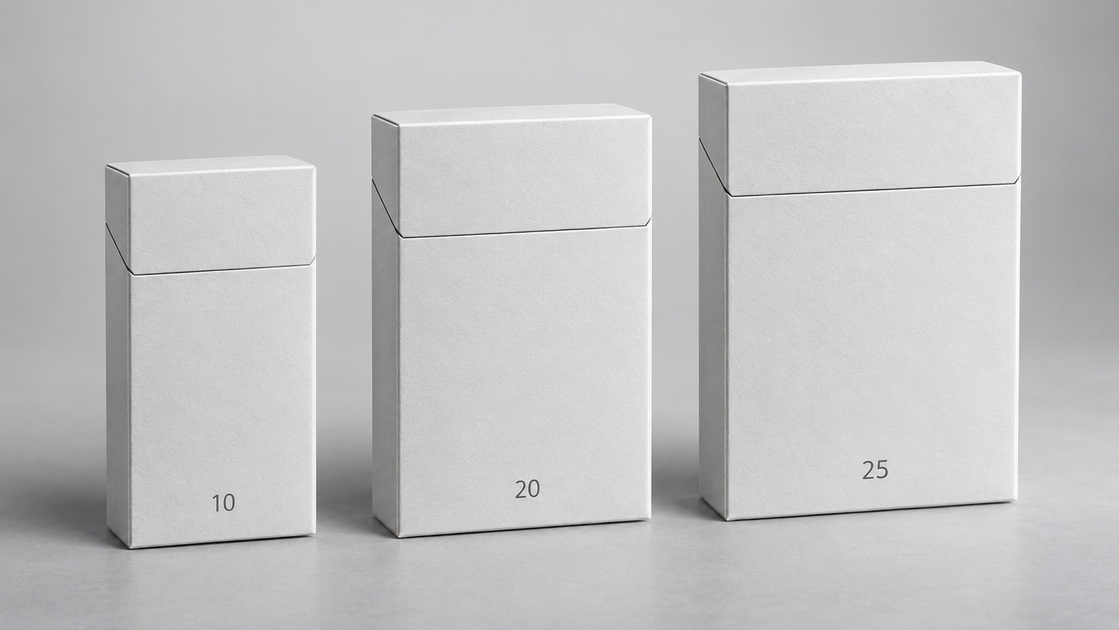
A standard cigarette pack in the United States commonly contains 20 cigarettes. A carton often contains 10 individual packs, resulting in 200 cigarettes per carton.
However, the actual count may vary by market and by pack format.
| Packaging Level | Typical Configuration | Total Cigarettes |
|---|---|---|
| Individual cigarette pack | 20 cigarettes | 20 |
| Smaller pack format | 10 cigarettes | 10 |
| Larger retail pack | 25 cigarettes | 25 |
| Larger retail pack | 30 cigarettes | 30 |
| Standard cigarette carton | 10 packs × 20 cigarettes | 200 |
| Master case / shipping case | Varies by market and logistics plan | Varies |
The 20-cigarette pack is widely recognized in the U.S. market, especially for standard king-size and 100 mm cigarette formats. Still, manufacturers should never assume that the same configuration, artwork, warning-panel allocation, or carton count is suitable in every export destination. Packaging requirements vary significantly across countries and regions.
From a packaging machinery perspective, cigarette count affects far more than the product quantity printed on a pack. It influences machine setup, pack geometry, blank dimensions, material consumption, output rate, logistics planning, and retail presentation.
A defined count makes production planning easier. If a factory produces 1 million cigarettes per shift, the number of finished packs depends directly on the configuration:
Finished Packs = Total Cigarettes Produced/Cigarettes per Pack
For example:
- 1,000,000 cigarettes ÷ 20 cigarettes per pack = 50,000 packs
- 1,000,000 cigarettes ÷ 25 cigarettes per pack = 40,000 packs
- 1,000,000 cigarettes ÷ 10 cigarettes per pack = 100,000 packs
This calculation affects the required quantities of inner foil, paper blanks, tax stamps, overwrap film, cartons, cases, labels, and pallets.
For packaging managers, the pack count also determines the throughput requirements of downstream equipment. A line producing 50,000 packs needs different secondary-packaging capacity than a line producing 100,000 smaller packs from the same cigarette output.
A cigarette packing machine is configured around a specific pack format. Changing from a 20-count standard hinge-lid pack to a 10-count compact pack or 25-count format may require adjustments to:
- Cigarette collating configuration
- Pack blank size
- Inner-frame dimensions
- Aluminum foil or metallized-paper dimensions
- Tax-stamp application position
- Film-overwrap settings
- Carton collation layout
- Case-packing pattern
- Vision-inspection parameters
For this reason, machinery buyers should confirm whether a cigarette packing line supports multi-format production, fast format changeovers, and compatible tooling before purchasing equipment.
The number of cigarettes in a pack changes the amount of packaging material required per cigarette. A smaller pack may use less total material per pack, but it can use more packaging material per individual cigarette because the pack structure is divided across fewer units.
A larger pack can improve material efficiency per cigarette, but it may also require a larger blank, larger warning panels, stronger carton-board specifications, and different distribution-case dimensions.
The best option depends on the target market, local rules, brand positioning, retail expectations, and production economics—not on pack count alone.
The 20-cigarette pack remains the most familiar retail configuration in many markets. A typical format is arranged in two rows of 10 cigarettes, often inside a hinged-lid paperboard box.
This standard configuration is popular because it balances several practical needs:
- It is familiar to consumers and retailers
- It fits established carton and case-packing systems
- It supports standard distribution quantities
- It is compatible with common cigarette-pack machinery configurations
- It provides sufficient external panel space for required labeling and warnings
- It is compact enough for pocket portability
For equipment planning, a 20-count hinge-lid pack is a common reference point. Some industrial cigarette packers are designed for high-speed hinge-lid production, with cited equipment capacities ranging from approximately 400 to 700 packs per minute depending on machine model and line configuration.
However, high rated speed should never be the only purchase criterion. Real-world output depends on material quality, cigarette consistency, operator training, maintenance practices, changeover frequency, reject rates, and integration with upstream and downstream equipment.
The number of cigarettes in a pack is only one part of the packaging equation. Cigarette length and circumference directly affect the pack's internal dimensions.
Common cigarette length categories include:
| Cigarette Type | Typical Length | Packaging Consideration |
|---|---|---|
| Standard / short | Approximately 70 mm | Compact pack height |
| King size | Approximately 84–85 mm | Common standard pack format |
| 100s | Approximately 100 mm | Taller pack and blank requirement |
| Slims | Often 97–100 mm | Narrower internal arrangement |
| Super slims | Varies | Requires dedicated tooling and precision handling |
A pack designed for 84 mm king-size cigarettes cannot automatically accommodate 100 mm cigarettes. The inner bundle, foil wrap, frame, blank, film overwrap, and carton configuration may all require adjustment.
Before selecting a machine or designing a cigarette pack, confirm these product variables:
1. Cigarette length
2. Cigarette circumference or diameter
3. Filter length
4. Cigarettes per pack
5. Arrangement pattern, such as 2 × 10 or another configuration
6. Pack style, such as hinge-lid, soft pack, or slide-and-shell
7. Inner-wrap material and sealing method
8. Destination-market warning and labeling rules
9. Secondary-packaging configuration
10. Required packs-per-minute output
This specification sheet should be finalized before equipment design, quotation, or tooling production begins.
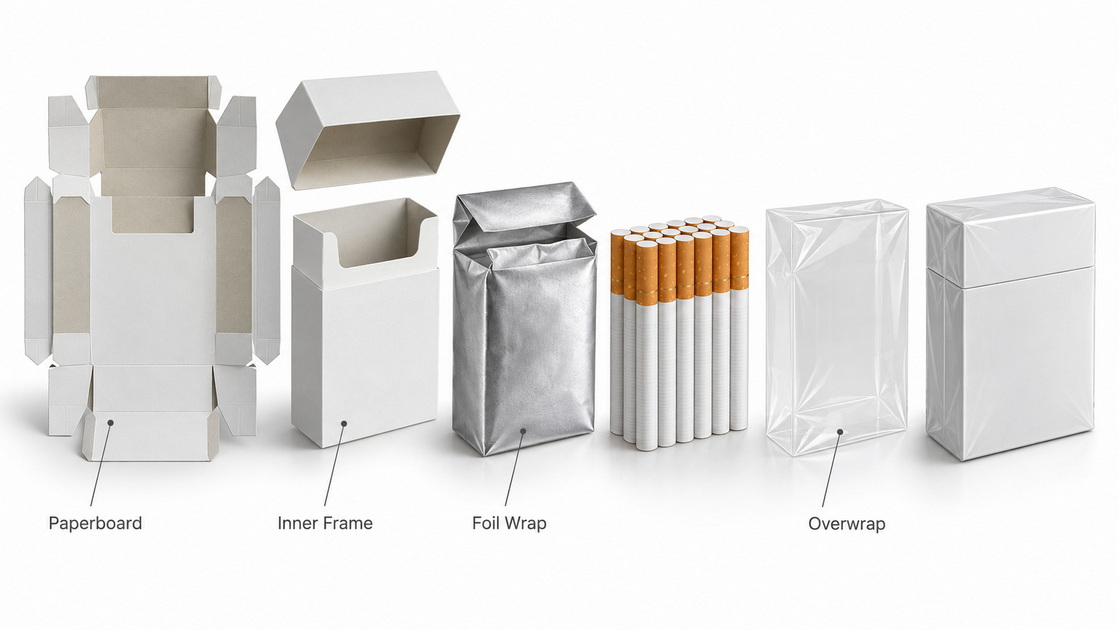
The hinge-lid pack is one of the most widely used cigarette package structures. It uses a folding paperboard box with an attached hinged lid, usually combined with an internal foil or barrier wrap and an inner frame.
For machinery buyers, hinge-lid packs require accurate blank feeding, folding, gluing or sealing, and consistent cigarette-bundle handling. The pack must open smoothly while remaining rigid enough to protect the product during transportation and retail handling.
Advantages of hinge-lid packs:
- Strong brand presentation
- Better crush resistance than soft packs
- Convenient opening and reclosing
- Good compatibility with high-speed automated packing lines
- Suitable for premium printing, embossing, foiling, and brand decoration
Soft packs typically use a more flexible paper or paperboard wrap. They may use less rigid material than hinge-lid boxes and can offer a different consumer experience.
From a manufacturing standpoint, soft packs may require different wrapping, sealing, and handling technology. Their lower structural rigidity can also change the requirements for downstream carton packing and transport protection.
Premium cigarette brands may use slide-and-shell, drawer-style, shoulder-box, or rigid paperboard structures to create a higher-end presentation.
These formats can elevate perceived value, but they involve more complex material handling and usually require more specialized machinery. They may be better suited to lower-volume premium product lines rather than very high-speed commodity production.
One of the main weaknesses in many articles about cigarette pack counts is the assumption that a standard cigarette quantity automatically means the package is compliant. That is not correct.
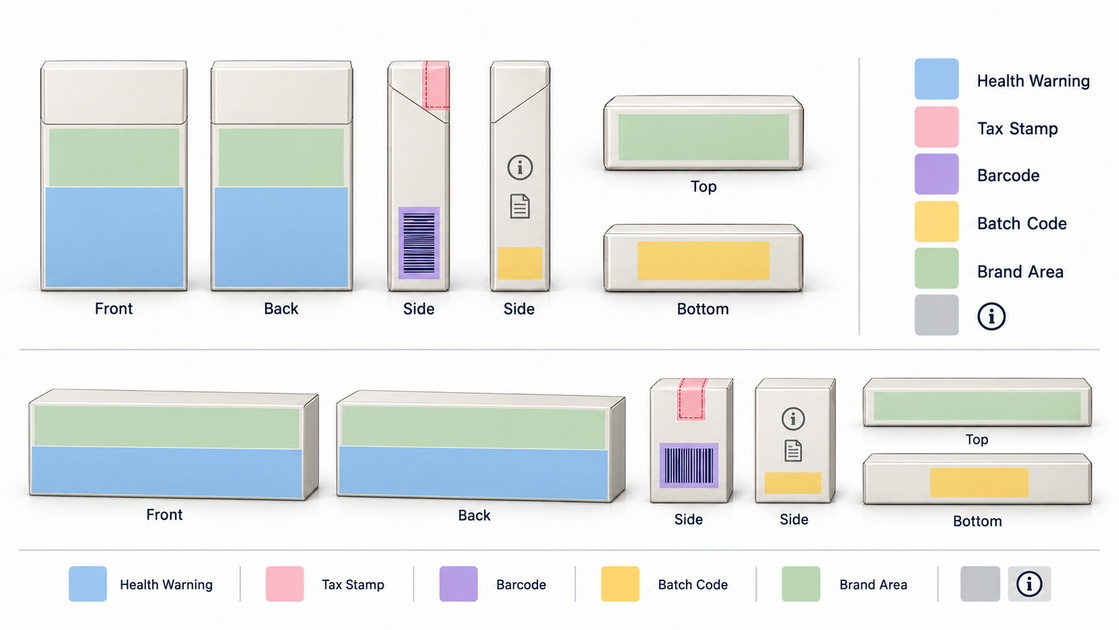
A compliant tobacco pack must meet the requirements of its destination market. Regulations may control:
- Health-warning size and placement
- Required language
- Graphic warning requirements
- Warning-message rotation
- Package color or plain-packaging rules
- Product descriptors and prohibited claims
- Tax-stamp placement
- Ingredient or emission disclosures
- Retail display restrictions
- Outer-carton warning requirements
In the United States, FDA materials state that required cigarette health warnings must occupy at least the top 50% of the front and rear panels of a cigarette package. The warnings must also be directly printed on or permanently affixed to the package and remain visible under clear outer wrapping.
The World Health Organization's Framework Convention on Tobacco Control recommends that tobacco health warnings cover at least 50% of the principal display areas and be clear, visible, legible, rotated, and, where appropriate, pictorial.
Australia applies particularly extensive warning requirements. Government guidance states that health-warning images must cover at least 75% of the front surface and 90% of the back surface of cigarette packs and cartons.
For tobacco exporters, this means a pack design should be treated as a market-specific compliance project, not simply a graphic-design exercise.
Validate artwork, warning layout, and pack geometry with qualified legal, regulatory, and local-market advisors before mass production.
A reliable cigarette packaging line is a connected system rather than a single machine. The most effective layout matches the product format, production target, and logistics plan.

A typical automated cigarette-packaging flow may include:
1. Cigarette feeding and collation
Cigarettes are counted, oriented, and arranged into the required bundle pattern.
2. Inner wrapping
The cigarette bundle is wrapped in foil, metallized paper, or another barrier material to support freshness and product protection.
3. Inner-frame insertion
A paperboard frame may be inserted to strengthen the pack opening and help retain the bundle shape.
4. Pack blank forming
The outer paperboard blank is folded into the selected pack format, such as a hinge-lid box.
5. Sealing and quality inspection
The line checks pack closure, code quality, warning placement, dimensions, and visible defects.
6. Film overwrapping
Clear outer film may be applied where permitted and required by the product specification.
7. Cartoning
Individual packs are grouped, commonly in 10-pack carton configurations.
8. Case packing and palletizing
Cartons are packed into corrugated cases and prepared for warehouse handling and shipment.
Many companies focus heavily on the primary packer's maximum speed. But a line only performs as well as its slowest connected process.
For example, if a hinge-lid packer runs at 400 packs per minute but the carton packer can only handle 300 packs per minute, the effective line capacity is limited to approximately 300 packs per minute before considering downtime and rejects.
When planning a new line, evaluate:
- Nominal speed
- Sustainable operating speed
- OEE target
- Changeover time
- Reject handling
- Spare-parts availability
- Operator access
- Material compatibility
- Integration with cartoners and case packers
- Data capture and traceability
HLun Pack recommends evaluating total-line performance rather than selecting machines based only on a single equipment-speed claim.
Before requesting a quotation for cigarette packaging machinery, prepare a clear project brief. This helps equipment suppliers recommend a practical configuration instead of offering a generic solution.
- Cigarette length, diameter, and filter specification
- Cigarette count per pack
- Pack style and blank dimensions
- Inner-wrap material
- Carton count and carton style
- Required packs-per-minute and cartons-per-minute output
- Current and future product formats
- Factory space and utility conditions
- Required automation level
- Destination markets
- Regulatory and traceability requirements
- Preferred print, embossing, foil, or anti-counterfeit features
- Can the machine handle our exact cigarette dimensions and count?
- What is the guaranteed speed under normal production conditions?
- What is the expected output after accounting for rejects and changeovers?
- Does the line support 10-, 20-, or 25-cigarette pack configurations?
- How long does a format changeover take?
- What spare parts and maintenance support are included?
- Can the system integrate with our existing cartoning and case-packing equipment?
- Does the machine support camera inspection and reject systems?
- What material tolerances are required for blanks, foil, and film?
- Can the line be expanded as production volume grows?
Knowing how many cigarettes are in a pack is the starting point—not the final packaging decision. Whether you produce 10-, 20-, 25-, or 30-cigarette formats, your equipment, materials, compliance layout, cartoning plan, and logistics system must be engineered as one coordinated solution.
HLun Pack provides packaging machinery and integrated packaging solutions for paper-based packaging applications. If you are planning a tobacco-packaging project, upgrading a cigarette packer, improving carton-packing efficiency, or developing a new paperboard pack format, contact our technical team with your product specifications and target output. We can help assess the practical equipment configuration for your production needs.
A standard cigarette pack commonly contains 20 cigarettes, especially in the United States. Other markets may use 10-, 25-, or 30-cigarette formats depending on consumer preferences, local rules, and product strategy.
A standard cigarette carton often contains 10 individual packs. If every pack contains 20 cigarettes, one carton contains 200 cigarettes.
No. Pack counts and tobacco-packaging rules vary by country and region. Manufacturers must confirm local legal requirements, including warning-label size, language, graphics, pack design, and outer-carton requirements.
Yes. A machine configured for king-size cigarettes may need different tooling, pack blanks, inner frames, foil dimensions, and carton settings to handle 100 mm, slim, or super-slim formats.
The hinge-lid cigarette pack is widely used for automated high-speed production because it provides rigidity, strong shelf appearance, convenient opening, and compatibility with established machinery platforms. Equipment suppliers report hinge-lid systems with production capacities ranging from hundreds of packs per minute depending on the machine and line setup.
Prepare product dimensions, cigarette count, pack style, packaging materials, target output, carton configuration, factory layout, utility requirements, future-format plans, and destination-market compliance requirements.
Potentially, yes. A multi-format line may support different pack counts, but it usually requires appropriate format parts, tooling, machine adjustments, and validated operating settings. Confirm the supported range and changeover process with the equipment supplier before purchase.
1. U.S. Food and Drug Administration. "[Cigarette Labeling and Health Warning Requirements]." Accessed September 19, 2026. This source explains U.S. cigarette-package warning requirements, including warning size, placement, visibility, permanence, and rotation requirements. [fda]
2. World Health Organization, Regional Office for Europe. "[Encouraging Health Warnings on Tobacco Packaging]." Accessed September 19, 2026. This source summarizes WHO Framework Convention on Tobacco Control Article 11 principles for tobacco packaging warnings. [who]
3. Australian Government Department of Health, Disability and Ageing. "[Health Warnings: Smoking and Vaping]." Updated January 16, 2025. This source details warning-image coverage requirements for Australian cigarette packs and cartons. [health.gov]
4. FOCKE & CO. "[Hinge Lid Series]." Accessed September 19, 2026. This source provides example production capacities for hinge-lid cigarette packers. [focke]
5. Coesia. "[Cigarette Packing Solutions]." Accessed September 19, 2026. This source describes hinge-lid and soft-pack cigarette packing equipment and reported machine speeds. [coesia]
6. OXO Packaging. "[How Many Cigarettes Are in a Pack? Comprehensive Guide]." Accessed September 19, 2026. This competitor article was reviewed as background for identifying content gaps and restructuring opportunities. [oxopackaging]


