


close
Choose Your Site
Global
Social Media
Views: 209 Author: Hlunpack Publish Time: 2026-07-01 Origin: Hlunpack


In the fast-growing global market for jelly products—including drinkable jelly, konjac jelly, and jelly sticks—manufacturers face increasing pressure to ensure food safety, extend shelf life, and maintain consistent packaging quality. As a packaging solutions provider with extensive experience in jelly packaging machines and integrated filling systems, HLun Pack has worked closely with international clients to resolve one of the most persistent and damaging issues in the industry: black spots and mold formation in jelly packaging seals.
From a technical and operational standpoint, this issue goes beyond surface-level defects. It directly impacts product integrity, customer satisfaction, and long-term brand trust. Through hands-on collaboration with a mid-sized export-oriented jelly manufacturer in Southeast Asia, we uncovered that the root cause was not the packaging material—as initially assumed—but rather a hidden flaw in the filling and sealing process.
This case study explores the underlying mechanisms of seal contamination, the limitations of conventional solutions, and how advanced servo pump filling technology integrated into modern jelly packaging machines can effectively eliminate these risks.
Our client, a rapidly expanding jelly producer specializing in high-sugar fruit jelly cups and stick packs, had successfully penetrated multiple export markets across Asia and the Middle East. However, as distribution scale increased, so did product complaints.
Key issues reported included:
- Black spots forming around the sealing edges after 30–60 days
- Occasional mold growth inside sealed packages
- Package swelling during extended storage
- Increased return rates from distributors
Despite upgrading to higher-barrier laminated films, the problems persisted. This indicated that the issue was not solely material-related.
Like many manufacturers, the client initially assumed that insufficient oxygen or moisture barrier properties were to blame. However, laboratory testing revealed that the packaging materials met all required specifications.
This led to a deeper investigation into the interaction between filling processes and seal integrity—a critical but often overlooked factor in jelly packaging.

High-sugar jelly products are particularly challenging to package due to their physical properties:
- High viscosity, making precise filling more difficult
- Strong adhesion, increasing residue risk
- Tendency to string or drip during filling
- Greater likelihood of contaminating sealing zones
In addition, the client's marketing strategy emphasized a "full-pack appearance", pushing filling volumes close to maximum capacity. While visually appealing, this significantly increased the probability of product contact with the heat-seal area.
Even microscopic residues can compromise seal quality.
One of the most critical findings in this case was the presence of the Micro Channel Effect, a phenomenon well-known in flexible packaging engineering but often underestimated in food production environments.
When jelly residue enters the sealing interface:
- Heat sealing layers fail to fully bond
- Microscopic channels (a few microns wide) form within the seal
- These channels allow oxygen and moisture to penetrate
Although invisible during initial inspection, these micro channels lead to:
- Oxidation and microbial growth
- Mold formation around seal edges
- Fermentation and gas buildup
- Package swelling and eventual failure
For products with a target shelf life of 6–12 months, even minor seal defects can result in major quality failures during transportation and storage.
Controlled testing conducted during the project revealed:
- Clean seals achieved strengths of 40–60 N/15 mm
- Contaminated seals showed a 20%–50% reduction in strength
- Lower seal strength significantly increased failure rates under transport stress
Considering export logistics—often involving 30–90 days of shipping, temperature fluctuations, and stacking pressure—these weakened seals became a critical failure point.
A key insight from this project was that high-barrier materials cannot compensate for poor sealing conditions.
Even advanced multilayer films with excellent oxygen and moisture resistance failed to prevent mold when:
- Seal contamination existed
- Micro channels were present
- Filling precision was inconsistent
This shifted the solution focus from materials to process control, particularly in the filling stage.
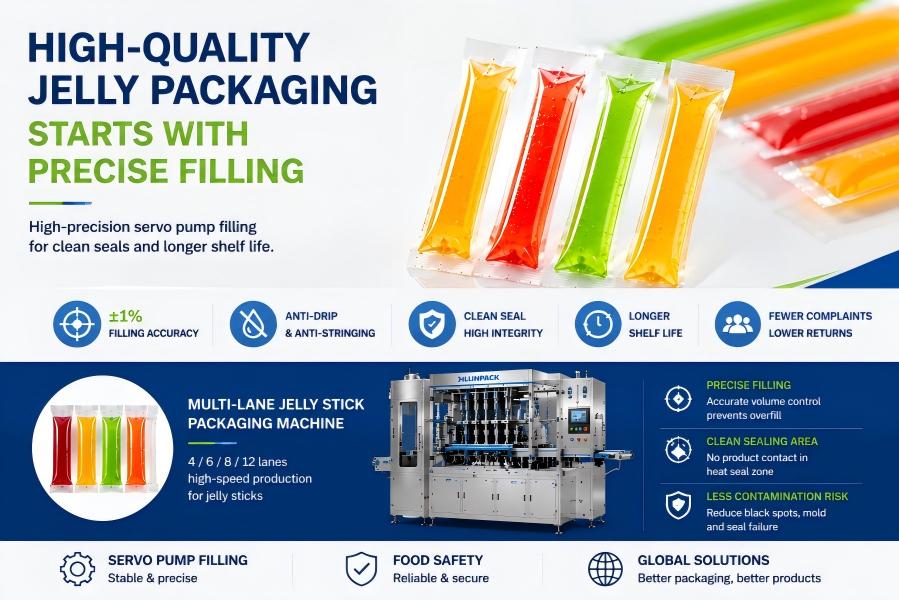
To address the issue at its source, HLun Pack implemented a servo pump-based filling system integrated into a customized jelly packaging machine.
This upgrade fundamentally changed how filling accuracy and seal cleanliness were controlled.
Using closed-loop servo systems, filling accuracy was maintained within ±1%, significantly reducing overfilling and variability.
Precise volume control ensured sufficient headspace, preventing product from reaching the sealing area.
Servo-controlled suck-back technology:
- Immediately cuts off product flow after filling
- Eliminates trailing residue
- Reduces contamination risk at the seal
The system maintained consistent performance even under multi-lane, high-output production conditions.
For the client's cup-style and triangle jelly products, HLun Pack deployed a single-lane triangle jelly packaging machine featuring:
- Integrated pouch forming, filling, and sealing
- Servo pump filling system
- Optimized sealing temperature control
This ensured both aesthetic presentation and seal reliability.
For high-volume jelly stick production, the solution included:
- 6-lane and 8-lane configurations (later expanded)
- Synchronized servo filling across all lanes
- Uniform filling accuracy across high-speed output
This allowed the client to scale production without sacrificing quality.
Within three months of implementation, the client observed significant improvements:
- Over 90% reduction in seal-related defects
- Elimination of visible mold in stored products
- Improved seal strength consistency across batches
- Reduced customer complaints and return rates
- Enhanced brand reputation in export markets
Additionally, the client reported improved operational efficiency due to reduced downtime and rework.
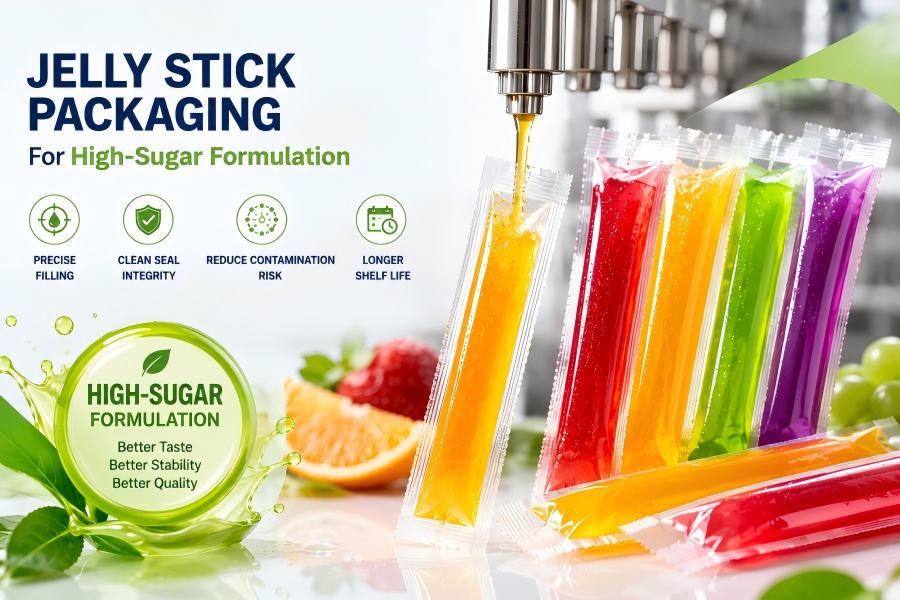
From an industry perspective, this case highlights a critical shift in packaging strategy.
Traditionally, manufacturers prioritized packaging materials as the primary factor in shelf-life performance. However, for high-sugar and high-viscosity products, filling accuracy and seal cleanliness are equally—if not more—important.
A reliable jelly packaging system must integrate:
- Precision filling technology
- Stable sealing performance
- Material compatibility
- Process consistency
Ignoring any one of these factors can compromise the entire packaging system.
Based on this project and broader industry experience, manufacturers should consider:
- Maintaining controlled filling volumes with adequate headspace
- Using servo-driven filling systems for high-viscosity products
- Implementing anti-drip mechanisms to prevent residue
- Regularly testing seal strength and integrity
- Selecting materials with wide heat-sealing windows
- Aligning equipment capabilities with product characteristics
This case demonstrates that black spots, mold growth, and seal failures in jelly packaging are rarely caused by a single factor. Instead, they result from a combination of formulation properties, filling precision, and sealing conditions.
By upgrading to a servo pump-enabled jelly packaging machine and optimizing the entire filling-sealing process, the client successfully eliminated long-standing quality issues and strengthened their market position.
For modern jelly manufacturers, investing in integrated packaging solutions is no longer optional—it is essential for ensuring product safety, extending shelf life, and maintaining competitive advantage in global markets.


