


close
Choose Your Site
Global
Social Media
Views: 269 Author: HLun PACK Publish Time: 2026-10-20 Origin: Site


Content Menu
● Are Coffee Bean Bags Recyclable? The Short Answer
● Why Are Coffee Bags Difficult to Recycle?
>> Coffee Freshness Requires More Than a Simple Container
● How to Recycle Coffee Bags: A Five-Step Check
>> 1. Read the Package Instructions
>> 2. Confirm Local Acceptance
>> 3. Empty and Prepare the Bag
>> 4. Follow Component Instructions
>> 5. Use General Waste When No Verified Route Exists
● Are Paper, Foil, and Mono-Material Coffee Bags Better?
>> Paper Coffee Bags: Appearance Is Not Evidence
>> Foil-Lined Coffee Bags: Strong Protection, Limited Routine Recovery
>> Mono-Material Coffee Bags: A Useful Direction, Not an Automatic Solution
● Recyclable vs. Compostable Coffee Bags
>> Industrial and Home Compostability Are Different
>> Certification Does Not Guarantee Collection
● A Buyer's Checklist for Recyclable Coffee Packaging
● How Packaging Equipment Affects the Transition
>> Validate Sealing Before Full Production
>> Evaluate the Complete System
● How Coffee Brands Can Make Clearer Environmental Claims
● A Practical Packaging Upgrade Roadmap
>> Start With the Required Performance
>> Compare Complete Candidate Structures
>> Run Production and Shelf-Life Trials
>> Finalize Instructions After Validation
● Build a Better Coffee Packaging System With HLun Pack
>> Can Coffee Bags Go in Curbside Recycling?
>> Are Coffee Bags With Valves Recyclable?
>> Are Brown Paper Coffee Bags Recyclable?
>> Can I Recycle a Coffee Bag at a Supermarket?
>> Should I Remove the Zipper and Valve?
>> Are Compostable Coffee Bags Better Than Recyclable Bags?
Are coffee bean bags recyclable? Some are, but many conventional coffee bags are not accepted in everyday recycling programs. The answer depends on the bag's complete construction, the collection system available where you live, and the instructions for that specific package.
A paper-looking pouch may contain plastic and aluminum. A plastic bag described as recyclable may require a specialist collection route rather than your household bin.
For coffee brands, this creates a practical challenge: protecting freshness while giving customers disposal instructions they can actually follow.
At HLun Pack, we approach this challenge from a packaging-and-equipment perspective. The bag, valve, sealing process, and recovery route must work together—not simply look sustainable.
Coffee bean bags are recyclable only when their complete construction is compatible with a recycling process and an appropriate collection program accepts them.
The most useful distinction is acceptance: a material's potential to be recycled does not guarantee that your local system collects it.
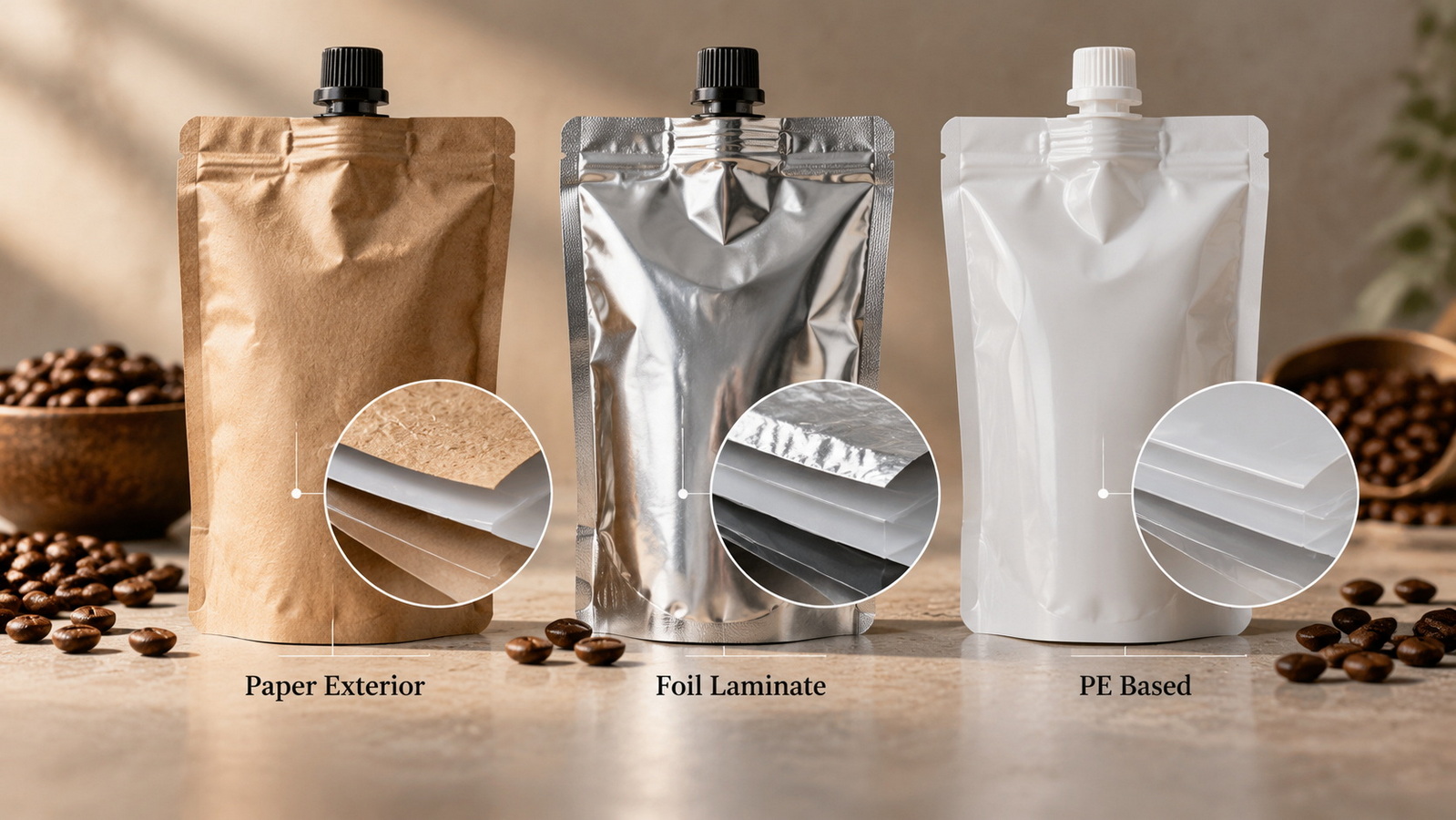
| Coffee bag type | Typical construction | Practical disposal guidance |
|---|---|---|
| Conventional foil laminate | Plastic layers combined with aluminum foil | Usually unsuitable for standard household recycling; check specialist options |
| Paper-look barrier pouch | Paper combined with plastic or other barrier layers | Do not assume it belongs in paper recycling |
| PE-based pouch | Predominantly polyethylene, sometimes with barrier layers | May qualify for designated film collection if the complete package meets requirements |
| PP-based pouch | Predominantly polypropylene | Requires a collection route that specifically accepts that format |
| Certified compostable pouch | Materials tested for specified composting conditions | Use an accepting composting program, not conventional plastic recycling |
These are screening guidelines, not universal disposal permissions. Always confirm the exact package and destination.
Roasted coffee needs protection from oxygen and moisture. Oxygen exposure contributes to oxidation and changes in aroma and flavor.
Freshly roasted beans also release carbon dioxide. A one-way degassing valve allows gas to escape while limiting air entry, helping prevent pressure buildup inside the package.
Traditional coffee bags combine materials because different layers perform different jobs:
- An outer layer provides printing and handling durability.
- A barrier layer limits oxygen or moisture transmission.
- An inner layer contacts the product and forms the heat seal.
- A valve manages gas release.
That combination can protect coffee effectively while making conventional recycling more difficult.
Assessing only the main film is not enough.
Zippers, valves, adhesives, inks, labels, and barrier layers can affect compatibility with a recycling stream. A predominantly polyethylene pouch does not automatically qualify simply because polyethylene itself can be recycled.
This is why "mono-material" should be treated as a design description, not a disposal guarantee.
For buyers, the right question is: "Has this complete package been evaluated for the recovery route we intend to claim?"

Look for a specific disposal label or written instruction. "Store drop-off," "commercially compostable," and "check locally" describe different routes.
Do not rely on a recycling symbol or resin code alone. Neither proves that your local program accepts the finished bag.
Check your municipal waste service or the relevant collection operator.
In the United States, most plastic bags, wraps, and films are not accepted in ordinary curbside recycling. Certain eligible polyethylene-based packages can instead use participating store drop-off programs.
A collection bin for shopping bags is not permission to add every flexible coffee pouch.
Remove remaining beans and loose grounds. Follow the collection program's preparation instructions.
Eligible film packages generally need to be clean and dry. If oily residue remains or cleaning would be impractical, ask the operator whether the package is acceptable.
Compost coffee grounds separately where an appropriate service exists.
Remove a valve, zipper, label, or other component only when the package instructions or collection program require it.
Cutting out a valve does not transform an incompatible multilayer pouch into a recyclable bag.
If neither your local program nor a confirmed specialist scheme accepts the bag, keep it out of recycling.
Putting an unsuitable pouch in the recycling bin does not create a recovery pathway. It introduces material the system may not be designed to process.
Brown kraft paper communicates a natural appearance, but appearance does not reveal the internal structure.
A paper coffee pouch may contain bonded plastic or foil layers that provide the required barrier and sealing properties.
Before describing it as recyclable paper packaging, request:
- The complete material specification.
- Details of coatings and laminated layers.
- Evidence relevant to the intended paper recycling system.
- Disposal instructions for the finished package.
"Made with paper" and "accepted in paper recycling" are different claims.
Aluminum foil can provide a strong barrier, but a foil-lined coffee pouch is not equivalent to a clean aluminum can.
In a laminated bag, thin layers are bonded together. Conventional collection and processing systems may not be able to separate or recover that combination economically.
Do not place a foil-lined coffee bag in metal recycling unless the operator explicitly accepts it.
PE-based or PP-based packaging can simplify material design. However, barrier chemistry, component selection, decoration, and collection access still matter.
Current design-for-recycling guidance evaluates these features individually because they can influence processing and the quality of recovered material.
For a coffee brand, material simplification is a starting point. Evidence for the complete package and its intended market is the next step.
Recycling and composting are separate systems.
Recycling processes suitable material into feedstock for new products. Composting relies on biological conditions to break down certified materials.
A compostable coffee bag should not enter conventional plastic film recycling unless that recycling operator explicitly permits it.
Commercial composting uses managed conditions that differ from a backyard compost heap.
Industrial compostability does not establish that a bag will break down successfully at home. Look for certification specifically covering the intended environment.
Likewise, "biodegradable" alone does not explain where, how, or under what conditions a package will break down.
Even certified compostable packaging needs an accepting destination.
A local organics service may accept food scraps but exclude compostable packaging. Check its rules before choosing a compostable pouch or printing disposal instructions.
For purchasing teams, verify the exact product—not merely the supplier's general certification or a certificate covering a different film.
Before comparing quotations, define the complete packaging requirement.
| Evaluation area | Questions to ask | Evidence to request |
|---|---|---|
| Material construction | What is every layer made from? | Full laminate specification |
| Recycling compatibility | Which recycling stream is intended? | Relevant assessment or certification |
| Components | Are the valve, zipper, inks, and labels included? | Finished-package evaluation |
| Coffee protection | Will it support the required shelf life? | Barrier data and product validation |
| Production performance | Can it run consistently on the intended equipment? | Trial records and operating parameters |
| Disposal communication | Where can customers actually take it? | Market-specific collection guidance |
Avoid comparing pouch prices without comparing specifications.
A lower-cost material that causes sealing failures, rejects, or insufficient product protection may not deliver a lower total packaging cost.
Equally, an expensive pouch with an impressive environmental description may offer customers no accessible disposal route.
Changing to a recyclable-oriented structure is not simply a purchasing decision. It is also a production change.
Different films can respond differently to heat, tension, handling, and sealing pressure. Existing settings should therefore be treated as a starting point, not an approved recipe.
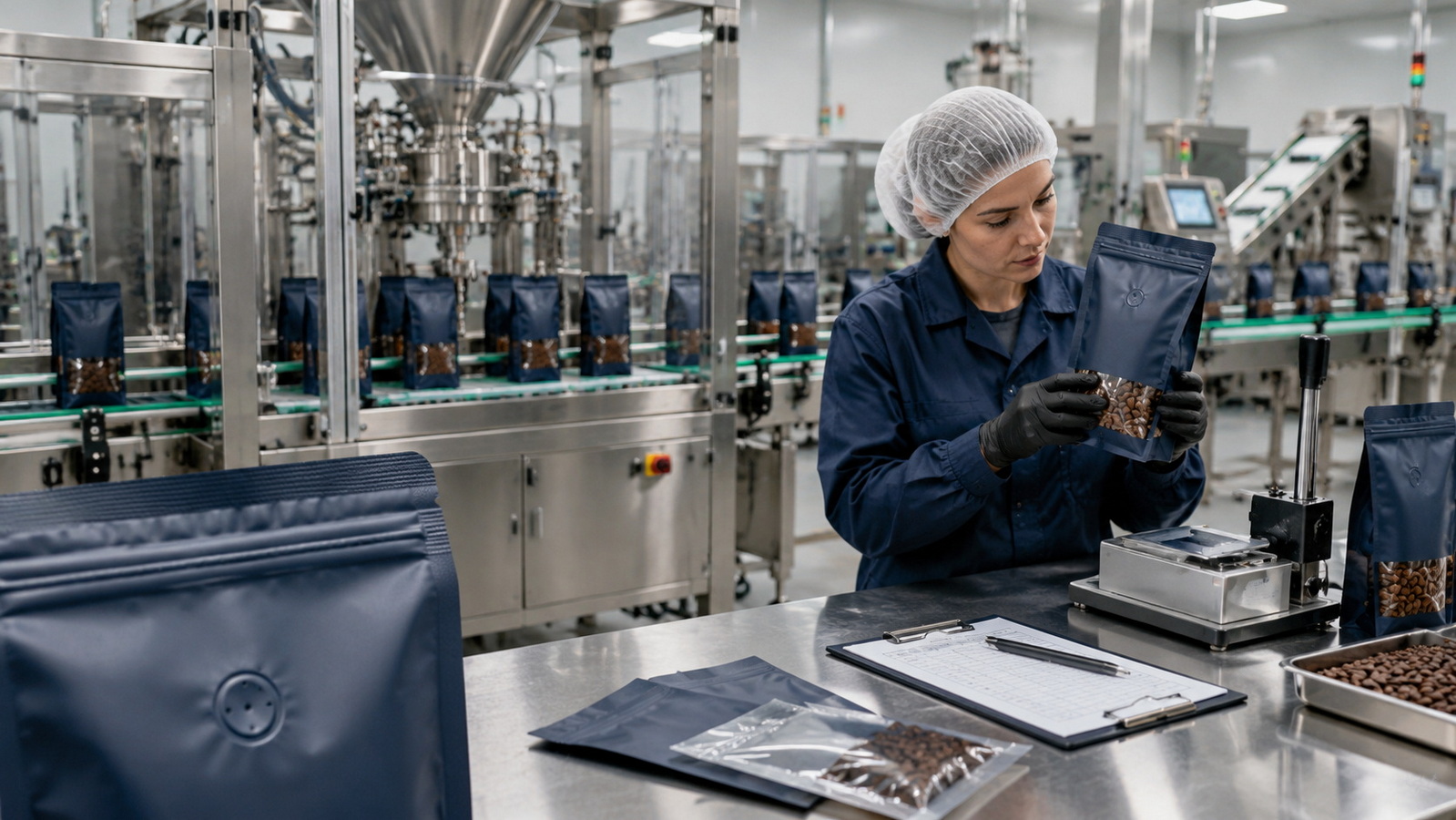
A practical trial should examine:
1. Seal temperature, dwell time, and pressure.
2. Seal consistency across the operating range.
3. Film tracking or pouch opening performance.
4. Coffee contamination in the seal area.
5. Valve attachment and leakage.
6. Finished-pack behavior during handling and transport.
Where nitrogen flushing is used, include residual oxygen checks and shelf-life validation rather than assuming flushing compensates for inadequate barriers or leaking seals.
Record the tested material specification alongside the machine settings. If the supplier changes the construction, review whether revalidation is necessary.
A useful comparison includes more than bags per minute.
Track rejected packages, seal defects, material consumption, operator adjustments, and product protection.
The objective is a repeatable packaging process that meets freshness requirements while supporting an accurate disposal claim.
For HLun Pack projects, this system-level approach connects material selection with machinery requirements and the customer's intended market.
Broad claims such as "100% eco-friendly" tell customers little about disposal.
More useful communication identifies the relevant route and any limitations:
- The intended collection method.
- Where that method is available.
- Whether components require removal.
- Whether composting is commercial or home-based.
- What customers should do when the preferred route is unavailable.
In the United States, the Federal Trade Commission's published Green Guides explain that recyclable claims should be qualified when appropriate facilities are unavailable to at least 60% of consumers or communities where the product is sold.
That figure concerns access to suitable facilities. It is not a claim that 60% of packages are actually recycled.
Before approving artwork, verify the applicable requirements in each sales market. A disposal statement suitable for one country may be misleading in another.
For a roaster replacing a conventional foil laminate, a controlled process is more useful than choosing a new pouch on appearance alone.
Document pack size, distribution conditions, intended shelf life, filling method, and freshness expectations.
Request barrier data, component details, food-contact documentation, and recovery-related evidence for each option.
Test the actual coffee, equipment, and package combination. Define acceptance criteria before evaluating results.
Check collection access in the markets where customers will use the packaging.
Approve environmental wording only after the material, production process, and disposal pathway have been checked.
This sequence helps prevent an attractive packaging redesign from becoming an operational or communication problem.
Choosing coffee packaging means balancing freshness, production reliability, and a realistic end-of-life route.
Share your current bag specification, pack size, target output, filling method, distribution market, and shelf-life requirements with HLun Pack. We can discuss packaging machinery and integrated solution requirements around those priorities, with material and line validation defined before scale-up.
Often not, particularly flexible plastic and multilayer bags in the United States. Follow the instructions for the exact package and confirm acceptance with your local service.
Sometimes. The answer depends on the complete bag structure, valve compatibility, and collection route. A valve does not automatically make a package recyclable or nonrecyclable.
Not necessarily. Paper-looking bags can contain bonded plastic or foil. Check the construction and local acceptance rather than judging by color or texture.
Only when the specific bag qualifies for the store's collection program. Eligible polyethylene films and conventional multilayer coffee pouches are not interchangeable.
Only if the disposal instructions require it. Removing components does not make an otherwise incompatible laminate suitable for recycling.
Neither is universally better. Compare product protection, verified material performance, and access to an accepting recycling or composting system.
1. [YLT Packing — "How to Seal Coffee Bags: Tips and Techniques for Home Brewers," retrieved from the supplied coffee-bag recycling URL.] Original content reviewed for topic alignment; the retrieved page discusses sealing rather than recycling. [yltpacking]
2. [How2Recycle — "Store Drop-off: US Only."] Guidance on eligible polyethylene-based films, limitations of curbside collection, and clean-and-dry preparation. [how2recycle]
3. [RecyClass — "Design for Recycling Guidelines."] Technical framework for assessing compatibility between packaging components and specific recycling streams. [recyclass]
4. [RecyClass — "Packaging Design for Recycling Guidelines."] Guidance distinguishing preferred, limited-compatibility, and incompatible packaging features. [recyclass]
5. [BPI — "Find BPI-Certified Products."] Product-level certification lookup and distinction between commercial and specifically identified home-compostability certification. [bpiworld]
6. [BPI — "Composting Certified Compostable Products at Home: What It Takes."] Explanation of the different conditions and certification requirements associated with home and industrial composting. [bpiworld]
7. [Federal Trade Commission — "Environmental Claims: Summary of the Green Guides."] Published guidance on qualifying recyclable claims and the 60% facilities-access threshold. [ftc]
8. ["Effects of Different Coffee Storage Methods on Coffee Freshness After Opening of Packages," ScienceDirect.] Research discussing oxygen exposure, barrier packaging, carbon dioxide release, and one-way valves in coffee storage. [sciencedirect]


