


close
Choose Your Site
Global
Social Media
Views: 258 Author: HLun PACK Publish Time: 2026-10-17 Origin: Site


Content Menu
● Types of Display Boxes by Retail Placement and Function
>> 1. Countertop Display Boxes
>> 2. Shelf-Ready Display Boxes
>> 5. Peg-Hook and Hanging Display Packaging
>> 6. Gravity-Feed Display Boxes
● Compare Retail Display Box Formats at a Glance
● Paperboard vs. Corrugated Display Boxes
>> When Folding Paperboard Makes Sense
>> When Corrugated Board Makes Sense
>> Choose Finishes With a Clear Purpose
● How to Choose Custom Display Boxes: A Six-Step Process
>> 1: Record Product Specifications
>> 2: Confirm Retail Requirements
>> 3: Map the Distribution Route
>> 4: Define the Packing Method
>> 5: Compare Structural Prototypes
>> 6: Agree on Acceptance Criteria
● Make Shelf-Ready Packaging Easy for Staff and Shoppers
● Match Display Packaging to Packaging Equipment
● Validate Display Performance Before Mass Production
>> Test the Complete Packaged System
>> Check Retail Performance Separately
● Evaluate Total Cost, Not Just Box Price
● Make Environmental Claims Specific and Supportable
● Plan Your Display Packaging Project With HLun Pack
>> What Is the Difference Between a Display Box and a Shipping Box?
>> Which Display Boxes Are Best for Small Products?
>> Are Corrugated Display Boxes Always Stronger Than Paperboard?
>> Can Custom Display Boxes Be Used With Automated Equipment?
>> What Information Is Needed for a Display Box Quotation?
>> Will a Display Box Increase Sales?
Choosing the right types of display boxes means balancing product visibility, protection, retail requirements, and packing efficiency. An attractive display still creates problems if it arrives damaged, takes too long to assemble, or prevents shoppers from removing products easily.
At HLun Pack, our focus is paper packaging, packaging machinery, and integrated packaging solutions. Our starting point is straightforward: evaluate the display as part of the complete packaging process, not simply as a printed container.
This guide explains the main retail display formats, how to compare materials, and what to validate before ordering custom display boxes.
Display boxes are packaging structures designed to organize and present products where customers make purchasing decisions. Some hold multiple individually packaged items. Others present a single product through an opening or transparent window.
For paper-based applications, two common material families are folding paperboard and corrugated board.
A useful distinction is that display categories overlap. "Countertop" describes placement, "gravity-feed" describes dispensing, and "corrugated" describes construction. One package can therefore be a corrugated countertop gravity-feed display.
Understanding these differences makes supplier discussions more precise.

Countertop display boxes hold compact products near checkout areas, service counters, or other approved selling points.
Typical applications include snack bars, lip balms, sample packs, and small accessories.
Their main constraint is limited space. The front panel should communicate the offer without hiding product labels, while the header must remain within the retailer's height allowance.
Check whether customers can remove the final few products without tipping the tray.
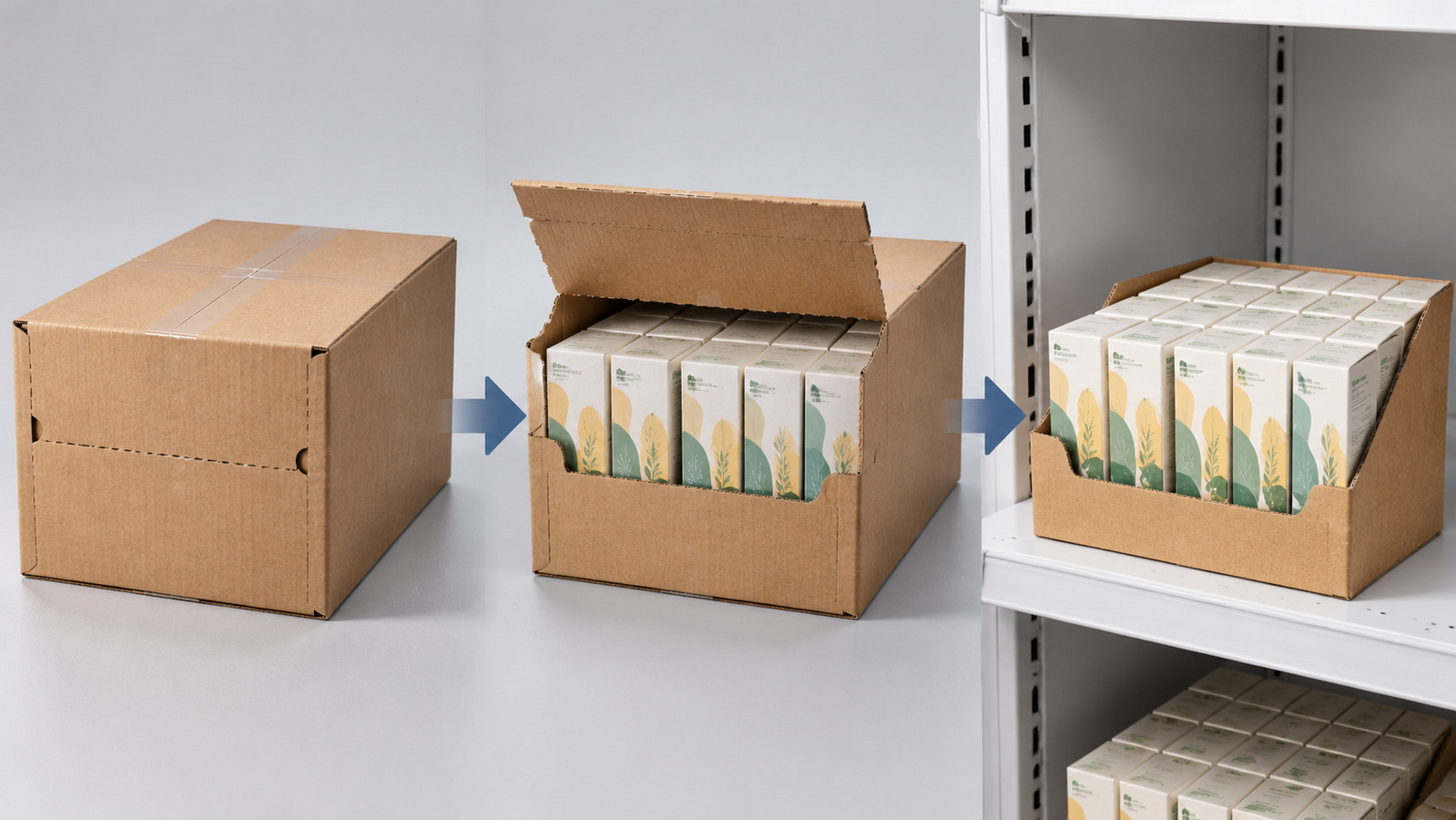
Shelf-ready packaging combines distribution and merchandising functions. A removable cover or tear-away section converts the shipping case into a shelf display.
This format suits products replenished in groups, including sachets, cartons, and multipacks.
The engineering challenge is balancing opening convenience with transport protection. Perforations must tear cleanly without weakening the case prematurely.
Confirm shelf dimensions before finalizing the dieline. A visually strong tray has little value if it overhangs the shelf or obstructs adjacent products.
Floor displays are freestanding structures positioned in retailer-approved areas.
They can accommodate multiple shelves, larger product quantities, or stronger brand messaging than compact countertop formats.
However, their greater size creates additional engineering questions:
- How is weight distributed across shelves?
- Does the display remain stable as products sell?
- Can store staff assemble it correctly?
- Will shoppers bump exposed edges or corners?
Validate the loaded structure rather than approving an empty mock-up.
Endcap displays occupy the ends of retail aisles. Depending on the store, they may use shelf trays, freestanding structures, or larger promotional assemblies.
They are suitable for launches, seasonal assortments, and coordinated promotions.
Placement is not automatically available. Retailer approval, campaign timing, merchandising rules, and allocated dimensions determine what can be installed.
Design the display around the confirmed retail brief, not an assumed standard footprint.
Peg-hook packaging suspends products from a retail hook through a reinforced opening or hanging tab.
It suits lightweight accessories, small tools, and other compact products.
Distinguish an individual hanging carton from a display unit containing several hooks. They have different structural requirements.
The hanging point must withstand the actual product load and repeated handling. Do not assume that hanging packaging is appropriate for heavier products without validating the board, reinforcement, hook, and retail fixture.
Gravity-feed displays use an inclined path so products move toward the dispensing opening as shoppers remove items.
They can suit consistently shaped packs that slide or roll predictably.
Performance depends on product geometry, surface friction, loading orientation, and the angle of the internal channel.
Test multiple units together. A package that moves freely on its own may jam when several products press against each other.
Gravity-feed designs do not inherently require spring-loaded pushers.
Window display boxes reveal part of the product through a cutout, sometimes covered with transparent film.
This is a visibility feature rather than a separate placement category. A window can appear in a hanging carton, shelf pack, or countertop presentation.
Before adding one, consider whether the opening weakens the structure, exposes the product, or complicates material separation.
Use a window when seeing the product helps the purchase decision—not simply because the feature looks premium.
| Display format | Suitable applications | Main advantage | Key validation point |
|---|---|---|---|
| Countertop | Small packaged goods | Compact presentation | Access and tipping resistance |
| Shelf-ready | Replenished retail products | Shipping-to-shelf conversion | Clean opening and shelf fit |
| Floor display | Multi-product promotions | Larger merchandising area | Loaded stability |
| Endcap | Approved aisle-end campaigns | Prominent positioning | Retailer specifications |
| Peg-hook | Lightweight hanging products | Vertical presentation | Hanging-point strength |
| Gravity-feed | Consistently shaped packs | Forward product movement | Reliable dispensing |
| Window carton | Products benefiting from visibility | Direct product inspection | Strength and material separation |
Folding paperboard is worth evaluating for lightweight products, compact cartons, and designs requiring a relatively smooth printed surface.
Its suitability depends on board grade, thickness, grain direction, crease quality, and product weight.
A thicker sheet is not automatically the best choice. Poor creasing can cause cracking or inconsistent folding even when the board appears substantial.
Corrugated board combines liners with a fluted medium. It is commonly considered for shipping displays, larger trays, and freestanding structures.
Different constructions offer different combinations of thickness, print surface, cushioning, and compression performance.
Specify the required performance rather than requesting "strong cardboard." Ask suppliers to explain how the proposed construction supports the intended load and distribution route.
Coatings, laminates, windows, and decorative treatments should solve an identified problem.
For example, a finish might improve scuff resistance or maintain artwork appearance during handling. However, it may also affect cost, folding behavior, adhesive compatibility, or recycling options.
Approve the finished construction, not only the unprinted board sample.
Provide product dimensions, individual weight, pack quantity, orientation, and any fragile or easily damaged areas.
Use actual production samples where possible.
Obtain the approved footprint, maximum height, shelf depth, signage restrictions, and replenishment expectations.
Also confirm whether the display ships assembled, flat, or prefilled.
Identify transport modes, storage periods, handling stages, and likely environmental exposure.
A display delivered locally may face different hazards from one moving through multiple warehouses.
Explain whether loading is manual, semi-automatic, or automated.
Include the required output, available labor, product grouping method, and changeover frequency.
Review at least the most promising alternatives using real products.
Compare access, stability, opening behavior, assembly effort, and packing consistency—not appearance alone.
Document what a successful sample must achieve before production begins.
Examples include an agreed assembly method, acceptable opening quality, undamaged products after testing, and reliable feeding during a machinery trial.
A practical industry framework evaluates shelf-ready packaging through five functions:
1. Easy to identify.
2. Easy to open.
3. Easy to place on the shelf.
4. Easy to shop.
5. Easy to flatten and recycle.
These functions connect packaging design with everyday store operations.
Clear external identification helps staff locate the correct variant. Opening instructions reduce uncertainty. A stable tray supports replenishment without transferring products individually.
For shoppers, the opening must allow comfortable product removal and replacement. Test the display when full, partly empty, and nearly depleted.
A tray that performs well only when fully stocked is not fully resolved.
Packaging and machinery decisions should be reviewed together before tooling is finalized.
For example, a blank that an operator can fold by hand may not feed consistently through an automated system. A visually appealing tear feature may interfere with a gripping or sealing area.
Review these interfaces during development:
- Blank dimensions, flatness, and orientation.
- Folding sequence and crease consistency.
- Product infeed and grouping.
- Glue application or mechanical locking.
- Loading access and product clearance.
- Inspection points and rejection handling.
- Changeover between different product sizes.

Do not select equipment solely by its advertised maximum speed. Evaluate sustained performance using the intended products and packaging materials.
For an integrated project, define the entire sequence: forming, grouping, loading, closing, inspection, and transfer. This helps identify bottlenecks before equipment specifications are fixed.
Transport testing should evaluate the actual product, display structure, closures, inserts, and any outer shipping protection.
ISTA provides guidance on choosing and conducting package-performance tests. The appropriate procedure depends on the distribution environment; no single test fits every display project.
Agree on the test plan with the retailer, packaging supplier, and qualified laboratory where appropriate.
Surviving transport does not prove that a display works in store.
Additional checks should examine:
- Loaded shelf deformation.
- Stability during product removal.
- Tear-away opening quality.
- Hanging-point durability.
- Gravity-feed jams.
- Staff assembly errors.
- Product visibility as stock decreases.
Record results with photographs and clear pass-or-fail criteria. Reassess relevant performance when the product, package, or packing process changes.
A lower purchase price can conceal higher handling costs.
Compare the complete operating picture:
- Packaging and tooling.
- Freight and storage.
- Assembly and loading labor.
- Packing-line interruptions.
- Retail setup time.
- Damage and replacement.
- Disposal handling.
For illustration, suppose one design requires 45 seconds of manual assembly and another requires 20 seconds. Across 12,000 units, the second design saves approximately 83 labor hours.
This is a hypothetical comparison, not an HLun Pack customer result. Actual savings depend on staffing, production conditions, and implementation costs.
The practical lesson is to measure the work around the box.
Paper-based construction does not automatically justify every environmental claim.
Assess the complete package, including coatings, adhesives, windows, and any non-paper components. Confirm that disposal instructions match the destination market.
For U.S. marketing, the FTC's Green Guides explain that unqualified recyclable claims depend partly on access to appropriate recycling facilities. The guides identify a "substantial majority" as at least 60 percent of consumers or communities where the item is sold.
That threshold is not a universal approval: material recovery and other applicable requirements still matter.
Avoid broad claims such as "100% eco-friendly." Prefer specific, documented statements about material composition, verified recycled content, or appropriate disposal instructions.
The most useful starting point is a validated packaging brief.
Share your product samples, dimensions, weight, target retail format, required quantity, distribution conditions, and current packing method with HLun Pack.
Include any retailer specifications and your target production output. This gives the packaging and equipment discussion a common foundation.
Ask us to review the display structure and packing workflow together so the proposed solution addresses presentation, handling, and production requirements—not just the printed artwork.
A shipping box primarily contains and protects goods during distribution. A display box primarily presents products for sale. Shelf-ready packaging combines both functions, provided its transport and retail performance are validated.
Countertop trays and peg-hook formats are useful starting points. The better choice depends on available space, product weight, hanging suitability, and how customers will remove individual items.
Not in every application. Performance depends on construction, dimensions, material grade, load direction, and environmental conditions. Compare complete designs rather than choosing by material name alone.
Yes, when their dimensions, materials, folding features, and loading method match the equipment. Confirm compatibility through trials using representative production materials and actual products.
Provide product dimensions and weight, pack quantity, order volume, artwork requirements, retail dimensions, delivery destination, and packing method. Samples and retailer specifications make the quotation more meaningful.
It may improve visibility and accessibility, but sales also depend on placement, pricing, availability, product appeal, and promotion. Evaluate results through a controlled retail trial rather than assuming a guaranteed uplift.
1. [OXO Packaging — "Types of Display Boxes & Their Benefits for Profitable Marketing"]. Original article used to identify the topic, existing format coverage, classification issues, and areas requiring deeper practical explanation. Its unsupported sales statistic was not retained. [oxopackaging]
2. [FEFCO — "Shelf Ready Packaging (SRP)"]. Industry guidance supporting the five functional requirements covering identification, opening, shelf placement, shopper access, and flattening for recycling. [fefco]
3. [Smurfit Westrock — "Shelf Ready Packaging"]. Manufacturer guidance supporting the relationship between transit protection, easy-opening features, shelf presentation, and automation-ready design. [smurfitwestrock]
4. [International Safe Transit Association — "Getting Started with Design & Testing"]. Primary guidance supporting package-testing planning, documentation, testing variants, and reassessment following product, packaging, or process changes. [ista]
5. [Intertek — "Retail Packaging Testing for Big-Box Compliance"]. Testing-service guidance supporting the discussion of distribution hazards, compression, vibration, shock, environmental conditioning, and retailer-specific requirements. [intertek]
6. [Federal Trade Commission — "Guides for the Use of Environmental Marketing Claims," 16 CFR Part 260]. Primary source supporting the U.S. recyclability-claim discussion, including qualification requirements and the 60 percent "substantial majority" threshold. Market-specific requirements should be checked before labels or claims are approved. [ftc]</


