


close
Choose Your Site
Global
Social Media
Views: 246 Author: Hlunpack Publish Time: 2026-08-05 Origin: Hlunpack


Content Menu
>> Sustainable Material Development
>>> Engineering Considerations
>> Recyclable Flexible Packaging
>>> Engineering Considerations
>>> Engineering Considerations
>>> Engineering Considerations
>>> Engineering Considerations
>>> Engineering Considerations
>>> Engineering Considerations
● Future Engineering Priorities
>> 1. Will recyclable packaging replace traditional multilayer laminates?
>> 2. Is mono-material packaging suitable for every application?
>> 3. What is the biggest challenge in future flexible packaging?
>> 4. How are digital technologies changing packaging manufacturing?
Retort Packaging Engineering Series · Chapter 8
Sustainability, High-Barrier Innovation and Smart Manufacturing
The flexible packaging industry continues to evolve in response to changing consumer expectations, environmental regulations and advances in packaging technology.
Food manufacturers are no longer focused solely on package protection.
Today’s packaging systems are expected to balance product safety, shelf-life performance, sustainability, manufacturing efficiency and supply chain optimization.
As a result, packaging engineering is becoming increasingly data-driven and application-focused.
Understanding these emerging trends helps manufacturers make better packaging decisions while preparing for future market requirements.
Several major trends are shaping the future of flexible packaging.
Rather than replacing traditional packaging technologies, these developments aim to improve performance, sustainability and manufacturing efficiency simultaneously.
The future of packaging is expected to focus on:
* Sustainable material solutions
* Recyclable packaging structures
* High-barrier innovation
* Lightweight packaging
* Digital manufacturing
* Smart packaging technologies
* Circular economy principles
Future packaging will be engineered not only to protect products, but also to reduce environmental impact while improving manufacturing efficiency.
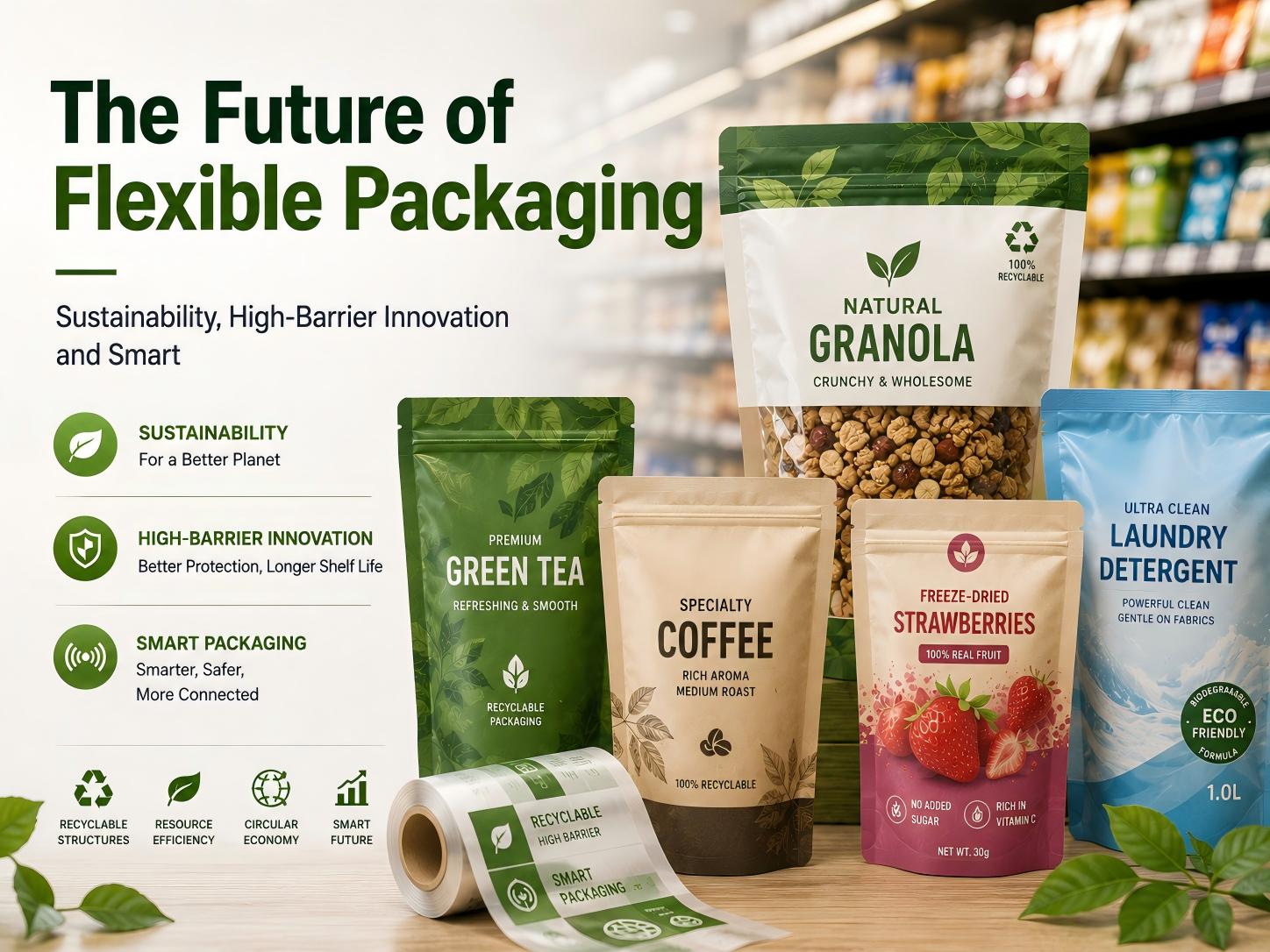
Sustainability has become one of the primary drivers of packaging innovation.
Manufacturers are increasingly seeking packaging solutions that reduce material consumption while maintaining product protection.
Packaging engineers are focusing on:
* Material reduction without sacrificing performance
* Improved resource efficiency
* Lower carbon footprint
* Renewable and responsibly sourced materials
* Packaging designed for recycling
Sustainability should always be balanced with food safety and shelf-life requirements.
Many countries are introducing regulations that encourage recyclable packaging.
As a result, flexible packaging structures are gradually shifting toward designs that simplify recycling.
Common approaches include:
* Mono-material PE structures
* Mono-material PP structures
* Simplified laminate structures
* Design for Recycling (DfR)
* Reduction of incompatible material combinations
Recyclability depends not only on material selection but also on the overall package design.
As recyclable packaging develops, maintaining high barrier performance has become one of the industry’s biggest engineering challenges.
Current innovations include:
* High-barrier transparent films
* EVOH-based structures
* Advanced coating technologies
* Vacuum metallization improvements
* Optimized laminate designs
The objective is to achieve excellent barrier performance while improving recyclability whenever technically feasible.
Reducing package weight improves transportation efficiency and lowers material consumption.
Packaging engineers achieve lightweighting through:
* Material optimization
* Structural redesign
* Improved mechanical performance
* Advanced resin technology
Lightweight packaging should never compromise package integrity or product protection.
Packaging production is becoming increasingly intelligent through digital technologies.
Manufacturers are adopting:
* Automated quality inspection
* Digital process monitoring
* AI-assisted defect detection
* Real-time production data analysis
* Predictive maintenance
Digital manufacturing improves consistency while reducing production waste.
Packaging is gradually becoming an information carrier as well as a protective container.
Emerging technologies include:
* QR Codes
* GS1 Digital Link
* NFC Tags
* RFID Tracking
* Temperature Indicators
* Freshness Monitoring
Smart packaging improves traceability, consumer engagement and supply chain visibility.
Future packaging systems are increasingly designed according to circular economy principles.
Packaging development considers:
* Material recyclability
* Reduced material consumption
* Renewable resources
* Collection infrastructure
* End-of-life management
Packaging performance should be evaluated across its entire life cycle rather than only during production.
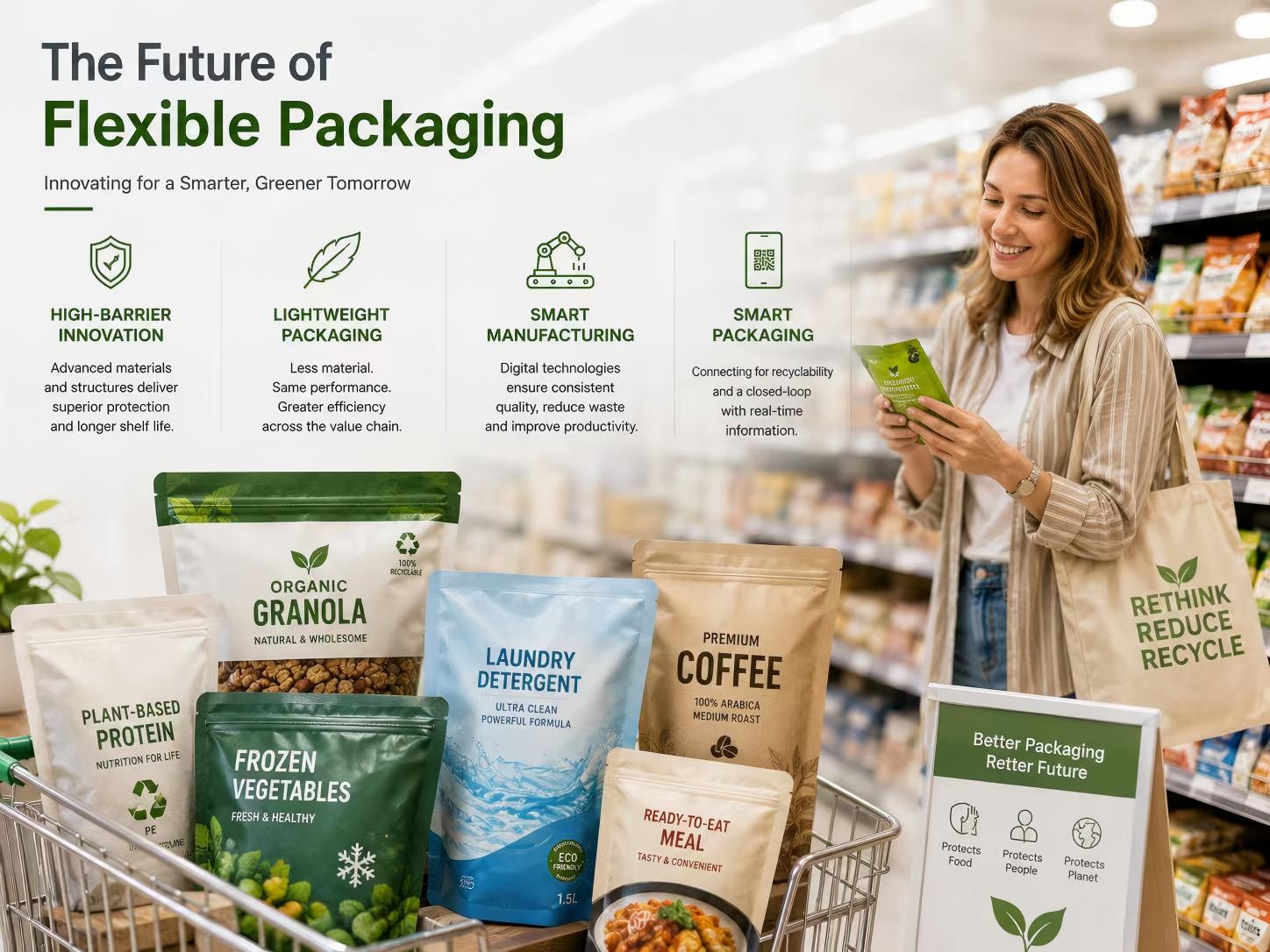
Future flexible packaging development is expected to focus on balancing:
* Product Protection
* Food Safety
* Sustainability
* Manufacturing Efficiency
* Cost Optimization
* Consumer Experience
* Regulatory Compliance
Successful packaging solutions will require these priorities to be considered together rather than independently.
Before adopting new packaging technologies, engineers typically evaluate:
* Recyclability Assessment
* Life Cycle Assessment (LCA)
* Barrier Performance Testing
* Mechanical Performance Testing
* Seal Integrity Testing
* Shelf-Life Validation
* Manufacturing Compatibility
* Transportation Simulation
Engineering validation ensures that innovative packaging technologies remain commercially practical.
The future of flexible packaging is not defined by a single technology.
Instead, it will be driven by the integration of sustainability, material science, manufacturing innovation and digital technologies.
The next generation of flexible packaging will deliver not only better product protection, but also greater environmental responsibility and smarter manufacturing.
This chapter focuses on:
* Sustainable Packaging
* Recyclable Flexible Packaging
* Mono-Material Packaging
* High-Barrier Packaging
* Lightweight Packaging
* Smart Packaging
* Digital Manufacturing
* Circular Economy
* Flexible Packaging Innovation
Applicable to:
* Ready Meals
* Retort Foods
* Sauces
* Soups
* Dairy Products
* Frozen Foods
* Pet Food
* Coffee
* Powdered Foods
* Household Products
Not entirely. Recyclable structures are expanding rapidly, but multilayer laminates will continue to play an important role where very high barrier performance or demanding processing conditions are required.
No. Mono-material structures can improve recyclability, but their suitability depends on the product, required shelf life and processing conditions.
Balancing product protection, sustainability, manufacturing efficiency and commercial cost remains one of the industry’s greatest engineering challenges.
Digital monitoring, AI-assisted inspection and real-time process control help improve consistency, reduce waste and increase production efficiency.
Throughout this eight-chapter series, we explored the key engineering principles behind reliable flexible packaging—from package re-evaluation and structure selection to material engineering, failure prevention and future innovation.
While every product presents unique challenges, one principle remains consistent:
Successful packaging is never the result of a single material or process. It is achieved through the integration of engineering, materials, manufacturing and application-specific design.
HLunPACK provides integrated solutions for flexible packaging, paper packaging and packaging machinery for the food, pharmaceutical and consumer goods industries.
By combining material engineering, packaging design and manufacturing expertise, we help customers develop packaging systems that improve product protection, manufacturing efficiency and long-term commercial success.


