


close
Choose Your Site
Global
Social Media
Views: 223 Author: Hlunpack Publish Time: 2026-03-26 Origin: Hlunpack


In today's fast-evolving beverage industry, tea bag packaging solutions have become critical for manufacturers aiming to meet rising global demand. From Ceylon black tea in Sri Lanka to herbal infusions in the Middle East and yerba mate in South America, each product category introduces unique processing and packaging complexities.
As a long-term observer and strategist in packaging automation for FMCG and B2B manufacturing sectors, I've seen how companies struggle to balance precision, efficiency, and scalability. HLUNPACK's tea bag packaging machines and automatic cartoning solutions offer a compelling example of how engineering innovation can directly impact operational performance and market competitiveness.
This case study explores how HLUNPACK helped multiple international tea producers overcome material variability, reduce labor dependency, and build fully automated packaging lines aligned with global standards.
The tea industry has undergone a structural shift toward convenience, consistency, and premiumization.
Key market insights include:
- Tea bags now account for over 60% of consumption in Europe and North America
- Rapid growth of herbal and functional tea in the Middle East
- Increasing demand for yerba mate in South America and export markets
- Rising labor costs pushing manufacturers toward automation
These trends have forced producers to rethink traditional packaging processes, especially when dealing with diverse tea formats.
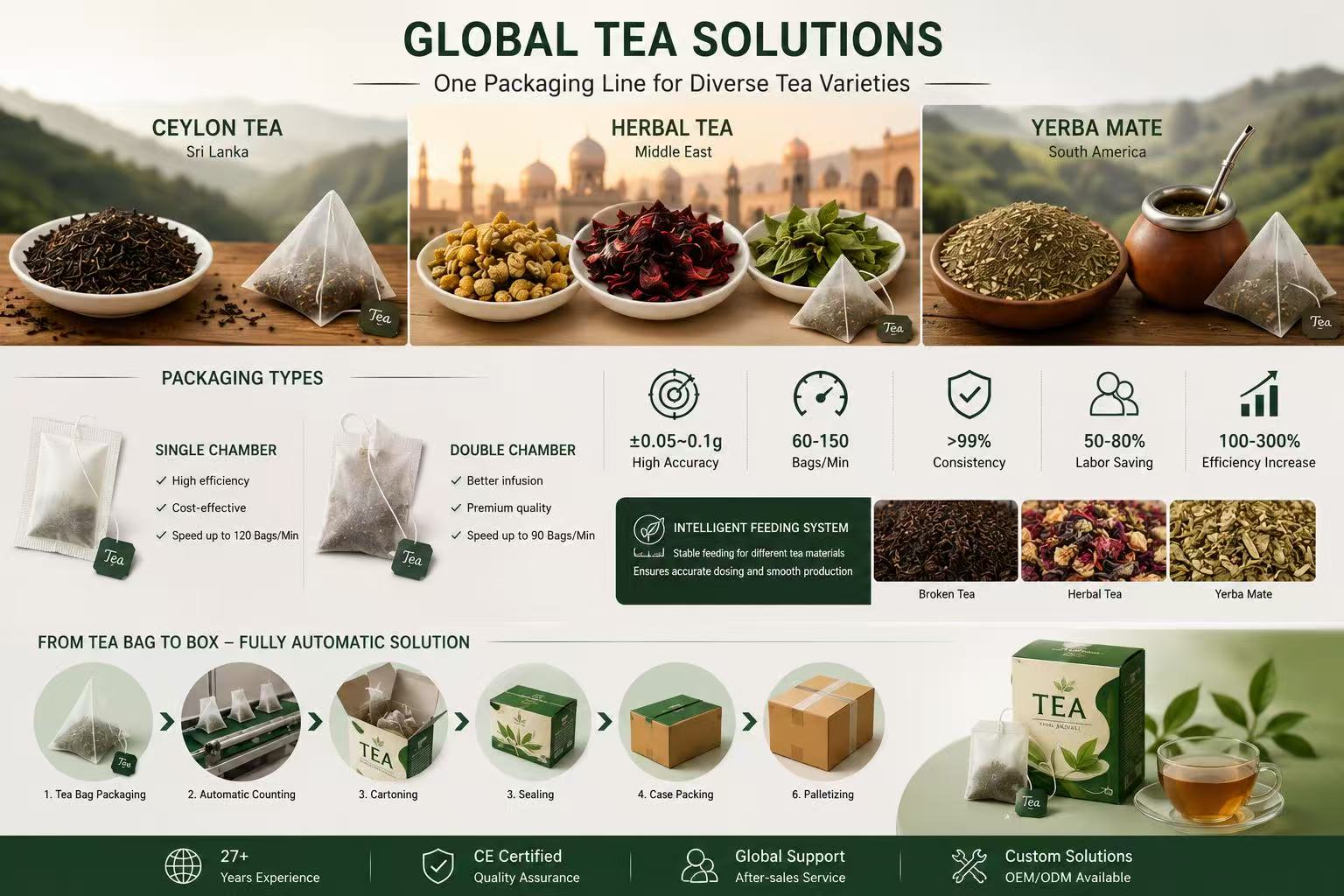
Unlike uniform products, tea varies significantly depending on origin and processing methods. This variability creates major challenges in automated packaging environments.
Sri Lanka's tea exports include multiple grades such as OP, BOP, BP, and tea dust.
Key issues faced by producers:
- Wide particle size distribution
- High dust content affecting flowability
- Weight inconsistencies at high speeds
For tea bags containing just 1.5g to 3g, even a deviation of 0.1g can impact both product quality and cost efficiency.
Middle Eastern markets demand diverse herbal blends, including chamomile, mint, hibiscus, and fruit infusions.
Operational challenges include:
- Delicate materials prone to breakage
- Mixed ingredient sizes causing uneven dosing
- Ingredient separation during feeding
Without precise control, these issues lead to inconsistent product quality and reduced shelf appeal.
Yerba mate presents one of the most difficult packaging scenarios due to its mixed composition of leaves, stems, and powder.
Common problems include:
- Unstable bulk density
- Irregular flow behavior
- Frequent clogging in standard feeders
Traditional packaging systems often fail to maintain consistency under these conditions.
HLUNPACK approached these challenges by designing modular, adaptable tea bag packaging machines combined with intelligent feeding systems.
Rather than offering a one-size-fits-all solution, the company focused on material-specific engineering—an approach that aligns strongly with real-world manufacturing needs.
Designed for large-scale production, this machine is widely used for black tea, green tea, and powdered tea products.
Key capabilities:
- Fully automatic bag forming, filling, sealing, and tagging
- High-speed production of 80–120 bags per minute
- Dosing accuracy up to ±0.1g
- Stable performance with fine or dusty materials
Client Impact:
A Sri Lankan exporter using HLUNPACK's single chamber system reported:
- 35% reduction in weight deviation
- 2x increase in production throughput
- Significant improvement in export compliance consistency
This machine is particularly effective for standardized, high-volume SKUs.
For higher-end tea products, especially in Europe and the Middle East, double chamber tea bags offer better infusion and presentation.
Machine features:
- Inner filter bag with outer envelope packaging
- Enhanced product protection and visual appeal
- Production speeds of 60–90 bags per minute
Use Case:
A UAE-based herbal tea brand leveraged this system to:
- Upgrade product positioning into premium retail channels
- Reduce breakage of delicate ingredients by 40%
- Improve customer perception and shelf performance
This highlights how packaging technology directly influences brand value—not just production efficiency.
One of HLUNPACK's most impactful innovations lies in its feeding system customization.
Best suited for:
- Broken tea leaves
- Herbal blends
- Fruit teas
Advantages:
- Smooth and consistent material flow
- Reduced blockage
- Lower breakage rates
Ideal for:
- High-value herbal and functional teas
Benefits:
- Real-time weight compensation
- Superior dosing precision
- Reduced material waste
Engineered for:
- Yerba mate
- Dust-heavy or sticky materials
Key outcomes:
- Continuous feeding without interruption
- Reduced downtime
- Improved machine reliability
In many packaging lines, feeding systems are underestimated. However, in reality, they determine up to 70% of dosing accuracy and operational stability. HLUNPACK's targeted approach addresses this critical bottleneck effectively.
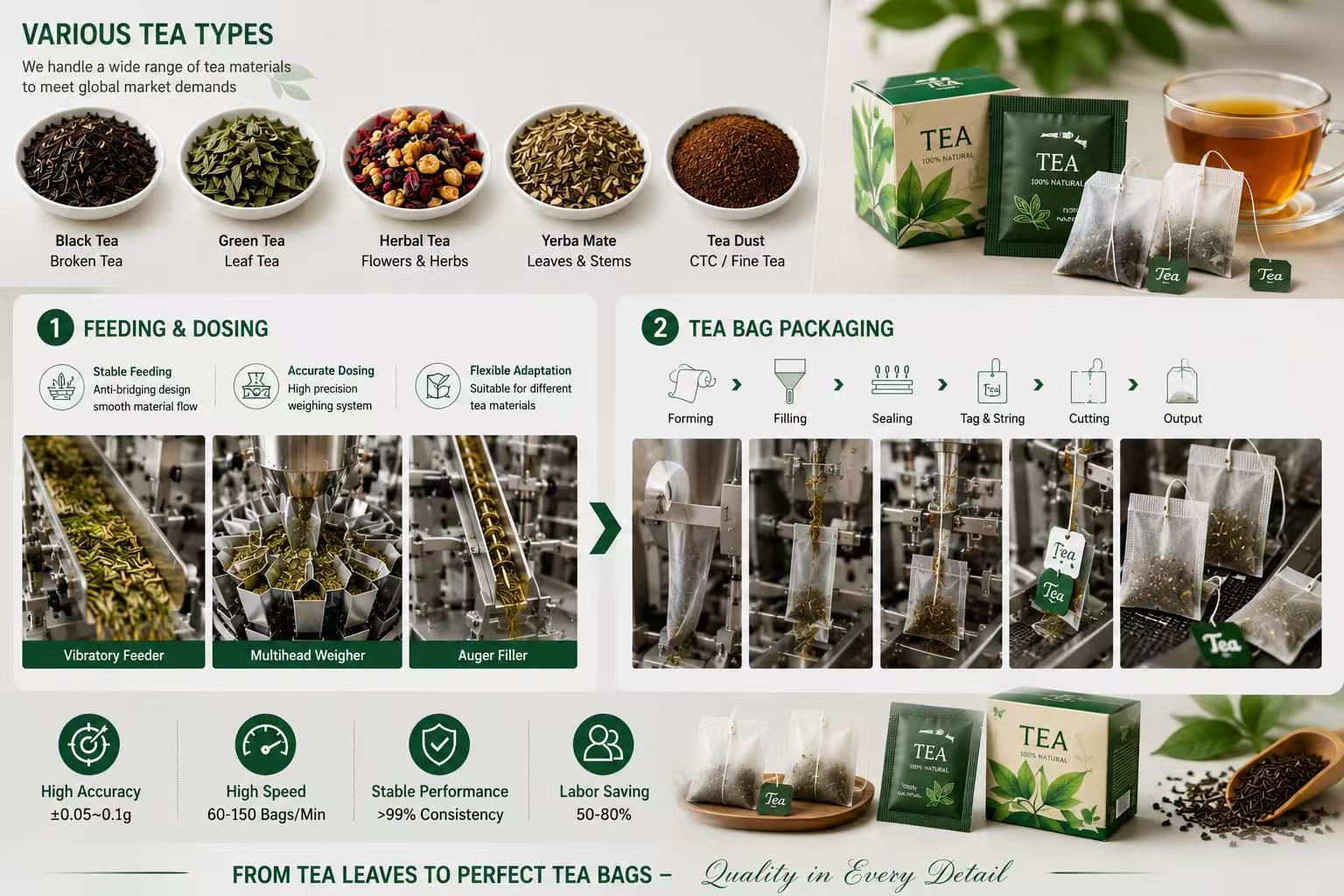
Beyond individual machines, HLUNPACK delivers fully integrated tea bag packaging and automatic cartoning solutions.
This includes:
- Bag forming
- Filling and sealing
- String and tag attachment
Supports flexible configurations:
- 10, 20, 25, or 50 bags per box
- Customizable pack sizes
- Carton erection
- Product insertion
- Carton closing
- Automatic case loading
- Carton sealing
- Conveyor-based logistics
This seamless workflow transforms fragmented processes into a unified, high-efficiency production line.
Across multiple projects, HLUNPACK's solutions delivered consistent, quantifiable improvements:
- 50%–80% reduction in labor dependency
- 100%–300% increase in packaging efficiency
- Over 99% dosing accuracy
- 3%–8% reduction in raw material waste
- Product qualification rates exceeding 99.5%
For export-oriented manufacturers, these metrics translate directly into:
- Stronger compliance with international standards
- Reduced operational risk
- Improved profit margins
From an industry perspective, automation is no longer optional for companies targeting global markets.
Buyers in Europe, the Middle East, and South America increasingly demand:
- Consistent packaging quality
- Traceable and standardized production
- Scalable supply capacity
Manual or semi-automatic processes simply cannot meet these expectations reliably.
HLUNPACK's integrated tea bag packaging and cartoning solutions provide a future-ready infrastructure that aligns with these demands.
With over 27 years of experience in packaging machinery manufacturing, HLUNPACK combines engineering expertise with practical application know-how to continuously help global tea manufacturers enhance production efficiency, product consistency, and long-term competitiveness.


