


close
Choose Your Site
Global
Social Media
Views: 239 Author: HLun PACK Publish Time: 2026-10-05 Origin: Site


Content Menu
● Are There Standard Milk Carton Dimensions?
>> Why an Online Size Chart Can Mislead
● How to Measure a Milk Carton Box
>> Measure for Two Different Decisions
● Can Carton Dimensions Reveal Fill Capacity?
● Gable-Top or Aseptic Carton?
● Match Paper Packaging to the Production Line
>> Review the Package–Machine Interface
>> A Practical Three-Stage Trial
● Check Food Contact and Environmental Claims
● Build a Production-Ready Carton Specification
● Choose Dimensions That Work Beyond the Drawing
>> What are the dimensions of a standard half-pint milk carton?
>> Does milk carton height include the spout or cap?
>> How do I calculate the volume of a gable-top milk carton?
>> Is a one-quart milk carton always the same size?
>> Do all milk cartons contain aluminum foil?
>> Can the same machine fill different milk carton sizes?
>> Are paper milk cartons recyclable everywhere?
Milk carton box dimensions are more than three numbers on a specification sheet. A carton must hold its declared volume, fit the filling line, seal reliably, travel through secondary packaging, and sit where the buyer expects it to sit. If you are comparing a half-pint milk carton with a one-liter format, the first question is not "What is the standard height?" It is "Which dimensions, for which carton design and production process?"
At HLun Pack, we approach paper packaging as a system rather than an isolated box. That means separating the filled carton's outside dimensions from its internal capacity, material construction, closure, and equipment requirements. This guide gives dairy and beverage buyers a practical way to compare options without relying on a misleading "universal" size chart.
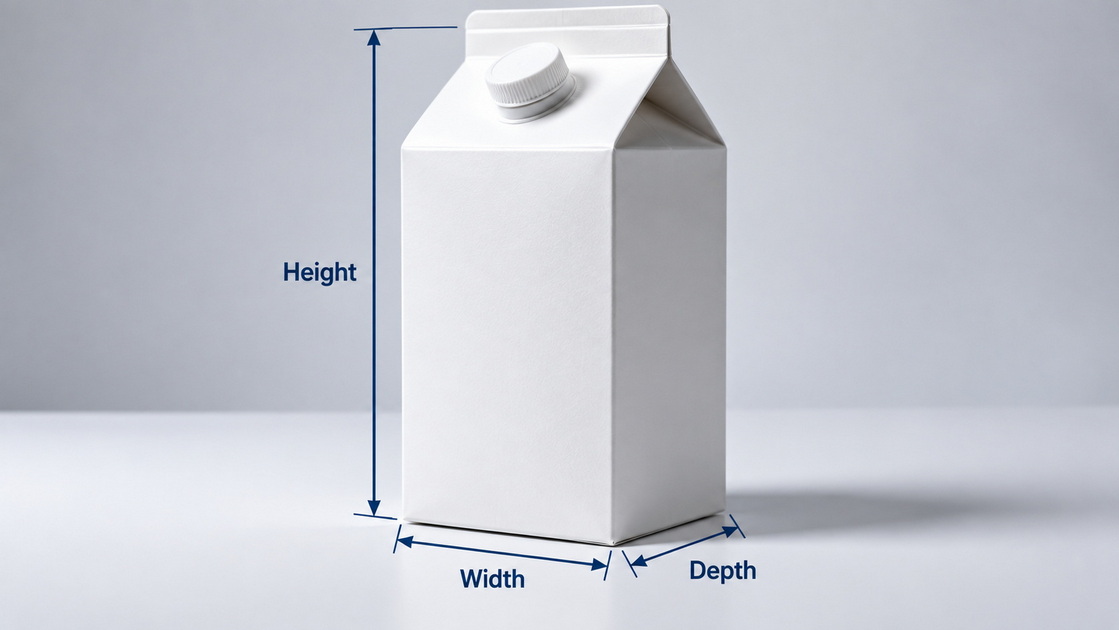
There are common fill volumes, but no single outside length, width, and height for every milk carton at a given volume. Two cartons labeled one quart can differ in footprint, roof profile, closure, board construction, and total height. A gable-top carton also has a different geometry from a flat-topped, brick-shaped carton.
The table below converts familiar U.S. liquid volumes. It does not assign universal carton dimensions.
| Nominal U.S. liquid size | U.S. fluid ounces | Approximate milliliters | What a buyer should verify |
|---|---|---|---|
| Half-pint | 8 fl oz | 237 mL | Serving format, straw or opening, and case count |
| Pint | 16 fl oz | 473 mL | Shelf footprint and opening style |
| Quart | 32 fl oz | 946 mL | Filled height, top closure, and line compatibility |
| Half-gallon | 64 fl oz | 1,893 mL | Handling, stiffness, and distribution case fit |
| Gallon | 128 fl oz | 3,785 mL | Ergonomics, weight, and verified format availability |
These are U.S. liquid measures. A British imperial gallon is different. If you sell internationally, put the target market and declared metric volume on the same specification sheet as the proposed carton dimensions.
A published dimension such as "3.6 × 3.6 × 8.3 inches" may describe a particular supplier's carton, an unfilled blank, a filled retail unit, or an approximate design. Without that context, it is not a production specification.
Ask four questions before using a number:
- What is being measured? A flat blank, formed empty carton, filled carton, or shipping case?
- Where are the endpoints? Does height include the gable peak or cap?
- Which orientation applies? Retail-facing width may differ from a machine drawing's "length."
- What is the tolerance? A nominal dimension alone does not define acceptable variation.
The safe approach is to request a dimensioned drawing and physical samples for the exact carton, opening, and fill volume under consideration.

For a filled retail carton, start with the panel intended to face shoppers. Measure the maximum outside dimensions while facing that panel. This keeps your measurements consistent when you share product data with retailers and logistics partners.
1. Stand the filled, closed carton on a flat surface. Use a representative production sample, not a flattened blank.
2. Identify the front panel. Record which panel you used so width and depth cannot be swapped later.
3. Measure height from base to highest point. Include a gable peak, cap, or other projection where it extends beyond the body.
4. Measure width from left to right. Use the carton's maximum outside width.
5. Measure depth from front to back. Include the farthest projecting feature.
6. Repeat across samples. Record the observed range, sample condition, unit of measure, and agreed acceptance limits.
Use a calibrated ruler or caliper appropriate to the feature. Board thickness is a separate material property; do not label a three-dimensional size chart "thickness." For engineering and purchasing, millimeters are usually easier to work with than rounded centimeter estimates. Convert inches using 1 inch = 25.4 mm, then agree how values will be rounded.
A useful specification often needs two sets of dimensions:
| Measurement | Primary use | Practical note |
|---|---|---|
| Maximum external filled dimensions | Retail data, shelf planning, case design | Include protrusions such as caps |
| Carton body and opening geometry | Filling-line and component review | Record separately from the overall envelope |
| Flat blank or sleeve dimensions | Material conversion and machine feeding | Do not substitute for filled dimensions |
| Packed case dimensions | Warehousing and transport | Measure the assembled, loaded case |
A line technician may need body-panel dimensions and crease locations. A retailer may need the largest dimensions of the finished unit. Both requests are valid, but they answer different questions.
No—not by themselves. Multiplying external length × width × height gives the volume of a rectangular envelope around the package. It does not give the usable liquid volume inside a coated paperboard carton.
Consider a hypothetical carton measuring 75 × 75 × 200 mm externally. Its rectangular envelope is 1,125,000 mm³, or 1.125 L. That does not mean you can fill it with 1.125 L of milk. The board and seal layers take up space; the roof is not a full rectangular prism; and the intended filling level leaves space required by the approved package design. The example is a calculation exercise, not a proposed one-liter carton specification.
For a gable-top carton, the body may be approximately rectangular, but the folded roof and sealed ridge complicate the interior shape. Even a geometric model remains only an estimate until the package design and filling process are validated.
For procurement, specify declared net contents separately from:
- Nominal internal capacity of the approved carton design.
- Target fill volume and permitted fill range.
- External dimensions of the finished carton.
- Carton design, closure, and sealing method.
- Applicable market and labeling requirements.
A packaging drawing should describe the container. A filling trial should confirm that the complete system can deliver the required product quantity and seal performance.
The phrase "milk carton box" can describe packages built for different distribution conditions. Decide how the milk will be processed and sold before you choose carton dimensions or machinery.
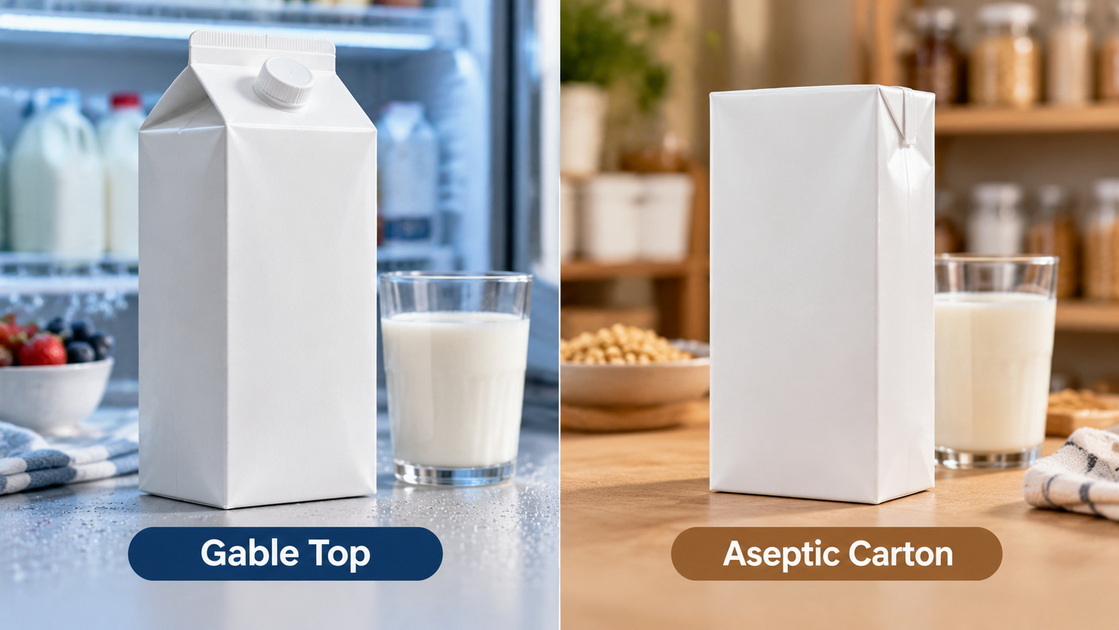
| Question | Refrigerated gable-top carton | Shelf-stable aseptic carton |
|---|---|---|
| Typical appearance | Pitched, roof-like top | Often a flat-topped brick format |
| Distribution plan | Usually chilled | Designed for ambient distribution before opening |
| Package structure | Paperboard with liquid-resistant polymer layers; structure varies | Multilayer barrier structure designed for the validated aseptic system |
| Production priority | Forming, hygienic filling, sealing, and cold-chain fit | Product treatment, package sterilization, aseptic filling, and barrier integrity |
| Dimension to check first | Overall height, including ridge or cap | Exact machine-approved format and case footprint |
Do not assume aluminum foil is inside every milk carton. A refrigerated gable-top carton and a shelf-stable aseptic carton can use different layer structures. Nor does a barrier material alone make milk shelf-stable. The product, processing conditions, package, and filling system must work together.
For HLun Pack's buyers, this distinction determines the scope of the enquiry. Are you sourcing paper-based packaging materials, a compatible packaging machine, or a coordinated packaging-and-equipment solution? State the intended product and distribution method before requesting a size recommendation.
A carton that looks right in a rendering can still fail at the machine interface. Before changing height, footprint, coating, or opening, check the whole route from incoming material to palletized case.
Ask the packaging and equipment teams to review:
- Format range: Can the proposed machine handle this exact blank or sleeve, filled height, and closure?
- Material specification: Are board stiffness, coating or laminate, crease behavior, and seal surfaces suitable for the intended process?
- Product conditions: What are the milk type, filling temperature, hygiene requirements, and intended storage conditions?
- Filling and sealing: Where are the fill level, seal zones, and potential contamination points?
- Downstream handling: Will the carton pass through conveying, coding, case packing, and palletizing without interference?
- Changeovers: If several volumes share one line, which components or settings must change?
These are qualification questions, not a claim that one machine accepts every carton type. Request the equipment maker's approved format range and test the proposed material and carton together.

1: Desk review. Compare the dimensioned drawing, material specification, declared volume, closure design, and machine requirements. Flag missing tolerances before tooling or printed materials are approved.
2: Sample and line trial. Check feeding, forming, filling, sealing, coding, and handling with representative samples. Record rejects and identify whether failures originate in material, carton geometry, machine settings, or product conditions.
3: Distribution validation. Examine filled units after the relevant storage and shipping conditions. Check leakage, deformation, case fit, readability of printed information, and whether the package still meets the agreed specification.
A simple acceptance sheet can prevent a costly misunderstanding: list each measurement, test method, sample quantity, acceptance criterion, and responsible party before the trial starts.
Paperboard is not automatically suitable for direct milk contact. The complete food-contact structure—including any coating, polymer layer, adhesive, ink interaction, and closure—must be assessed for its intended use and destination market. For a U.S. project, request the supplier's relevant food-contact documentation rather than accepting "food grade" as a complete specification.
Be equally precise with environmental language. A paper-based carton may still contain polymer layers, and some shelf-stable structures contain aluminum. "Paper-based," "recyclable," "compostable," and "biodegradable" make different claims. Recycling access can vary by location; compostability requires evidence for the complete package and the stated disposal conditions.
A stronger buyer question is: "What is the verified structure, and what evidence supports this specific claim in our sales market?" That is more useful than asking whether every milk carton is simply "eco-friendly."
If you need a quotation, send more than a target volume and an image. A concise brief helps a packaging partner identify workable paper materials, carton geometry, and equipment requirements.
1. Product: Milk type, processing method, and intended shelf-life conditions.
2. Market: Sales country, declared volume, and relevant labeling requirements.
3. Package: Gable-top or other format, opening preference, and target appearance.
4. Dimensions: Target external height, width, and depth, with maximum allowable limits.
5. Material: Required barrier and food-contact documentation.
6. Line: Existing equipment model or requested production scope, target output, and changeover needs.
7. Distribution: Case configuration, pallet plan, and storage conditions.
8. Approval: Required samples, trials, measurements, and test criteria.
For example, "one-quart carton" is too vague. "U.S. 32 fl oz refrigerated milk in a capped gable-top carton, with a maximum filled height defined by our retail shelf and a sample trial on our existing line" gives an engineer a useful starting point. The final dimensions must come from the approved design and trial, not from this example.
The best milk carton dimensions are not merely the smallest or most familiar numbers. They are the dimensions that support the declared fill, approved material structure, reliable production, retail fit, and distribution plan. Validate those requirements together before you commit to printed cartons or equipment changes.
Planning a paper-based milk packaging project? Send HLun Pack your target fill volume, carton style, product and storage conditions, proposed dimensions, and existing equipment details. Ask for a packaging-and-equipment compatibility review and a clear sample-trial plan before finalizing your specification.
There is no universal outside size. A U.S. liquid half-pint is 8 fl oz, approximately 237 mL, but its carton dimensions depend on the manufacturer, top design, and opening. Ask for the filled carton's dimensioned drawing.
For the maximum external dimension used in retail and logistics data, include the highest projection. A body-only dimension can also be useful for machinery, but label it separately.
Do not use outside width × depth × total height as the fill capacity. That calculates a rectangular envelope. Use the approved package specification and verify the intended fill through a controlled production trial.
No. One quart describes the nominal U.S. liquid quantity—32 fl oz, not a fixed exterior shape. Confirm the particular carton's footprint, filled height, and tolerance.
No. Carton constructions vary. Refrigerated gable-top packages commonly differ from shelf-stable aseptic structures. Request a layer-by-layer material specification for the selected format.
Some equipment supports multiple approved formats, but that does not mean every size or material will work. Confirm the machine's format range, required change parts, settings, and test results with its supplier.
No. A package's technical recyclability does not guarantee collection in every community. Check acceptance in the target market and qualify any consumer-facing recycling claim accordingly.
1. [OXO Packaging, "Read This Blog to Know How to Measure Milk Carton Box Dimension"]. Source article used to identify the original search intent, size examples, and claims requiring correction; its sample dimensions were not adopted as universal standards. [oxopackaging]
2. [NIST, *Handbook 44—2026, Appendix C: General Tables of Units of Measurement*]. Source for U.S. liquid-volume relationships, approximate metric conversions, and inch-to-centimeter conversion. [nist]
3. [GS1, *Package and Product Measurement Standard*, Release 3.2]. Source for identifying the retail-facing front and measuring maximum external height, width, and depth, including projections. [gs1]
4. [Galdi, "Brick-shaped, Brik® or Gable Top Carton"]. Industry explanation of package shapes, materials, and differences between gable-top and aseptic-brick production. [galdi]
5. [Tetra Pak, "Aseptic Carton Packages Portfolio"]. Source on ambient distribution of milk in aseptic packages. [tetrapak]
6. [U.S. Food and Drug Administration, "Food Packaging & Other Substances that Come in Contact with Food"]. Source for the food-contact assessment and authorization context relevant to U.S. projects. [fda]
7. [U.S. Federal Trade Commission, *Guides for the Use of Environmental Marketing Claims*]. Source for substantiating and qualifying recyclable, compostable, and broader environmental claims. [ftc]
8. [Recycle Cartons, "Carton Recycling 101"]. Industry source distinguishing refrigerated gable-top and shelf-stable cartons and explaining that local recycling access should be checked. [recyclecartons]


