


close
Choose Your Site
Global
Social Media
Views: 264 Author: Tom Publish Time: 2026-09-30 Origin: Hlunpack


For chili sauce packaging, film performance is about much more than simply achieving a reliable seal. As a product expands into wider markets, longer transportation, changing storage conditions and faster packaging lines can create completely new requirements for the laminate.
In this project, the customer’s packaging film evolved through two major technical upgrades:
· BOPA/PE — the original structure, focused mainly on toughness and basic sealing performance.
· PET/VMPET/PE — the first upgrade, adding metallized barrier protection for longer distribution.
· PET/VMPET/BOPA/Special Low-Temperature Sealing PE — the final four-layer structure, combining barrier protection, mechanical strength and improved compatibility with high-speed rotary sealing.
The project demonstrates why flexible packaging should be developed as a complete system involving the product, distribution environment, laminate structure and packaging machine.

Parameter | Project Detail |
Product | Chili sauce containing chili particles, spices and mint leaves |
Original film | BOPA/PE |
First upgrade | PET/VMPET/PE for stronger light, oxygen and moisture barrier |
Final film | PET/VMPET/BOPA/Special Low-Temperature Sealing PE |
Machine change | New continuous rotary roller sealing system |
Observed issue | Seal instability and leakage increased above approximately 65 packs/min under the existing settings |
Production target | Up to approximately 100 packs/min |
Optimization focus | Barrier protection + mechanical toughness + lower SIT + stronger hot tack + wider sealing window |
The customer originally used a BOPA/PE roll film. In the earlier stage of the business, when distribution distances were shorter, this structure offered useful toughness, puncture resistance and basic heat-sealing performance.
As the sales network expanded, the chili sauce began to travel to more remote markets and remain in distribution for longer periods. The customer gradually observed changes in the color of some chili particles. Because the formulation also contained mint leaves and other aromatic ingredients, aroma and flavor stability became a greater concern during extended transport and storage.
The packaging requirement had therefore changed from basic containment to longer-term product protection.
Long-term stability of chili sauce containing chili particles, herbs, spices and aromatic ingredients can be influenced by multiple factors, including light exposure, oxygen transmission, temperature, storage duration and the product formulation itself. As the distribution radius expanded, the packaging needed stronger protection from external environmental influences.
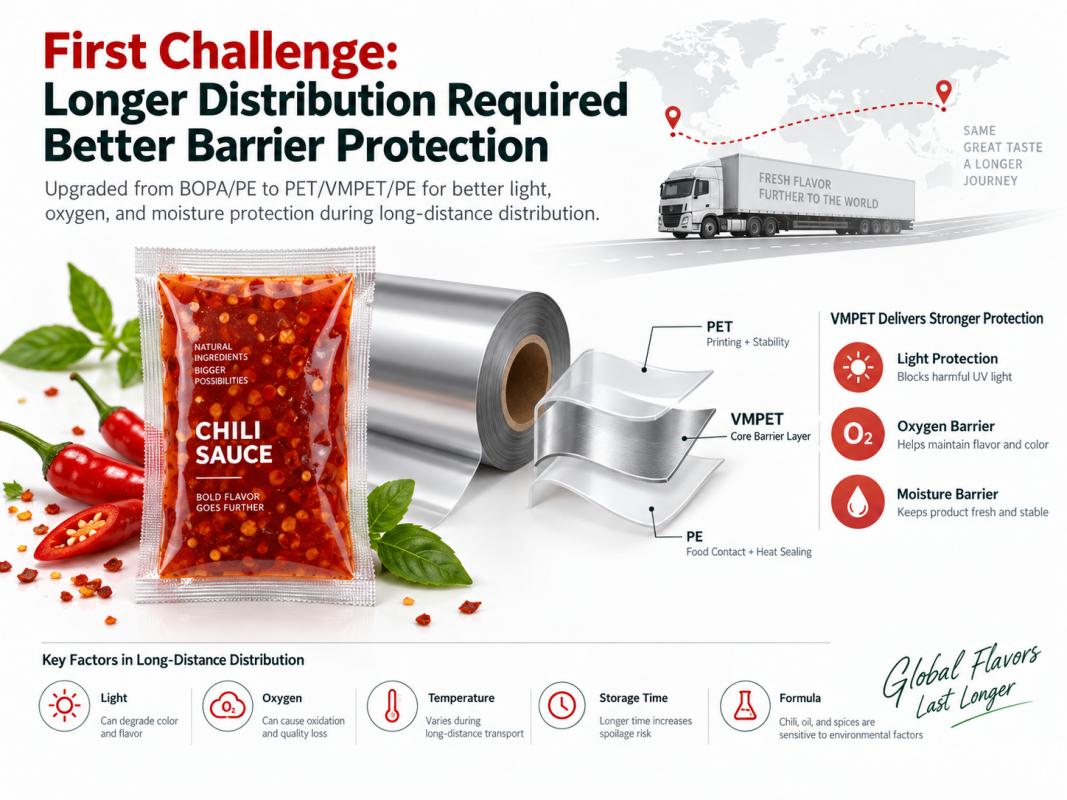
We therefore recommended introducing a metallized barrier layer, resulting in the first upgraded structure:
First upgrade: PET / VMPET / PE
Layer | Primary Function |
PET | Printing performance, dimensional stability, outer-layer support and stable converting performance. |
VMPET | Improved light protection plus stronger oxygen and moisture barrier for extended distribution. |
PE | Food-contact and heat-sealing layer for basic package integrity. |
By introducing VMPET, the packaging evolved from a structure focused mainly on mechanical performance into one combining mechanical performance with stronger barrier protection.
As production volume increased, the customer upgraded to a faster packaging machine with a target output of approximately 100 packs/min. When the existing PET/VMPET/PE roll film was transferred to the new line, sealing instability began to appear at higher speeds.
Above approximately 65 packs/min, the customer reported increasing leakage, local film deformation, sticking around the sealing area and reduced production stability. At lower speeds the film could still run, which indicated that the problem was not simply insufficient film thickness.
Key diagnosis: The heat-sealing behavior of the existing PE layer was not well matched to the new high-speed rotary sealing environment.
The new machine used a continuous rotary roller sealing system. During operation, the laminate passed continuously through heated sealing rollers and was exposed to a combination of relatively high temperature, strong roller pressure, short effective contact time and continuous motion.
As machine speed increased, the effective sealing time decreased. The conventional PE sealant therefore had less time to form a reliable seal, while still being exposed to significant heat and pressure. Under this combination, the sealing layer could become excessively soft and over-compressed.
· Sealant over-softening
· Excessive compression and local sealant squeeze-out
· Film deformation around the sealing zone
· Sticking at the rotary sealing rollers
· Narrower process tolerance
· Seal instability and leakage at higher speeds
Simply increasing the sealing temperature could worsen the problem. The correct solution required optimizing the sealant response rather than relying on more heat.
After evaluating the product, long-distance distribution requirements and the sealing mechanism of the new machine, we redesigned the laminate into a four-layer structure:
Final structure: PET / VMPET / BOPA / Special Low-Temperature Sealing PE
The objective was not simply to add another film layer. Each layer was selected for a specific engineering function.
Material | Role in the Final Laminate |
PET | Printability, dimensional stability and outer-layer support. |
VMPET | Light protection plus enhanced oxygen and moisture barrier. |
BOPA | Toughness, puncture resistance, flex-crack resistance and additional mechanical durability. |
Special Low-Temperature Sealing PE | Lower seal initiation temperature, improved hot tack and a wider sealing window for high-speed rotary sealing. |
The chili sauce contains solid chili particles and mint leaves. For this type of product, barrier protection is important, but mechanical toughness also matters during filling, handling, stacking and transportation. BOPA was therefore added to reinforce puncture resistance and overall laminate durability while the VMPET layer continued to provide the main barrier function.
This makes the four-layer structure more balanced than treating the project as a barrier-only upgrade.
The innermost PE layer was the key to addressing the high-speed sealing problem. Instead of using a conventional PE sealant, we selected a special low-temperature sealing PE more suitable for continuous rotary sealing.
The optimized PE can begin forming an effective seal at a lower temperature. This reduces the thermal energy required during each sealing cycle and is especially useful as the available sealing time becomes shorter at higher machine speeds.
At high speed, the package leaves the sealing zone while the seal is still hot. Improved hot-tack performance helps maintain initial seal strength before the seal has fully cooled.
A wider sealing window provides more tolerance to changes in temperature, pressure, machine speed and contact time, reducing the need to run within an extremely narrow process range.
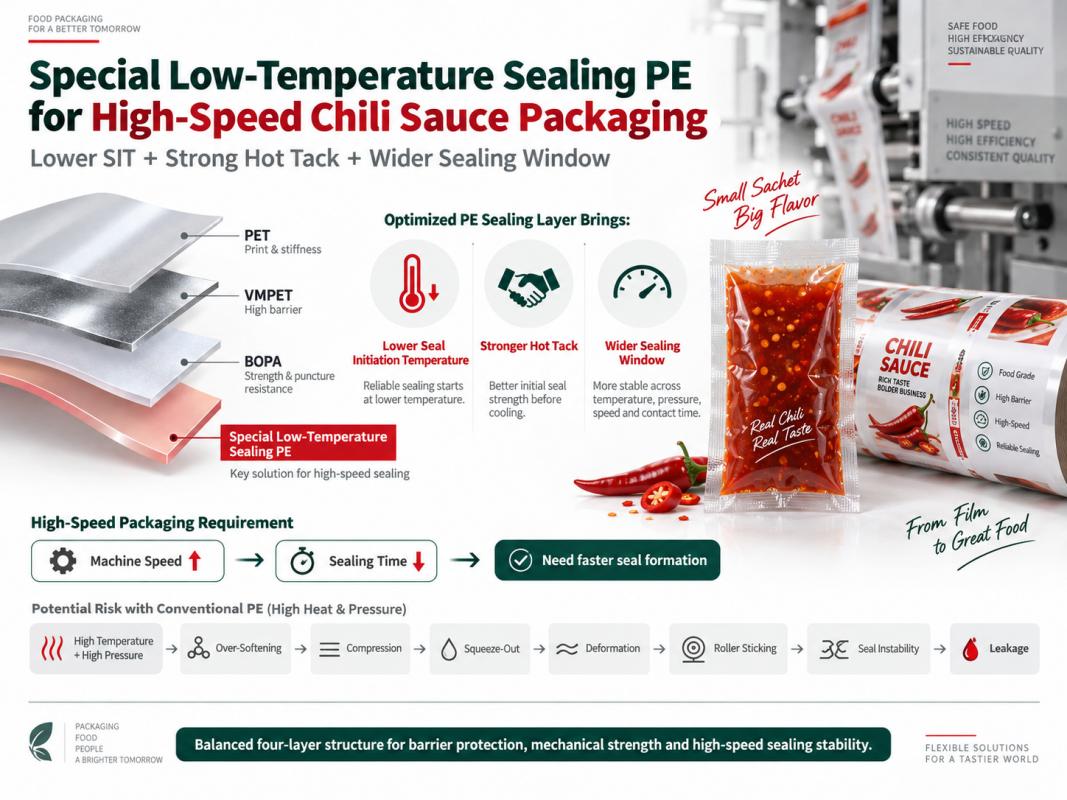
The high-speed sealing relationship can be summarized simply:
Machine Speed ↑ → Effective Sealing Time ↓ The sealant must form a reliable seal within a shorter thermal cycle.
If a sealant requires too much heat to initiate sealing, increasing machine temperature may create a negative chain reaction:
High Temperature + High Pressure → Sealant Over-Softening → Excessive Compression → Sealant Squeeze-Out → Local Deformation → Roller Sticking → Seal Instability → Leakage
The target was therefore not simply “more heat resistance.” The actual optimization target was:
Lower SIT + Strong Hot Tack + Wider Sealing Window Combined with VMPET for barrier protection and BOPA for mechanical strength.
When leakage appears after a machine speed increase, simply making the laminate thicker does not necessarily improve sealing. A thicker structure may even require additional time or thermal energy for heat to reach the sealing interface.
High-speed heat sealing is influenced by the interaction of sealant chemistry, seal initiation temperature, hot tack, sealing temperature, pressure, contact time, machine speed, web tension and sealing-roller design.
For this project, changing the functional behavior of the laminate was more important than simply adding gauge.
A film that performs well on one packaging machine may behave differently on another. When the customer’s market expanded, the barrier structure had to be reconsidered. When the customer upgraded the packaging equipment, the sealing layer had to be reconsidered again.
The final solution was therefore developed around three conditions:
· Product: chili sauce containing chili particles, mint leaves and aromatic ingredients.
· Distribution: longer transport and storage periods requiring stronger light and oxygen protection.
· Packaging machine: high-speed rotary sealing requiring faster and more stable seal formation.
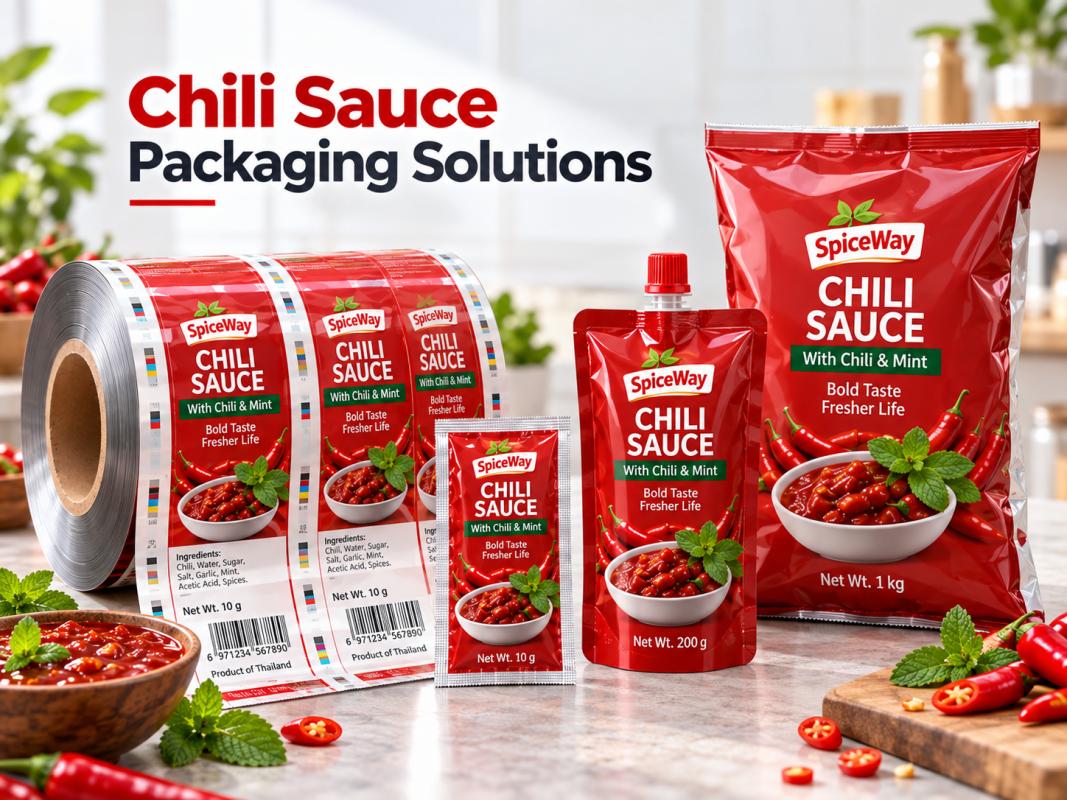
The same product category may require different packaging formats depending on serving size, distribution channel and filling system. HLunPACK can develop rollstock and finished flexible packaging for applications including small sauce sachets, spout pouches and larger commercial four-side-seal packs.
This case can be summarized as two different challenges requiring two different material responses:
· Stage 1 — BOPA/PE → PET/VMPET/PE: improved light, oxygen and moisture protection for longer distribution.
· Stage 2 — PET/VMPET/PE → PET/VMPET/BOPA/Special Low-Temperature Sealing PE: restored mechanical reinforcement and optimized the sealing layer for the customer’s faster rotary sealing system.
The final four-layer film was developed around the customer’s target production speed of up to approximately 100 packs/min. Actual production performance should be confirmed under the final product, filling conditions, machine settings and quality-control protocol before mass production.
At HLunPACK, flexible packaging film is not treated as an isolated material. When customers encounter issues such as color change during distribution, aroma instability, seal leakage, roller sticking, deformation or reduced stability after a machine upgrade, we analyze the complete packaging system.
Our evaluation can include product characteristics, barrier requirements, laminate structure, sealant selection, packaging speed, sealing temperature, sealing pressure, contact time and web handling. By combining flexible packaging material development with packaging-machine knowledge, we can optimize the film around the actual operating environment rather than relying only on a standard laminate structure.
For high-speed chili sauce packaging, the best solution is not automatically the thickest film or the laminate with the most layers. A stable packaging system comes from matching the product, distribution conditions, material structure, sealing system and production speed.
In this project, the structure evolved from BOPA/PE to PET/VMPET/PE and finally to PET/VMPET/BOPA/Special Low-Temperature Sealing PE—moving from basic mechanical protection to stronger barrier performance and then to a more balanced structure designed for demanding high-speed rotary sealing conditions.
HLunPACK capability: Flexible Packaging Film Development + Barrier Structure Optimization + High-Speed Sealing Compatibility + Packaging Machinery
The structure depends on product formulation, particle content, required shelf life, filling conditions, distribution environment and machine type. In this case, the final engineering direction was PET/VMPET/BOPA/Special Low-Temperature Sealing PE.
VMPET can improve light protection and provide stronger oxygen and moisture barrier performance, which can be useful when the product faces longer transportation and storage periods.
As speed increases, effective sealing time decreases. If the sealant layer is not matched to the machine’s temperature, pressure and contact time, seal instability, deformation, sticking or leakage can occur.
A suitable low-temperature sealant can lower the seal initiation temperature, improve hot tack and widen the sealing window, helping the film form a stable seal within a shorter high-speed sealing cycle.
No. Thickness is only one variable. Sealant chemistry, hot tack, temperature, pressure, dwell/contact time, web tension and the sealing mechanism can be equally or more important.


