


close
Choose Your Site
Global
Social Media
Views: 247 Author: HLun PACK Publish Time: 2026-11-06 Origin: Site


Content Menu
● Gusseted Pouch vs. 3 Side Seal Pouch
● What Is a Gusseted Pouch for Whole Bean Coffee?
>> Where Gussets Add Complexity
● What Is a 3 Side Seal Pouch for Coffee?
>> Where the Flat Format Works Well
>> Its Main Capacity Limitation
● Nitrogen Flushing: What Actually Protects Coffee?
>> Residual Oxygen Matters More Than the Format Name
>> Equal Oxygen Percentages Can Hide Different Oxygen Quantities
● Degassing Valves: Do Both Pouch Formats Need One?
>> Select the Valve Around the Coffee
● Barrier Film and Seal Integrity: The More Important Comparison
>> Compare Materials Under Matching Conditions
>> Test Seal Strength and Leaks Separately
● Packaging Machine Compatibility and Production Efficiency
>> Equipment Questions for Gusseted Coffee Bags
>> Equipment Questions for 3 Side Seal Pouches
● A Practical Validation Plan Before Ordering
>> 1: Define the Commercial Requirement
>> 2: Build Comparable Trial Packs
>> 4: Confirm Quality Through Storage
● Cost and Sustainability: Compare Accepted Packs
● Which Coffee Pouch Should You Choose?
>> Is a gusseted pouch better for nitrogen-flushed whole bean coffee?
>> Can a 3 side seal pouch have a degassing valve?
>> Does nitrogen flushing eliminate the need for a coffee valve?
>> What residual oxygen level should we specify?
>> Can either pouch guarantee twelve months of freshness?
>> Does a zipper preserve the original nitrogen atmosphere?
Choosing a gusseted pouch vs. 3 side seal pouch for nitrogen-flushed whole bean coffee requires more than comparing appearance. Both formats can protect roasted beans when properly specified. The stronger choice depends on fill weight, oxygen control, degassing, sealing consistency, and how customers use the coffee.
At HLun Pack, our packaging-system perspective starts with one principle: validate the complete package, not just its shape. Film, valve, filling equipment, nitrogen delivery, and final seal must work together. This guide compares both formats and explains how to make a defensible purchasing decision.
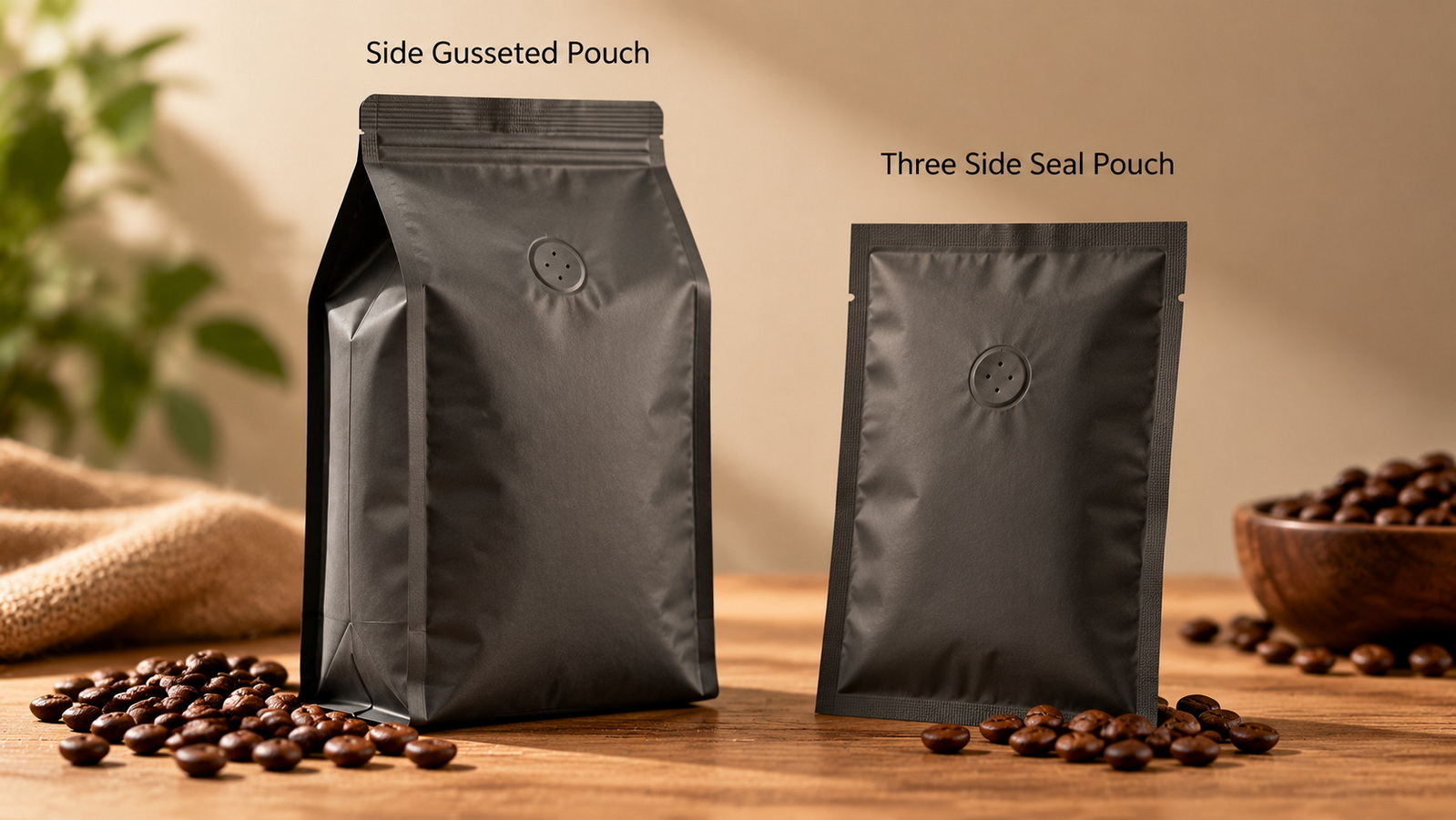
For larger retail and foodservice packs, a side-gusseted pouch is often the more practical starting point. Its expandable sides accommodate bulky beans and can create a compact filled package.
For samples, promotional packs, and smaller portions, a 3 side seal pouch often provides a simpler, flatter format.
Neither structure automatically delivers longer shelf life. A well-sealed, high-barrier flat pouch can outperform a poorly specified gusseted bag. Equally, an attractive gusseted package cannot compensate for excessive residual oxygen.
| Decision factor | Side-gusseted pouch | 3 side seal pouch |
|---|---|---|
| Structure | Expandable side folds | Flat construction without side gussets |
| Typical starting application | Larger retail and foodservice packs | Samples and smaller portions |
| Nitrogen flushing | Requires control around expanded folds and beans | Requires adequate mouth opening and gas access |
| Final sealing | Fold intersections can create thickness changes | Usually flatter across the filling opening |
| Display | Familiar coffee-bag silhouette | Broad, flat graphic area |
| Main caution | Fold control and seal consistency | Overfilling and bean interference at the seal |
A gusseted pouch incorporates folded material that expands as the package fills.
This comparison focuses on side-gusseted coffee bags. Bottom-gusset stand-up pouches, quad-seal bags, and flat-bottom bags are related options, but they are not interchangeable specifications.
Whole beans create an irregular product mass with spaces between individual beans. Side folds provide additional volume without requiring an equally wide front panel.
Potential advantages include:
- Convenient capacity for larger fills.
- A familiar presentation for retail coffee.
- Side panels for product information.
- Opportunities to optimize filled dimensions for shipping cartons.
However, a side-gusseted pouch does not necessarily stand upright reliably. Base construction, fill level, and bean distribution determine its stability. Request filled samples rather than judging an empty bag.
The final sealing area may include transitions between different numbers of film layers. These locations require controlled positioning, pressure, temperature, and dwell time.
A sealing setup that works across the center may not perform equally well near folded edges. Coffee fragments or oil contamination can introduce additional variability.
The practical question is whether the selected machine can produce consistent seals across the actual pouch geometry.
A 3 side seal pouch, also called a flat or lay-flat pouch, typically arrives with three edges sealed and one opening available for filling. The packaging operation closes that opening after dispensing the beans and establishing the intended atmosphere.
It should not be confused with every type of sachet. Seal configuration depends on the manufacturing method.
A 3 side seal coffee pouch is worth evaluating for:
- Tasting samples.
- Subscription inserts.
- Promotional distributions.
- Smaller retail portions.
- Packs intended for quick consumption after opening.
Its broad face provides space for origin details, roast information, and brewing instructions. A generally flat filling opening can also simplify positioning during sealing.
A flat pouch can hold whole beans, but increasing the fill may create a rounded, bulky package.
Too much product can reduce the clear space above the beans, interfere with nitrogen delivery, and contaminate the sealing area. The solution is not simply increasing the machine's gas flow.
Evaluate pouch width, usable internal height, fill volume, and clearance together.
Nitrogen flushing replaces much of the air inside the package before sealing. Its purpose is to reduce oxygen exposure and slow oxidative deterioration.
It does not sterilize coffee, remove every source of oxygen, or eliminate the need for protective packaging.
Residual oxygen is the oxygen remaining after the packaging process.
It depends on several interacting variables:
1. Nitrogen supply purity.
2. Gas flow and nozzle position.
3. Displacement of air between beans.
4. Time between flushing and sealing.
5. Pouch opening and headspace geometry.
6. Seal and valve performance.
A 2022 study involving roasted coffee used nitrogen-packed samples and excluded packs with initial oxygen concentrations above 0.5%. That was an experimental acceptance condition—not a universal commercial requirement.
For production, agree on a measurable oxygen specification and sampling method before approving the equipment.
Consider two hypothetical packages with the same measured oxygen concentration. The package containing more gas volume also contains more oxygen in that gas phase.
For example, at 1% oxygen:
- A 100 mL gas volume contains approximately 1 mL oxygen.
- A 300 mL gas volume contains approximately 3 mL oxygen.
This simplified illustration excludes oxygen associated with the product and later ingress. It explains why a percentage alone does not describe the complete oxygen burden.
Compare headspace, fill weight, and measurement timing—not just analyzer readings.
Freshly roasted beans continue releasing carbon dioxide after roasting. A one-way degassing valve allows gas to escape while restricting outside air entry.
Nitrogen flushing and degassing valves perform different jobs:
- Nitrogen flushing reduces oxygen during packing.
- A valve manages subsequent gas release.
- Barrier film limits transmission through the package.
- Seals maintain package closure.
Flushing does not make ongoing degassing disappear.
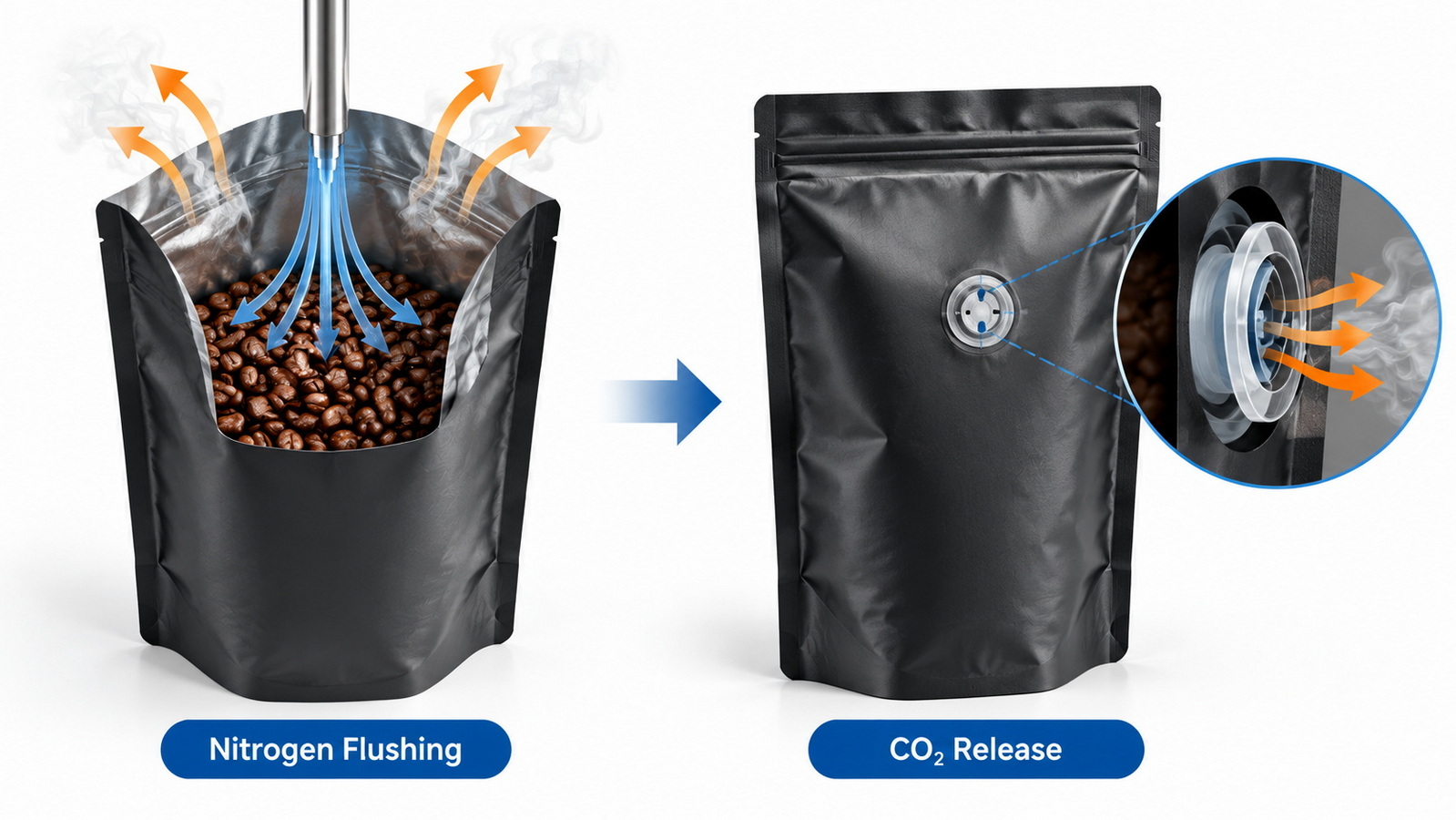
Evaluate roast level, roast-to-pack interval, bean characteristics, storage temperature, and expected distribution conditions.
Either pouch format can incorporate a suitable valve if its construction and production process support the installation.
Check valve placement against bean contact, graphics, sealing jaws, and the completed package. Avoid treating any valve as a perfect barrier: its performance must be assessed within the finished pack.
A meaningful gusseted pouch vs. 3 side seal pouch comparison should hold the barrier specification reasonably constant. Otherwise, differences attributed to shape may actually come from the laminate.
Request documented specifications for:
- Oxygen transmission rate, or OTR.
- Water vapor transmission rate, or WVTR.
- Test temperature and humidity.
- Film thickness and layer structure.
- Light protection.
- Sealant compatibility.
- Applicable food-contact documentation.
OTR and WVTR describe different transmission processes. Values measured under different conditions are not directly comparable.
Foil-containing, metallized, and other high-barrier structures may be candidates. Selection should reflect the intended shelf life, handling conditions, machine requirements, and disposal infrastructure.
Seal strength measures resistance to separation. Leak testing investigates pathways through which gas may pass. One result cannot substitute for the other.
ASTM F88/F88M provides a method for measuring seal strength in flexible barrier materials. ASTM F2096 addresses gross leaks through internal pressurization.
Select methods appropriate to the package. A valve-equipped pouch requires a defined testing approach so intended valve venting is not confused with an unintended leak.
The packaging line can change which format makes commercial sense.
A pouch that looks inexpensive in a quotation may become costly if it needs frequent repositioning, generates rejects, or runs below the required output.
Ask whether the proposed system can:
- Open and hold the gussets consistently.
- Dispense beans without contaminating the seal.
- Position the nitrogen nozzle correctly.
- Control folds through the sealing station.
- Handle the required bag sizes and valve positions.
Do not assume that a machine capable of handling one gusseted structure supports every related format.
For premade flat pouches, verify opening reliability, filling access, and sufficient clearance above the product.
Smaller openings may constrain bean flow or nozzle placement. A flatter seal area may simplify one operation while creating restrictions elsewhere.
For either format, request a trial using actual beans, the intended laminate, production-representative nitrogen conditions, and the target operating speed.
A structured trial is more valuable than an unsupported shelf-life promise.
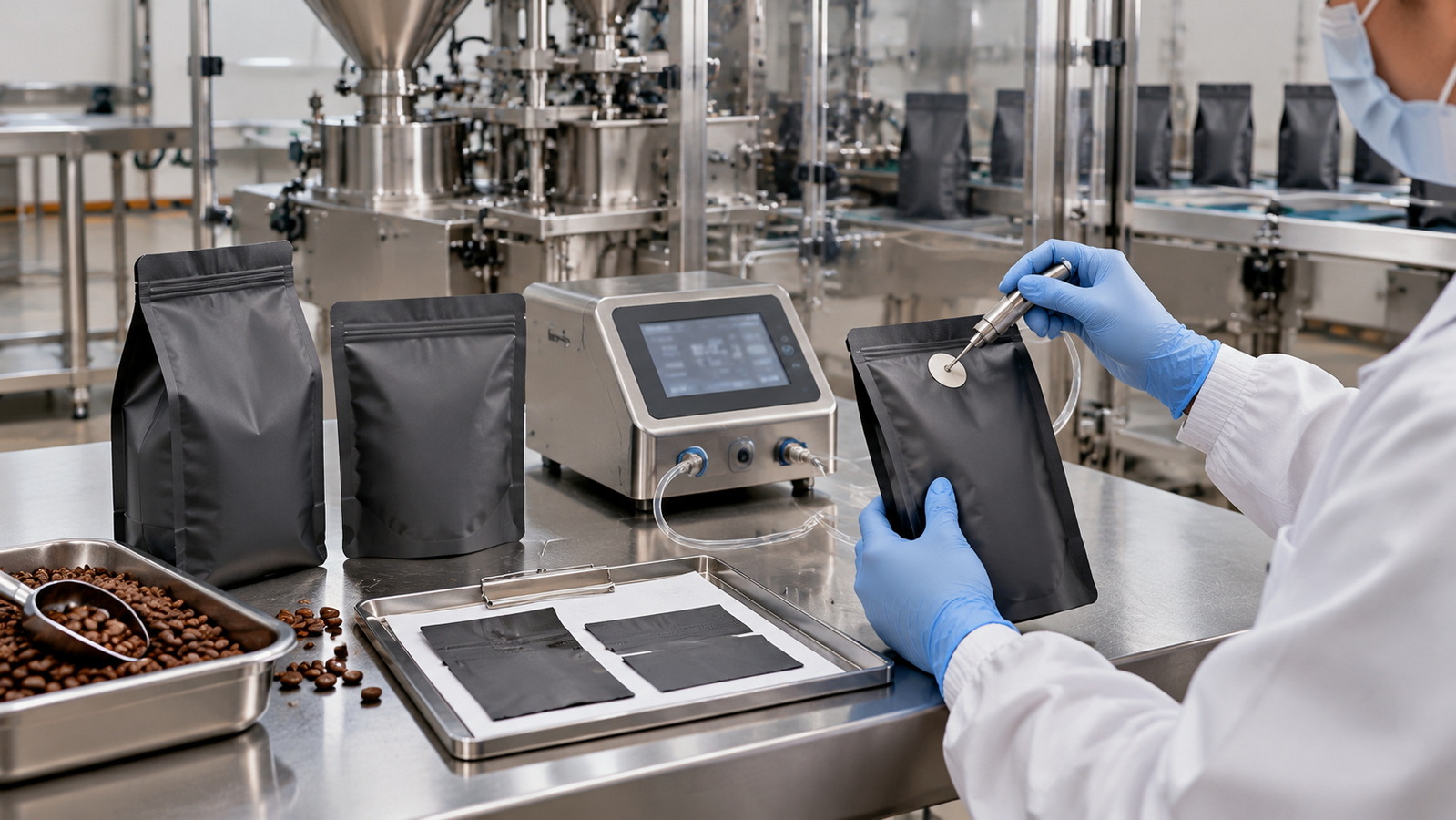
Document fill weight, distribution duration, storage conditions, sales channel, opening features, and required output.
Specify what acceptable quality means. Sensory deterioration may become unacceptable before any visible packaging failure.
Use the same coffee batch and similar roast-to-pack timing. Keep barrier performance comparable and record differences in pouch area, valve, and headspace.
Include repeat samples. One successful package proves very little about production consistency.
Record:
- Residual oxygen at a defined time after sealing.
- Nitrogen consumption.
- Actual production speed.
- Seal condition and leak results.
- Reject rate.
- Filled dimensions and carton utilization.
Repeat measurements after suitable storage intervals. Later oxygen readings reflect several processes, including gas release and oxygen ingress, so interpret them alongside package-integrity results.
Assess representative packs over the intended storage period. Use consistent brewing and preferably blind sensory evaluation.
Include realistic transport and handling conditions. Neither an attractive empty pouch nor a strong laboratory seal establishes the finished product's shelf life.
The relevant cost is the cost per saleable, conforming package—not merely the purchase price of an empty bag.
Include:
- Pouch material and conversion.
- Valves and closures.
- Nitrogen consumption.
- Labor and changeovers.
- Rejects and lost coffee.
- Cartons, storage, and freight.
For illustration, a cheaper bag becomes less attractive if it requires slower production or creates additional sealing rejects.
Environmental comparisons also need equivalent boundaries. Consider material weight, product protection, manufacturing losses, and available collection systems.
Do not assume a flat pouch always uses less material, or that a gusseted pouch always ships more efficiently. Compare actual dimensions and filled-pack trials.
Start with a side-gusseted pouch when larger fills, a familiar coffee presentation, and efficient filled dimensions are priorities.
Start with a 3 side seal pouch when samples, smaller portions, and flat presentation are central to the product.
Then confirm the decision through oxygen measurement, seal testing, sensory evaluation, and production economics.
For a project discussion with HLun Pack, provide your fill weights, pouch drawings, roast-to-pack interval, target output, and intended distribution conditions. Use that brief to define a coordinated pouch, filling, nitrogen-flushing, and sealing solution rather than selecting each component separately.
It is often a practical option for larger fills. However, freshness depends on barrier performance, residual oxygen, valve function, and package integrity—not gussets alone.
Yes, provided the pouch construction, valve position, and manufacturing process support it. Confirm performance using filled samples.
Not automatically. Freshly roasted beans can continue releasing carbon dioxide after sealing. Valve requirements depend on the coffee and validated packing conditions.
Set the acceptance limit through product trials and measurement capability. The 0.5% condition used in one published study is not a universal requirement.
No. A shelf-life claim requires evidence for the specific coffee, packaging structure, process, storage environment, and sensory acceptance criteria.
No. Opening introduces air. A zipper helps with reclosure but does not recreate the original low-oxygen conditions.
1- Specialty Coffee Association. "Preserving Freshness: A Race Against Time." April 18, 2018. Background on oxygen, temperature, degassing, and coffee packaging. [sca]
2- Smrke, S., et al. "Effects of Different Coffee Storage Methods on …" Food Packaging and Shelf Life, 2022. Research on nitrogen-packed roasted coffee, initial oxygen screening, and changes after package opening. [sciencedirect]
3- ASTM International. "ASTM F88/F88M-23: Standard Test Method for Seal Strength of Flexible Barrier Materials." Basis for the distinction between seal-strength measurement and package leak testing. [store.astm]
4- ASTM International. "ASTM F2096: Standard Test Method for Detecting Gross Leaks in Packaging by Internal Pressurization (Bubble Test)." Scope and limitations of gross-leak testing. [store.astm]
5- ePac Flexible Packaging. "Custom Pouch Packaging for Ecommerce & Retail." Commercial terminology identifying lay-flat pouches as 3-side-seal pouches. [epacflexibles]
6- QuantumPak. "How Does a Gas-Flush Packaging System Help Keep Coffee Fresh?" October 21, 2022. Operational background on nitrogen flushing and prompt sealing. [quantumpak]


