


close
Choose Your Site
Global
Social Media
Views: 268 Author: HLun PACK Publish Time: 2026-11-02 Origin: Site


Content Menu
● Vacuum Bag vs Stand Up Pouch for Frozen Food: Quick Comparison
● What Is a Vacuum Bag for Frozen Food?
>> Where Vacuum Bags Offer Practical Advantages
>> Where Vacuum Bags Need Extra Attention
● What Is a Stand Up Pouch for Frozen Food?
>> Where Stand Up Pouches Add Value
>> Why a Freezer-Grade Specification Matters
● Which Packaging Better Prevents Freezer Burn?
>> Evaluate the Whole Package, Not Just Residual Air
● How Film Structure Changes Frozen Food Packaging Performance
>> Thickness Alone Is Not a Quality Standard
● Matching Packaging Machinery to Each Format
>> Vacuum Bag Packaging Equipment
>> Stand Up Pouch Filling and Sealing Equipment
● Practical Selection Examples for Frozen Food Producers
● A Five-Step Validation Plan Before Commercial Production
>> 1. Define the Product and Distribution Conditions
>> 2. Create a Written Package Specification
>> 3. Run Representative Machine Trials
>> 4. Check Seals and Package Integrity
>> 5. Validate Frozen Storage and Distribution
● Compare Total Cost per Saleable Pack
● Food Safety: Neither Format Replaces Process Controls
● Choose a Packaging System with HLun Pack
>> 1. Can a Stand Up Pouch Be Vacuum Sealed?
>> 2. Which Format Is Better for Frozen Meat?
>> 3. Are Stand Up Pouches Suitable for Long-Term Frozen Storage?
>> 4. Does Vacuum Packaging Eliminate Freezer Burn?
>> 5. Is a Resealable Zipper Airtight?
>> 6. Can One Machine Package Both Formats?
Choosing between a vacuum bag vs stand up pouch for frozen food starts with one question: what must your packaging accomplish? Vacuum bags typically suit compact, tightly packed portions of meat and seafood. Stand up pouches often suit resealable frozen vegetables, fruit, and meal components that benefit from convenient dispensing and prominent branding.
However, this comparison involves two different concepts. Vacuum packaging describes an air-removal process. A stand up pouch describes a package shape. A suitably engineered stand up pouch can also be vacuum sealed.
The real decision is therefore about compatibility: matching the food, film structure, package design, sealing process, and distribution conditions. From a packaging-system perspective, I would assess those requirements before choosing either format.
For HLun Pack, this approach connects flexible packaging selection with packaging machinery and integrated production-line planning.
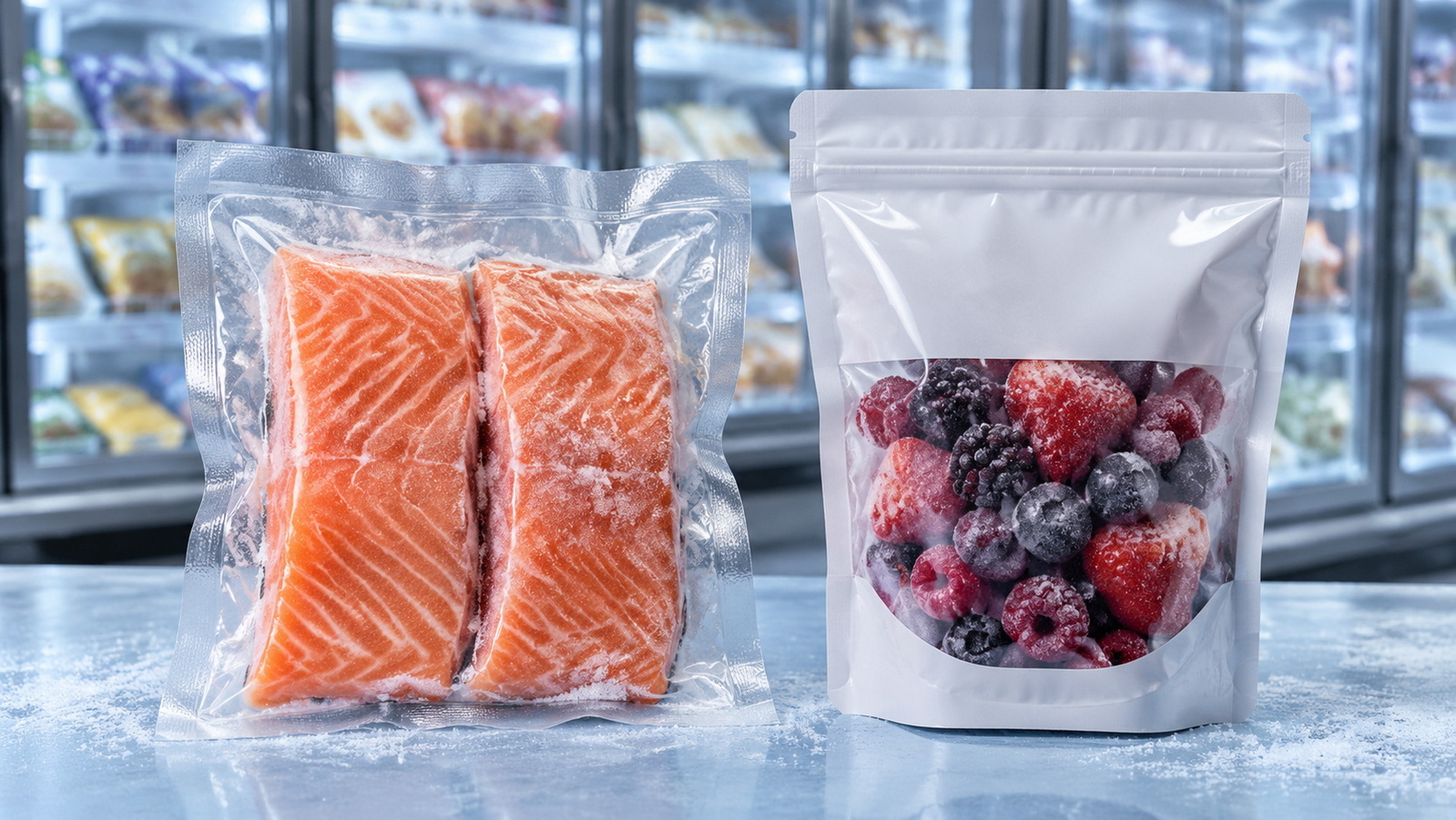
The table below compares conventional vacuum bags with typical resealable stand up pouches. Actual performance depends on the specified materials and validated packaging process.
| Selection factor | Conventional vacuum bag | Typical stand up pouch |
|---|---|---|
| Main purpose | Close-fitting packaging with air removal | Upright presentation and convenient access |
| Common applications | Meat portions, fish fillets, foodservice ingredients | Frozen berries, vegetables, dumplings, meal components |
| Air removal | Integral to the packaging process | Optional; requires compatible construction and equipment |
| Reclosure | Usually requires an additional closure feature | Frequently available with a zipper |
| Product compression | Can deform soft or fragile products | Can retain headspace when packed without vacuum |
| Branding | Printable, but presentation follows product contours | Broad panels support graphics and instructions |
| Machinery | Vacuum sealing equipment | Pouch opening, filling, and sealing equipment |
| Main validation concern | Vacuum retention, punctures, and seals | Gussets, closures, seals, and frozen handling |
Neither format automatically guarantees longer shelf life or lower operating costs.
A vacuum bag is a flexible package designed to work with an air-evacuation and sealing process. After filling, equipment removes air and heat seals the opening.
Vacuum packaging can reduce residual air around the product and produce a close-fitting pack. This makes it a strong candidate for portioned proteins and compact foodservice packs.
Potential advantages include:
- Less product movement inside the package.
- Compact packs for secondary packaging.
- Reduced exposure to oxygen when an appropriate barrier structure is used.
- Clear visibility of the packaged product.
Nevertheless, removing air does not compensate for weak seals, inadequate moisture protection, or temperature abuse.
Sharp bones, frozen edges, and handling damage can puncture an unsuitable bag. Strong vacuum can also compress products whose shape or texture matters commercially.
I would therefore avoid specifying vacuum level in isolation. The appropriate setting depends on the product's tolerance, package dimensions, film properties, and required presentation.
A soft dumpling and a dense beef portion should not automatically receive the same packaging treatment.
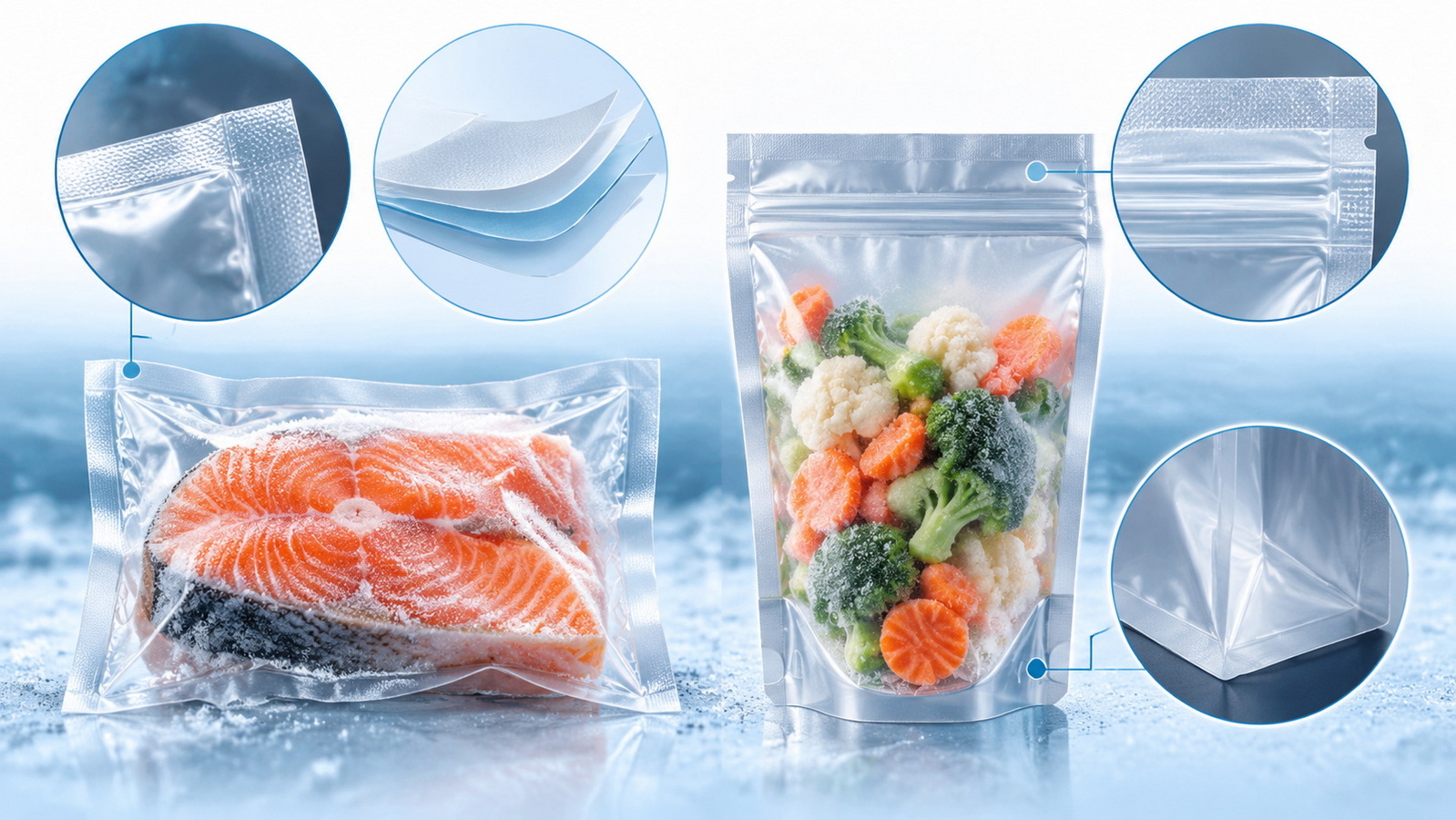
A stand up pouch uses a shaped bottom gusset to support an upright position when appropriately filled. It can incorporate printed panels, tear notches, and a resealable zipper.
For frozen food, these features are especially useful when consumers remove several portions over multiple occasions.
A frozen fruit pouch can communicate serving suggestions, storage instructions, and product information while allowing consumers to pour out a portion and reclose the package.
Typical advantages include:
- Convenient access to loose frozen pieces.
- Large printable surfaces.
- Optional resealable closures.
- A format suited to branded, multi-serving products.
However, a stand up pouch does not always stand reliably. Fill weight, product distribution, gusset geometry, and freezer display conditions all influence stability.
A pouch suitable for dry snacks is not automatically suitable for frozen food.
The supplier should confirm that the complete structure—including seals, zipper, inks, and adhesives where applicable—is appropriate for the intended frozen application.
Freezer-capable commercial stand up pouches exist, but their performance cannot be generalized to every pouch with the same appearance.
Freezer burn involves moisture loss from the food surface. USDA guidance describes it as a quality problem rather than, by itself, a food-safety hazard.
Vacuum packaging can help by reducing air around the food. However, a well-designed stand up pouch can also protect frozen products when its moisture barrier and seals are appropriate.
Compare these factors:
1. Water vapor transmission rate, which helps characterize moisture-barrier performance.
2. Oxygen transmission rate, where oxidation affects product quality.
3. Seal integrity throughout storage and handling.
4. Resistance to punctures and repeated flexing.
5. Cold-chain stability.
Request the test temperature and humidity conditions alongside barrier figures. Results obtained under different conditions are not directly interchangeable.
There is no defensible universal claim that vacuum bags preserve every frozen food twice as long as stand up pouches. Shelf-life claims require product-specific validation.
Package shape does not determine barrier performance. Material construction does.
Common design approaches include polyamide/polyethylene structures for applications requiring toughness and sealability, and polyester/polyethylene laminates where print presentation and structural properties are important. Additional barrier layers may be appropriate for particular products.
These are starting points for specification, not interchangeable recipes.
A thicker film does not necessarily provide the best oxygen barrier, cold resistance, or sealing behavior.
Ask suppliers to explain:
- Each layer's functional role.
- Suitability for the target storage temperature.
- Puncture and impact performance.
- Seal initiation and operating conditions.
- Food-contact documentation for the intended market and use.
Likewise, "recyclable" should not be inferred from pouch shape. Material composition and local collection and processing systems must be considered separately.
For HLun Pack's customers, the packaging machine should be evaluated alongside the package—not selected after the pouch order is finalized.
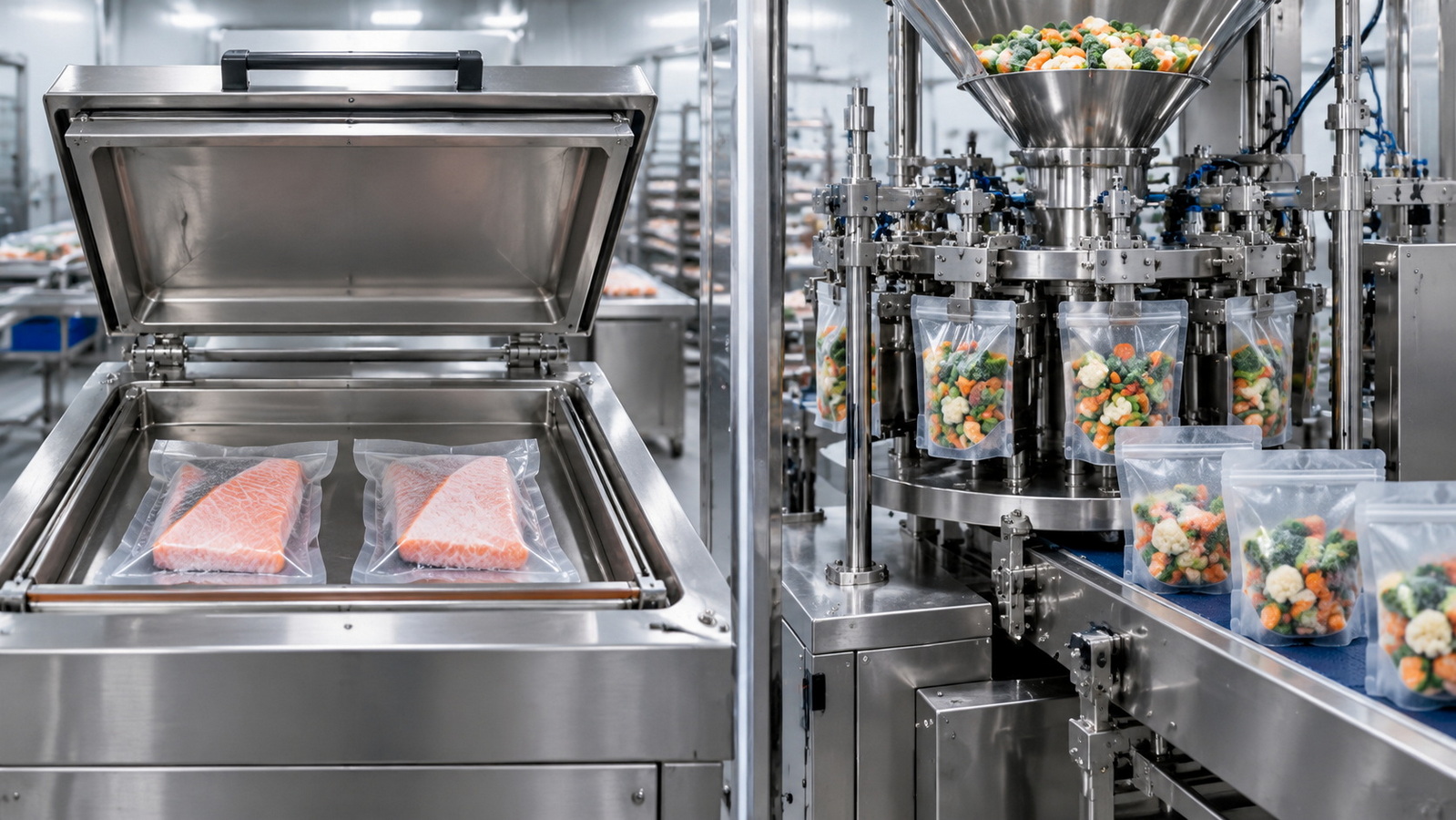
A chamber vacuum machine removes air from the chamber and the open package before sealing. Equipment selection should consider:
- Chamber dimensions and sealing-bar length.
- Number of packs accommodated per cycle.
- Vacuum and sealing controls.
- Product loading time.
- Cleaning access and maintenance requirements.
Published cycle speed is not the same as sustained production output. Loading, unloading, changeovers, and rejected packs affect actual throughput.
A premade-pouch line may need to pick up the pouch, open its mouth and zipper, fill it, and produce the final heat seal.
Product characteristics influence the filling system. Loose frozen vegetables require different handling from sticky marinated portions.
Evaluate pouch-opening reliability, filling accuracy, product drop height, seal-area cleanliness, and changeover procedures.
If vacuum or gas flushing is required, confirm that the proposed machine and pouch construction support that process. A zipper alone is not a substitute for the initial protective heat seal.
The following are illustrative selection scenarios, not reported customer results.
A flat vacuum bag may suit individually portioned fillets because it follows the product's shape and supports compact packing.
However, seafood requires a separate safety assessment. Reduced-oxygen packaging can create conditions associated with *Clostridium botulinum* hazards if temperature and handling controls fail.
Packaging selection must therefore include the processor's hazard analysis, frozen-storage controls, and appropriate thawing instructions.
A resealable stand up pouch may suit consumers who remove a small amount for smoothies and return the remainder to the freezer.
Aggressive vacuum may be undesirable if it compresses or damages the fruit. Trials should assess dispensing, closure usability, and product condition after handling.
A stand up pouch can provide branding and portion access, but product breakage remains a priority.
The trial should examine drop height during filling, compression during distribution, and sharp frozen edges. Pouch appearance alone cannot establish suitability.
This is where a technically reasonable design becomes a dependable packaging system.
Record product dimensions, fill weight, sharp edges, fat content, filling temperature, intended storage period, distribution route, and consumer handling.
Distinguish between food frozen before packing and food frozen after packing.
Specify dimensions, material structure, thickness tolerances, seal areas, zipper configuration, and required documentation.
Define acceptance criteria before testing rather than deciding afterward what counts as acceptable.
Use actual food and production-intent packaging. Include normal variation in product size and filling conditions.
Record machine settings, sustained output, rejects, seal contamination, and changeover time.
ASTM F88/F88M provides a method for measuring seal strength. ASTM F2096 addresses gross-leak detection using internal pressurization.
These tests answer different questions. Seal strength alone does not demonstrate that every pack is leak-free, and a gross-leak test does not establish shelf life.
Select methods appropriate to the package and intended failure modes.
Inspect packs after freezing, handling, transport simulation where appropriate, and the intended storage period.
Assess leakage, punctures, delamination, closure function, freezer burn, and product quality. Use the results to approve or revise the specification.
Comparing bag prices alone can produce the wrong commercial decision.
A more useful measure is:
Total packaging-related cost ÷ saleable packs produced.
Include:
- Packaging materials.
- Labor and utilities.
- Equipment ownership and maintenance.
- Changeover losses.
- Rejected packs and damaged product.
- Secondary packaging and distribution effects.
A lower-priced bag may become expensive if it produces frequent leaks. A higher-priced resealable pouch may also be unnecessary for a single-use foodservice portion.
Without a shared product specification, production target, and distribution requirement, broad cost comparisons are unreliable.
Frozen storage and vacuum packaging do not sterilize food.
USDA guidance recommends maintaining freezer storage at 0°F, approximately −18°C, or below. Packaging helps preserve quality, but it cannot correct unsafe processing or an interrupted cold chain.
For reduced-oxygen packaged fish, follow the applicable food-safety plan and labeling requirements. FDA's Food Code includes removal-from-package requirements for certain thawing situations; retail food-service provisions and processor controls should not be treated as identical requirements.
Also, freezer suitability does not establish suitability for boiling, microwaving, or cooking in the bag. Those uses need separate confirmation.
Choose a conventional vacuum bag when close-fitting protection and portion packing are primary requirements. Consider a stand up pouch when resealability, dispensing, and branded presentation have greater value.
For either option, approve the material and machinery combination through trials.
Share your frozen food type, pack weight, target output, storage conditions, market, and preferred package with HLun Pack. Request a coordinated review of the packaging format, filling method, sealing process, and equipment configuration before committing to commercial production.
Yes, provided its construction, gusset design, and sealing area are compatible with the vacuum process and equipment. Not every zipper pouch qualifies.
Conventional vacuum bags are often suitable for portioned meat. Bone protection, moisture barrier, seal integrity, and distribution conditions still require validation.
They can be. Suitability depends on the complete material structure, seals, closure design, and validated storage performance—not the upright shape.
No. It can reduce air around food, but moisture-barrier performance, seal condition, handling damage, and temperature stability still matter.
Do not assume so. Closure performance varies. A zipper provides reclosure convenience but should not replace the initial protective seal without specific validation.
Sometimes. Confirm pouch handling, vacuum capability, seal geometry, size range, and changeover requirements through trials with both proposed packages.
1. United States Department of Agriculture, Food Safety and Inspection Service. "Freezing and Food Safety." Supports frozen-storage guidance, packaging considerations, and the distinction between freezer burn and food safety. [fsis.usda]
2. United States Department of Agriculture, Food Safety and Inspection Service. "Meat and Poultry Packaging Materials." Explains vacuum packaging and the limitations of air-permeable supermarket wrapping for prolonged frozen storage. [fsis.usda]
3. U.S. Food and Drug Administration. "Fish and Fishery Products Hazards and Controls Guidance," Chapter 13: *Clostridium botulinum* Toxin Formation. Supports reduced-oxygen seafood hazard controls and frozen-product handling considerations. [fda]
4. U.S. Food and Drug Administration. "Supplement to the 2017 Food Code." Provides the cited removal-from-reduced-oxygen-packaging provisions for fish during specified thawing procedures. [fda]
5. ASTM International. "Paper Standards and Packaging Standards." Identifies ASTM F88/F88M for seal-strength measurement and ASTM F2096 for gross-leak testing. [store.astm]
6. ASTM International. "F2096: Standard Test Method for Detecting Gross Leaks in Packaging by Internal Pressurization (Bubble Test)." Explains the test's scope and limitations. [store.astm]
7. PAC Machinery. "Chamber Vacuum Sealers." Describes chamber operation, air evacuation, sealing, and multiple-package loading considerations. Manufacturer technical information, not an independent comparative study. [pacmachinery]
8. ProAmpac. "Kapak StandPAK." Provides a commercial example of heat-sealable, reclosable stand up pouches described as capable of withstanding freezing. This product-specific information does not establish performance for other pouches. [store.proampac]


