


close
Choose Your Site
Global
Social Media
Views: 270 Author: HLun PACK Publish Time: 2026-10-22 Origin: Site


Content Menu
● Common Tissue Box Dimensions: Verified Examples
● Tissue Sheet Size Is Not Tissue Box Size
● Rectangular, Upright, and Custom Tissue Box Formats
>> Upright and Cube-Style Tissue Boxes
>> Cylindrical and Specialty Formats
● How to Measure Tissue Box Dimensions Correctly
>> 1. Establish the Measurement Convention
>> 2. Separate Internal and External Dimensions
>> 3. Measure Multiple Samples
● A Practical Workflow for Custom Tissue Box Sizing
>> 1: Define the Tissue Product
>> 2: Measure the Folded Stack
>> 4: Test Full-to-Empty Dispensing
>> 5: Approve the Complete Specification
● Paperboard Thickness: Specify Performance, Not Just Weight
● Matching Tissue Box Dimensions to Packaging Machinery
>> Check the Entire Carton Geometry
>> Define Product Insertion Requirements
>> Agree on Measurable Acceptance Criteria
● Reducing Shipping Space Without Compromising Dispensing
● Request a Coordinated Packaging Review from HLun Pack
>> What Are Standard Tissue Box Dimensions?
>> What Size Box Holds 100 Tissues?
>> Are Cube Tissue Boxes Perfect Cubes?
>> How Do I Measure a Tissue Box for a Cover?
>> Does a Taller Tissue Box Always Contain More Sheets?
>> Can One Packaging Machine Handle Several Tissue Box Sizes?
Tissue box dimensions affect more than shelf appearance. They determine whether tissues dispense smoothly, fit existing holders, load reliably into packaging equipment, and ship without unnecessary empty space. For buyers comparing standard tissue box sizes, the most important distinction is between a familiar retail format and a production-ready specification.
There is no universal size for every facial tissue box. Dimensions vary with tissue count, folding pattern, ply, product bulk, and carton construction.
At HLun Pack, our packaging and equipment perspective connects these decisions: start with the tissue product, develop the carton around its functional requirements, and validate the combination on the intended packing line.
This guide explains common measurements and a practical route from initial sizing to an approved packaging specification.
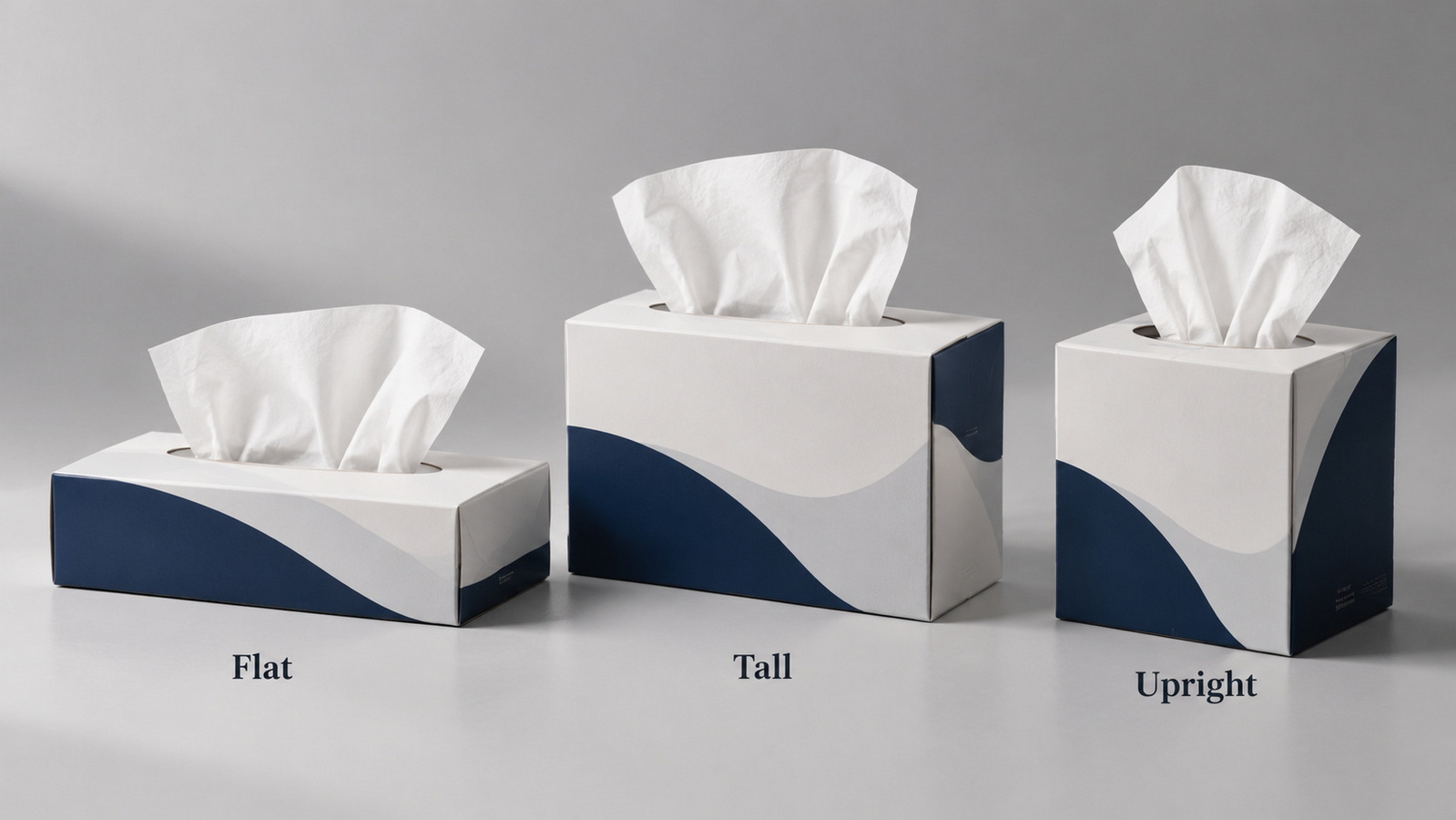
Manufacturer-published measurements provide useful reference points. However, they describe particular products, not mandatory industry standards.
The examples below use length × width × height. Metric measurements are rounded to the nearest millimeter.
| Product example | Published dimensions, inches | Approximate dimensions, mm |
|---|---|---|
| Kleenex Trusted Care, 72-count rectangular box | 8.875 × 4.75 × 2.28125 | 225 × 121 × 58 |
| Kleenex Trusted Care, 160-count rectangular box | 8.875 × 4.75 × 3.4675 | 225 × 121 × 88 |
| Kleenex Trusted Care, 200–230-count listing | 8.875 × 4.75 × 4.625 | 225 × 121 × 117 |
| Kleenex Ultra Soft, 120-count rectangular box | 8.875 × 4.75 × 3.4675 | 225 × 121 × 88 |
These examples show why a single "standard tissue box size" can mislead buyers. Several products share a footprint but differ substantially in height.
They also demonstrate that count alone does not determine dimensions: the listed 120-count and 160-count products share the same box measurements.
Use published sizes for preliminary comparison. Before ordering cartons, holders, or machinery, verify the current product specification and measure representative samples.
A tissue sheet measurement normally describes the unfolded product. It does not describe the carton footprint or the folded stack entering the box.
For example, Kimberly-Clark Professional lists an 8.3 × 7.8-inch unit size for its product 21400. That measurement should not be copied into a carton drawing as the box length and width.
Keep three measurements separate:
- Unfolded sheet size: the dimensions of one opened tissue.
- Folded stack size: the bundle's length, width, and height before loading.
- Finished carton size: the assembled box dimensions.
A change in folding pattern can alter the required carton geometry without changing the unfolded sheet size. Likewise, changing tissue bulk can affect stack height even when the sheet count remains unchanged.
For packaging development, measure the actual folded product rather than estimating from sheet dimensions.
Rectangular cartons offer a broad base and can accommodate different stack heights within a similar footprint. Low-profile versions suit locations with limited vertical clearance.
For custom rectangular tissue boxes, confirm the available counter space, holder opening, and intended display orientation before finalizing dimensions.
Upright boxes use a smaller countertop footprint and a taller profile. The commercial term "cube" does not guarantee equal length, width, and height.
Check all three dimensions separately. A decorative cover may accept the base of an upright box but fail to accommodate its height.
Dispensing should also be evaluated throughout the pack's life, not only when the carton is full.
Cylindrical and other shaped cartons require their own drawings and packing assessments. A round container intended for a vehicle must fit the actual holder geometry.
Do not assume that equipment configured for rectangular cartons can process a cylinder through a simple adjustment. Carton forming, feeding, insertion, and closing requirements may differ.
Choose the format for its application first, then assess manufacturing feasibility.
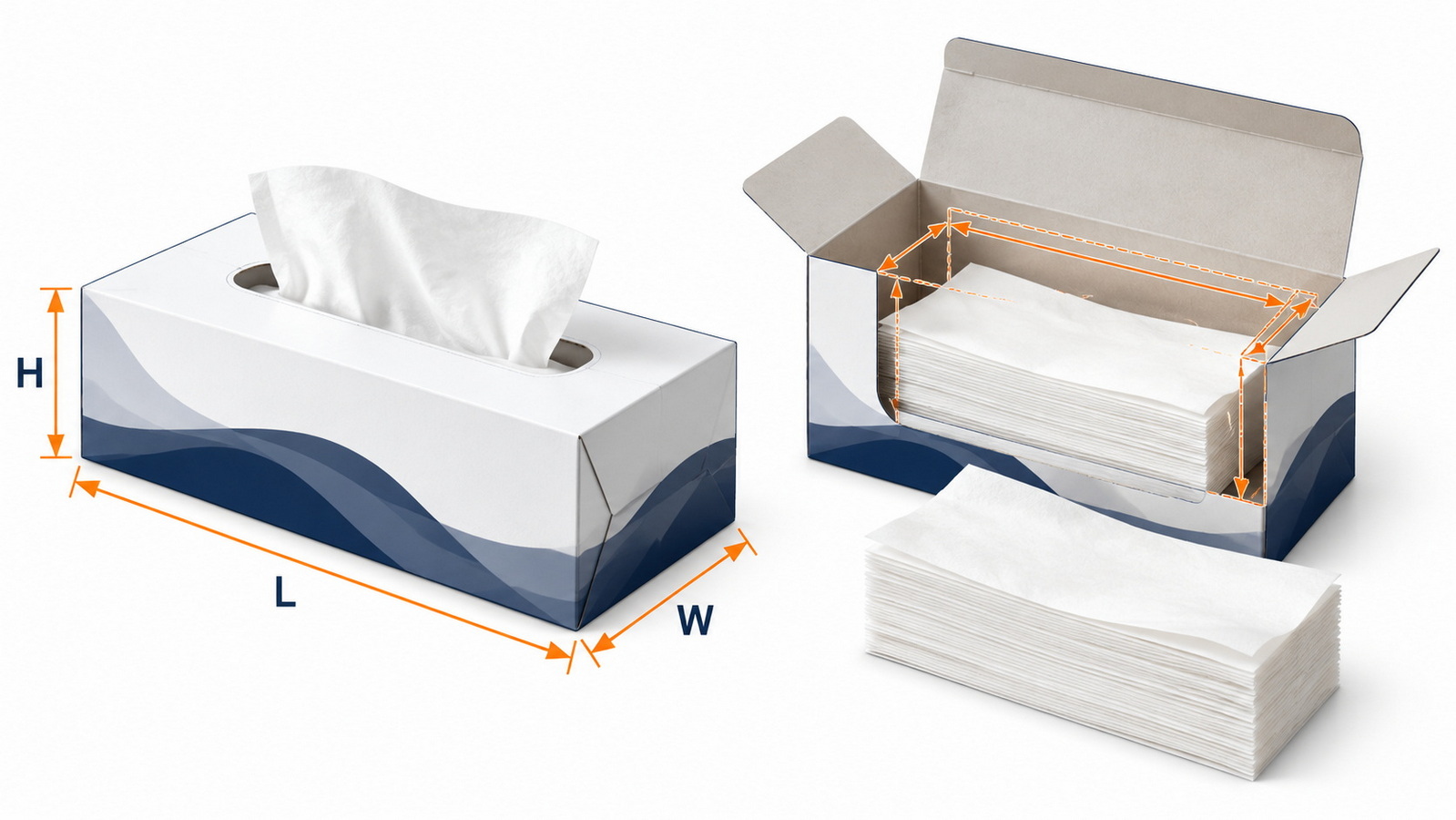
Record dimensions as length × width × height, and illustrate the orientation on a drawing.
This matters because suppliers may label the same physical sides differently. A photograph with dimension arrows helps prevent an otherwise avoidable ordering error.
For cylindrical packaging, specify outside diameter × overall height.
Internal dimensions describe the space available for the tissue stack. External dimensions determine fit within holders, shipping cases, shelves, and machine guides.
These measurements are not interchangeable. Board thickness, folded panels, and closure construction affect the relationship between them.
Ask suppliers to identify whether a quotation refers to internal size, external size, or another drawing convention.
Measure assembled cartons from more than one production batch when possible. Record variation, including panel bulging and closure irregularities.
For decorative tissue box covers, measure the usable internal opening and cavity—not the cover's outside dimensions.
Allow practical clearance for insertion and removal. Determine that allowance using samples rather than assuming a universal gap.
The most useful starting point is not a competitor's carton. It is your own tissue stack.
Document the sheet dimensions, ply, count, folding pattern, and any product treatment.
Make sure samples represent the intended commercial product. A prototype made with a different tissue grade can produce misleading sizing results.
Record stack length, width, and height under a defined measurement condition.
Avoid measuring one bundle while heavily compressed and another while loosely expanded. Consistent handling makes comparisons meaningful.
Develop samples around the measured stack and test loading clearance.
The carton should accept the product without damaging the tissue, distorting the panels, or forcing the closures open. Excessive free space is not automatically better; it can allow unwanted movement.
Evaluate more than the first pull:
- Can users locate and lift the first tissue?
- Do sheets separate individually?
- Do tissues tear or pull out in groups?
- Does the next sheet remain accessible?
- Does dispensing change near the bottom?
Record the tissue grade, carton revision, and opening design used in each test.
Freeze the carton drawing only after product-fit and dispensing checks.
Include agreed dimensions, tolerances, board specification, opening geometry, closure details, and an approved physical sample. This creates a clearer reference for repeat orders and troubleshooting.
Paperboard thickness, often called caliper, differs from basis weight. Basis weight describes mass per unit area, commonly expressed as grams per square meter.
Do not assume that two boards with the same weight will behave identically during folding or machine feeding.
A useful tissue carton specification should address:
- Board grade and caliper.
- Stiffness and panel stability.
- Grain direction and crease quality.
- Print and coating requirements.
- Glue compatibility and closure performance.
Avoid choosing thicker board simply because a box contains more tissues. The complete structure matters, including panel dimensions, folds, closures, and transport protection.
Evaluate the proposed material as a finished carton. A sheet sample alone cannot demonstrate how the assembled package will perform.
A carton that fits the tissues may still be unsuitable for the intended packing line.
From an equipment-selection perspective, the important question is not simply, "Does this size fall within the machine range?" It is, "Can this exact product-and-carton combination run consistently?"
Provide the equipment supplier with both assembled-carton dimensions and the flat blank or supplied-carton drawing.
Relevant details include flap lengths, glue areas, opening orientation, and the direction in which the carton travels through the machine.
Two cartons with similar finished dimensions can require different handling arrangements.
The tissue stack must enter without catching on edges, unfolding, or becoming excessively compressed.
Assess stack presentation, insertion direction, guide clearance, and the interaction between the loading mechanism and carton.
Trial the actual tissue grade. A different stack can behave differently even when its nominal measurements look similar.

Before purchasing equipment, define the conditions under which performance will be evaluated.
| Item | What to agree before the trial |
|---|---|
| Production output | Accepted finished packs per minute |
| Quality | Limits for damaged tissues and malformed cartons |
| Closure | Acceptable flap position and bond condition |
| Changeover | Required tasks, settings, and format parts |
| Trial materials | Actual tissue, carton, adhesive, and artwork |
| Test duration | An agreed run long enough to assess stability |
Separate maximum advertised speed from sustained output of acceptable packs. Ask suppliers to document trial conditions and results.
Smaller cartons can reduce the space occupied by each pack, but only when the tissue still loads and dispenses correctly.
Consider an illustrative redesign—not a customer case study.
A carton measuring 225 × 120 × 90 mm has an external geometric volume of 2.43 liters. Reducing its height to 85 mm gives 2.295 liters, approximately 5.6% less volume.
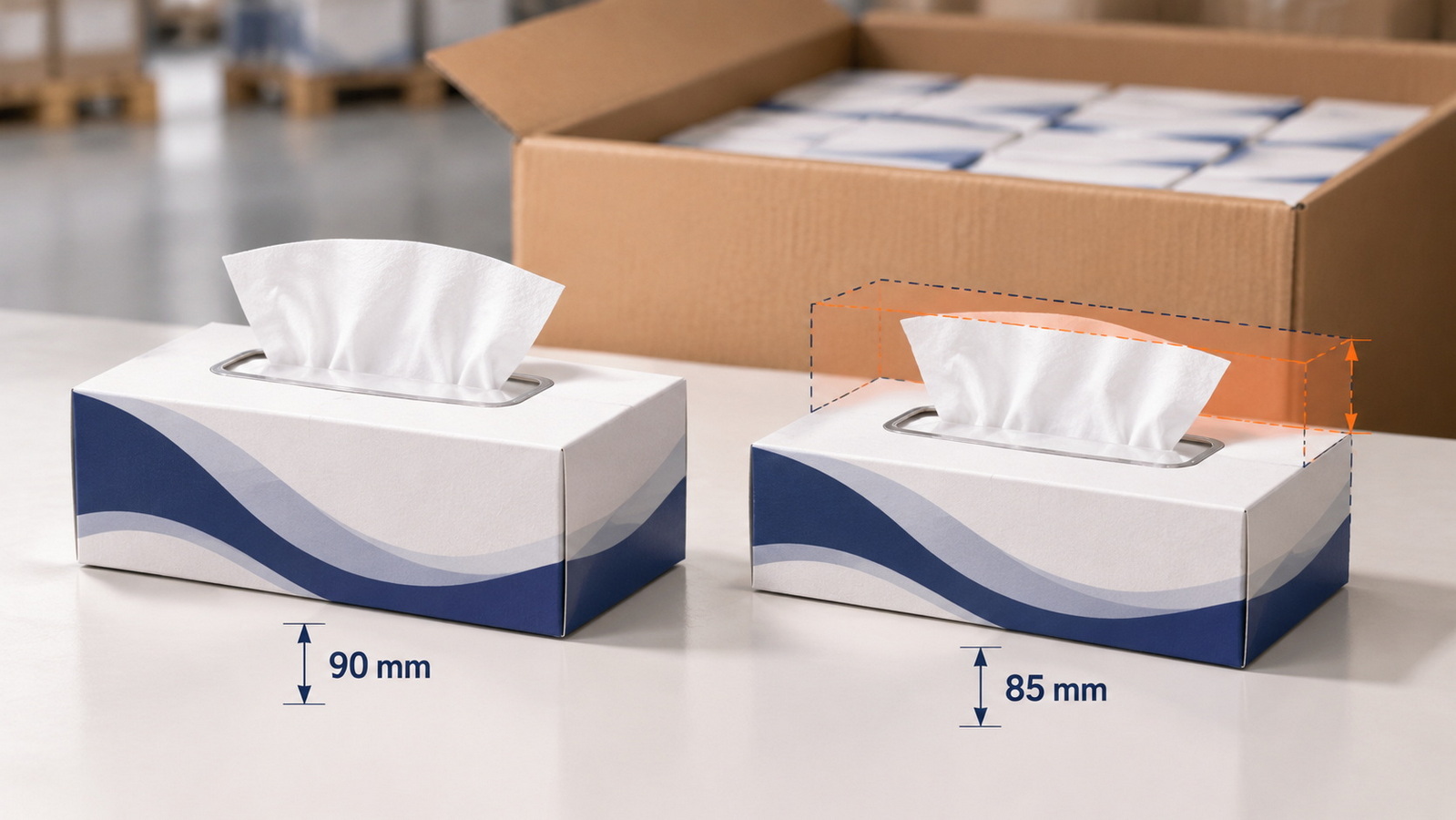
That does not automatically mean a 5.6% freight saving. Actual results depend on shipping-case dimensions, packing arrangements, pallet patterns, and carrier charging rules.
Evaluate the redesign at three levels:
1. Retail carton: loading, appearance, and dispensing.
2. Shipping case: arrangement, protection, and empty space.
3. Distribution unit: pallet utilization or parcel configuration.
Use transport testing appropriate to the real distribution route. Parcel shipments and palletized freight should not automatically receive the same test plan.
Tissue packaging works best when carton design and equipment requirements are reviewed together.
HLun Pack provides packaging materials and packaging machinery solutions. For a tissue packaging inquiry, send your folded-stack samples, target sheet count, preferred box format, dimensional drawing, and required production output.
Also include existing equipment details, holder restrictions, and shipping-case requirements.
Ask HLun Pack to assess the packaging-and-equipment combination before you approve tooling or place a volume order. The objective is a documented specification that connects product fit, dispensing performance, and manufacturing feasibility.
There is no single universal measurement. Published Kleenex rectangular examples include 8.875 × 4.75-inch footprints with different heights. Treat these as product-specific references, not specifications for every tissue carton.
Count alone is insufficient. Tissue bulk, ply, sheet size, and folding pattern affect the required space. Measure the intended 100-sheet stack and validate a trial carton before approving dimensions.
Not necessarily. "Cube" can describe an upright retail format rather than a mathematically exact cube. Verify length, width, and height individually, especially when selecting decorative holders or machine format parts.
Measure the tissue carton's maximum external dimensions and compare them with the cover's usable internal dimensions. Check the loading opening, internal obstructions, and dispensing alignment as well as overall clearance.
No. Different tissue grades can occupy different volumes. The published examples above include 120-count and 160-count products with identical carton dimensions. Compare the full product specification rather than height alone.
Possibly, within its validated format range. Confirm carton geometry, tissue insertion, closure requirements, and changeover parts. Validate representative formats through trials instead of relying solely on a minimum-to-maximum dimension table.
1. OXO Packaging — "Here's Everything You Must Know About Tissue Box Dimensions!" Original article reviewed for topic coverage, dimensional claims, material guidance, and calculation consistency. [oxopackaging]
2. Kleenex — "Trusted Care® Facial Tissues Rectangular Box." Primary source for the published 72-count, 160-count, and 200–230-count rectangular carton measurements. [kleenex]
3. Kleenex — "Ultra Soft™ Gentle Facial Tissues Rectangular Box." Primary source for the published 120-count carton dimensions. [kleenex]
4. Kimberly-Clark Professional — "Kleenex® Professional Facial Tissue—Flat Box," product 21400. Source for the 8.3 × 7.8-inch tissue unit measurement and product configuration. [kcprofessional]
5. Kimberly-Clark Professional — "Commercial Facial Tissue Product Guide." Source for flat and upright format distinctions and application considerations. [kcprofessional]
6. ePack Printing — "Paper Weight and Thickness Guide: GSM, Caliper & Packaging Uses." Supporting reference for the distinction between basis weight and caliper, plus folding and grain-direction considerations. [epackprinting]
7. International Safe Transit Association — "Test Procedures" and "Getting Started with Design & Testing." Primary references for distribution-specific test selection and defining damage criteria before testing. [ista]
8. HLunPACK — Official company website. Source for the company's combined packaging-materials and packaging-machinery positioning. Company descriptions are self-reported; no tissue-specific production speed or customer result is asserted in this article. [hlunpack]


