


close
Choose Your Site
Global
Social Media
Views: 288 Author: HLun PACK Publish Time: 2026-08-12 Origin: Site


Content Menu
● Side Gusset Bag Vs Quad Seal Bag
● Structural Differences That Matter
>> 1. Seal Architecture and Load Distribution
>> 2. Bottom Shape and Upright Performance
>> 3. Branding Surface and Shelf Impact
>> 4. Material Efficiency and Sustainability Claims
● Choosing the Right Bag for Your Product
>> Decision Checklist for Packaging Buyers
● A Practical Validation Process
● FAQ
>> 1. Is a quad seal bag the same as a side gusset bag?
>> 2. Which is better for coffee: a side gusset bag or a quad seal bag?
>> 3. Does a quad seal bag use more material?
>> 4. Can side gusset bags stand upright?
>> 5. What products are suitable for quad seal bags?
>> 6. What machine is needed for quad seal bag packaging?
When comparing a side gusset bag vs quad seal bag, the key distinction is not simply whether the package has expandable side folds. It is how those gussets are joined, sealed, and supported once the bag is filled. Both formats can create more volume than a flat pouch, but they serve different goals in filling efficiency, shelf presentation, branding, and packaging-line complexity.
At HLun Pack, we evaluate bag structures from both a flexible-packaging and equipment perspective. A bag that looks premium in a flat artwork file can still cause inefficient filling, unstable shelves, seal defects, or changeover delays if its structure is not matched to the product, laminate, and packaging machine.
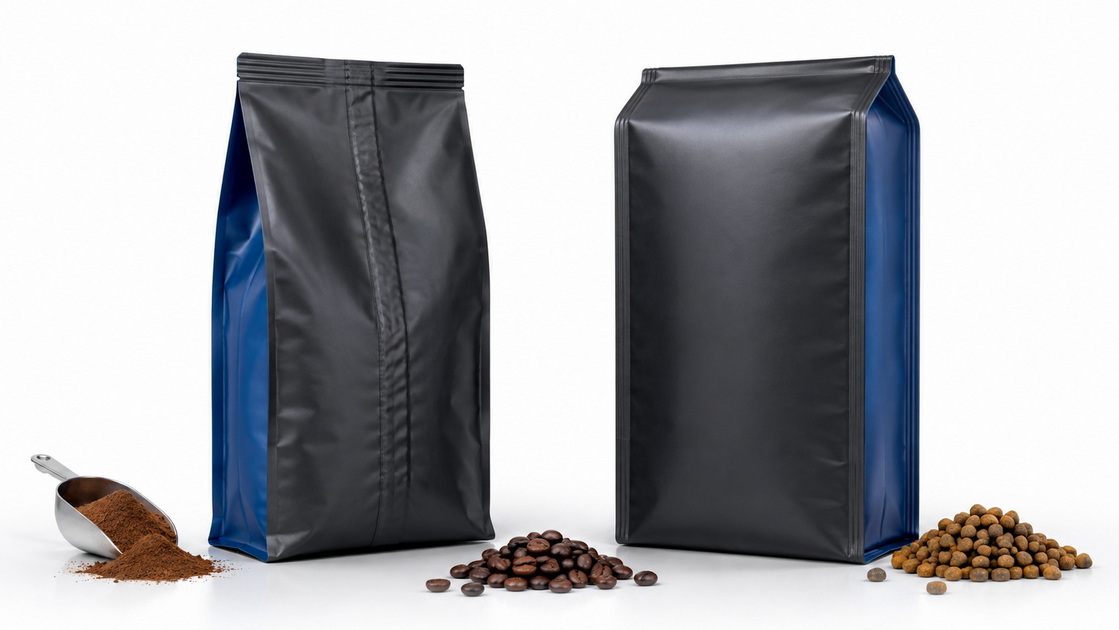
A side gusset bag is a flexible package with folded panels running along one or both vertical sides. Before filling, the gussets fold inward, allowing the bag to lie relatively flat. As product enters the bag, the folded sections expand and create additional internal volume.
This format is common for coffee, tea, flour, grains, pet food, powders, confectionery, and industrial dry goods. It is particularly useful when a brand needs more capacity than a simple flat bag without moving to a rigid carton or container.
However, "side gusset bag" describes the bag's geometry, not one fixed sealing method. Depending on the design, it may have:
- A center back seal or fin seal
- A folded or sealed bottom
- A top seal made after filling
- Side gussets with varying depths
- Optional valves, zippers, tear notches, handles, or tin ties
A conventional side gusset bag can develop an attractive rectangular shape when full. Yet it may not stand consistently if the product is light, the fill volume varies, the bottom is not well supported, or the gusset depth is excessive relative to the bag width.
A quad seal bag, also called a corner seal bag or four-corner seal pouch, uses front and back panels plus two side gussets. Its defining feature is the four vertical seals at the corners. These seals connect the gussets to the main panels and give the filled package more defined edges.
Unlike a standard side gusset bag with a central back seam, a quad seal bag normally keeps the major front and back panels visually uninterrupted. That gives brands broader printable areas and a more premium, organized shelf appearance. Industry descriptions commonly identify the four vertical seals and expandable side gussets as the defining construction features of quad seal packaging.
When properly specified, the bag forms a stable, column-like pack. Its shape can support high-value retail positioning, particularly for roasted coffee, specialty tea, premium snacks, dry pet food, nutrition powders, and products that must remain neat during transport and display.
| Feature | Side Gusset Bag | Quad Seal Bag | Practical Packaging Impact |
|---|---|---|---|
| Core definition | A bag with expandable side folds | A side-gusset bag with four vertical corner seals | Quad seal is generally the more structurally defined format |
| Typical seam layout | Often includes a center back seam or fin seal | Four sealed vertical corners; no central back seam on the main panels | Quad seal provides cleaner front and back branding panels |
| Bag shape when filled | Rectangular, but may be softer or less consistent | More rigid, box-like, and better defined | Quad seal usually creates stronger premium shelf presence |
| Shelf stability | Depends heavily on fill level and bottom construction | Usually stronger when dimensions and product weight are properly balanced | Quad seal is preferred for upright retail display |
| Print area | Front and back panels may be interrupted by a rear seam | Front, back, and gusset panels can support more deliberate design | Quad seal gives designers more usable storytelling space |
| Material usage | Often lower for a comparable product volume | Usually higher because of extra folds, seals, and reinforcement | Side gusset can be more economical for volume-led packs |
| Manufacturing complexity | Moderate | Higher; sealing alignment is more critical | Quad seal requires more precise converting and filling control |
| Best fit | Value packs, bulk dry goods, transport-focused packaging | Premium coffee, pet food, specialty foods, branded retail packs | Choose according to market position, not appearance alone |
The most important difference is the seal architecture. A standard side gusset bag may rely on a central back seam and top/bottom seals. Its side folds provide volume, but they do not necessarily create the same corner reinforcement as a quad seal construction.
A quad seal bag distributes its shape through four vertical corner seals. These sealed edges help define the package and reduce the visual "ballooning" often seen in softer gusseted packs. This is especially useful for products with moderate to high fill weights, such as 250 g to 1 kg coffee, powders, nuts, cereals, or pet treats.
That said, more seals do not automatically mean a better package. Seal width, dwell time, temperature, pressure, film compatibility, product contamination in the seal area, and cooling time all affect real-world seal integrity. A structurally premium bag can fail if the packaging process is poorly tuned.
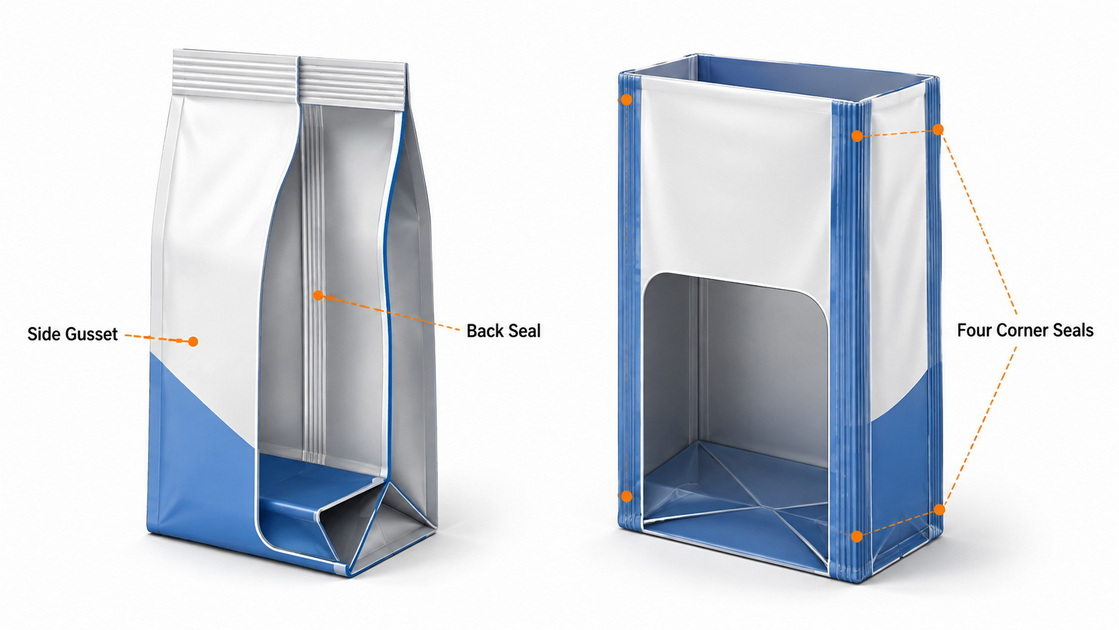
A common mistake is to assume every side gusset bag and every quad seal bag has the same bottom. They do not.
Some side gusset bags have a simple folded bottom and may lean or require shelf support. Some quad seal bags use a folded, reinforced, or block-bottom-like configuration that creates a more reliable footprint. The filled product itself also matters: free-flowing coffee beans can settle differently from fine powder, irregular snacks, or low-density dried fruit.
Before selecting either format, test these variables:
1. Filled bag footprint: Measure width, gusset depth, and bottom contact area after settling.
2. Center of gravity: Tall, narrow packs become less stable as product weight moves upward.
3. Drop and compression resistance: Confirm that seals and corners tolerate logistics stress.
4. Shelf-facing behavior: Evaluate whether bags stand independently after being handled by consumers.
5. Fill-weight variation: Small volume changes can noticeably alter the appearance of structured bags.
A production sample is more reliable than a flat digital mock-up. It reveals whether the bag stands, wrinkles, leans, or distorts after filling and transport simulation.
For premium brands, the quad seal bag's visual advantage is substantial. Its front and back panels are generally free from a center back seam, so designers can create cleaner graphics, larger product imagery, and more readable claims.
The two gussets can also become useful design surfaces. For example, one gusset may carry preparation instructions, while the other communicates origin, certifications, QR codes, or a brand story. This turns an otherwise unused structural feature into a communication asset.
A side gusset bag can still support excellent printing. It is often the more practical choice when the product is primarily sold in bulk, packed into secondary cartons, or displayed in an environment where the front panel—not 360-degree shelf impact—is the main sales surface.
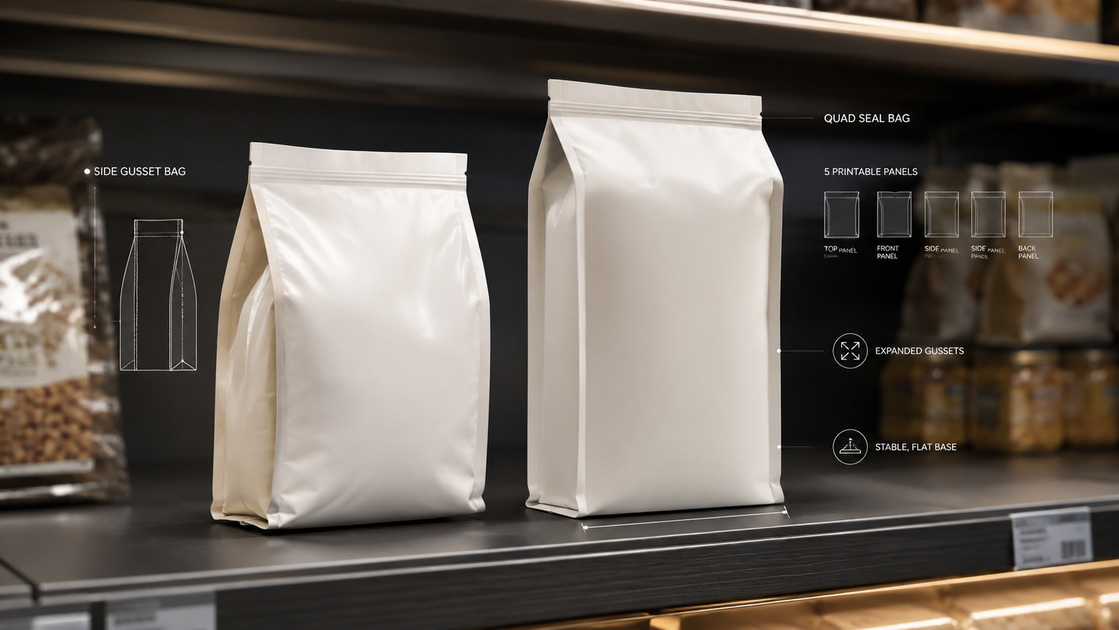
Flexible packaging can use less material and weigh less than many rigid alternatives, while still providing barrier, protection, and sealing functions. The Flexible Packaging Association notes that flexible formats combine materials such as film, paper, and aluminum foil to provide protective performance with relatively minimal material use.
However, do not treat "less material" as a universal sustainability claim. Quad seal bags may require additional film area and more complex laminate structures than simpler side gusset bags. A package should be assessed by total product protection, material weight, production scrap, transport efficiency, food-waste prevention, and the collection or recycling system available in its actual sales market.
For export brands, the best practice is to substantiate environmental language with a documented material specification and, where appropriate, a life-cycle assessment. Avoid generic claims such as "eco-friendly" unless the claim can be verified for the product and destination market.
Choose a side gusset bag when your priority is efficient volume, familiar packaging construction, or a cost-conscious dry-product format. It is often a strong option for bulk coffee, flour, grains, fertilizers, hardware components, and products where the bag will be packed in a carton or displayed with external support.
Choose a quad seal bag when shelf presence, premium positioning, upright stability, and multi-panel branding are central to the product strategy. It is especially suitable for retail products where the package itself must communicate quality before the shopper touches it.
Use these questions before approving a structure:
- Is the product free-flowing, fine, irregular, sharp-edged, oily, or dusty?
- Does the bag need to stand independently on a retail shelf?
- Is the brand selling value, convenience, or a premium experience?
- Do you need a degassing valve, zipper, tin tie, handle, or resealable feature?
- What barrier is required against oxygen, moisture, aroma loss, light, or grease?
- Will the product be packed manually, on a vertical form-fill-seal line, or on a premade-pouch machine?
- Can the equipment reliably handle the bag's dimensions, gusset depth, and top-seal geometry?
- What recycling, labeling, and food-contact requirements apply in the destination market?
From an equipment perspective, a bag format is not only a packaging choice; it is an operating choice. Side gusset and quad seal bags require stable bag opening, controlled dosing, accurate top alignment, dependable seal contamination management, and repeatable finished-pack handling.
Quad seal bags generally demand tighter control because visible corner seals make alignment errors easier to notice. A slightly skewed gusset, uneven product distribution, or poorly centered top seal can reduce the premium effect that justified choosing the format.
Modern packaging operations are also prioritizing automation, reduced downtime, flexible changeovers, and shorter production runs across a larger number of SKUs. PMMI identifies automation, sustainability, and flexible equipment as major packaging and processing priorities, including the need for faster changeovers and greater SKU variability.
At HLun Pack, we recommend validating the bag, film structure, filling method, and machine settings together. HLun Pack provides flexible packaging, packaging machinery, and integrated solutions for products including granules, powders, and liquids, which allows the package and the production process to be considered as one system rather than two separate purchases.
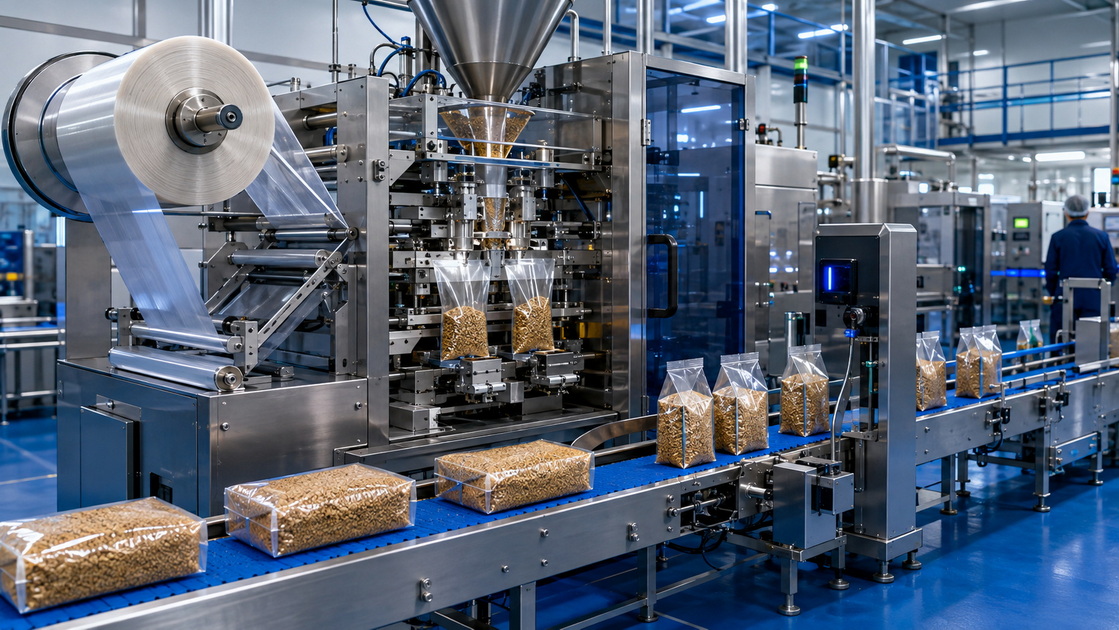
Before committing to a large print run or machine configuration, follow this process:
1. Define product behavior. Record particle size, bulk density, dust level, oil content, flowability, and target fill weight.
2. Select preliminary dimensions. Set width, length, gusset depth, and headspace based on the actual filled volume—not only a theoretical calculation.
3. Produce physical samples. Test both side gusset and quad seal structures using the intended laminate and closure features.
4. Run line trials. Confirm opening, filling, settling, top sealing, coding, inspection, and secondary packing performance.
5. Perform distribution testing. Evaluate drop resistance, compression, vibration, seal integrity, and shelf-standing behavior.
6. Review commercial results. Compare material consumption, line speed, reject rate, shipping cube, and perceived shelf value.
This approach prevents a frequent and costly error: selecting a package based on appearance, then trying to force the packaging line to accommodate it later.
The side gusset bag vs quad seal bag decision should start with your product and production realities—not with a design preference. A side gusset bag can deliver high capacity and practical value. A quad seal bag can provide stronger structure, a more premium silhouette, and more effective retail branding.
If your product needs a distinctive, upright, premium package, start with a quad seal sample. If material efficiency, bulk capacity, or simpler conversion is the priority, begin with a conventional side gusset structure. In both cases, validate the finished package with your actual product and machine conditions.
Planning a new coffee, powder, snack, grain, or pet-food package? Contact HLun Pack to evaluate side gusset and quad seal bag samples, film structures, closure options, and compatible packaging machinery as one integrated solution.
Not exactly. A quad seal bag uses side gussets, but it adds four vertical corner seals that create a more structured package. Therefore, a quad seal bag is usually considered a specialized side-gusset construction.
A quad seal bag is often better for premium retail coffee because it stands more neatly and provides larger, cleaner branding panels. A standard side gusset bag can be a better choice for larger value packs, especially when cost and packing efficiency are more important than premium shelf impact.
Often, yes. The extra folds, gussets, and sealing areas can increase film usage compared with a simpler side gusset format of similar capacity. The exact difference depends on bag dimensions, laminate, seal widths, and fill volume.
They can, but upright stability depends on the bottom construction, filled product, fill level, dimensions, and handling conditions. A side gusset alone does not guarantee that the bag will stand independently.
Quad seal bags work well for coffee beans, ground coffee, tea, pet food, nuts, cereals, protein powder, confectionery, dried fruit, and other dry products that benefit from a premium, upright pack.
The appropriate machine depends on whether you are forming bags from rollstock or filling premade bags. The system must consistently manage bag opening or forming, product dosing, settling, top sealing, and finished-bag handling; trial testing is essential before final equipment selection.
1. HLun Pack. "[About Us: Packaging Materials, Machinery and Integrated Packaging Solutions]." Company profile and product-solution overview. [hlunpack]
2. Flexible Packaging Association. "[Advantages of Flexible Packaging]." Overview of flexible packaging materials, protection, and material-efficiency benefits. [flexpack]
3. Flexible Packaging Association. "[Sustainability]." Resource-efficiency, life-cycle, and responsible environmental-claim considerations for flexible packaging. [flexpack]
4. PMMI, The Association for Packaging and Processing Technologies. "[AI, Automation, and Sustainability Lead Packaging and Processing Trends]." Packaging-line automation, flexible equipment, and changeover trends. [pmmi]
5. TedPack. "[Quad Seal Bag, Coffee Quad Seal Pouches Manufacturer]." Industry description of quad seal pouch construction, gussets, and four-seal reinforcement. [tedpc]
6. Smithers. "[The Future of Global Flexible Packaging to 2026]." Flexible packaging market context and growth outlook. [smithers]<p>


