


close
Choose Your Site
Global
Social Media
Views: 252 Author: Hlunpack Publish Time: 2026-07-31 Origin: Hlunpack


Content Menu
>> Nylon (PA)
>> Material Selection Strategy
>> Transparent Retort Products
>> Frozen Foods
>> 1. Is thicker PET always better?
>> 2. Does every retort pouch require aluminum foil?
>> 3. Why is nylon used in some retort pouches?
>> 4. Can one material structure be used for every food product?
Retort Packaging Engineering Series · Chapter 6
Engineering Considerations for PET, Aluminum Foil, Nylon and Sealant Layers
Flexible packaging materials do far more than simply contain a product.
They play a critical role in preserving product quality by providing barrier protection, mechanical strength, heat resistance and reliable sealing throughout the product’s commercial life cycle.
For this reason, material selection is rarely about choosing one “best” material.
Instead, packaging engineers develop a laminate structure by combining multiple materials, each performing a specific engineering function.
In commercial retort packaging, PET, aluminum foil, nylon (PA) and sealant layers are among the most commonly used materials, each contributing differently to the overall package performance.
Food manufacturers frequently ask questions such as:
* Is a thicker PET layer always better?
* Is aluminum foil always necessary?
* Does every retort pouch require a nylon layer?
* Can one material structure be used for every product?
In reality, there is no universal material structure suitable for every food application.
Material selection should be based on product characteristics, processing requirements and distribution conditions rather than individual material specifications.
Successful material selection is achieved by combining materials that complement one another—not by maximizing the performance of a single layer.
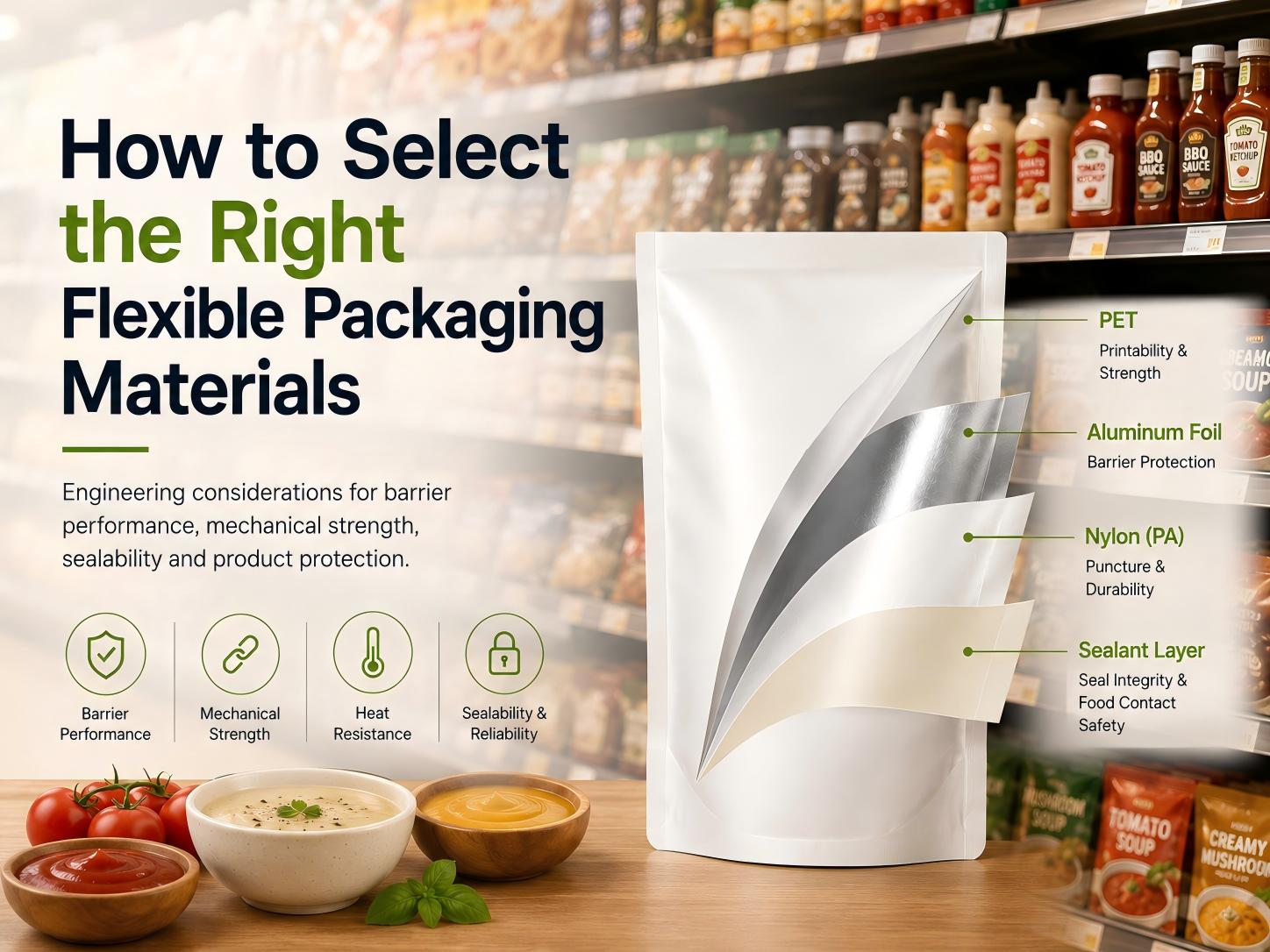
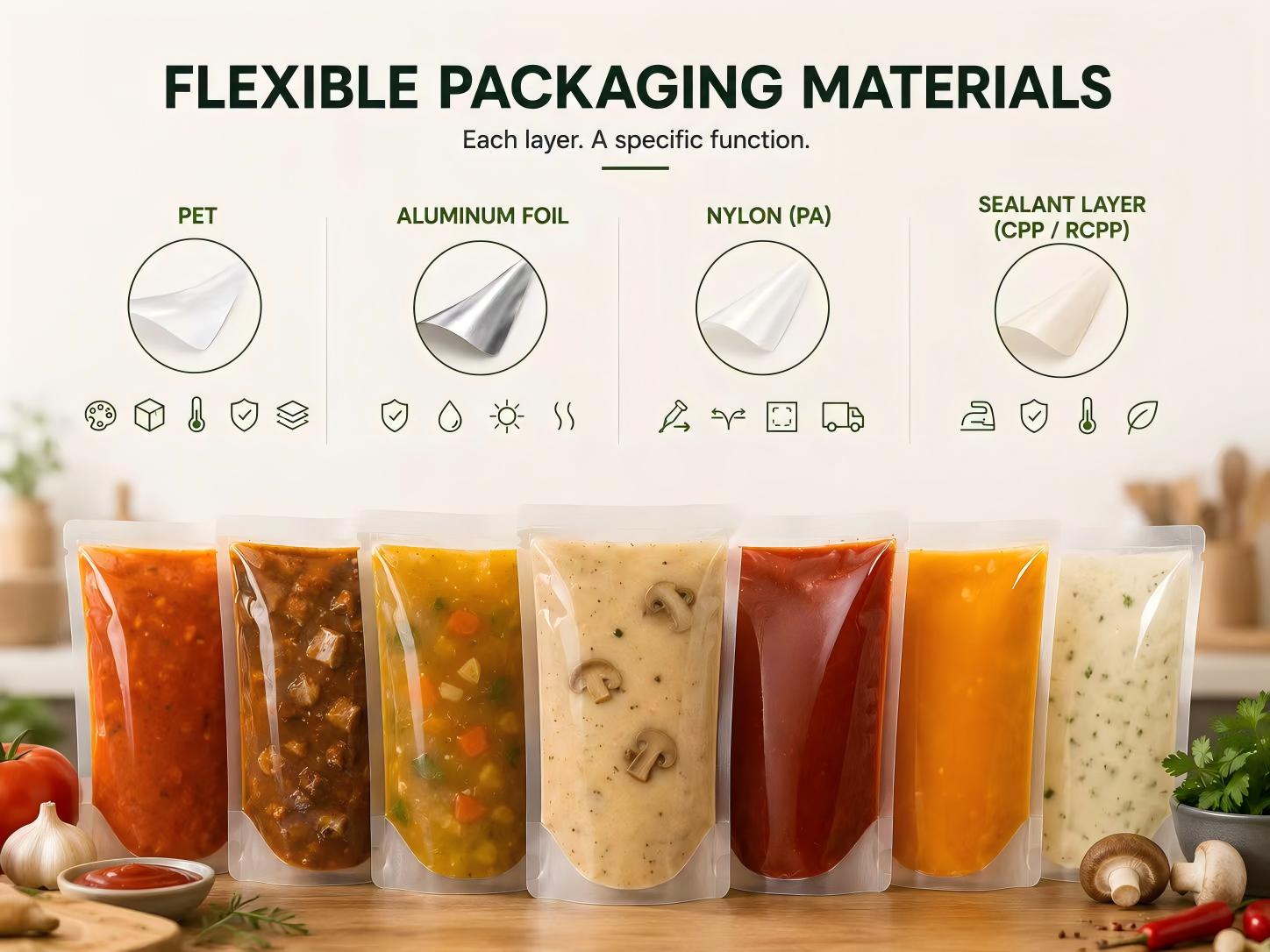
PET is commonly used as the outer layer of flexible packaging structures.
Its primary functions include:
* Excellent printability
* Dimensional stability
* Heat resistance during processing
* Surface protection
* Structural rigidity
Although PET contributes some barrier performance, it is generally selected for its mechanical and printing characteristics rather than as the primary barrier layer.
Aluminum foil provides one of the highest levels of barrier protection available in flexible packaging.
Typical functions include:
* Excellent oxygen barrier
* Excellent moisture barrier
* Complete light protection
* Aroma retention
Because of these properties, aluminum foil remains a preferred material for many long shelf-life retort products.
However, its use may reduce package flexibility and increase material cost, making it unnecessary for every application.
Nylon primarily improves the mechanical performance of the package.
Typical benefits include:
* High puncture resistance
* Excellent flex-crack resistance
* Improved dimensional stability during retort processing
* Better protection during transportation
PA is commonly used for products containing bones, sharp ingredients or applications requiring higher mechanical durability.
The sealant layer is the only layer that comes into direct contact with the food product.
Its primary functions include:
* Reliable heat sealing
* Package integrity
* Retort resistance
* Product compatibility
Depending on product requirements, different sealant materials such as CPP or RCPP may be selected to achieve the required sealing performance.
Although the adhesive layer is not visible after lamination, it plays an essential role in package reliability.
Engineering considerations include:
* Laminate bond strength
* Retort durability
* Long-term laminate stability
A properly selected adhesive system helps maintain structural integrity throughout processing and storage.
Material selection is achieved by balancing multiple engineering considerations, including:
* Product formulation
* Processing method
* Barrier requirements
* Mechanical performance
* Distribution environment
* Manufacturing efficiency
Rather than maximizing the performance of a single material, packaging engineers develop laminate structures in which each layer performs a dedicated function.
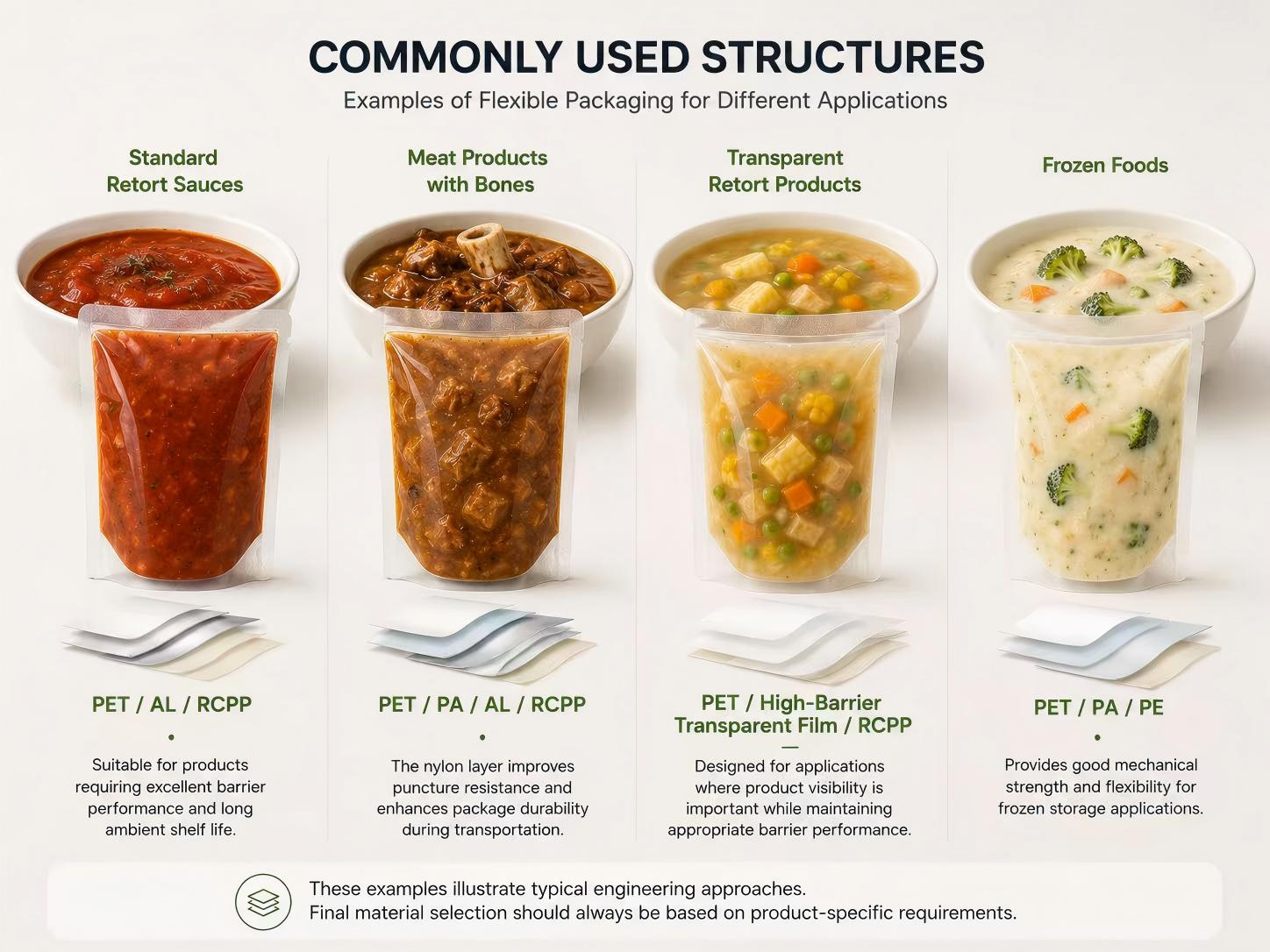
Examples of commonly used structures include:
Standard Retort Sauces
PET / AL / RCPP
Suitable for products requiring excellent barrier performance and long ambient shelf life.
PET / PA / AL / RCPP
The nylon layer improves puncture resistance and enhances package durability during transportation.
PET / High-Barrier Transparent Film / RCPP
Designed for applications where product visibility is important while maintaining appropriate barrier performance.
PET / PA / PE
Provides good mechanical strength and flexibility for frozen storage applications.
These examples illustrate typical engineering approaches. Final material selection should always be based on product-specific requirements.
Before commercial production, material structures are typically evaluated through engineering validation.
Common evaluations include:
* Oxygen Transmission Rate (OTR)
* Water Vapor Transmission Rate (WVTR)
* Heat-Seal Strength
* Retort Resistance
* Puncture Resistance
* Laminate Bond Strength
* Shelf-Life Validation
These evaluations help confirm that the selected material structure can reliably support the intended commercial application.
Packaging performance is rarely determined by a single material.
Instead, it results from the combined performance of multiple materials working together as one engineered laminate structure.
The best flexible packaging material is not a single film.
It is a well-engineered material system designed for a specific product application.
This chapter focuses on:
* Flexible Packaging Materials
* PET Packaging
* Aluminum Foil Packaging
* Nylon (PA)
* Sealant Layer
* Material Selection
* Retort Packaging
* Laminate Structure
Applicable to:
* Ready Meals
* Sauces
* Soup Concentrates
* Pet Food
* Dairy Products
* Frozen Foods
* Snack Foods
* Coffee
* Powdered Foods
Not necessarily. PET is primarily selected for printability, heat resistance and dimensional stability. Thickness should match the application’s engineering requirements.
No. Aluminum foil provides excellent barrier performance, but transparent high-barrier structures may be suitable for products that require product visibility.
Nylon improves puncture resistance, flex-crack resistance and overall mechanical durability, making it suitable for demanding applications.
No. Material structures should always be selected according to product formulation, processing conditions, shelf-life objectives and distribution requirements.
Selecting the right materials is only one part of developing a reliable packaging system.
Even well-designed laminate structures may experience quality issues if engineering controls are not properly managed.
In Chapter 7 – Common Flexible Packaging Problems and How to Prevent Them, we’ll explore common packaging failures, their causes and engineering approaches to improving long-term package reliability.
HLunPACK provides integrated solutions for flexible packaging, paper packaging and packaging machinery for the food, pharmaceutical and consumer goods industries.
By combining material engineering, packaging design and manufacturing expertise, we help customers develop packaging systems that balance product protection, production efficiency and commercial practicality.cial practicality.


