


close
Choose Your Site
Global
Social Media
Views: 277 Author: HLun PACK Publish Time: 2026-10-31 Origin: Site


Content Menu
● How We Selected Flexible Packaging Bags Suppliers
>> Scope of the Requested Additional Companies
● Why Source Flexible Packaging Bags in Mexico?
>> An Established Market With Multiple Packaging Segments
>> A Distributed Converting Network
● Capacity, MOQ, and Certification Evidence
● Leading Flexible Packaging Bags Manufacturers and Suppliers
>> 1. HLun PACK — An International Alternative for Packaging and Equipment Integration
>>> Core Strength and OEM/ODM Scope
>> 2. Folmex — A Strong Candidate for Printed Consumer Packaging Programs
>>> Core Strength and OEM/ODM Scope
>> 3. Flair Flexible Packaging Mexico — A Practical Option for Stock and Custom Programs
>>> Core Strength and OEM/ODM Scope
>> 4. Constantia Aluprint — An Engineering-Focused Flexible Packaging Converter
>>> Core Strength and OEM/ODM Scope
>> 5. PAC Worldwide Mexico — A High-Volume Option for Poly Bags and Specialized Formats
>>> Core Strength and OEM/ODM Scope
>> 6. PolyRafia — An Industrial Packaging Specialist
>>> Core Strength and OEM/ODM Scope
● Additional Engineering Contacts: Relevant to Machinery, Not the Bag Shortlist
● Technical Buyer's Guide: Specify Performance Before Requesting Price
>> Define the Material Structure, Not Just "Food Grade"
>> Separate Packaging Compliance From Machinery Compliance
● A Practical Factory, Sampling, and Logistics Approval Process
>> 1: Verify the Actual Manufacturing Site
>> 3: Lock the Commercial and Technical Conditions
>> 4: Check Logistics and Origin Separately
● A Matching Thickness Does Not Mean a Matching Laminate
● Common Sourcing Problems and How to Avoid Them
● Conclusion: Select the Supplier Around the Application
● FAQ
>> 1. How can I verify whether a manufacturer's ISO or food-packaging certificate has expired?
>> 2. Can two bags with the same material names and thickness have different shelf lives?
>> 3. Can a supplier change resin, adhesive, or ink without changing the approved specification?
>> 4. How should I verify that a "recyclable" or recycled-content pouch is suitable for food?
>> 5. How can I confirm that a pouch will run reliably on our existing packaging machine?
Mexico offers a practical sourcing base for flexible packaging bags, particularly for brands supplying North American markets. Its converter network includes consumer-packaging specialists, industrial sack manufacturers, regional pouch suppliers, and multinational packaging groups with local operations. However, these businesses serve different applications, and a supplier with substantial film capacity is not automatically the right partner for a technically demanding premade pouch.
This guide evaluates suppliers through manufacturing relevance, material-development capabilities, quality documentation, customization support, and delivery practicality—not promotional claims alone. It includes five suppliers with Mexican operations, plus HLun PACK as an international packaging-and-equipment alternative.
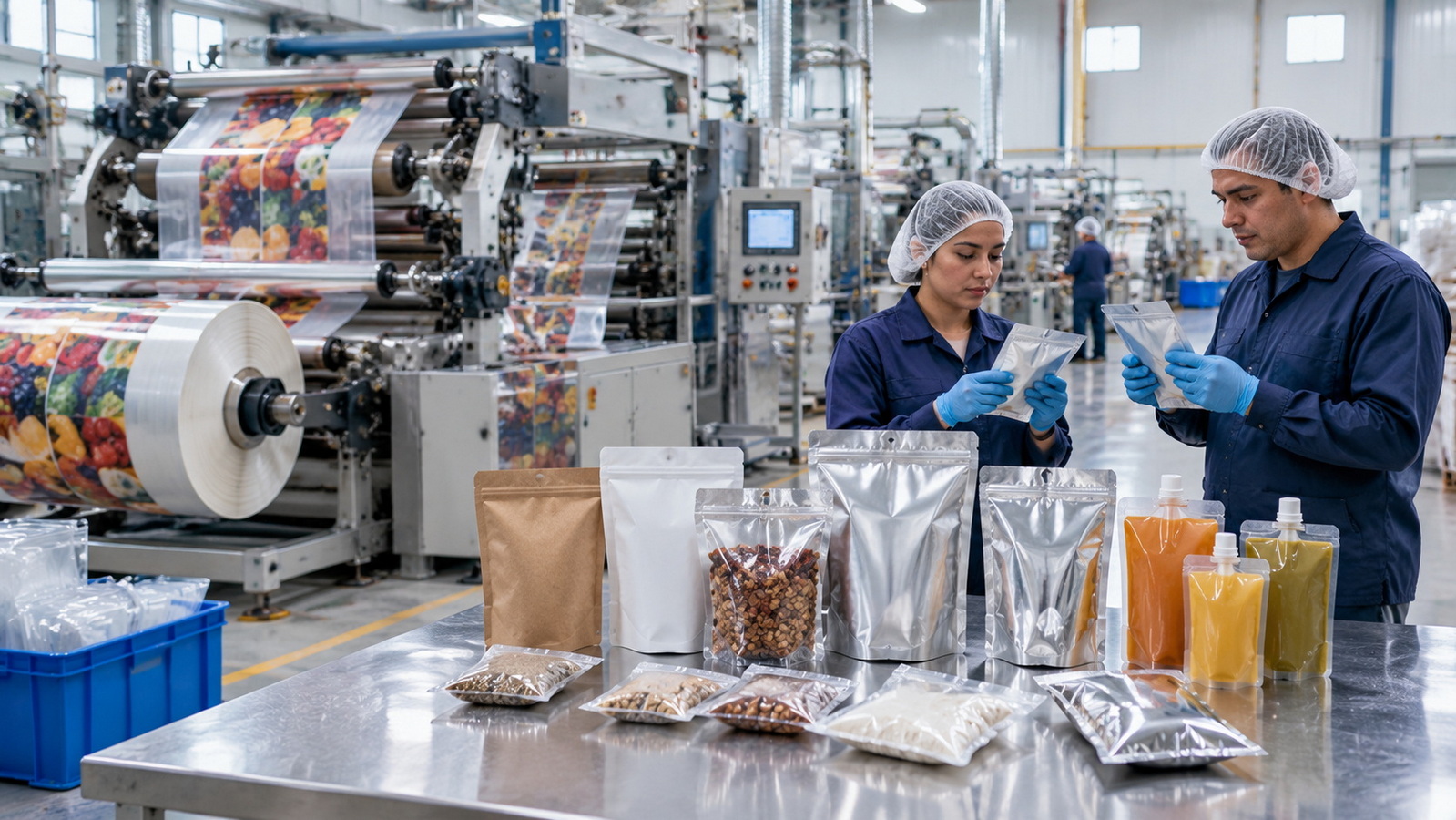
A useful supplier assessment starts with traceability: the ability to connect an approved specification to its raw materials, production records, test results, and delivered batches.
For this shortlist, the main selection criteria are:
1. Manufacturing relevance: Evidence of flexible packaging production, converting, or specialized bag supply.
2. Product-development support: Ability to adapt structures, dimensions, printing, closures, or processing requirements.
3. Quality-system evidence: Published certification information, laboratory investment, or documented quality-management practices.
4. Commercial fit: Suitability for development projects, repeat production, industrial applications, or smaller purchasing programs.
5. Supply-chain practicality: Manufacturing location, regional service coverage, inventory support, and integration with filling operations.
6. Disclosure quality: Clear separation between published facts, company claims, and information requiring quotation-stage verification.
Published production figures are not treated as guaranteed available capacity. Likewise, a historical certification announcement is not proof that a certificate remains valid today. BRCGS provides a directory specifically for checking supplier certification information.
ANEBON, Shangchen, and U-Need were reviewed because they were requested for inclusion. Their websites describe precision machining, prototyping, tooling, or related manufacturing services—not Mexican flexible packaging bag production. They are therefore discussed separately as potential equipment-development contacts rather than placed ahead of genuine Mexican bag manufacturers.
Mordor Intelligence estimates Mexico's flexible packaging market at USD 3.84 billion in 2025 and USD 4.02 billion in 2026, with a projected 4.69% compound annual growth rate through 2031. Its definition includes films, wraps, bags, and pouches; these figures should not be presented as the size of the bag segment alone.
Official trade data also demonstrates substantial activity in relevant product categories. Mexico's Secretaría de Economía reports USD 867 million in total international trade during 2024 for HS 392321, covering sacks, bags, and cones of ethylene polymers. This is combined imports and exports, not export revenue or the value of all flexible packaging bags.
Mexico's packaging capabilities are distributed across several industrial locations rather than concentrated in one city:
- San Luis Potosí: Constantia Aluprint operates a flexible packaging plant serving food, personal-care, and home-care applications.
- Querétaro: PAC Worldwide operates polymer-packaging manufacturing facilities serving Mexican and wider North American customers.
- Greater Guadalajara, Jalisco: Flair provides converting, material management, quality assurance, and regional packaging support.
- State of Mexico: Folmex operates from Tlalnepantla, while PolyRafia identifies the Atlacomulco industrial corridor as its strategic operating location.
For procurement teams, this geographic spread creates options. The practical advantage depends on the supplier's actual production site, delivery lane, stock policy, and ability to support the buyer's packaging process.
| Supplier | Manufacturing or supply location | Main sourcing fit | Published capacity evidence | MOQ information | Certification or quality evidence |
|---|---|---|---|---|---|
| HLun PACK | Shantou, China | Custom pouches, roll films, packaging machinery, integrated projects | Comparable annual pouch output not disclosed | Project-specific; confirm by structure, format, and artwork | Company reports development milestones and innovation recognition; request relevant current certificates |
| Folmex | State of Mexico | Printed consumer packaging and premade formats | More than 2 billion packaging units annually, across its broader portfolio | Not publicly disclosed | Associated Instapouch website reports BRC High Hygiene, FSSC 22000, and Industria Limpia; verify site and current scope |
| Flair Flexible Packaging Mexico | Jalisco, Mexico | Stock and custom bags, pouches, rollstock, regional converting support | Comparable annual bag output not disclosed | Stock and custom programs; confirm quantities | Mexico facility has announced FSSC 22000 certification; verify current validity |
| Constantia Aluprint | San Luis Potosí, Mexico | Engineered flexible laminates for consumer applications | Comparable annual bag output not disclosed | Not publicly disclosed | Published 2025 laboratory and production upgrades; obtain application-specific certification documents |
| PAC Worldwide Mexico | Querétaro, Mexico | Poly bags, security bags, mailers, pouches, and roll film | Announced more than 700,000 bags daily at full capacity for its expanded plant | Not publicly disclosed | Request food-contact and quality documentation for the selected product and site |
| PolyRafia | Atlacomulco, Mexico | Industrial flexible packaging, woven sacks, printed and coextruded films | Comparable annual bag output not disclosed | Not publicly disclosed | Request current certificates and product-specific compliance evidence |
The figures above are not directly interchangeable. Folmex reports broad annual packaging output, while PAC describes a plant's full-capacity daily bag output; neither figure establishes available capacity for a particular pouch construction.
Shantou Hualun Paper Products Industrial Co., Ltd., operating as HLun PACK, combines packaging materials with packaging machinery and integrated packaging solutions. Its published history begins in paper packaging in 1989, adds machinery manufacturing in 1998, and records expansion into flexible packaging in 2012.
Its flexible packaging range includes:
- Stand-up pouches.
- Gusseted pouches.
- Spout pouches.
- Eight-side seal bags.
- Packaging roll films.
The company also supplies equipment for granules, liquids, and powders, positioning it as a potential partner when a buyer needs to develop the package and evaluate the filling process together. Its stated application sectors include food, daily chemicals, and pharmaceuticals, with worldwide service rather than a publicly quantified country-by-country sales breakdown.
HLun PACK's strongest differentiation is the combination of material manufacturing and equipment development. Its website describes in-house design, development, and production, together with responsive communication and cross-department collaboration.
For small and midsize brands, this makes the company worth evaluating for coordinated OEM customization: pouch dimensions, printed graphics, closure selection, film structure, and compatibility with proposed machinery. However, buyers should establish which development tasks are included, which require paid tooling or testing, and who owns the final technical specification.
Its potential cost-effectiveness should be assessed through comparable quotations—not assumed from location or marketing language. Ask for separate pricing for packaging, tooling, machinery changes, sample production, and freight.
HLun PACK is not a Mexican nearshore manufacturer. Buyers considering it alongside Mexican suppliers should compare landed cost, replenishment time, import administration, and spare-parts support. Publicly reviewed information does not establish a universal low MOQ, a guaranteed response time, or Mexico-specific service coverage.
Folmex is a Mexican flexible packaging converter with a substantial consumer-packaging portfolio. Its company profile lists 1966 as its founding year, although procurement teams should distinguish the operating business's history from the incorporation date of the precise contracting entity.
The company reports more than 2 billion packaging units annually, serving more than 70 brands across over 300 presentations, with products reaching markets throughout the Americas. A DuPont case study independently describes the same broad production scale and its work in personal care, home care, food, beverages, and pet food.
Folmex's published premade range includes polyethylene wicketed bags for high-speed filling, stand-up pouches, and bags for solids and liquids. Zippers and valves can be incorporated into suitable formats.
This makes Folmex particularly relevant to buyers seeking:
- Repeat printed packaging programs.
- Consumer-product line extensions.
- Wicketed bags matched to filling equipment.
- Resealable pouch development.
- Consistency across multiple product presentations.
Its associated Instapouch website reports BRC High Hygiene, FSSC 22000, and Industria Limpia credentials. These claims should trigger document verification rather than be treated as automatic approval for every manufacturing site and product.
The company's overall production scale does not establish the economic order quantity for a specific small brand. Ask about production-route selection, tooling ownership, order consolidation across designs, and how small repeat orders enter the schedule.
Flair was founded in 1992 in Calgary, Canada. Its Mexican operation was established in 2017, and the company subsequently announced a new facility near Guadalajara in El Zapote, Jalisco. Its Mexico business supports customers in Mexico and other Latin American markets.
Flair's Mexican facility supports converting, quality assurance, material management, logistics, and customer service. Its stock program includes bags, pouches, and rollstock, alongside forming films, lidding films, and vacuum pouches.
For buyers, the important distinction is between a stock packaging purchase and a fully customized development project. A stock pouch may suit a market test, while a custom structure may better address a specific barrier or machine-performance requirement.
Flair's broader business describes quantitative color management, technical material controls, and food-safety management as parts of its quality system. Its Mexico facility has announced FSSC 22000 certification.
Confirm which activities occur locally and where the underlying film or laminate is manufactured. "Supplied from Mexico," "converted in Mexico," and "manufactured entirely in Mexico" are different statements with different implications for replenishment and origin documentation.
Constantia Aluprint operates in San Luis Potosí and develops flexible packaging for food, personal-care, and home-care applications. Its published site profile describes mono-web and multilayer constructions combining film, paper, foil, and other materials. The reviewed location page does not establish an unambiguous original founding year for this specific operation; buyers should request that information directly rather than substitute the parent group's history.
The company's relevance lies in engineered material combinations and a manufacturing environment supporting both rotogravure and flexographic processes.
In June 2025, Constantia announced USD 315,000 of investment at Aluprint, including:
- A new slitter in its rotogravure area.
- Expansion and redesign of its quality laboratory.
- Production-floor problem-solving modules.
- Improvements to scrap-material handling.
For buyers, these are more informative signals than a generic claim of advanced equipment. They identify actual investment in cutting accuracy, inspection workflows, and production reliability.
A flexible laminate supplier is not necessarily the manufacturer of the finished premade bag. Confirm whether the quotation covers rollstock, pouch conversion, closure insertion, and final inspection—or only part of that chain.
PAC Worldwide was founded in 1975. Its announcement of an expanded Mexican facility states that the company first established Mexican production 26 years before the 2023 expansion, placing its initial local operations at approximately 1997.
The company's expanded San Juan Vistha plant in Querétaro covers 83,000 square feet. Its announced product scope includes poly mailers, pouches, roll film, and security bags, serving Mexico and other North American markets.
PAC's publicly described strength is customized polymer packaging with substantial potential throughput. The company states that the expanded facility can produce more than 700,000 bags per day when operating at full capacity.
It is particularly relevant for buyers assessing:
- Security and tamper-evident bag formats.
- E-commerce and shipping applications.
- Repeat poly-bag programs.
- Packaging connected to automated handling.
Do not transfer capacity assumptions from mailers to complex food pouches. Ask for line-specific output, relevant construction experience, food-contact suitability, and confirmed production slots.
PolyRafia is a Mexican manufacturer located in the Atlacomulco industrial corridor. Its stated markets include Mexico, the United States, Central America, South America, and the Caribbean.
Its public history descriptions are not fully consistent: its current website describes more than 40 years of experience, while a 2023 trade publication described 35 years. An exact founding year should therefore be confirmed rather than inferred as a verified fact.
PolyRafia's reported product families include woven packaging, stretch film, coextruded film, and printed film. Trade reporting also describes development work on lighter sugar sacks and shrink film containing 30% post-consumer recycled material.
This makes the company more relevant to industrial packaging and film programs than to every premium retail pouch application.
Suitable customization discussions include package dimensions, load requirements, print specifications, film gauge, and transport performance. Food-contact suitability must be established for the specific product, particularly when recycled content is proposed.
An industrial sack and a high-barrier consumer pouch require different converting expertise. Specify whether the requirement is woven polypropylene, polyethylene film, a laminated retail pouch, or another structure before requesting a quotation.
The three requested companies can be considered separately if a packaging project requires precision components or prototypes.
| Company | Verified business focus | Establishment information | Possible project relevance |
|---|---|---|---|
| ANEBON | CNC machining, die casting, sheet-metal fabrication, and prototyping | Founded in 2010; based in China | Drawing-based components or prototype parts |
| Shangchen | Rapid prototyping, CNC machining, sheet-metal fabrication, vacuum casting, and molding | Founding year not established from reviewed pages | Prototype equipment components, subject to technical review |
| U-Need | Precision machining, molds, tooling, and related manufacturing services | Founded in 2016; based in China | Custom parts and tooling development |
None should be described as a verified Mexican flexible packaging bags manufacturer based on the reviewed evidence. Likewise, their suitability for food-zone equipment components would require separate material, hygiene, and engineering validation.
"Food grade" alone is not an adequate purchasing specification.
A technically useful request should identify:
- Product composition, including oils, acids, aromas, and moisture.
- Filling temperature and any later heat treatment.
- Required shelf life and storage conditions.
- Proposed layer structure and individual layer thicknesses.
- Oxygen- and moisture-barrier requirements.
- Sealant material and sealing conditions.
- Closure, spout, valve, and tear-feature requirements.
- Destination-market compliance documentation.
Typical development discussions may involve PET/PE for printed laminated structures, BOPP/CPP for selected dry-food applications, or foil- and EVOH-containing constructions where barrier performance is necessary. These are starting points for supplier evaluation, not interchangeable recipes or shelf-life guarantees.
Require oxygen transmission rate and water vapor transmission rate results with the test temperature, humidity, method, and units stated. A barrier value without its measurement conditions is not a reliable comparison.

CE marking and RoHS are not general environmental certifications for ordinary flexible packaging bags.
CE marking applies only to product categories covered by relevant European legislation; it must not be applied where no applicable rule requires it. Packaging machinery may fall within relevant requirements, but an ordinary pouch does not become compliant through a generic "CE certificate." RoHS principally addresses electrical and electronic equipment.
For bags, concentrate on the applicable food-contact requirements, material composition, migration evidence, intended conditions of use, and product-specific declarations.
For recycled plastics, obtain evidence supporting the precise recycling process, resin source, food type, contact temperature, and duration. FDA identifies contamination and unsuitable additives as central concerns in recycled food-contact plastics; a recycled-content percentage alone does not establish safety.
Request the legal company name, contracting entity, production address, and a process map.
Ask which activities are performed in-house:
- Film extrusion.
- Printing.
- Lamination.
- Slitting.
- Pouch making.
- Zipper or spout application.
- Laboratory testing.
Subcontracting is not automatically unacceptable. Undisclosed subcontracting is the concern.
1. Structural samples: Check size, filling access, closure operation, and product fit.
2. Production-intent samples: Use the intended material structure, printing route, and conversion process.
3. Filled-product trials: Evaluate sealing, leakage, distribution performance, and shelf-life behavior.
A hand-made sample can approve appearance. It cannot establish stable performance at the intended filling speed.
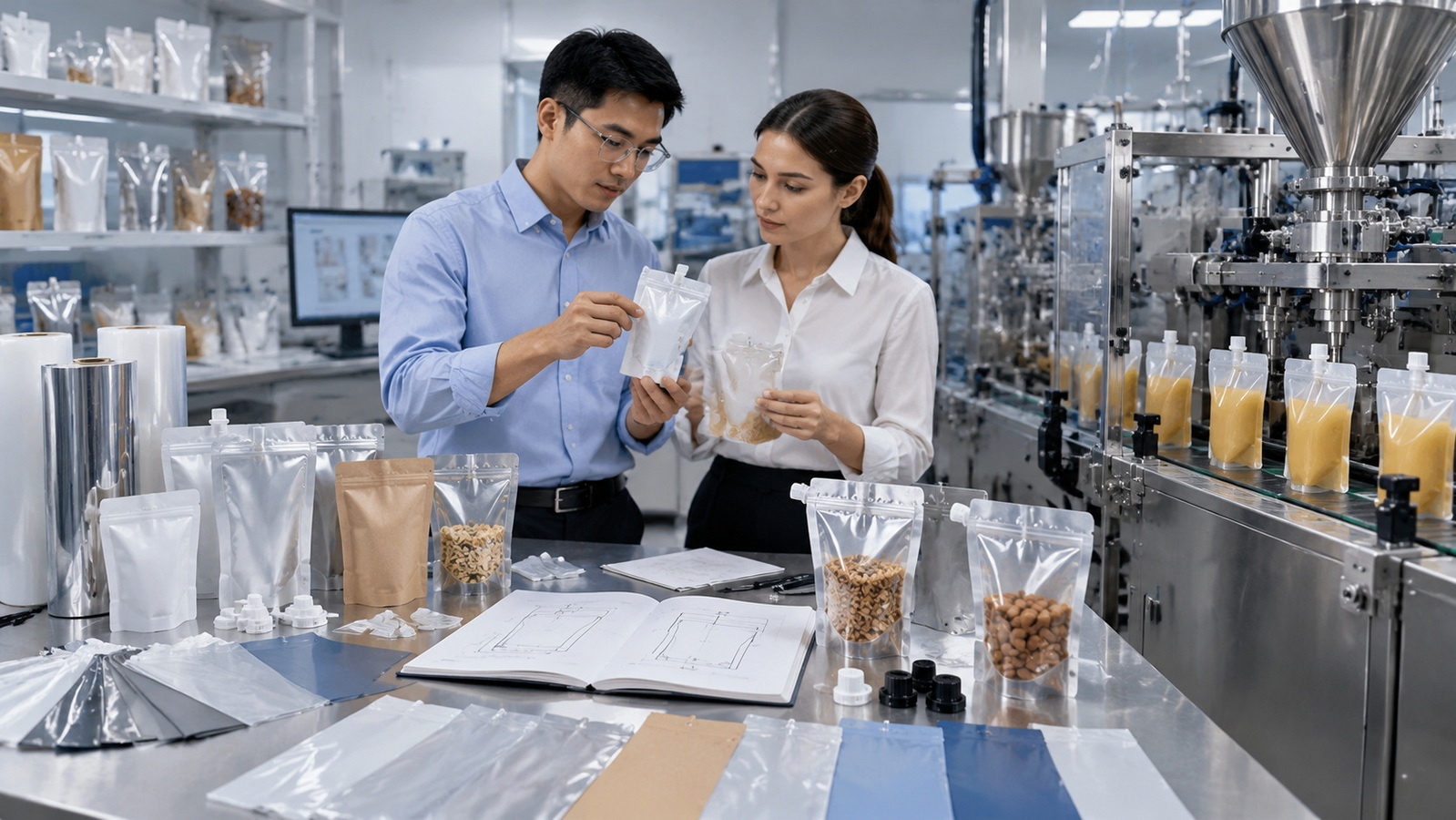
Before issuing the purchase order, agree on:
- MOQ per size, structure, and artwork.
- Tooling charges and ownership.
- Quantity overrun and underrun limits.
- Thickness and dimensional tolerances.
- Inspection criteria and sampling plan.
- Material-substitution approval.
- Complaint handling and corrective-action deadlines.
- Production lead time versus shipping time.
These details prevent a low initial quotation from turning into a higher-cost purchasing program.
Specify the delivery term, named delivery location, importer responsibilities, carton protection, pallet configuration, and storage conditions.
For cross-border North American purchases, ask the customs broker to validate tariff classification and any preferential-origin claim. A Mexican shipping address is not, by itself, evidence that a product qualifies for preferential treatment.
For imported supply from China, compare the complete replenishment cycle—including production, inspection, transport, customs clearance, and contingency stock—against the local alternative.
One procurement risk deserves more attention: a supplier can maintain the approved total thickness while changing the internal layer balance.
For example, a nominally identical laminate may contain a thinner sealant layer or a different sealant grade. The finished pouch can look correct and measure close to the agreed total gauge while behaving differently during hot tack, sealing through contamination, or filled-product handling.
A practical prevention plan is to:
- Approve individual layer specifications, not total thickness alone.
- Identify critical resin grades and permitted alternatives.
- Retain production-intent reference samples.
- Require written approval before material or adhesive changes.
- Compare sealing behavior over the intended operating window.
- Repeat filled-product and transport trials after consequential changes.
The useful purchasing question is not simply, "Does this bag pass inspection?" It is, "Does it remain stable across the actual conditions of our filling line?"
| Sourcing problem | Why it creates risk | Procurement control |
|---|---|---|
| Cheaper material substituted after approval | Appearance may remain acceptable while performance changes | Approved material schedule and formal change control |
| A certificate covers another address | The actual production site may be outside the audited scope | Match legal entity, site address, process scope, and status |
| A recyclable claim lacks a defined market | Material design and practical collection access may differ | Request the assessment basis and destination-specific justification |
| Samples are unlike production goods | Manual preparation may hide commercial-process variation | Approve production-intent samples and first-lot records |
| Capacity is quoted only as a company-wide figure | Required lines may already be booked or unsuitable | Obtain line-specific available capacity and a production commitment |
| Low unit price hides tooling or freight charges | Landed cost becomes difficult to compare | Use a standardized quotation template |
Mexico provides a credible sourcing base, but the right shortlist depends on the package. Folmex merits attention for printed consumer formats; Flair for stock and custom packaging support; Constantia Aluprint for engineered laminates; PAC for poly-bag and specialized high-volume programs; and PolyRafia for industrial flexible packaging. Their published capabilities support different purchasing priorities rather than one universal ranking.
HLun PACK provides an international alternative when buyers want to assess custom flexible packaging together with machinery and integrated development support. Its suitability should be established through a documented specification, production-intent samples, a machinery trial where relevant, and a complete landed-cost comparison.
To begin a technical review with HLun PACK, prepare your product description, target shelf life, bag dimensions, annual demand, artwork count, filling conditions, and destination market. Request a proposed structure, sampling plan, customization scope, and itemized quotation before committing to production.
Request the complete certificate and check the legal name, manufacturing address, certificate number, standard, scope, issuing body, and expiry date.
For ISO certification, seek confirmation through the issuing certification body and relevant accreditation records. For BRCGS certification, use the official directory to check live supplier information. A PDF supplied by the manufacturer should not be your only verification method.
Also check whether the scope covers the process you are buying. Certification for one site or activity should not be assumed to cover another.
Yes. A high-level description does not capture all differences in resin grade, layer distribution, adhesive system, barrier performance, conversion quality, or seals.
Require a complete specification and evaluate the filled package. Do not approve shelf life solely from an empty-film data sheet or a nominal structure description.
Your purchasing agreement should explicitly control this.
List the changes requiring prior written approval, including resin grade, recycled-content source, adhesive system, ink system, film supplier, and subcontracted production site. Define which changes trigger new migration review, barrier testing, or filled-product validation.
Treat recyclability, recycled content, and food-contact suitability as separate questions.
Ask for the construction, recycled-material source, percentage, assessment method, intended collection stream, and documentation supporting the food-contact application. FDA emphasizes that contaminants, additives, recycling-process controls, and intended use conditions matter when assessing recycled plastics for food packaging.
A sustainability claim does not replace food-contact evidence.
Provide the supplier with your machine model, filling process, target speed, sealing conditions, pouch-handling method, and product characteristics.
Run production-intent pouches on the actual machine. Record opening performance, feeding failures, wrinkles, leakage, rejects, and achievable speed. Where possible, test realistic temperature and dwell-time ranges rather than only a single favorable setting.
Approval should establish a workable operating window—not merely demonstrate that one sample can be sealed.
1- Mexico market estimates: Mordor Intelligence's Mexico Flexible Packaging Market report; values cover the broader flexible packaging market, not bags alone. [mordorintelligence]
2- Official trade statistics: Secretaría de Economía, Data México, HS 392321; the cited USD 867 million figure represents combined 2024 imports and exports. [economia.gob]
3- Industry association: Asociación Mexicana de Envase y Embalaje, which represents and supports Mexico's packaging sector. [amee]
4- HLun PACK: Company profile, product scope, development history, and integrated packaging capabilities. [hlunpack]
5- Folmex: Company product information, published production scale, DuPont case study, and associated Instapouch certification claims. [folmex]
6- Flair Flexible Packaging: Company history, Mexican facility capabilities, and FSSC 22000 announcement. [flairpackaging]
7- Constantia Aluprint: Mexican location profile and June 2025 production and laboratory investment announcement. [cflex]
8- PAC Worldwide: Mexican facility expansion, product scope, company history, and announced full-capacity output. [pac]
9- PolyRafia: Operating location, regional markets, product development, and company-history descriptions. [polyrafia.com]
10- Food-contact recycled plastics: FDA guidance and technical considerations. [fda]
11- Certification verification: BRCGS Directory. [directory.brcgs]
12- European compliance scope: European Commission guidance on CE marking and RoHS. [europa]
13- Additional engineering-company classification: ANEBON, Shangchen, and U-Need company websites. [anebonmetal]


