


close
Choose Your Site
Global
Social Media
Views: 277 Author: HLun PACK Publish Time: 2026-09-28 Origin: Site


Content Menu
● Cereal Box Dimensions at a Glance
>> How Tall Is a Standard Cereal Box?
>> How Wide and Deep Is a Cereal Box?
● How to Measure a Cereal Box Correctly
● Why Box Volume Is Not Cereal Capacity
● A Better Sizing Workflow for Cereal Brands
>> 1: Define Product and Market Constraints
>> 2: Prototype Carton and Inner Bag Together
>> 3: Verify the Packaging Equipment Window
● Paperboard, Freshness, and Recycling Claims
● Plan Your Cereal Packaging With HLun Pack
>> Is 12 × 8 × 2 Inches the Standard Cereal Box Size?
>> How Tall Is a Family-Size Cereal Box?
>> How Do I Calculate Cereal Box Volume?
>> Does a Bigger Box Always Contain More Cereal?
>> Should I Use the Same Dimensions for the Machine and Retailer?
>> Can Paperboard Alone Keep Cereal Fresh?
>> What Should I Send for a Cereal Carton and Equipment Quote?
A standard cereal box is often about 12 inches (30.5 cm) tall, but there is no universal cereal box size. If you are sourcing cartons or configuring a packaging line, the more useful question is: which cereal box dimensions will fit your product, inner bag, retailer, case pack, and equipment? This guide gives practical reference sizes and shows how to validate them before ordering tooling.
Measure a standing rectangular box as height × width × depth (H × W × D). Height runs from base to top; width crosses the front face; depth runs front to back. GS1 defines these directions relative to the package's "default front," which should be established before measurements are exchanged with retailers or logistics partners.
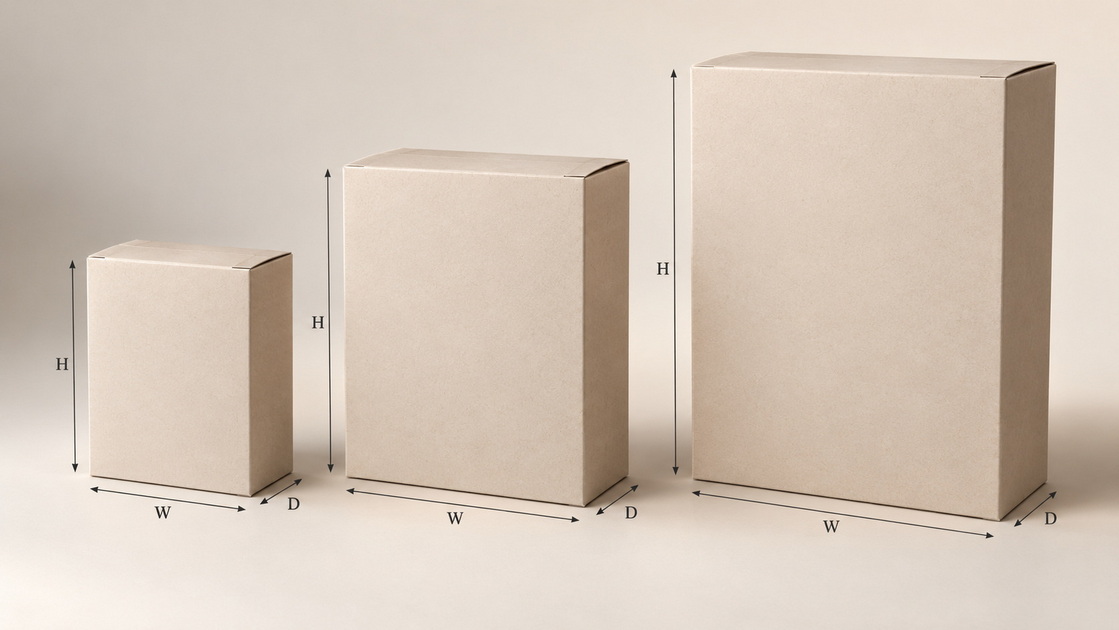
| Format | Illustrative outer H × W × D | Outer geometric volume | Planning note |
|---|---|---|---|
| Mini or single-serve | 6.5 × 4 × 1.5 in | 39 in⊃3; | Confirm the serving format; a mini carton may contain a small bag. |
| Standard reference | 12 × 8 × 2 in | 192 in⊃3; | Use as a starting mock-up, never a fixed industry standard. |
| Deeper standard | 12 × 8 × 2.5 in | 240 in⊃3; | Check bag width, shelf depth, and case count. |
| Illustrative family pack | 15 × 8 × 3 in | 360 in⊃3; | Check retailer height limits and loaded-carton stiffness. |
The mini, standard, and family dimensions above are illustrative sizes discussed in the source article; volumes are calculated from those dimensions. They are not a surveyed market average. Another packaging supplier publishes broader retail ranges, illustrating why brand, region, and SKU should determine the final specification.
Around 12 inches is a useful first answer for a conventional upright carton. Yet "standard" can describe a front-panel silhouette, not a contractual dimension. Two boxes at the same height can differ substantially in depth and internal capacity. Measure an actual filled sample when matching a competitor's shelf presence; do not scale a dieline from a product photograph.
An 8-inch front width and roughly 1.75–2.5-inch depth are helpful reference points from the existing guide. Some packs fall outside that interval. Depth deserves particular attention because it affects bag fit, case layout, front-to-back shelf space, and whether a carton can be opened and loaded consistently on the chosen machine. Confirm which party means width, length, or depth on every drawing.
A carton has at least three useful dimensional states: flat blank, erected empty carton, and finished retail pack. They are related but not interchangeable. A dieline controls panels, creases, glue flap, and closures. A finished pack includes any outward bowing or attached promotional component. For retail data, GS1 instructs users to identify the default front and measure the maximum outside extent.
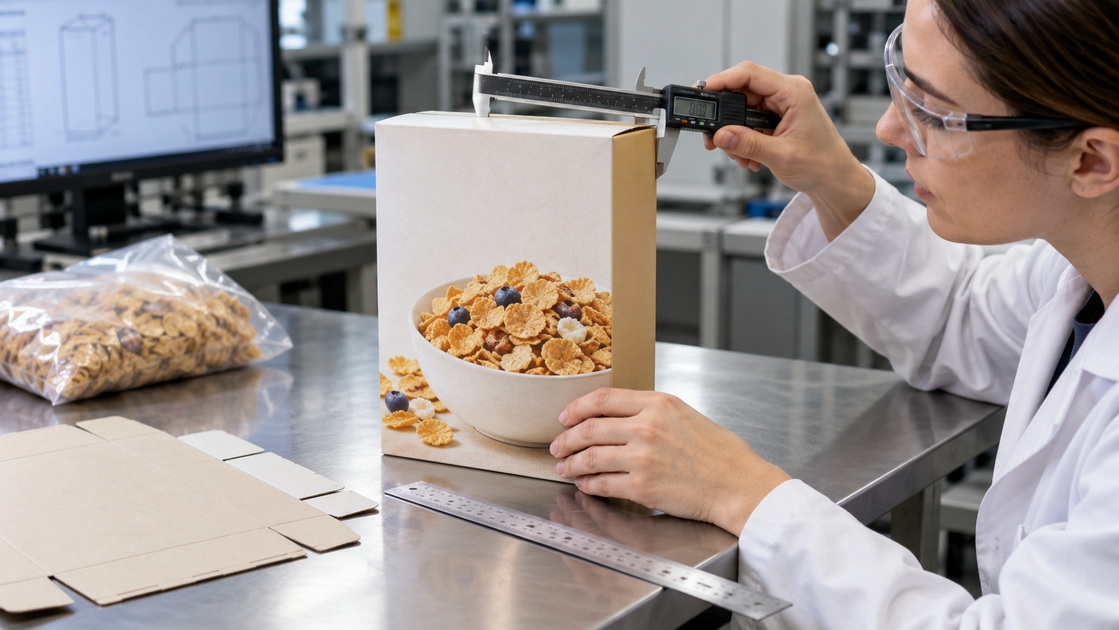
1. Put a closed, filled sample on a level surface and identify its branded default front.
2. Measure maximum outside height, front width, and front-to-back depth. Include projections and attached on-pack items when relevant to the finished trade item.
3. Record units and measurement state: blank, erected carton, filled consumer pack, or shipping case.
4. Measure multiple representative samples, including samples from different runs if available. GS1 recommends random samples to account for manufacturing and environmental variation.
5. Issue a dimensioned specification and confirm retailer data, bag drawings, and machine-format drawings against the same version.
The rectangular outer-volume calculation is simple: H × W × D. A 12 × 8 × 2-inch carton occupies 192 cubic inches, about 3.15 liters of geometric space. A 12 × 8 × 1.75-inch carton occupies 168 cubic inches, while a 2.5-inch-deep version occupies 240 cubic inches. Increasing depth from 2 to 2.5 inches increases outer geometric volume by 25%; it does not promise 25% more saleable cereal.
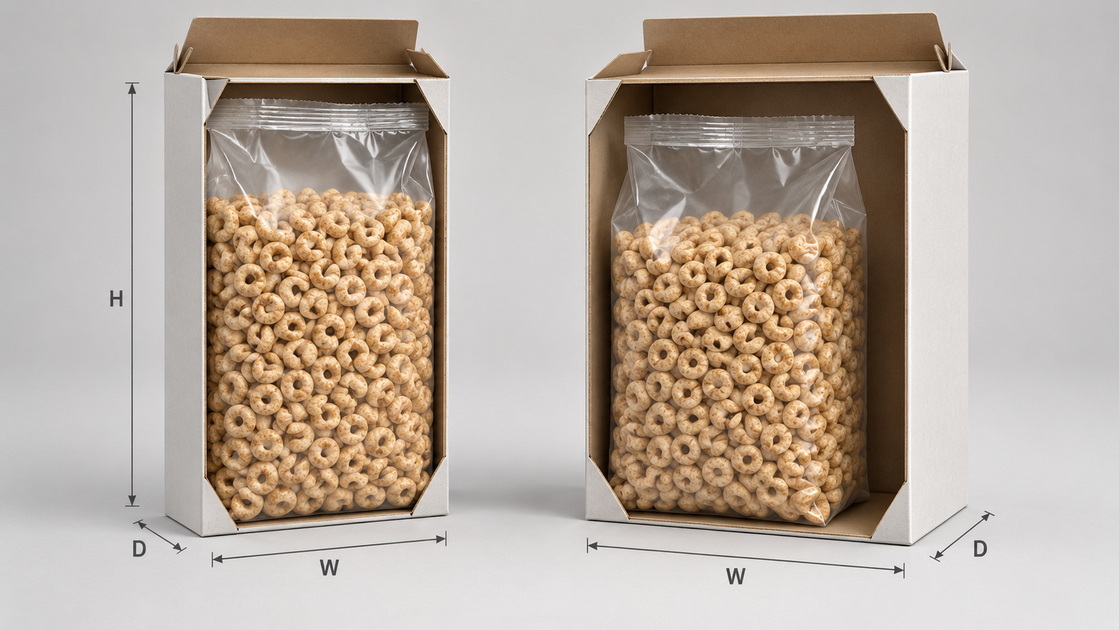
The inner bag occupies space. Its seals, folds, and top closure need clearance. Paperboard has thickness, and the carton must close without crushing the food or trapping the bag in a flap. Cereal pieces also have different shapes and settle differently. Net weight on a label is therefore not a reliable shortcut to box dimensions.
For a preliminary estimate, divide target product mass by measured loose bulk density to estimate the cereal's occupied volume. If a hypothetical cereal has a loose bulk density of 0.12 g/mL, a 360 g fill occupies approximately 3,000 mL *before* allowances for settling, bag geometry, and headspace. That density is an illustrative assumption, not a published value for any named cereal. Test the real formulation at the intended filling conditions; then size the liner and carton from measured packs rather than forcing the product into an attractive outer rectangle.
For an HLun Pack project, carton sizing should start as a system-design brief, not a choice between "regular" and "family." The steps below are a proposed engineering workflow, not a claim about a proprietary HLun Pack process or a completed customer project.
Specify cereal type, target net weight, target markets, shelf-life goal, and intended sales channel. Bring a real product sample. Flakes, clusters, and puffed shapes may occupy different volumes at the same mass; fragile products may also constrain handling. Obtain any retailer limits for maximum height, facing width, shelf depth, and case configuration before designing artwork. Never assume every supermarket uses one shelf height.
In the United States, the principal display panel also matters for labeling. For a rectangular package where one whole side is the principal display panel, federal rules determine its area from that side's height times width. Review label requirements with a qualified regulatory specialist before approving the print layout; this article is not a compliance determination.
A folding paperboard carton supplies shape, printable area, and handling protection. The inner bag or liner typically performs the primary food-containment and moisture-control role. Select a liner against the actual shelf-life and sealing targets, not a generic "food grade" promise. If any material is intended for food contact, obtain documentation for its particular composition and conditions of use. FDA guidance evaluates food-contact materials by the status of their constituent substances and applicable authorizations.
Produce physical mock-ups in at least two depths. Fill and seal the real cereal in each candidate bag, place it inside the carton, and check flap interference, panel bow, pouring behavior, and post-transport appearance. Leave enough clearance for reliable loading without creating an unnecessarily loose pack. Record the chosen geometry in a controlled dieline and bag specification.
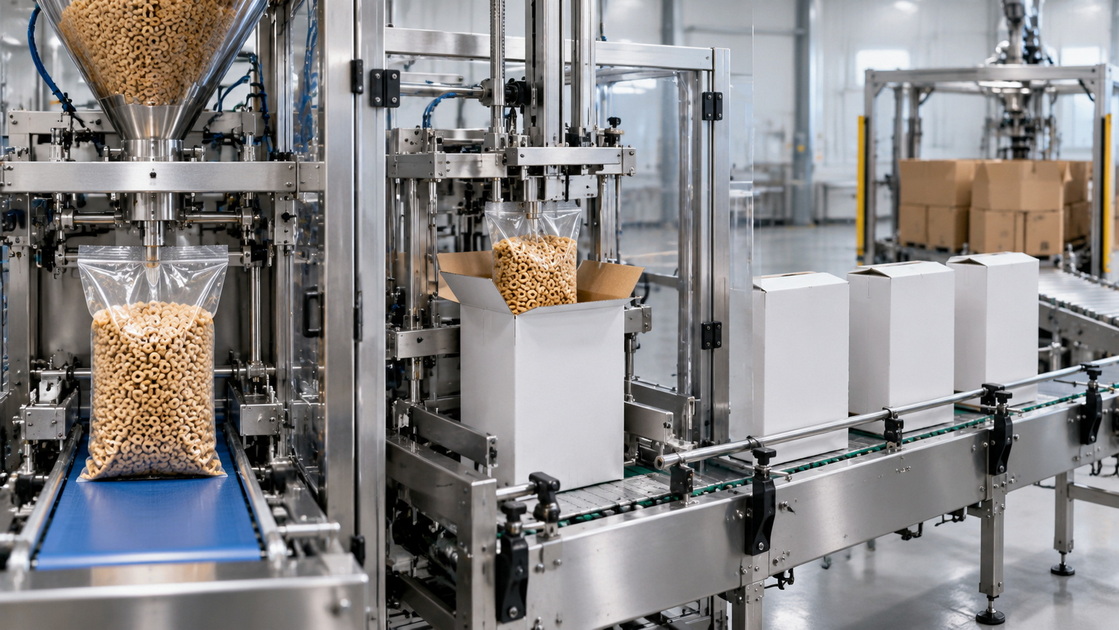
For an automated bag-in-box line, confirm the interface between bagging, loading, cartoning, coding, and case packing. Commercial cereal systems may combine baggers, endload cartoners, and case packers; Syntegon documents that configuration for boxed cereal. A supplier must still verify the actual format range and line layout for your project.
Ask for confirmation of the erected carton's minimum and maximum dimensions, blank quality requirements, bag-loading method, flap and glue arrangement, changeover procedure, and target output under your product conditions. Do not quote a nominal speed without stating the cereal, bag material, carton style, and inspection criteria. Run trials at start-up, steady state, and changeover; count jams, rejected packs, damaged cereal, and improperly sealed bags.
Suppose a brand proposes a 12 × 8 × 2-inch cereal carton because it matches its desired front-panel footprint. Its outer geometric volume is 192 in⊃3;. The team then compares an alternative 12 × 8 × 2.5-inch carton, at 240 in⊃3;. Both present the same 96-square-inch rectangular front face, but the deeper option has 48 in⊃3; more external volume and consumes more shelf depth.
The right choice cannot be made from these numbers alone. Fill real bags to the stated net weight. Check whether the shallower carton loads and closes without creasing the bag; verify that the deeper carton does not increase case voids or reduce units per case. Then confirm retailer dimensions and repeat the test after shipping simulation. The win is a carton that works across the entire distribution path, not the largest-looking pack.
This is a hypothetical calculation, not a claim that HLun Pack achieved a particular material saving, throughput, or customer result. Publish a real case study only after collecting and approving measured data from a named or permissioned project.
Paperboard grade and caliper should be chosen by trial: the carton needs adequate folding behavior, print quality, squareness, and stiffness after actual distribution exposure. A single wall-thickness figure from another supplier is not a safe universal design rule. The source article mentions approximately 0.022-inch board, but a converter should select a material specification based on carton geometry, load, and test performance.
Do not confuse paperboard with a moisture barrier. A cereal bag's material and seal design require their own validation. Before promoting a new paper-based or alternative liner, test it for barrier performance, seal integrity, shelf life, food-contact suitability, and compatibility with the planned equipment. FDA guidance provides a route for checking whether food-contact components are authorized for their intended use.
Keep environmental claims component-specific. "The paperboard carton is recyclable" is a different claim from "the entire cereal package is recyclable." The FTC's Green Guides caution against misleading unqualified recyclable claims and require appropriate qualification when access to recycling is limited; they define "substantial majority" as at least 60% of consumers or communities where the product is sold. Verify both the carton and liner against actual collection and processing options in your target market rather than promising automatic recyclability.
The practical answer to "How tall is a box of cereal?" is about 12 inches for a common reference carton—but the right height must be engineered for your SKU. HLun Pack focuses on paper packaging, packaging machinery, and integrated packaging solutions. To discuss a cereal carton or a bag-in-box packaging project, contact HLun Pack with your product sample, target net weight, draft H × W × D, inner-bag material, target throughput, and sales market. Ask for a feasibility review and prototype test plan before approving tooling or print files.
It is a useful illustrative design reference, not an official universal standard. Measure the intended SKU and confirm its retailer, liner, and equipment requirements. The source article cites 12-inch height and roughly 8-inch width, with depth varying by format.
A 15-inch height is one example, not a category rule. Published supplier references differ; one supplier's family-size range is approximately 12–14 inches tall. Always verify the particular brand or proposed product with a filled sample.
Multiply outside height × width × depth to obtain the outer rectangular volume. For example, 12 × 8 × 2 = 192 cubic inches. This figure cannot tell you directly how much cereal the sealed inner bag holds.
No. Net weight, piece density, bag design, and headspace vary. Compare the labeled net contents and, for engineering work, measure cereal bulk density and the filled bag's dimensions rather than inferring content from the outer box.
Use a single controlled specification, but distinguish the finished consumer pack from the flat carton blank and shipping case. GS1's consumer-trade-item measurement method applies to the finished pack; the machine supplier also needs the relevant blank, erected-carton, and bag measurements.
Do not assume so. Validate an appropriate liner or alternative food-contact structure, its seals, and the required shelf life. Request materials documentation and test the completed packaging system for the intended distribution conditions.
Send target net weight, a real cereal sample, proposed carton and bag dimensions, board and liner specifications, expected output, retailer limits, case configuration, and destination market. Note which measurements are estimates. That allows a packaging supplier to discuss feasibility and trials instead of guessing from box height.
1. OXO Packaging, ["What Are the Dimensions of a Cereal Box?—All Your Answers on Cereal Box Height"]. The source article supplied for restructuring; its reference dimensions and board-thickness statement are not treated as independently verified market averages. [oxopackaging]
2. GS1, [*GS1 Package and Product Measurement Standard*, release 3.2]. Method for identifying a default front and measuring outside dimensions of consumer items. [gs1]
3. Gentlever, ["Cereal Packaging Boxes: A Complete Guide for Brands and Consumers"], February 4, 2026. Alternative supplier-published dimensional ranges; not a market census. [gentlever]
4. U.S. Electronic Code of Federal Regulations, [21 CFR § 101.1, Principal display panel of package form food]. Rectangular-pack principal-display-panel area rule. [law.cornell]
5. U.S. Food and Drug Administration, ["Determining the Regulatory Status of Components of a Food Contact Material"]. Component-level regulatory status and conditions-of-use guidance. [fda]
6. Syntegon, ["Cereal Packaging Solutions"]. Industry example of baggers, endload cartoners, and case packers used for boxed cereals. [syntegon]
7. U.S. Federal Trade Commission, [*Guides for the Use of Environmental Marketing Claims*, § 260.12]. Guidance on recyclable claims and availability of recycling programs. [ftc]


