


close
Choose Your Site
Global
Social Media
Views: 255 Author: HLun PACK Publish Time: 2026-07-14 Origin: Site


Content Menu
● What Is a Packaging Dieline?
● Why Dielines Make or Break Paper Packaging
>> Precision Saves Money and Time
>> Brand Consistency on Every Shelf
>> Regulatory and Compliance Assurance
>> Scalability Across SKUs and Campaigns
● Core Elements of a Professional Dieline
>> Cut (Trim) Line – The Structural Outline
>> Bleed Line – Protecting the Printed Edge
>> Fold (Score) Line – The Crease Map
>> Perforation Line – Controlled User Interaction
>> Glue Tab and Exclusion Zone – The Hidden Backbone
● Expert Workflow: Creating a Press‑Ready Dieline in Illustrator
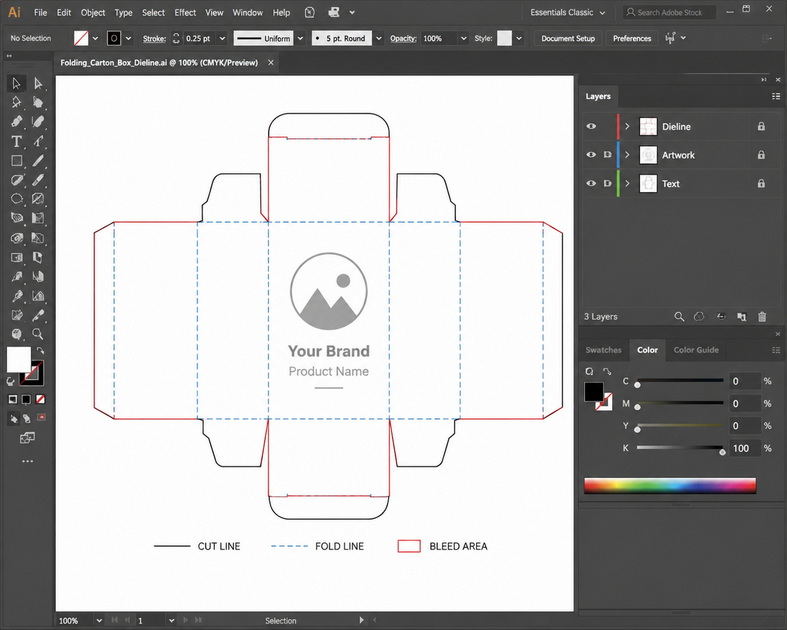
>> Build a Logical Layer Stack
>> Use Spot Colors for Brand Control
>> Outline Strokes for Die‑Making Clarity
>> Why Not Use Photoshop for Dielines?
● Common Dieline Types in Paper Packaging
● Pro Tips from the Production Floor
● Advanced Paper Packaging Dieline Strategies (New Insights)
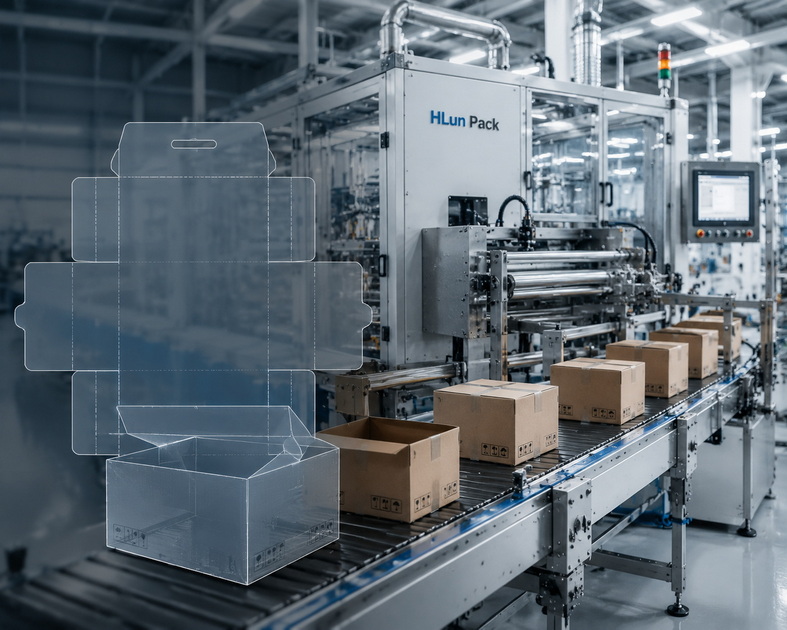
>> Aligning Dielines with Automated Equipment
>> Sustainability and Material Efficiency
>> Using Dielines as a Collaboration Tool
● When to Involve a Packaging Engineer
● CTA: Turn Your Dieline into a Production‑Ready Solution
● FAQs About Packaging Dielines
A packaging dieline is the precision blueprint that turns flat paperboard into a high‑performing box, bag, or label—and it is the single most important file if you care about print accuracy, cost control, and brand consistency. In my work with paper packaging lines at HLun Pack, I treat dielines as the technical foundation that connects design creativity with the realities of automated die‑cutting and high‑speed packing equipment. [marketingmetricscorp]
Put simply, a packaging dieline is a vector‑based technical drawing that tells cutting and creasing machines exactly where to slice, fold, and glue a package. It is created in flat form, but every panel, tab, and flap corresponds to a 3D structure once the box is assembled. [marketingmetricscorp]
I often describe the dieline as the "GPS of your packaging project": it guides artwork safely through production, so barcodes, logos, and legal text land exactly where they should, on every run and every SKU. For paper packaging manufacturers and brand owners, this is the document that aligns designers, printers, and packaging machinery engineers around a single source of truth. [kerkarmedia]
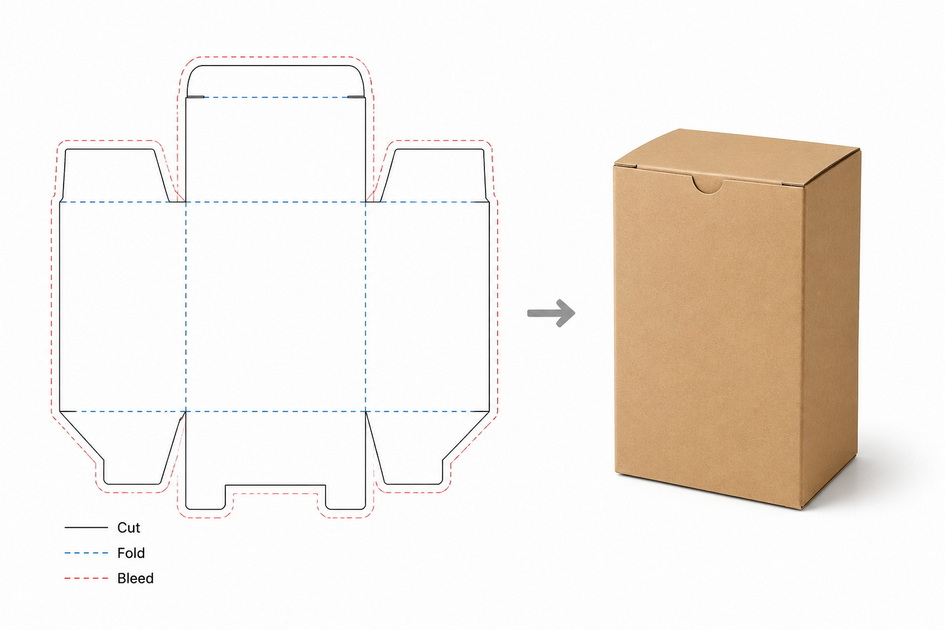
A laser‑accurate dieline keeps every cut, score, and glue tab precisely where it belongs. When the dieline is clean, cartons slide through die‑cutters and folder‑gluers in one pass—no emergency trimming, no mis‑folded batches, and no surprise overtime costs. [marketingmetricscorp]
For high‑volume paper packaging lines, even a 0.5 mm shift can translate into thousands of rejected boxes and hours of machine downtime. Getting the dieline right up front protects your production budget and your delivery promises. [kerkarmedia]
Your packaging is a physical extension of your brand, and dielines act as fixed coordinates for visual elements. A tight dieline prevents barcodes from creeping onto folds, hazard icons from slipping under glue tabs, or hero images from being sliced in half. [marketingmetricscorp]
In competitive retail environments, that consistency helps shoppers recognize your products instantly, reinforces quality perception, and supports repeat purchase behavior. Over multiple print runs, the dieline becomes the anchor that keeps every variant aligned with your brand system. [gushwork]
Paper packaging for food, cosmetics, pharmaceuticals, or electronics must comply with strict labeling regulations. A well‑engineered dieline reserves "safe zones" for mandatory information—ingredient lists, recycling marks, warning labels, and certifications—so you can drop legal copy into the layout once and trust it will stay compliant. [magetop]
From an operations perspective, this reduces the risk of recalls, reworks, and fines and simplifies audits across multiple regions and standards. [foremostmedia]
Once you have a proven master dieline, you can scale it across families of products—mini sizes, gift sets, seasonal editions—without paying for new tooling each time. You adjust panel lengths, update artwork layers, and the underlying structure still fits the same equipment and packing process. [kerkarmedia]
For HLun Pack and our partners, this flexibility shortens time‑to‑market and lets brands respond quickly to demand spikes or promotional windows.
The cut line defines the exact silhouette of your finished paper package. In professional workflows, it is usually set at 0.25 pt in a clearly distinguishable color (such as 100% magenta) and locked on a dedicated layer. [marketingmetricscorp]
If the cut line is off—even slightly—you pay for it twice: material waste and rush reprints. In integrated lines where HLun Pack machinery is calibrated to precise die profiles, a clean, consistent cut outline is essential for smooth downstream performance. [marketingmetricscorp]
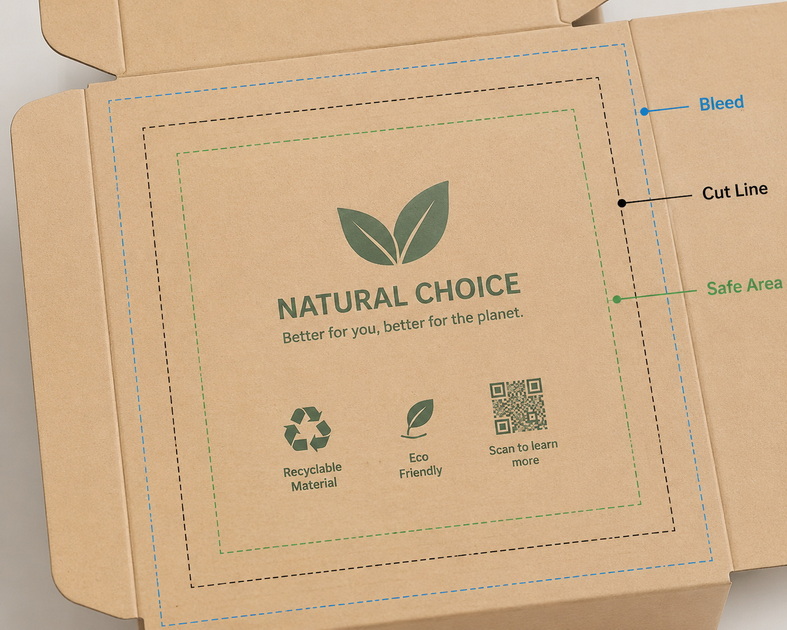
Bleed extends artwork beyond the cut line, usually by 3 mm (⅛ in) for paperboard packaging. This ensures solid colors and images "wrap" past the edge so minor sheet movement on press does not produce unwanted white borders. [marketingmetricscorp]
Bleed is especially critical for dark backgrounds, full‑bleed photos, or rich brand colors common in premium paper packaging. Without it, you risk entire runs that look misprinted even when the structural cut is technically correct. [marketingmetricscorp]
Fold lines (scores) indicate where the paper should bend, not crack. They're typically drawn as dashed strokes at around 0.5 pt, in a distinct color such as cyan, and separated from cut lines on their own layer. [marketingmetricscorp]
Scores must align with structural needs and artwork; text should never straddle a fold, and critical icons should not sit directly on crease points. Printing and folding a paper dummy from the dieline is still one of the most effective ways to catch alignment issues before mass production. [marketingmetricscorp]
Perforation lines build user interaction into the packaging: tear‑off coupons, opening strips, vent holes for hot food, or display panels. They're marked with distinctive patterns (dot‑dash) or colors so die‑makers and machine operators can identify them at a glance. [marketingmetricscorp]
In paper packaging equipment planning, perforation decisions affect tear strength, airflow, and packing speed, so they need to be engineered alongside your dieline—not added as an afterthought. [kerkarmedia]
Glue tabs are narrow flaps that lock walls together and hold the box shape. Professional dielines flag these areas clearly, often with a 50% black tint and labels such as "Glue Area — No Art." [marketingmetricscorp]
We also add a glue exclusion zone—usually 2–3 mm inside the tab—where varnish, foil, or lamination is avoided to keep adhesive performance consistent. Strong bonds reduce packaging failures, returns, and line stoppages on automated HLun Pack machinery. [marketingmetricscorp]
Start by switching your document color mode to CMYK, since all commercial presses for paper packaging run in CMYK, not RGB. This prevents unpleasant color shifts when you hand the file to pre‑press. [marketingmetricscorp]
Create at least three main layers before you draw any lines: [marketingmetricscorp]
- Dieline – cut, fold, perforation, glue marks. [marketingmetricscorp]
- Artwork – logos, photos, patterns. [marketingmetricscorp]
- Text & Icons – legal copy, barcodes, symbols. [marketingmetricscorp]
Locking the dieline layer after completion ensures designers cannot accidentally move structural paths while adjusting visuals. [marketingmetricscorp]
If your brand relies on specific spot colors (Pantone), load them via Illustrator's Pantone color books and add them to your swatches. Spot colors help maintain consistent reds, blues, or metallic tones across multiple packaging SKUs and print vendors. [marketingmetricscorp]
Outlining strokes converts hairlines into closed shapes, which die‑makers read more reliably. This reduces misinterpretation and avoids "soft" edges that might vary between machines or operators. [marketingmetricscorp]
Use descriptive names such as Dieline_Cut, Dieline_Fold, Art_Main, and Text_Legal. Clear naming speeds up pre‑press checks and minimizes errors when different teams open the file. [marketingmetricscorp]
Before you export, confirm: [marketingmetricscorp]
- Bleed extends at least 3 mm past the cut line.
- Text sits 3–5 mm inside folds and edges (safe zones).
- Fonts are outlined or properly packaged to avoid missing‑font problems. [marketingmetricscorp]
These simple steps can save days during production and approval cycles.
Saving as PDF/X‑4 embeds fonts, locks colors, and keeps vectors and transparency intact. It's widely accepted as a press‑ready standard and helps printers and packaging equipment manufacturers maintain predictable output. [marketingmetricscorp]
Photoshop works in pixels, which can blur at different scales and make millimeter‑level accuracy difficult. Paper packaging dielines require vector precision, which is why Illustrator (or equivalent CAD tools) remains the professional choice. [marketingmetricscorp]
| Dieline type | Typical use in paper packaging | Key considerations |
|---|---|---|
| Box dieline | Retail cartons, folding boxes, subscription packaging (marketingmetricscorp) | Requires glue tabs, dust flaps, and clear safe zones for folds. (marketingmetricscorp) |
| Bag dieline | Paper shopping bags, flat or gusseted pouches (marketingmetricscorp) | Needs handle reinforcement marks and bottom gusset strength mapping. (marketingmetricscorp) |
| Label dieline | Wrap‑around labels for bottles, jars, cans (marketingmetricscorp) | Must include full bleed and seam gap allowances for overlap. (marketingmetricscorp) |
For HLun Pack's paper packaging equipment, defining these dieline types correctly ensures the right combination of cutting dies, folding tools, and inline inspection systems.
Drawing on both design practice and packaging equipment integration, here are practical tips to keep printers and machinery operators happy: [kerkarmedia]
1. Stay vector at every stage—avoid rasterized dielines in any layer. [marketingmetricscorp]
2. Use clearly differentiated line weights and colors for cut vs. fold vs. perforation. [marketingmetricscorp]
3. Lock and, when needed, hide the dieline layer before you place artwork. [marketingmetricscorp]
4. Print and fold a low‑cost paper mock‑up to test alignment and fit. [marketingmetricscorp]
5. Share dielines early with your printer or HLun Pack's engineering team for feasibility checks. [kerkarmedia]
These habits reduce miscommunication and help your project move smoothly from digital file to finished paper package.
In modern packaging plants, dielines do not exist in isolation; they must align with conveyor widths, case packer jaws, and cartoner pockets. When HLun Pack designs packaging machinery solutions, we evaluate dielines for: [kerkarmedia]
- Machine‑friendly geometry – avoiding overly delicate flaps that catch in guides.
- Consistent panel ratios – so boxes erect reliably at speed.
- Clear inspection points – panels where codes and print marks remain visible to cameras.
Treat your dieline as a mechanical specification as much as a graphic template, especially when your goal is fully automated paper packaging lines. [kerkarmedia]
Paper packaging brands increasingly care about fiber use, recyclability, and regulatory trends around waste. Thoughtful dieline decisions can: [kerkarmedia]
- Remove unnecessary flaps or oversized panels to reduce board consumption.
- Optimize nesting on the sheet to minimize offcuts and scrap. [marketingmetricscorp]
- Reserve space for recyclability marks, FSC logos, or sustainability messages. [kerkarmedia]
Dielines designed with sustainability in mind help you meet corporate ESG targets without compromising structural integrity.
A well‑annotated dieline becomes a communication hub between stakeholders: [quickcreator]
- Designers see where they can place visuals safely.
- Regulatory teams validate compliance zones.
- Printers plan die‑making and layout.
- Equipment engineers simulate folding and packing behavior.
When HLun Pack collaborates on new paper packaging projects, we often start workshops around the dieline file, aligning expectations before any machinery settings are locked in.
If you are developing complex paper packaging—multi‑layer inserts, heavy contents, or automated case packing—bring a packaging engineer in early. They can: [kerkarmedia]
- Validate that your dieline will run on existing or planned HLun Pack equipment.
- Suggest structural changes to improve strength, stacking, and line speed.
- Translate marketing ideas into mechanically stable panel layouts.
This upfront investment turns the dieline into a robust production document rather than a purely aesthetic sketch. [quickcreator]
If you want your next paper packaging project to move smoothly from design to automated packing, HLun Pack can help you refine or create a dieline that matches both print and equipment needs. Our engineers specialize in paper packaging machinery and integrated solutions that reduce waste and improve line efficiency.
Share your current dieline or concept with us, and we'll provide practical feedback on structure, material usage, and machine compatibility—so your box not only looks great, but runs flawlessly.
1. Do I always need a custom dieline for paper packaging?
Not always; standard box styles (such as common folding cartons) can use existing dielines, but custom dimensions, special features, or automated equipment requirements usually justify a tailored dieline for optimal performance. [kerkarmedia]
2. How early should I create the dieline in a new product launch?
Create or select the dieline before artwork development, so designers can work within exact panel sizes and safe zones and you can validate compatibility with your chosen packaging equipment. [quickcreator]
3. Who "owns" the dieline—designers or engineers?
Ideally, both. Designers shape visual communication, while packaging and equipment engineers validate structure, material, and mechanical behavior; the final dieline is a shared production document. [kerkarmedia]
4. Can a poor dieline really impact sustainability metrics?
Yes. Inefficient panel layouts and poor nesting increase board usage and scrap, while misaligned structures can cause damage and rework—both of which hurt environmental and cost performance. [kerkarmedia]
5. What file format should I deliver to printers and equipment partners?
Vector‑based PDF/X‑4 exported from Illustrator or CAD tools is widely accepted; it locks in colors, fonts, and paths while staying compatible with pre‑press, die‑making, and simulation workflows. [marketingmetricscorp]
1. Pakoro. "What is Packaging Dieline? Guide for Perfect Box Design." [https://pakoro.com/blog/packaging-dieline/] [marketingmetricscorp]
2. QuickCreator. "SEO for Packaging Manufacturers: 2025 Best Practices." [https://quickcreator.io/blog/seo-for-packaging-manufacturers-2025-best-practices/] [quickcreator]
3. Kerkar Media. "SEO for Packaging Manufacturers." [https://kerkarmedia.com/seo-for-packaging-manufacturers/] [kerkarmedia]
4. Magetop. "How SEO Can Transform the Packaging Industry: A Guide for Manufacturers." [https://www.magetop.com/blog/how-seo-can-transform-the-packaging-industry-a-guide-for-manufacturers/] [magetop]
5. Foremost Media. "How to Take Advantage of Google E‑E‑A‑T for Manufacturing Websites." [https://www.foremostmedia.com/resources/blog/posts/how-to-take-advantage-of-google-e-e-a-t-for-manufacturing-websites] [foremostmedia]
6. Gushwork. "How SEO Helps Packaging Manufacturers Generate More Leads." [https://www.gushwork.ai/blog/seo-packaging-manufacturers] [gushwork]


