


close
Choose Your Site
Global
Social Media
Views: 222 Author: Amanda Publish Time: 2026-02-16 Origin: Site


Content Menu
● Cardboard vs Corrugated: Key Differences
>> What Is Corrugated Fiberboard?
>> Cardboard vs Corrugated: Quick Comparison
● Corrugated Liner Materials and Flute Papers
● Corrugated Flute Types (Flute Grades)
>> Overview of Major Flute Types
>> Common Double‑Wall Flute Combinations
● Types of Corrugated Board (Board Constructions)
>> Core Corrugated Board Structures
● Corrugated Box Styles and Structural Options
>> Popular Corrugated Box Styles
● Quality Control Tests for Corrugated Boxes
● Box Maker's Certificate (BMC): How to Read It
● Benefits of Corrugated Packaging
● Disadvantages of Corrugated Boxes (and How to Mitigate Them)
>> Weather Sensitivity and Moisture
● How to Choose the Right Corrugated Box for Your Product
>> Step‑by‑Step Selection Framework
● Corrugated Packaging Trends and Market Outlook
>> Key Trends Shaping Corrugated Design
● Integrating Corrugated Boxes with Packaging Machinery & End‑of‑Line Solutions
>> Why Machinery Compatibility Matters
● Work With HLun Pack on Your Next Corrugated Packaging Project
>> 1. What is the difference between cardboard and a corrugated box?
>> 2. How do I know which flute grade my product needs?
>> 3. What does the Box Maker's Certificate tell me?
>> 4. Are corrugated boxes environmentally friendly?
>> 5. How can I reduce corrugated packaging costs without compromising protection?
Corrugated boxes are the backbone of modern shipping, providing a strong, lightweight and customizable packaging solution for almost every industry, from e‑commerce and FMCG to industrial machinery and electronics. Understanding corrugated materials, flute grades, box styles and quality tests helps brands design safer, more cost‑effective and sustainable packaging systems instead of guessing and over‑spending on the wrong box strength.
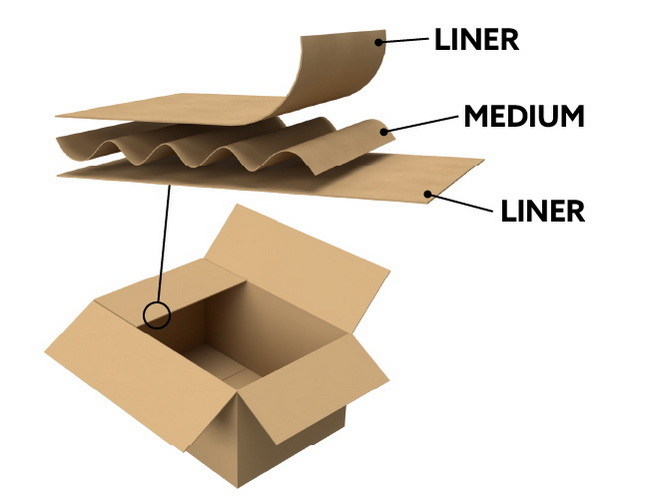
A corrugated box is a container made from corrugated fiberboard, which combines flat linerboard layers with a fluted (wavy) paper medium glued in between. This structure creates a lightweight but high‑strength panel that can absorb impact, resist compression and protect products through long, complex supply chains.
In many markets, the vast majority of shipped products use corrugated material because it offers a unique combination of protection, printability and cost efficiency. Corrugated packaging ranges from small retail mailers and pizza boxes to heavy‑duty triple‑wall containers that can hold very heavy loads.
Many people use “cardboard box” as a catch‑all term, but cardboard and corrugated board are different materials with very different performance profiles.
Cardboard is generally a thick paper stock or paper pulp board used for folding cartons and simple sleeves. It offers limited cushioning and stacking strength, so it is best suited for lightweight products, inner cartons, dividers or display packaging rather than primary shipping containers.
Corrugated fiberboard typically has three main layers: an outside liner, an inside liner and a fluted medium in between. By changing flute type, liner weight and board construction, packaging engineers can tune corrugated panels for cushioning, stacking strength, puncture resistance and print quality.
Feature | Cardboard (Paperboard) | Corrugated Fiberboard |
Structure | Single solid sheet | Two or more liners with fluted medium in between |
Typical use | Folding cartons, sleeves, displays | Shipping boxes, transit packaging, e-commerce mailers |
Cushioning | Low impact absorption | High cushioning from flutes |
Stacking strength | Limited | Good to excellent, depending on flute and wall type |
Weight range | Light products | Light to very heavy products |
Sustainability options | Widely recyclable | Widely recyclable; often high recycled content |
For any product that needs reliable transit protection or pallet stacking, corrugated boxes are usually the safer, more economical choice than plain cardboard folding cartons.
Choosing the right liner material and fluting paper directly affects box strength, print quality and sustainability profile.
- Kraft paper liners contain a high proportion of virgin chemical pulp, giving a very stiff, durable and moisture‑resistant outer surface. Kraft is usually the most sustainable and premium‑looking option but also the most costly due to its higher virgin fiber content.
- Test paper liners use a higher proportion of recycled fibers, making them more affordable but somewhat less durable and harder to print at very high resolution. Test liner is commonly used for inner liners where aesthetics matter less than cost.
- Fluting papers are available as semi‑chemical fluting (using virgin fibers and a specific pulping process) and waste‑based fluting (100% recycled fibers). Semi‑chemical mediums tend to offer higher compression strength, while waste‑based fluting emphasizes recycling and cost efficiency.
A practical approach for many brands is kraft outer liner plus test inner liner plus recycled fluting to deliver a premium shelf appearance with a lower total environmental footprint.
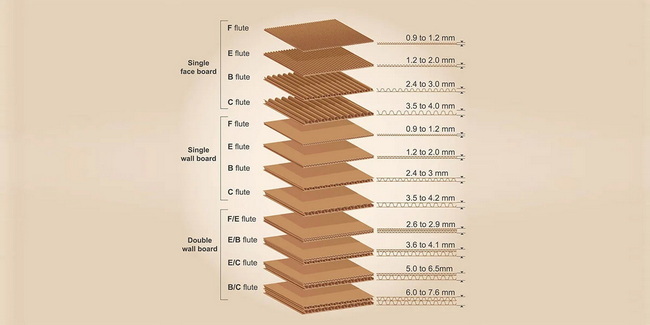
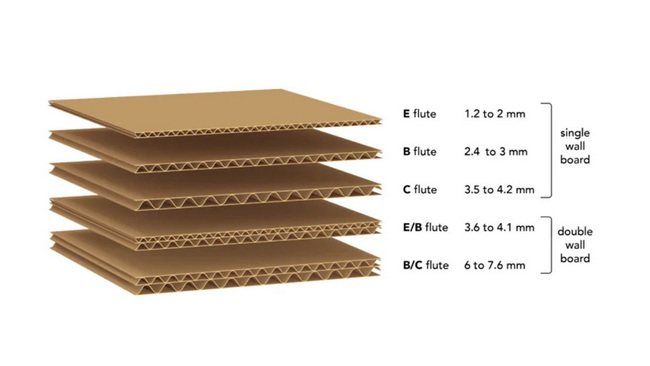
Flutes are the arched, wavy layer between liners that provide cushioning, rigidity and stacking strength. Different flute grades trade off print quality, thickness and protective performance.
- A‑Flute – approximately 1/4” thick: The largest common flute size with the highest cushioning and excellent stacking strength, suitable for fragile items and heavy‑duty shipping.
- B‑Flute – approximately 1/8” thick: Thinner profile with very good puncture and crush resistance, widely used for die‑cut boxes, inner packaging and retail‑ready corrugated.
- C‑Flute – approximately 3/16” thick: A versatile, general‑purpose flute used in many standard shipping boxes, glass packaging and dairy or furniture packs.
- E‑Flute – approximately 1/16” thick: Micro‑flute with excellent print surface, often replacing paperboard in premium retail boxes, cosmetics and small fragile products.
- F‑Flute – approximately 1/32” thick: Ultra‑thin flute with a very smooth surface for high‑quality printing, frequently used in fast‑food clamshells and specialty retail packaging.
- AC flute: Combines A and C flutes for maximum cushioning and stacking strength in extremely demanding shipping environments.
- BC flute: A widely used all‑round structure that balances transit protection, cost and machinability, ideal for logistics and industrial goods.
- EB flute: Pairs E‑flute printability with B‑flute strength, making it popular for retail‑ready transit packaging and branded e‑commerce boxes.
When choosing a flute profile, consider product fragility, stacking height, palletization pattern, printing needs and the level of automation on your packing line.
Beyond flute type, board construction describes how many liner and fluting layers are combined to form the final panel.
- Linerboard: The flat face sheets to which the fluted medium is glued.
- Single face: One liner glued to exposed fluting; often used as wrap or inner protection, not as a full box.
- Single wall: Two liners with one fluted layer; the most common construction for standard shipping boxes and mailers.
- Double wall: Three liners and two fluted mediums; used for heavier, bulkier or more fragile products needing greater crush resistance.
- Triple wall: Four liners and three fluted mediums; can handle very heavy loads and is used for industrial, export and heavy machinery packaging, though it is less flexible and more material‑intensive.
For automated lines, it is critical that board caliper (thickness) and stiffness are matched to machinery tolerances to avoid jams, mis‑feeds and excessive wear on equipment.
Once you understand board construction, you can select from a wide range of box styles that optimize material use, filling speed and stacking stability.
Common shipping and e‑commerce box styles include:
- Regular Slotted Box (RSC): Standard box with two major and two minor flaps; highly efficient in board usage and suitable for most products.
- Full Slotted Box: Similar to RSC but with all flaps the same length, providing more protection on the top and bottom.
- Half Slotted Container (HSC): One open end, often used with a separate lid for easier top access to products.
- One‑Piece Folder: A single, scored sheet folded around the product; ideal for books, flat items and e‑commerce apparel.
- Tuck Top Auto Bottom: Bottom pre‑glued and snaps into place for fast assembly; suitable for higher‑volume packing lines.
- Roll End Tuck Front / 3‑Flap Tuck / Tab‑Lock Roll End: Die‑cut styles often used for subscription boxes, premium mailers and retail‑ready presentation.
For export shipments or high‑value equipment, brands may combine these styles with internal dividers, foam inserts, corrugated pads or custom fixtures to maintain product position and improve drop resistance.
Because boxes face stacking, impacts and vibration across warehouses and transport networks, standardized tests are used to verify their performance.
The Edge Crush Test measures how much force a short column of corrugated board can withstand when force is applied to its edge until it buckles. ECT values correlate with stacking strength and are widely used to specify box performance in palletized loads.
The Flat Crush Test applies force directly on the surface of the board until the flutes collapse. This test evaluates the compression resistance of the fluted medium and helps ensure the board can resist localized pressure in storage and transportation.
The Mullen Test (Burst Test) measures the pressure required to rupture the board surface, indicating resistance to punctures and rough handling. Mullen ratings are often preferred in applications where abrasion and sudden impacts are more critical than purely vertical stacking strength.
The Box Maker's Certificate is a printed stamp on the bottom or side of many corrugated boxes that summarizes key construction and performance data.
- Box manufacturer: Identifies the company that produced the box.
- Board construction: Indicates whether the board is single, double or triple wall.
- Minimum combined weight of facings: Shows the combined basis weight of the liners used before conversion into boxes.
- Size limit: States the maximum allowable box dimensions (sum of length, width and depth) for which the performance rating is valid.
- Gross weight limit: The maximum allowable weight of the box contents under normal shipping conditions.
- City and state: Location where the box was manufactured.
For buyers, the BMC is a quick quality checkpoint, enabling easy verification that delivered boxes meet the specified strength and regulatory requirements.
Corrugated packaging remains a leading transit packaging material worldwide because it balances protection, cost and sustainability better than many alternatives.
- Protection and durability: Corrugated panels absorb shock, resist compression and provide stable stacking, helping products survive long distribution chains.
- Lightweight efficiency: High strength‑to‑weight ratio can reduce freight costs and carbon emissions compared with heavier rigid packaging materials.
- Sustainability: Corrugated boards are typically made with high levels of recycled fiber and are easily recyclable through existing paper recovery systems.
- High customization: Brands can tailor shape, board grade, flute type, interior fittings and print finishes to their exact logistics and marketing needs.
Global demand for corrugated packaging continues to grow as e‑commerce expands and more companies shift from mixed‑material packaging to fully recyclable fiber‑based solutions.
Despite its strengths, corrugated packaging has limitations that need to be managed through design and material choices.
Corrugated boards can lose stiffness and deform when exposed to high humidity, rain or direct water contact. Added barrier coatings, plastic or paper‑based liners, and optimized warehouse conditions can significantly improve moisture performance without sacrificing recyclability.
Corrugated pricing can rise due to pulp market volatility, supply chain disruptions and sustainability regulations. Brands can reduce total system cost by right‑sizing boxes, optimizing flute grades and increasing automation to lower labor and damage rates rather than only chasing cheaper board grades.
Selecting the correct corrugated specification is a structured process that directly affects damage rates, freight costs and customer experience.
- Define product and risk profile: Consider weight, fragility, surface sensitivity, unit price and route risk (for example, export versus local shipping).
- Set stacking and pallet requirements: Define maximum stacking height, storage duration and warehouse climate conditions.
- Select flute and wall type: Choose from single, double or triple wall and appropriate flute combinations (for example, B/C for heavy loads, E/B for retail‑ready transit packs).
- Choose liner combination: Decide on kraft versus test liner mix to balance print quality, moisture resistance and cost.
- Validate via testing: Use ECT, Mullen and transport simulations to confirm that the chosen specification meets performance targets with a safety margin.
Working with an experienced packaging partner and equipment supplier ensures the final box runs smoothly on packing lines while meeting performance and sustainability objectives.
Corrugated packaging demand continues to grow, supported by e‑commerce, retail omnichannel strategies and sustainability commitments.
- E‑commerce unboxing: Brands increasingly use printed corrugated mailers and inserts as a low‑cost storytelling surface that enhances the unboxing experience.
- Right‑sizing and automation: Automated case erectors, packers and sealers favor consistent, well‑engineered board grades that minimize downtime and waste.
- Sustainable coatings and inks: Water‑based inks and recyclable functional coatings help improve barrier performance without compromising recyclability.
- Retail‑ready transit packaging: EB and B‑flute display trays that move directly from pallet to shelf are gaining share in supermarkets and club stores.
Over the next decade, corrugated packaging is expected to maintain steady growth, with strong opportunities in food, beverage, consumer electronics and industrial e‑commerce segments.
Corrugated box performance is only fully realized when it is integrated with the right packaging machinery, sealing materials and line design.
- Consistent box forming: Case erectors and formers require board stiffness and creasing quality within specific tolerances to avoid mis‑formed boxes and stoppages.
- Efficient sealing: Automated tapers, hot‑melt systems or strapping equipment must be tuned to board caliper and surface finish to ensure reliable closure without crushing.
- Damage reduction: Correctly configured cushioning, dividers and palletization patterns reduce product damage and claims, offsetting small increases in board cost.
Working with an integrated packaging partner that provides both materials and machinery helps companies optimize corrugated specifications, consumables and equipment as a complete system instead of isolated components.
If you are planning a new corrugated packaging project or want to upgrade an existing box specification, this is the ideal time to combine structural engineering with smart automation. HLun Pack specializes in packaging materials and machinery, helping you align corrugated box design, sealing materials and end‑of‑line equipment into one efficient system. Reach out to our team to discuss your products, shipping risks and production setup, and we will help you develop a tailored corrugated solution that reduces damage, improves efficiency and supports your long‑term growth.
Contact us to get more information!
Cardboard is a single‑ply paperboard used mainly for folding cartons and displays, while a corrugated box is made from multiple layers of liners and a fluted medium for higher strength and cushioning. Corrugated boxes are therefore better suited for shipping and stacking heavy or fragile products.
The right flute grade depends on product weight, fragility, stacking height, print requirements and shipping conditions. As a rule of thumb, A and C flutes are used for higher cushioning and stacking, B for puncture resistance and die‑cut styles, and E/F for high‑quality printed retail packaging.
The Box Maker's Certificate shows the manufacturer, board construction (single, double or triple wall), minimum combined weight of facings, size limit and maximum gross weight. It also indicates whether the box is rated by ECT or Mullen Test, helping you verify that it meets your performance requirements.
Yes, corrugated packaging typically contains a high proportion of recycled fiber and is widely recyclable in standard paper recovery systems. Many manufacturers now offer responsibly sourced virgin fibers and eco‑friendly coatings to further improve sustainability credentials.
You can reduce costs by right‑sizing boxes, optimizing flute and wall types, using a kraft/test liner mix and improving packing line automation to cut labor and damage rates. Working with a packaging engineer or integrated partner allows you to model performance versus cost and avoid unnecessary over‑specification.
1. https://pakfactory.com/blog/learn/corrugated-box-101/
2. https://pakfactory.com/blog/what-is-corrugated-packaging/
3. https://www.gwp.co.uk/guides/corrugated-board-grades-explained/
4. https://www.precedenceresearch.com/corrugated-packaging-market
5. https://www.deprintedbox.com/corrugated-board-for-corrugated-box.php
6. https://www.quickbox.co/learn-board-grade
7. https://www.wexxar.com/
8. https://www.youtube.com/watch?v=NlYini3nmYQ


