


close
Choose Your Site
Global
Social Media
Views: 234 Author: Tom Publish Time: 2026-10-12 Origin: Hlunpack


High-speed flexible packaging creates a fundamental sealing challenge: as machine speed increases, the time available to create a reliable seal becomes shorter.
For conventional heat-sealing systems, thermal energy must pass through the laminate before the inner sealant layer reaches the condition required to form a stable bond. As packaging speed increases, the available time for heat transfer, seal formation and initial seal stabilization becomes increasingly limited.
Two different material technologies are commonly used to address this challenge: Cold Seal and Low-SIT PE. Although both can support high-speed packaging, they solve the problem through fundamentally different mechanisms.
Core Technical Insight
Cold Seal changes the sealing mechanism. Low-SIT PE keeps the thermal sealing mechanism but engineers the sealant layer to respond faster and more reliably.
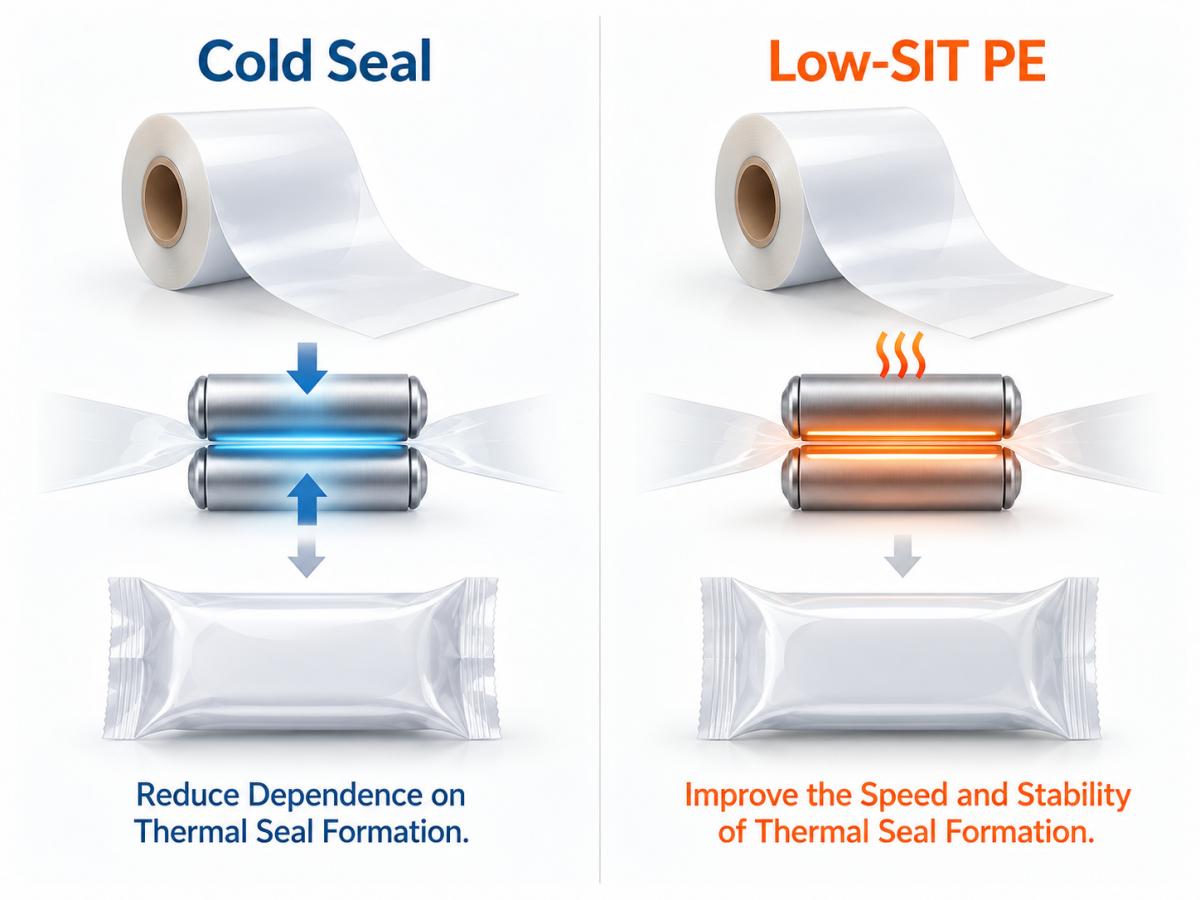
Cold-seal packaging generally uses a self-sealing cold-seal coating applied to designated sealing areas of the web. When two compatible cold-seal-coated surfaces contact each other under appropriate pressure, the coating forms the package seal.
The process relies mainly on cold-seal coating, surface contact and pressure rather than melting a thermoplastic inner sealing layer. Cold seal should therefore not be understood as an extremely low-temperature version of heat sealing; it is a different sealing mechanism.
Low-SIT PE remains a thermoplastic heat-sealing system. The seal is still formed through heat, pressure and time, but the PE-based sealant system is engineered to begin developing seal strength at a lower temperature.
SIT means Seal Initiation Temperature. In practice, a high-performance Low-SIT solution is often better described as a specially engineered PE-based sealant system rather than simply a low-temperature PE film.
Cold Seal
Reduce dependence on thermal seal formation.
Low-SIT PE
Improve the speed and stability of thermal seal formation.
In a conventional heat-sealing system, thermal energy must move from the sealing element through the film structure before reaching the seal interface. A simplified sequence is:
Heat-Seal Sequence
Heated jaw or rotary roller → outer film → laminate → inner sealant → seal formation → hot-seal stabilization → cooling.
As machine speed increases, available sealing time decreases. If the sealant cannot respond quickly enough, incomplete sealing, reduced seal strength, seal opening before cooling, leakage, excessive temperature compensation, film deformation, sealant squeeze-out or sticking may appear.
Cold seal largely bypasses the thermal-transfer bottleneck. Low-SIT PE improves the sealant response within the thermal process.
Cold seal does not require the inner thermoplastic layer to melt in order to form the primary package seal. Instead, compatible cold-seal-coated surfaces are pressed together. This removes much of the thermal dependency from the sealing step and can provide a major advantage at very high packaging speeds.
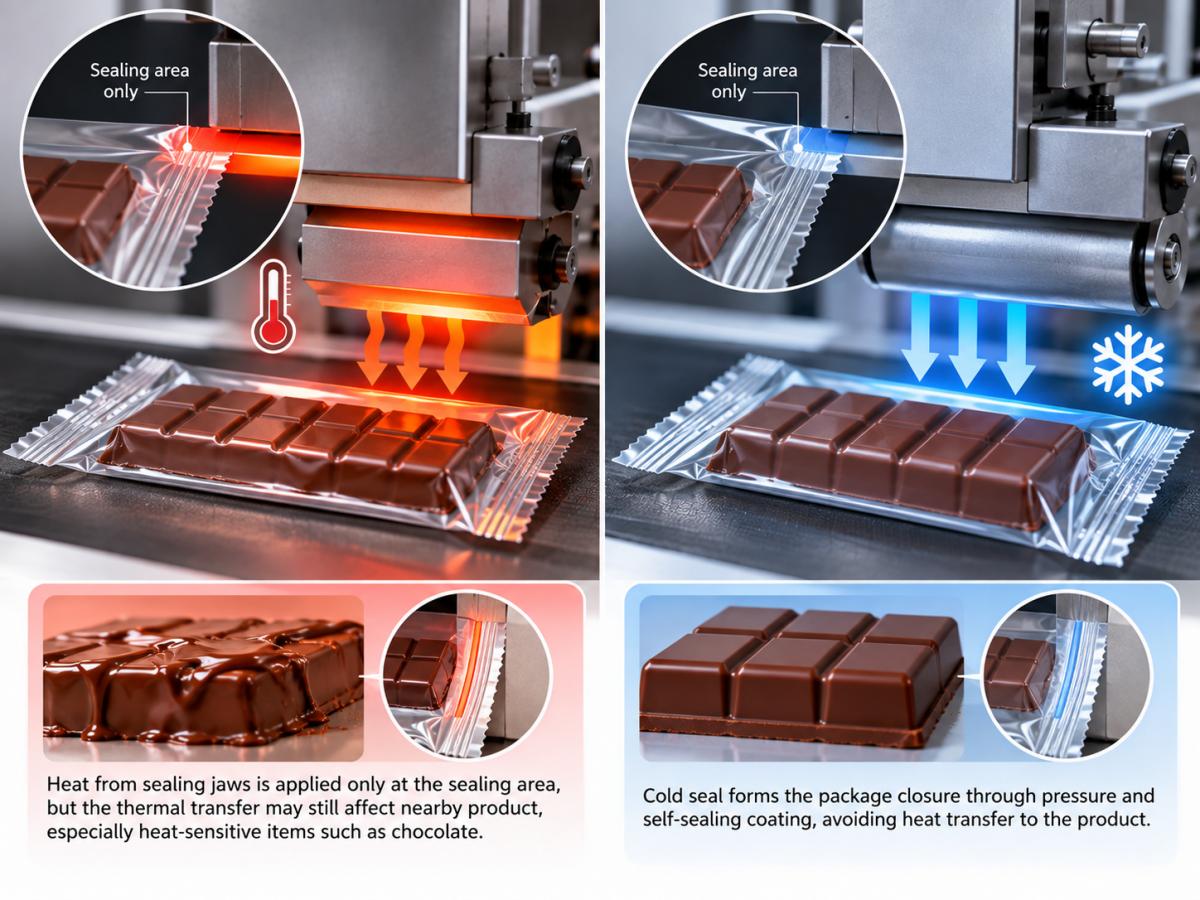
Cold seal is commonly used for products such as chocolate, confectionery, ice cream, protein bars, cereal bars, snack bars and certain heat-sensitive bakery products. The issue is not only machine speed; it is also product heat sensitivity.
A hot sealing jaw or rotary sealing system applies heat only at the sealing area, but thermal transfer from that area can still affect nearby product. Possible effects include chocolate softening, surface melting, shape deformation, texture changes and product sticking.
Because cold-seal packaging relies far less on heat for seal formation, it can reduce thermal exposure to the product. Cold seal should therefore be understood as both a high-speed sealing technology and a heat-sensitive product protection technology.
A cold-seal laminate requires more than changing one resin layer. The complete structure and converting process may include printed film, functional laminate layers, a cold-seal coating and a release system.
When the film is wound into a roll, the cold-seal-coated surface can contact the opposite surface of the web. A release coating or release lacquer helps prevent unwanted blocking during winding, storage and unwinding.
Cold-seal performance therefore depends on coating formulation, coating weight, coating pattern, release performance, pressure, web tension, storage conditions and machine alignment.
Cold-seal adhesive is often applied only where the final package needs to be sealed. The coating must therefore correspond accurately with longitudinal seal areas, cross-seal areas, cut positions and printed graphics.
At high speed, three registrations may need to work together: print registration, cold-seal pattern registration and cut registration. If the cold-seal pattern shifts, incomplete sealing, exposed adhesive, adhesive entering the product area, poor package appearance or seal-width variation can result.
Cold-Seal Converting Requirement
Printing + coating + registration + machine setup must work as one system.
Low-SIT PE follows a different strategy. Instead of bypassing thermal sealing, it improves the response of the heat-seal layer. A good high-speed PE-based sealant system should normally be evaluated through three characteristics:
· Lower Seal Initiation Temperature (SIT)
· Strong Hot Tack
· Wider Material Heat-Seal Window
Seal Initiation Temperature is the temperature at which a sealant begins developing a defined level of measurable seal strength under specified test conditions. A lower SIT can help the material begin sealing with less thermal input and within a shorter available sealing cycle.
However, SIT alone does not determine high-speed performance.
Hot tack describes the ability of a newly formed heat seal to resist mechanical stress while the seal is still hot and before it reaches its final cooled strength.
Immediately after leaving the sealing jaws, the package may already experience web tension, product weight, film pulling, cutting force or conveyor movement. If hot-tack strength is insufficient, the seal can partially open before cooling is complete.
High-Speed Heat-Seal Logic
Lower SIT + Strong Hot Tack is more meaningful than simply choosing the lowest possible sealing temperature.
A film can show good final seal strength after cooling but still perform poorly on a high-speed packaging line because the line can apply mechanical load before the seal has completely cooled. For faster lines, hot tack can become as important as final cooled seal strength.
In practice, a more useful property than the lowest possible sealing temperature is the material heat-seal window: the temperature range over which a material can achieve the required sealing performance under defined pressure and dwell time.
· Too low: insufficient seal development
· Stable heat-seal range: reliable seal performance
· Too high: excessive softening, distortion, squeeze-out or sticking
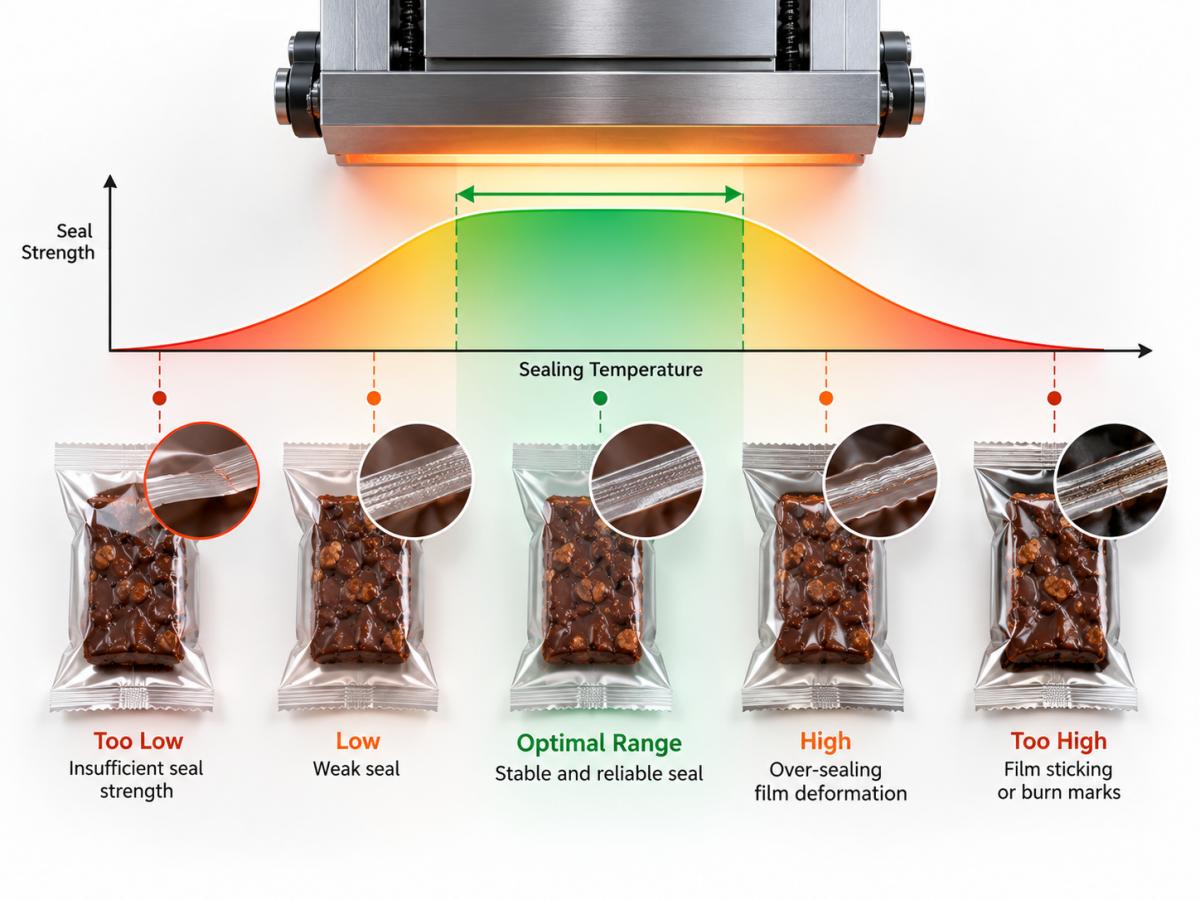
The material heat-seal window mainly describes how the sealant responds over a temperature range under specified test conditions. The actual machine operating window is broader and also depends on pressure, effective dwell time, machine speed, jaw or roller geometry, film tension, cooling and product contamination.
Important Distinction
A wider material heat-seal window helps create a wider machine operating window, but it does not determine the operating window by itself.
Real food packaging does not always have a perfectly clean sealing zone. Oil, powder, crumbs, seasoning, chocolate particles, moisture or sauce may enter the seal area.
Cold seal depends on effective contact between compatible coated surfaces. If powder, oil or other residues interrupt that contact, the effective bonding area can be reduced, leading to reduced bond strength, partial sealing or leakage channels.
Heat-seal systems can also be negatively affected by contamination. However, specially engineered sealant systems may be designed to provide improved seal-through-contamination performance. The real product should still be used for application validation.
Packaging performance is not only about whether a seal is strong. The required seal profile may include easy-open behavior, peelability, controlled peel strength, a strong permanent seal or high-integrity hermetic sealing.
Cold-seal systems and PE-based heat-seal systems can both be engineered for different opening behaviors. The application therefore needs a defined target for seal strength, peel behavior and package integrity.
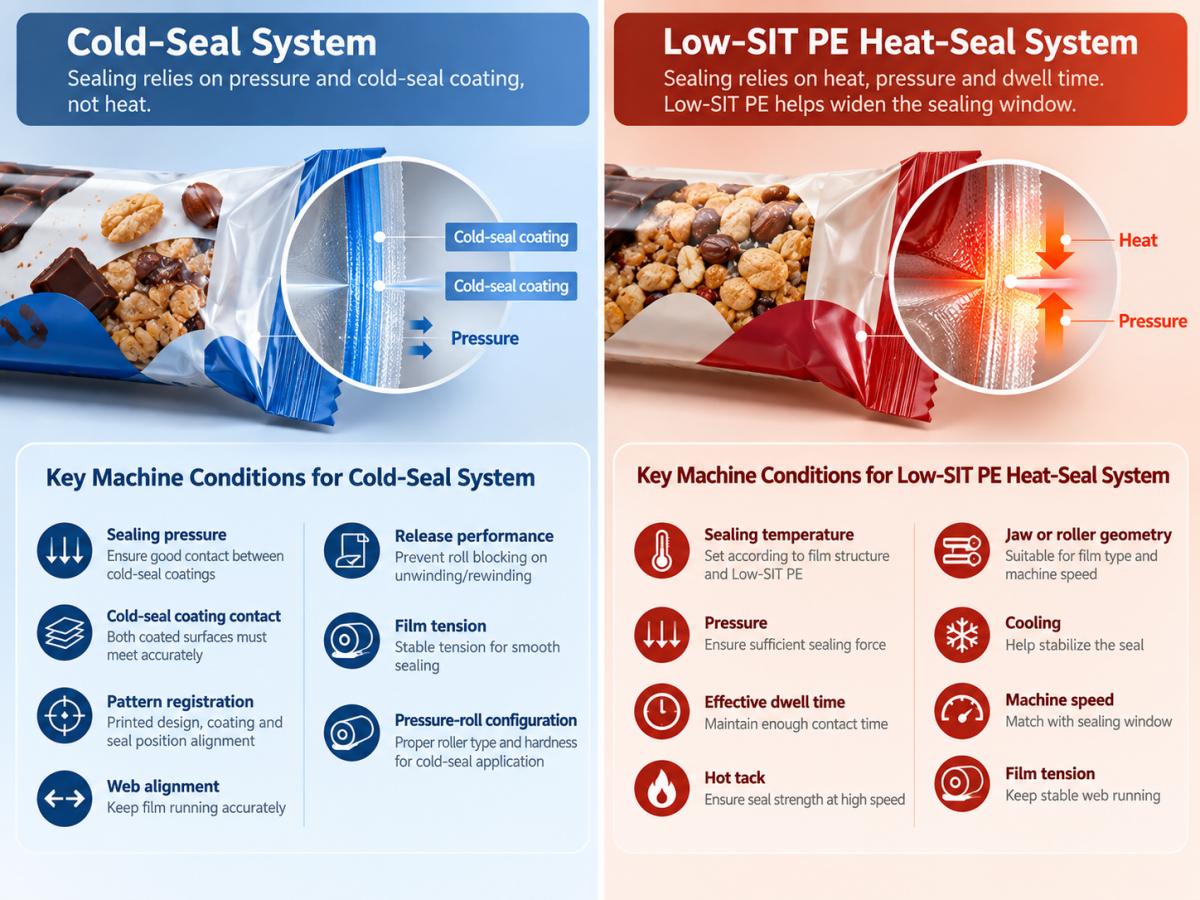
Packaging material cannot be selected independently from the packaging machine. The critical variables are different for the two sealing technologies.
· Sealing pressure
· Cold-seal coating contact
· Pattern registration
· Web alignment
· Release performance
· Film tension
· Pressure-roll configuration
· Sealing temperature
· Pressure
· Effective dwell time
· Hot tack
· Jaw or roller geometry
· Cooling
· Machine speed
· Film tension
Changing from heat-seal film to cold-seal film may therefore require more than replacing the rollstock. The sealing system itself must be compatible.
Cold seal should not be viewed as the premium version of Low-SIT PE. The technologies solve different packaging problems. Cold seal is a specialized self-sealing coating system designed to reduce dependence on heat. Low-SIT PE is a high-performance thermoplastic heat-seal system designed to make thermal sealing faster and more stable.
Cold seal becomes particularly attractive when very high packaging speed and high product heat sensitivity occur together.
· Chocolate bars
· Confectionery
· Ice cream
· Protein bars
· Cereal bars
· Selected heat-sensitive snack or bakery products
In these applications, cold seal can support high throughput while reducing thermal exposure to the product.
A Low-SIT PE-based sealant system is often more practical when the product is not highly heat sensitive, the existing machine uses heat sealing, strong hot tack is required, a broad operating window is valuable, minor seal contamination may occur or conventional heat-seal machine compatibility is important.
· Snacks
· Dry foods
· Granules
· Powder products
· General food packaging
· Selected liquid or sauce applications
Technical Factor | Cold Seal | Low-SIT PE |
Primary sealing mechanism | Self-sealing coating + pressure | Thermoplastic heat seal + pressure |
Requires sealant melting | No | Yes |
Thermal load on product | Very low | Lower than conventional PE systems |
High-speed potential | Very high, especially in heat-sensitive flow wrap | High, dependent on thermal transfer and machine design |
Heat-sensitive products | Major advantage | Partial improvement |
Hot tack importance | Not the primary mechanism | Critical at high speed |
Material processing focus | Coating, release and registration | SIT, hot tack and seal strength |
Heat-seal window | Not applicable in the same way | Very important |
Seal contamination | Can interrupt coating-to-coating contact | Can be improved through specialized sealants |
Conversion complexity | Higher | More conventional |
Machine requirement | Cold-seal-compatible pressure system | Heat-seal equipment |
Typical applications | Chocolate, bars, ice cream | Snacks, powders, granules, general foods |
Instead of asking “Which material seals faster?”, the packaging engineer should ask the following questions:
1. Is the product highly heat sensitive?
2. What machine speed is required?
3. How clean is the sealing area during actual production?
4. What sealing system does the machine use?
5. What seal profile is required: easy-open, peelable or high-integrity permanent seal?
If the product is highly heat sensitive
Evaluate Cold Seal, then confirm coating registration, contamination risk, machine compatibility and required peel profile.
If the product is not highly heat sensitive
Evaluate Low-SIT PE, then optimize SIT, hot tack, heat-seal window and seal-through-contamination performance.
The final confirmation should always treat film, seal interface, product and machine as one complete packaging system.
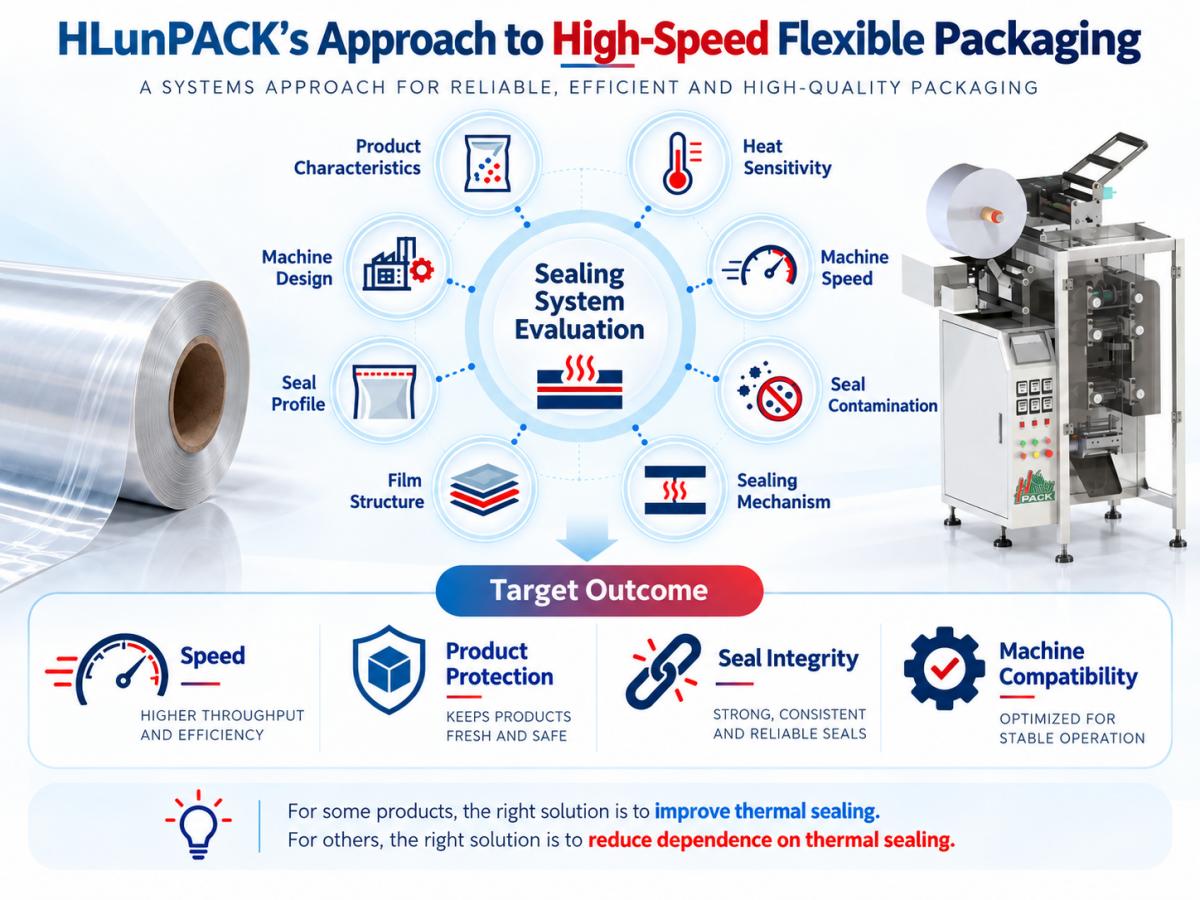
At HLunPACK, we do not treat flexible packaging film as an isolated material. For high-speed packaging applications, we evaluate product characteristics, heat sensitivity, machine speed, seal contamination, sealing mechanism, film structure, seal profile and machine design.
The objective is not simply to recommend the lowest-temperature material or the fastest sealing technology. The objective is to identify the sealing system that provides the most stable combination of speed, product protection, seal integrity and machine compatibility.
For some products, the correct solution is to improve thermal sealing. For others, the correct solution is to reduce dependence on thermal sealing altogether.
Cold seal and Low-SIT PE can both support high-speed flexible packaging, but they do so through fundamentally different technical routes.
Cold Seal
Uses a self-sealing cold-seal coating and pressure to largely bypass the thermal seal-formation process. It is especially valuable when very high speed and high heat sensitivity occur together.
Low-SIT PE
Keeps the conventional heat-sealing principle but optimizes the sealant through lower SIT, strong hot tack and a wider heat-seal window. It is especially useful when high speed, conventional heat-seal machinery and broader process tolerance are required.
The most important technical insight is simple: Cold Seal changes the sealing mechanism. Low-SIT PE optimizes the sealing mechanism. Neither is automatically the better technology. The correct solution depends on matching product, film, seal interface and machine.
Cold seal uses a compatible self-sealing coating and pressure, while Low-SIT PE still uses thermoplastic heat sealing but begins developing seal strength at a lower temperature.
No. Cold seal is especially useful for heat-sensitive products and very high-speed flow wrapping. Low-SIT PE may be more practical when the product tolerates heat and the packaging line already uses conventional heat sealing.
SIT means Seal Initiation Temperature: the temperature at which a sealant begins developing a specified level of measurable seal strength under defined test conditions.
Hot tack describes seal strength while the seal is still hot. High-speed lines can apply mechanical load before the seal has fully cooled, so weak hot tack can cause the seal to open even if its final cooled seal strength is good.
A wider stable heat-seal range gives the packaging process more tolerance to normal temperature variation and helps reduce weak seals, excessive deformation, squeeze-out and sticking.
Not necessarily. Cold seal has different requirements for pressure, coating-to-coating contact, pattern registration, release performance and machine configuration. The sealing system must be compatible with the film.


