


close
Choose Your Site
Global
Social Media
Views: 222 Author: HLun PACK Publish Time: 2026-05-30 Origin: Site


Content Menu
● Understanding Ice Cream Container Sizes
>> Core Retail Sizes (Consumer-Facing)
● When Each Ice Cream Container Size Works Best
>> Single-Serve Containers (3–8 oz)
>> Pint Containers (16 oz / 473 ml)
>> Quart Containers (32 oz / 946 ml)
>> Half-Gallon and Gallon Containers (64–128 oz)
● Beyond Size: What Really Drives Your Container Choice
>> 1. Portion Control and Nutrition Positioning
>> 2. Shelf Life, Barrier, and Product Integrity
>> 3. Freezer Logistics and Retail Merchandising
● Materials: Paper, Flexible, and Rigid Packaging Options
>> Paper Packaging for Ice Cream
>> Flexible Packaging in Ice Cream and Frozen Desserts
>> Rigid Plastic and Composite Options
● How HLun Pack Supports Ice Cream and Frozen Dessert Brands
>> Our Core Capabilities for Ice Cream and Related Products
● Matching Container Size to Business Model
>> For Craft and Premium Brands
>> For Mass Retail and Private Label
>> For Foodservice and QSR Operators
● Sustainability and Ice Cream Packaging
● Practical Steps to Choose Your Ideal Ice Cream Container
>> Define Your Product and Customer
>> Analyze Channels and Logistics
>> Select 1–2 Primary Sizes (Plus Optional Test Size)
>> Work with Your Packaging Partner on Structure and Equipment
● Clear Call to Action: Work with HLun Pack
● FAQs About Ice Cream Container Sizes
The ideal ice cream container size depends on who you serve, how you sell, and how your packaging supports freshness, branding, and cost control—not just how many ounces fit in a tub. As a packaging manufacturer working daily with paper and flexible packaging lines, I've seen that brands that treat container size as a strategic decision (rather than "just a standard pint") gain better margins, lower waste, and happier customers. [hallpack]
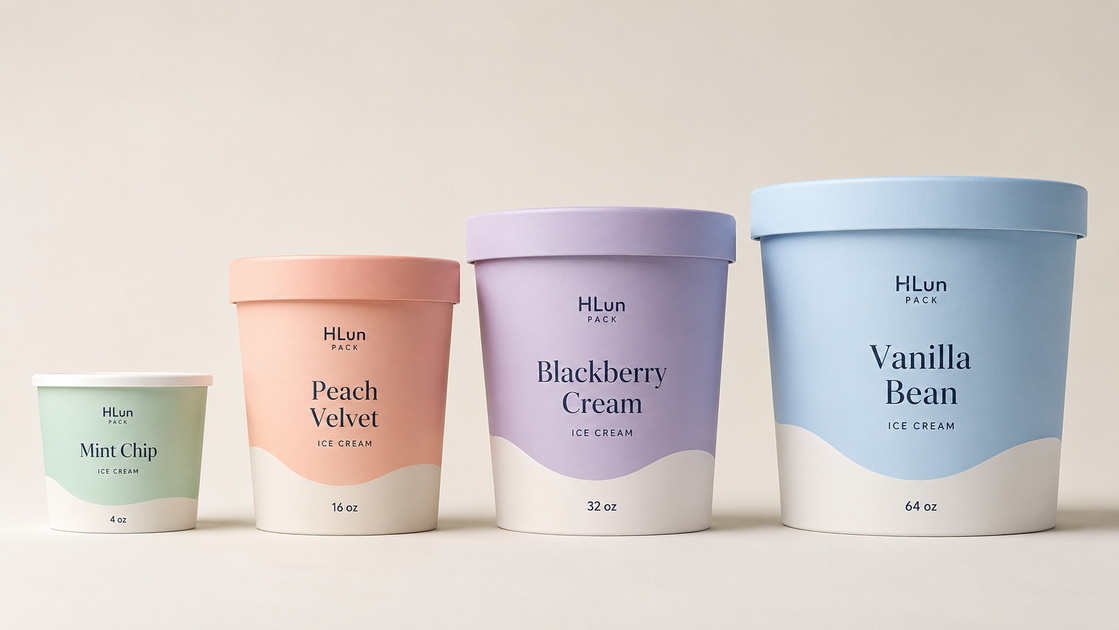
In this expert guide, I'll walk you through:
- The most common ice cream container sizes and when to use them
- How container size impacts portion control, shelf life, logistics, and branding
- How to choose between paper packaging, flexible packaging, and rigid containers
- Practical tips from the shop floor and packaging lines at HLun Pack (HLun Pack / HL Pack)
- Actionable steps to work with a packaging partner to develop your own custom solution
Throughout, I'll write from an industry practitioner's perspective, blending real-world packaging considerations with up-to-date market trends in ice cream and frozen desserts. [enoline]
Ice cream containers range from single-serve cups to multi-gallon tubs used in foodservice and industrial applications. Each size serves a specific buyer intent, from impulse purchases at a convenience store to high-volume scooping in busy parlors. [epackagesupply]
| Container type | Typical volume | Typical use case |
|---|---|---|
| Single-serve cup | 3–8 oz | Impulse buys, portion control, kids' sizes hallpack |
| Pint | 16 oz / 473 ml | Premium retail, indulgent personal size hallpack |
| Quart | 32 oz / 946 ml | Small families, heavy users who want value hallpack |
| Half gallon | 64 oz / 1.89 L | Parties, large families, value packs hallpack |
| Gallon | 128 oz / 3.78 L | Foodservice, back-of-house storage hallpack |
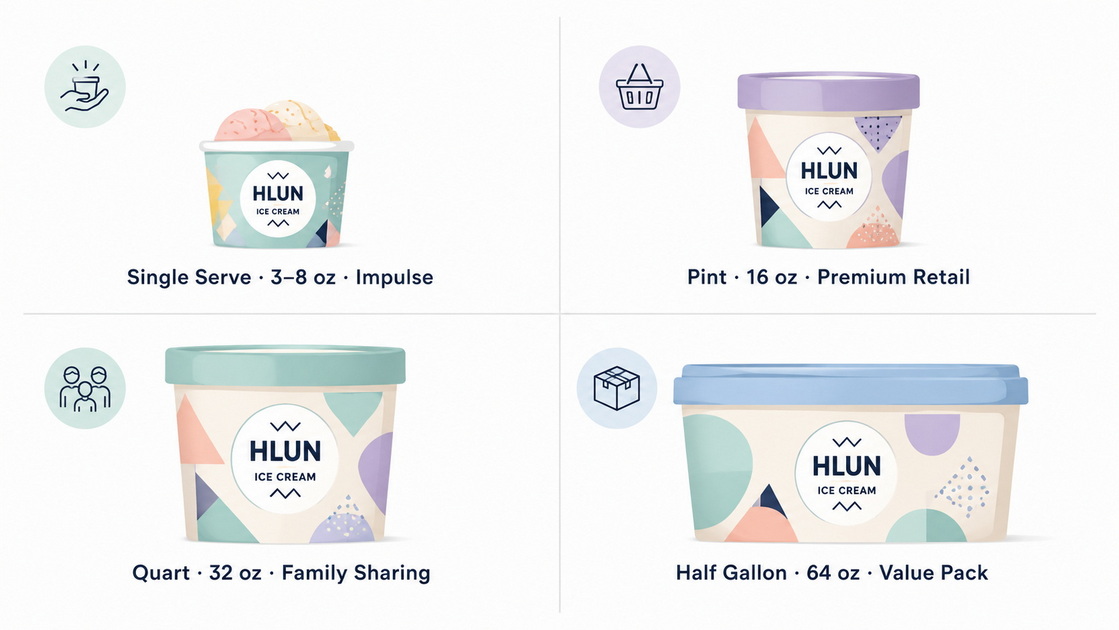
Key takeaway: Don't pick a size just because "everyone uses pints." Start from your channel (retail vs foodservice), price point, and brand positioning, then match your container size. [innovamarketinsights]
From my experience with dairy and frozen dessert clients, the "best" size is the one that matches a specific usage scenario—not a generic template. [smurfitwestrock]
Single-serve paper or plastic cups dominate in cinemas, convenience stores, airlines, and hospital or school catering. [enoline]
Use this size when:
- You want tight portion control for calorie-conscious customers or institutional foodservice. [innovamarketinsights]
- You are launching sample packs or variety packs with multiple flavors. [hallpack]
- You need high-speed filling and lidding on automated lines with minimal leakage. [enoline]
From a packaging standpoint, single-serve cups benefit from paper-based, PE-coated or PLA-coated structures that balance insulation, stiffness, and printability, with optional heat-sealed lidding film or snap-on lids. [smurfitwestrock]
The pint is the hero size for premium and craft ice cream brands. [customcupfactory]
Best suited for:
- Small-batch, high-value SKUs with rich inclusions (nuts, chocolate chunks, etc.). [hallpack]
- Direct-to-consumer shipping where smaller mass helps control thaw/ freeze cycles. [enoline]
- Retail price points that sit above mid-market tubs but below luxury multi-packs. [customcupfactory]
Here, paper packaging with a tight-fitting paper or plastic lid is common, because it offers:
- Excellent print area for storytelling and branding
- Good stacking strength in freezers
- Reasonable barrier performance when combined with the right coating and lid system [smurfitwestrock]
Quarts occupy the sweet spot between personal indulgence and family sharing. [customcupfactory]
Use quarts when:
- Your customers are small families or roommate households who buy weekly or bi-weekly. [epackagesupply]
- You want to offer better value per ounce without jumping to half-gallon. [epackagesupply]
- Your product is premium but designed for sharing, e.g., frozen yogurt, sorbets, or better-for-you lines. [innovamarketinsights]
Structurally, quart containers can share the same filling and sealing line as pints, which keeps your capex and changeover time lower if your packaging supplier designs for compatible diameters and lid formats. [hallpack]
These sizes are common where volume and value matter most. [epackagesupply]
Ideal scenarios:
- Supermarkets and hypermarkets selling family packs. [epackagesupply]
- QSR and restaurant chains that scoop into cones or desserts in-house. [customcupfactory]
- Institutional catering (cafeterias, buffets, hotels) where cost per scoop is critical. [epackagesupply]
In this range, your key challenges are:
- Preventing freezer burn over a long open-shelf life
- Maintaining lid integrity after repeated openings and closings
- Ensuring the container is strong enough to survive cold-chain logistics from factory to distributor to outlet [smurfitwestrock]
A mix of paperboard tubs, plastic pails, or composite solutions can be used, depending on your brand's sustainability commitments and logistics model. [enoline]
Selecting ice cream container size is not just about volume; it's about balancing experience, operations, and economics.
If your brand promises moderation or functional health benefits, portion sizes must align with that story. [innovamarketinsights]
- Smaller containers (3–8 oz) support built-in portion control and reduce guilt. [enoline]
- Pints can still be positioned as "shareable" when the lid and graphics signal 2–3 portions, not one sitting. [hallpack]
From an operational perspective, more smaller units also mean more packaging cost per liter, so you need a clear pricing and margin strategy. [epackagesupply]
Ice cream is highly sensitive to temperature fluctuations, oxygen, and moisture. The right size helps: [smurfitwestrock]
- Minimize headspace and trapped air that accelerates ice crystal growth. [hallpack]
- Ensure the product is consumed before quality declines, especially for half-gallon or larger formats. [epackagesupply]
At HLun Pack, we usually look at fill volume vs. container internal volume alongside your cold-chain profile to recommend the right combination of container height, diameter, and barrier materials. [smurfitwestrock]
On the manufacturing and retail side, container size directly affects:
- How many units fit per tray, per case, and per pallet
- How efficiently you can block-stack containers in chest freezers or upright cabinets
- Whether your container shape and size gives you enough vertical billboard on shelf [enoline]
For example, slightly taller pints can increase label visibility in crowded freezer doors, even if the volume remains the same. [hallpack]
As a packaging and packaging equipment manufacturer, we work across paper packaging, flexible packaging, and diverse filling solutions—which gives us a front-row view of what works in frozen applications. [smurfitwestrock]
Paper-based containers (round tubs, cups, and lids) remain the standard for premium retail ice cream. [smurfitwestrock]
Advantages:
- Strong sustainability perception, especially with recyclable or compostable coatings. [innovamarketinsights]
- Excellent printability for high-impact branding. [hallpack]
- Good structural rigidity for stacking and transport. [smurfitwestrock]
When combined with the right coatings and lidding systems, paper packaging can handle deep-freeze environments and resist condensation and leakage. [hallpack]
Flexible packaging typically appears in:
- Ice cream bars and sticks (flow wraps, pillow pouches). [youtube]
- Multipack bags containing individually wrapped treats. [youtube]
- Refill bags for soft-serve mixes or powdered dessert bases. [youtube]
Flexible films with high barrier properties help:
- Extend shelf life by controlling oxygen and moisture ingress. [youtube]
- Reduce overall packaging weight and shipping costs. [youtube]
- Enable high-speed packaging on automatic lines, including granular, liquid, and powder formats associated with ice cream mixes. [youtube]
In some markets, rigid plastic containers dominate large-format ice cream SKUs. [customcupfactory]
They offer:
- High impact resistance during distribution. [enoline]
- Resealable lids with audible "click" closures that reassure consumers. [epackagesupply]
- Potential for transparent windows to showcase inclusions, especially in gelato-style offerings. [enoline]
However, growing consumer pressure and regulations are pushing brands to explore paper-based or hybrid structures, which is where integrated packaging lines and material selection become strategic. [innovamarketinsights]
As HLun Pack (HLun Pack / HL Pack), we do more than supply containers—we provide integrated packaging and equipment solutions across paper and flexible formats. [smurfitwestrock]
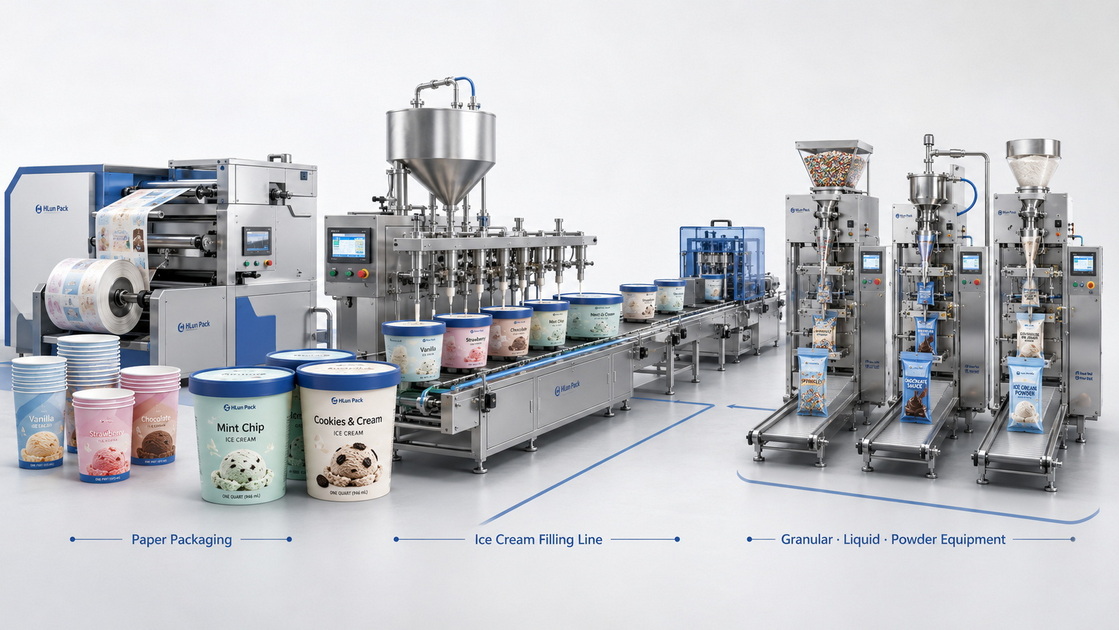
- Paper packaging: Custom-printed ice cream cups, pints, quarts, and lids designed for deep-freeze performance. [hallpack]
- Flexible packaging: Film structures and pouches for cones, bars, mix powders, and topping sachets. [youtube]
- Granular packaging equipment: For inclusions like nuts, chocolate chips, cookie crumbs, or topping kits that accompany your ice cream. [youtube]
- Liquid packaging equipment: For ready-to-freeze dessert bases, sauces, and syrups. [youtube]
- Powder packaging equipment: For instant ice cream powders, soft-serve bases, and dairy/plant-based mixes. [youtube]
This integrated view matters because the container size you choose should align with your filling, sealing, and secondary packaging equipment. A mismatch can cause unnecessary downtime, product loss, or costly line modifications. [smurfitwestrock]
One gap in most container size guides is that they treat all businesses the same. In practice, the "right" size for an artisan brand is very different from a private-label supplier or a QSR chain. [enoline]
Focus on:
- Pints and small-format quarts to highlight premium positioning and justify higher price points. [customcupfactory]
- Distinctive paper packaging with high-quality graphics and tactile finishes (matte varnish, spot UV). [shopify]
- Low to medium-speed filling lines where flexibility (frequent flavor changeovers) beats absolute throughput. [enoline]
Prioritize:
- Quarts, half-gallons, and gallons for strong price-per-unit advantage. [epackagesupply]
- Highly standardized containers that maximize pallet efficiency and lower tooling costs. [hallpack]
- Equipment capable of high OEE (Overall Equipment Effectiveness) and minimal downtime, often involving automated case packing and palletizing. [youtube]
Look for:
- Gallon and multi-gallon pails that align with back-of-house usage. [customcupfactory]
- Containers and lids designed for frequent opening and reclosing without cracking at low temperatures. [epackagesupply]
- Optional tamper-evident features for safety and compliance. [enoline]
When we work with clients at HLun Pack, we start from these business model constraints, then map back to container size and equipment selection. [smurfitwestrock]
Consumer and regulatory pressure on sustainability is reshaping ice cream packaging decisions worldwide. [innovamarketinsights]
Key trends:
- Shift towards paper-based containers with improved recyclability and lower plastic content. [enoline]
- Increasing use of plant-based or bio-based coatings instead of traditional PE where infrastructure allows. [innovamarketinsights]
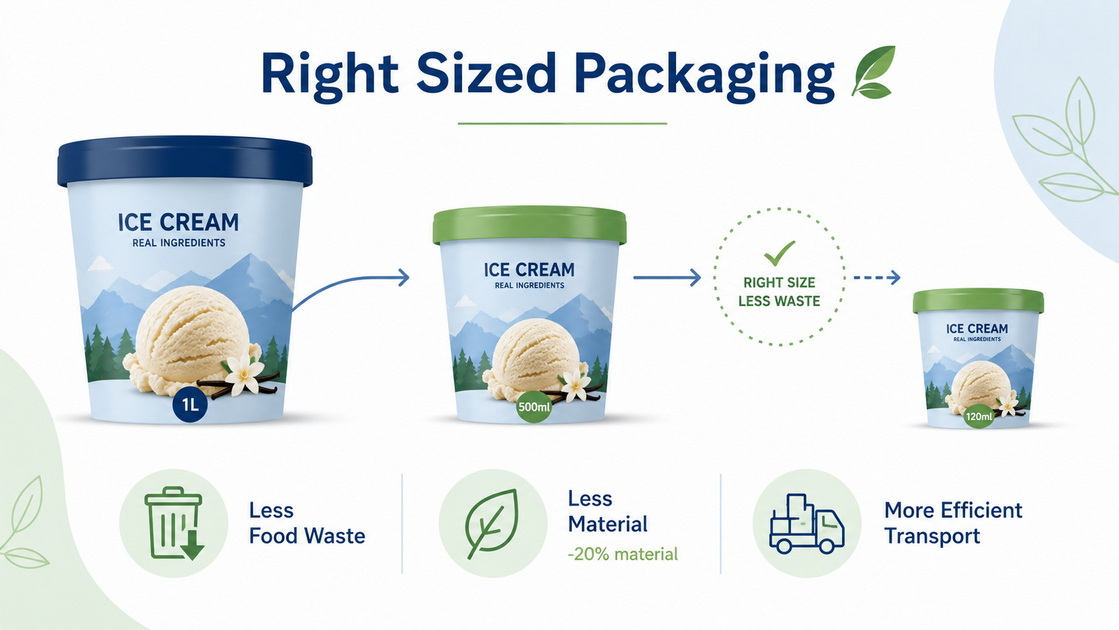
- Interest in lightweighting and right-sizing containers to cut material usage while keeping the same perceived volume. [innovamarketinsights]
Container size plays directly into this:
- Smaller portions can reduce food waste when consumers fail to finish larger tubs before quality declines. [innovamarketinsights]
- Efficient container footprints reduce transport emissions per liter of ice cream moved through the supply chain. [smurfitwestrock]
As a manufacturer, we see more brands requesting LCA-informed (Life Cycle Assessment) packaging recommendations, which combine material, size, and process choices to reduce overall impact. [innovamarketinsights]
To turn this into an actionable plan, here is the step-by-step process we often recommend to ice cream brands evaluating new packaging. [shopify]
- Are you selling premium, mid-market, or value ice cream?
- Who is your core customer: single professionals, families, or foodservice buyers?
- Are you offering dairy, plant-based, or functional/health-oriented products? [innovamarketinsights]
These answers narrow down your primary container size range and materials. [innovamarketinsights]
- Which channels matter most: supermarkets, convenience stores, e-commerce, or HORECA?
- What are your cold-chain constraints, from factory to final freezer?
- Are there pallet height, weight, or footprint limitations from distributors? [enoline]
This step often determines whether you should use standard footprints or invest in custom tooling. [smurfitwestrock]
Rather than launching with too many SKUs:
- Choose one hero size (e.g., 16 oz pint) plus one value or family size (e.g., 32 oz quart). [customcupfactory]
- Optionally test a single-serve format in targeted channels if your positioning supports it. [hallpack]
Engage early with a manufacturer like HLun Pack to align on:
- Container design (diameter, height, lid type, rim design) [hallpack]
- Material structure (paperboard grade, coating, film type) [enoline]
- Filling and sealing equipment specs for granular, liquid, or powder components related to your ice cream workflow. [youtube]
This alignment avoids costly redesigns and ensures your container is truly "line-ready." [smurfitwestrock]
Finally:
- Run line trials to check sealing integrity, filling accuracy, and line speed. [shopify]
- Conduct transport and drop tests to simulate real-world handling. [shopify]
- Collect consumer feedback on usability (lid opening, scoopability, storage in home freezers). [shopify]
Once validated, you can scale production with confidence, knowing your container size and structure are optimized end-to-end. [shopify]
If you are planning a new ice cream line or upgrading your packaging, the next step is to align container size, materials, and packaging equipment with your business goals.
As a manufacturer covering paper packaging, flexible packaging, granular packaging equipment, liquid packaging equipment, and powder packaging equipment, HLun Pack can help you:
- Audit your current packaging and size strategy
- Recommend optimized container sizes for your channels and margins
- Design and produce the right containers and compatible packaging machinery
- Support testing, optimization, and long-term capacity planning
Ready to develop the ideal ice cream container for your brand?
Reach out to HLun Pack to discuss your product, target market, and packaging requirements, and we'll help you build a complete, scalable solution from container to equipment. [smurfitwestrock]
1. What is the most popular ice cream container size for retail?
The 16 oz pint is the dominant format for premium ice cream in many markets because it balances indulgence, price point, and freezer convenience. [customcupfactory]
2. Which container size is best for family use?
For most families, a quart (32 oz) or half-gallon (64 oz) provides enough servings for multiple dessert occasions while still fitting comfortably into home freezers. [customcupfactory]
3. What size should I choose for foodservice and restaurants?
Foodservice buyers typically prefer gallon (128 oz) or larger pails and tubs that integrate easily into back-of-house freezers and scooping routines. [customcupfactory]
4. Are paper ice cream containers suitable for deep freeze storage?
Yes, when designed with the right paperboard grade, barrier coatings, and lids, paper containers can perform very well in deep freeze conditions and withstand distribution. [hallpack]
5. How does container size affect sustainability?
Right-sized containers reduce food waste, packaging materials, and transport footprint, especially when combined with recyclable or lower-impact materials. [innovamarketinsights]
1. Pakoro – "Ice Cream Container Size Guide: All You Need To Know." <https://pakoro.com/blog/ice-cream-container-size/> [hallpack]
2. Hall Pack – "How Big Are Ice Cream Containers? Size Guide & Dimensions." <https://www.hallpack.net/how-big-are-ice-cream-containers.html> [hallpack]
3. EPackageSupply – "Choosing the Perfect Ice Cream Container: A Complete Guide." <https://epackagesupply.com/blogs/packaging-guide/5-key-questions-about-ice-cream-containers-with-lids> [epackagesupply]
4. Custom Cup Factory – "Ice Cream Container Size Guide: All You Need To Know." <https://customcupfactory.com/blogs/news/ice-cream-container-size-guide-all-you-need-to-know> [customcupfactory]
5. Enoline – "Ice cream packaging: Innovative trends and essential tips." <https://enoline.com/en/articles/ice-cream-packaging/> [enoline]
6. Innova Market Insights – "Ice cream trends & dairy alternative ice cream trends." <https://www.innovamarketinsights.com/trends/ice-cream-trends/> [innovamarketinsights]
7. Smurfit Westrock – "Flexible Dairy Packaging." <https://www.smurfitwestrock.com/industries/food/dairy-packaging> [smurfitwestrock]
8. Shopify – "产品包装设计完整指南(2026)." <https://www.shopify.com/zh/blog/product-packaging-design> [shopify]
9. Select Equip – "Flexible Packaging Solutions For Dairy | Video." <https://www.youtube.com/watch?v=aOSDyzWgLPY> [youtube]


