


close
Choose Your Site
Global
Social Media
Views: 266 Author: HLun PACK Publish Time: 2026-10-13 Origin: Site


Content Menu
● How This Supplier Shortlist Was Selected
● Why Source Frozen Food Pouches from China?
>> Access to Multiple Manufacturing Regions
>> Demand Is Moving Toward More Carefully Specified Packaging
● Frozen Food Pouch Manufacturer Comparison
● The Top 10 Frozen Food Pouch Manufacturers in China
>> 1. Shantou Hualun Paper Products Industrial Co., Ltd. — HLun PACK
>> 2. DQ PACK — Guangdong Danqing Printing Co., Ltd.
>> 3. BOWE PACK — Guangdong Bowe Packaging Co., Ltd.
>> 4. LD PACK — LD Packaging Co., Ltd.
>> 5. DXC PACK — Foshan DXC Packaging Co., Ltd.
>> 6. Sunkey Packaging — Jiangsu Sunkey Packaging High Technology Co., Ltd.
>> 8. Beyin Packing — Kazuo Beiyin Paper and Plastic Packing Co., Ltd.
>> 9. Guangzhou Novel Packaging Co., Ltd.
>> 10. YLTPACK
● Technical Buyer's Guide: Specify the Pouch Before Comparing Prices
>> Choose Materials According to Failure Risk
>> Food-Contact Compliance Comes Before Certificate Logos
>> Sustainability Claims Need Product-Level Evidence
● Common Procurement Problems and How to Avoid Them
>> Material Substitution Behind an Unchanged Appearance
>> Room-Temperature Samples That Hide Cold Failures
>> A Factory Certificate That Does Not Cover Your Order
>> A Low Pouch Price That Raises Filling Costs
● An Overlooked Qualification Trap: Approving the Wrong Sample
● Factory Verification, Sampling, and Logistics
>> Use a Staged Sampling Process
>> Set Logistics Requirements in the Purchase Order
● FAQ
>> 1. How Can I Verify Whether a Manufacturer's ISO or BRCGS Certificate Has Expired?
>> 2. Can Two Pouches with the Same PET/PE Structure and Thickness Perform Differently?
>> 3. Does Frozen Food Pouch Approval Also Cover Microwave or Boil-in-Bag Use?
>> 4. How Should Buyers Respond When a Supplier Changes Resin or Adhesive?
>> 5. How Can a Buyer Compare MOQ and Capacity Between Factories Fairly?
China offers a broad supplier base for custom frozen food pouches, from export-oriented converters to manufacturers that combine flexible packaging materials with packaging machinery. For procurement managers, the challenge is not finding a factory that can print a bag. It is finding a partner that can reproduce the same material structure, sealing performance, food-contact documentation, and delivery reliability across repeated orders.
A frozen food pouch must withstand more than low-temperature storage. Sharp product edges, distribution impacts, frost, seal contamination, and temperature changes can expose weaknesses that remain invisible in an attractive room-temperature sample. Selecting the right manufacturer therefore requires both commercial evaluation and application-specific testing.
This guide presents ten China-based manufacturers worth evaluating for frozen food pouch projects. It compares their disclosed capabilities, explains important material and compliance requirements, and provides a practical purchasing framework.
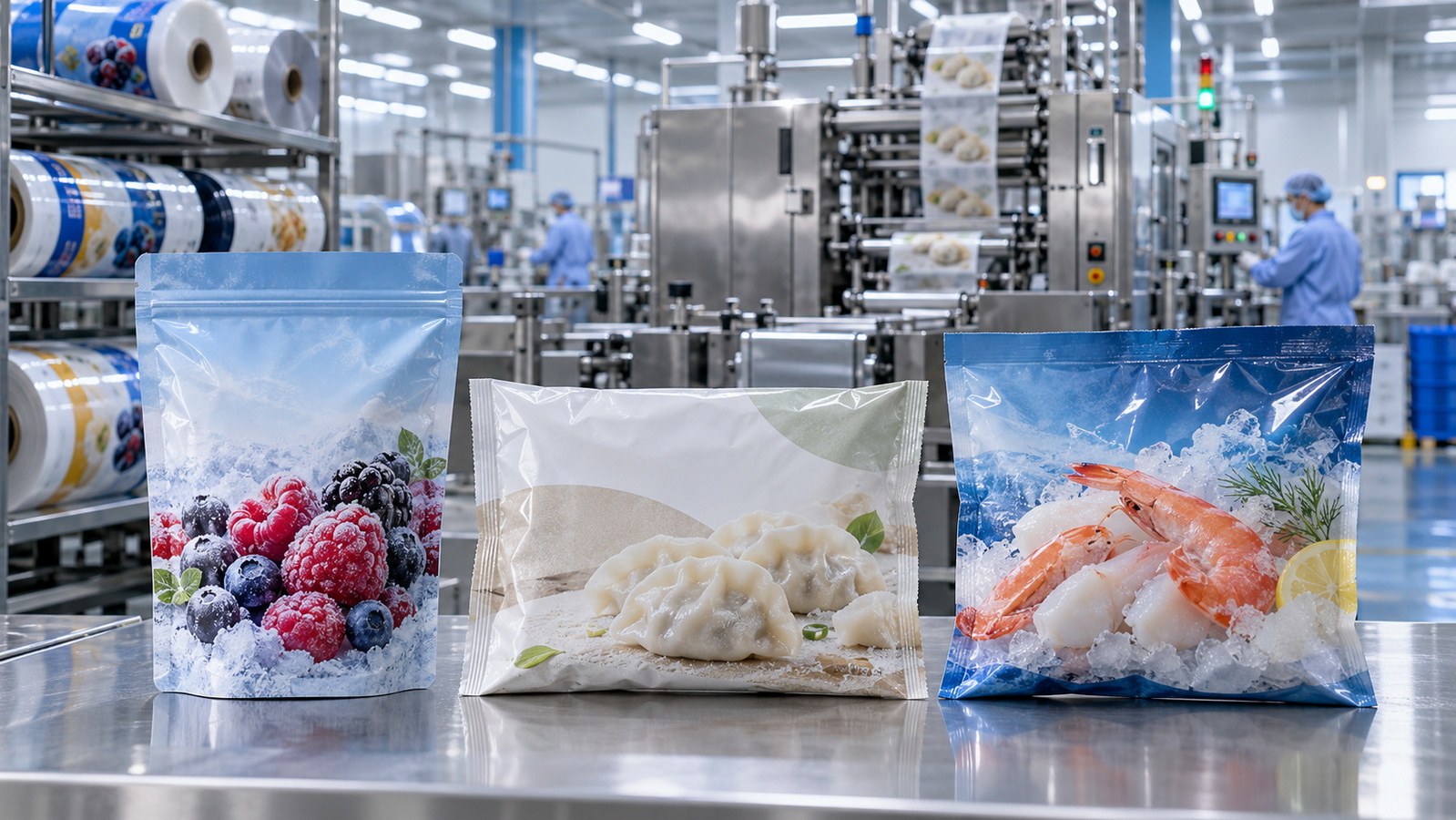
The manufacturers below were selected using publicly available company information, product coverage, disclosed production capabilities, and their relevance to custom food packaging.
The evaluation considers six purchasing dimensions:
1. Manufacturing relevance: flexible pouches, laminated films, or packaging formats suitable for frozen food applications.
2. Development capability: support for material selection, structural design, printing, closures, and packaging-line compatibility.
3. Quality control: evidence of in-house production processes and disclosed quality or food-safety systems.
4. Compliance transparency: availability of certification claims and a clear route for requesting application-specific documentation.
5. Commercial suitability: potential fit for emerging brands, established processors, or high-volume purchasing programs.
6. Delivery and repeatability: capacity information, production infrastructure, and the ability to support repeat orders.
This is an editorial procurement shortlist, not an independently audited ranking by revenue, quality, or market share. Company-reported capacity and certification claims require verification before supplier approval. Unless stated otherwise, numerical minimum order quantities are not publicly confirmed.
HLun PACK appears first because this guide is prepared for the company. Its position should not be interpreted as proof that it has the largest capacity or lowest price.
The shortlist illustrates the geographical depth of China's flexible packaging supply base:
- Shantou and Chaozhou, Guangdong: HLun PACK and DQ PACK.
- Foshan, Guangdong: LD PACK and DXC PACK.
- Guangzhou, Shenzhen, Yunfu, and Jiangmen, Guangdong: Novel Packaging, YLTPACK, BOWE PACK, and MST Packaging.
- Wuxi, Jiangsu: Sunkey Packaging.
- Chaoyang, Liaoning: Beyin Packing.
This concentration gives buyers access to several types of converters within southern China, alongside alternatives in eastern and northeastern China. It can simplify multi-factory visits and comparisons between pouch-making, printing, laminating, and integrated packaging capabilities.
Geographical proximity alone does not guarantee supplier quality. Buyers still need to verify the actual production address, approved subcontractors, and the site responsible for their order.
Mordor Intelligence estimates the global flexible frozen food packaging market at 2.38 million tonnes in 2025 and 2.45 million tonnes in 2026. These figures describe a global packaging category, not China's production or exports and not exclusively premade pouches.
Separately, the Flexible Packaging Association's 2025 industry report states that U.S. flexible packaging sales reached $42.6 billion in 2024, compared with $41.4 billion in 2023. This is broader flexible packaging industry output, rather than a frozen food pouch market figure.
For purchasers, the relevant takeaway is not simply market growth. It is the need to distinguish general packaging capability from proven performance for a specific frozen product.
The figures below are supplier-reported or drawn from published supplier profiles. Total factory capacity is not equivalent to available frozen food pouch capacity.
| Manufacturer | Established or business origin | Disclosed scale or capacity | Published MOQ position | Disclosed certifications or systems | Main purchasing consideration |
|---|---|---|---|---|---|
| HLun PACK | Packaging origins in 1989; flexible packaging expansion in 2012 | One packaging materials factory and one machinery factory; tonnage not disclosed | Project quotation required | Guangdong High-Tech Enterprise recognition reported; food-contact and management certificates require confirmation | Coordinated pouch and equipment development |
| DQ PACK | 1991 | 6 printing lines, 6 solvent-free lamination lines, 20 pouch-making lines | Project quotation required | BRC, ISO 9001, and AEO reported | Export-oriented laminated pouches and rollstock |
| BOWE PACK | 1997 | Frozen packaging page reports 4 production lines and output up to 30 tonnes/day | Project quotation required | ISO and BRC claims; food-contact evidence requires review | Broad custom pouch formats |
| LD PACK | 1990 | Over 25,000 tonnes/year reported | Project quotation required | Request current site-specific certificates | Larger-volume technical packaging programs |
| DXC PACK | 2005 | Published sources differ: 3 versus 4 production lines | Project quotation required | BRC, ISO 22000, FSC, and GRS reported | Conventional and sustainability-oriented customization |
| Sunkey Packaging | 2002 | Published profile reports 6 high-speed production lines | Project quotation required | Request current site-specific certificates | R&D-oriented flexible packaging |
| MST Packaging | 1993 | Over 5,000 tonnes/year reported | Project quotation required | ISO 22000, BRC, and HACCP reported | Multiple lamination and pouch options |
| Beyin Packing | 1998 | Comparable annual output not confirmed | Project quotation required | ISO and BRC claims; verify scope and validity | Custom bag and format development |
| Guangzhou Novel Packaging | 2004 | Over 15,000 tonnes/year reported | Project quotation required | BRC Grade A reported in company profile | High-barrier films and larger supply programs |
| YLTPACK | 2005 | 6,520 m² facility reported | Frozen food page advertises 1,000 pieces; confirm project conditions | ISO 22000 claim; supporting documentation required | Smaller trial orders and custom pouches |
Sources for the comparison: HLun PACK; DQ PACK; BOWE PACK; LD PACK; DXC PACK; Sunkey; MST; Beyin; Novel; and YLTPACK.
A blank or unconfirmed figure is not necessarily a weakness. A factory that provides an honest, SKU-specific production commitment may be more useful than one advertising a large theoretical output without explaining its current workload.
HLun PACK traces its packaging business to 1989, established its packaging machinery manufacturing division in 1998, and expanded into flexible packaging in 2012. Its company profile describes one packaging materials factory and another factory dedicated to packaging machinery and integrated solutions.
Its flexible packaging range includes roll films, stand-up pouches, gusseted pouches, spout pouches, and eight-side seal bags. The company also develops equipment for granules, liquids, and powders. This combination makes it relevant to buyers who need to coordinate packaging materials with the machinery that forms, fills, or seals them.
- Core strength: integration of packaging materials, equipment development, and technical support.
- Market coverage: the profile describes overseas expansion and worldwide service, but does not identify its largest export markets.
- OEM/ODM scope: custom pouch and film development, packaging design, equipment development, and integrated solution support.
- Potential buyer fit: small and midsized brands looking for a coordinated development partner rather than separate material and machine suppliers.
HLun PACK's stated emphasis on proactive communication, cross-department collaboration, and full-cycle technical support is particularly relevant when a buyer needs repeated artwork changes, packaging trials, or machine-setting adjustments. These are company-stated service commitments, not independently measured response-time results.
Its value proposition should be assessed through total project cost: development time, trial waste, filling efficiency, and ongoing support—not an unsupported claim that its pouch price is always lower.
Before approval, request frozen-application samples, the proposed laminate specification, current food-contact documentation, production MOQ, and written delivery commitments. Its machinery-related recognition and patent history should not be treated as proof of frozen food pouch compliance.
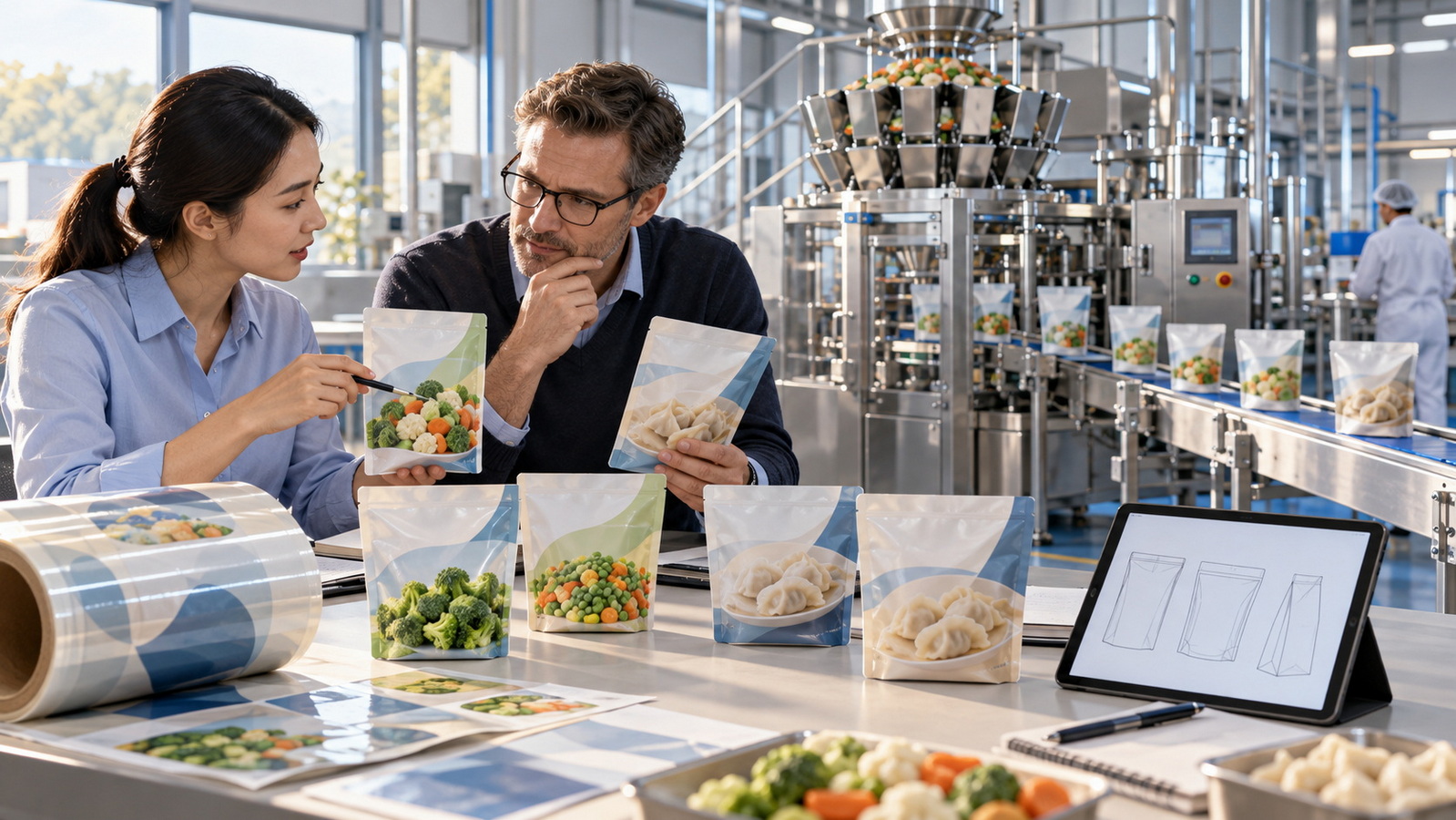
DQ PACK dates its flexible packaging business to 1991. Its company profile reports six printing lines, six solvent-free lamination lines, seven slitting machines, and twenty pouch-making lines. It also markets frozen food packaging specifically.
- Core strength: substantial disclosed converting infrastructure and a broad laminated packaging portfolio.
- Market coverage: its website names the United States, United Kingdom, Mexico, Australia, Turkey, and other export destinations.
- OEM/ODM scope: custom printed rollstock, stand-up pouches, zipper pouches, flat-bottom formats, and other laminated packaging.
- Potential buyer fit: export-oriented food brands seeking both premade pouches and machine-fed films.
DQ PACK reports BRC, ISO 9001, and AEO certification. Buyers should verify the current documents and distinguish food-safety certification from customs-related recognition.
Its published export-country counts vary between pages. Rather than relying on headline totals, request recent references from customers with similar frozen products and destination-market requirements.
BOWE PACK identifies 1997 as its manufacturing starting point and offers a dedicated frozen food packaging range. Its frozen packaging page lists stand-up pouches, flat-bottom pouches, three-side-seal bags, rollstock, and spouted formats.
- Core strength: broad format coverage and explicit frozen food packaging positioning.
- Market coverage: global brand customers are described, although a reliable breakdown of leading export destinations is not published.
- OEM/ODM scope: custom printing, pouch construction, film development, and closure options.
- Potential buyer fit: brands comparing several retail formats for the same frozen product.
The company reports four production lines and output up to thirty tonnes per day on its frozen packaging page. Buyers should confirm whether that figure represents total flexible packaging output or production available for their specific structure.
BOWE's website uses ISO, BRC, SGS, and FDA-related terminology. Request the actual certificates and test reports: a laboratory report and a management-system certificate answer different purchasing questions.
Established in 1990, LD PACK reports annual production capacity exceeding 25,000 tonnes. Its disclosed portfolio includes liquid packaging, pet food packaging, dairy packaging, modified-atmosphere packaging, and other technical film applications.
- Core strength: large disclosed production scale and a technically diverse packaging portfolio.
- Market coverage: the company positions itself as a global supplier; principal export destinations are not established in the reviewed profile.
- OEM/ODM scope: application-specific flexible packaging development, films, pouch structures, and technical support.
- Potential buyer fit: buyers with larger annual requirements or demanding barrier and structural specifications.
Its broader technical portfolio makes it a candidate for frozen packaging development, but buyers should not assume every structure is already qualified for their product.
Request a frozen food reference structure, cold-conditioned test results, current certification records, and the production site that will make the order.
DXC PACK was established in 2005 and identifies itself as an OEM flexible packaging manufacturer. Its food packaging coverage includes frozen food, while its wider offering includes digital printing, high-barrier packaging, and sustainability-oriented structures.
- Core strength: customization across conventional and alternative material formats.
- Market coverage: worldwide food, pet food, nutrition, and personal-care customers.
- OEM/ODM scope: printed films and pouches, digital-print options, structural customization, and selected recyclable or compostable offerings.
- Potential buyer fit: brands comparing production methods or developing sustainability-focused packaging.
DXC illustrates why certificate dates matter. Its HKTDC profile displays a BRC certificate valid through March 11, 2026, and a GRS certificate valid through June 7, 2025. Those historical listings do not establish current validity as of October 2026. Buyers should obtain renewal records and verify them independently.
Published facility descriptions also differ. Confirm the current production address, equipment, and site allocation rather than combining figures from different sources.
Sunkey reports registration in 2002. Its product coverage includes food packaging and frozen food, and its company information describes capabilities across printing, laminating, extrusion, slitting, and bag making.
- Core strength: a broad manufacturing process base and an R&D-oriented company profile.
- Market coverage: multinational and domestic customers are described; the reviewed information does not establish a ranked list of export markets.
- OEM/ODM scope: laminated films, printed packaging, zipper bags, vacuum-related formats, and application development.
- Potential buyer fit: processors requiring technical film development alongside finished bags.
The company's published profiles contain historical figures alongside newer promotional statistics. Buyers should request a current equipment list and a dated capacity statement rather than treating every online figure as directly comparable.
For frozen food projects, establish the precise product-contact layer, intended storage conditions, seal requirements, and whether the package will ever be heated.
MST Packaging lists 1993 as its establishment year and reports annual capacity above 5,000 tonnes. Its manufacturing description includes ten-color gravure printing and dry, extrusion, and solvent-free lamination.
- Core strength: multiple lamination processes and a broad food packaging offering.
- Market coverage: international food and non-food customers; major export destinations are not specified in the reviewed company profile.
- OEM/ODM scope: food pouches, printed laminates, paper/plastic packaging, and selected alternative-material developments.
- Potential buyer fit: brands comparing material and lamination routes across several product lines.
MST reports ISO 22000, BRC, and HACCP-related systems. Confirm current validity and whether the certificate scope covers the actual manufacturing site and process used for the order.
A compostability claim for one product should not be transferred to a different frozen pouch. Require evidence for the exact finished construction.
Beyin Packing reports establishment in 1998 and an international trade department launched in 2014. Its disclosed range includes customized packaging bags, stand-up pouches, gusseted formats, flat-bottom bags, and film rolls.
- Core strength: custom bag development across multiple formats.
- Market coverage: international sales development is documented, including participation in overseas trade events; principal export destinations are not quantified.
- OEM/ODM scope: custom dimensions, printed artwork, pouch formats, and laminated packaging development.
- Potential buyer fit: brands looking for structural and presentation flexibility.
Beyin's certification page lists ISO, BRC, FDA, and SGS-related claims. Buyers should separate recognized certification records from compliance statements and testing services.
Its general food packaging capability should be followed by a specific frozen food qualification process. Ask for cold-conditioned samples and evidence relevant to the actual product—not only samples from dry-food applications.
Guangzhou Novel Packaging states that it was established in 2004 as a joint venture. Its company profile reports annual output above 15,000 tonnes and BRC Grade A certification. The company also publishes a dedicated frozen food flexible packaging page.
- Core strength: high-barrier and functional flexible packaging with substantial disclosed output.
- Market coverage: food, pharmaceutical, and industrial customers; leading export destinations are not established by the reviewed official profile.
- OEM/ODM scope: custom printed laminates, functional films, and frozen food packaging development.
- Potential buyer fit: larger programs or products requiring more demanding barrier structures.
Buyers should identify the exact legal entity and factory address in the quotation. Similar brand names within a wider packaging group can otherwise create confusion about certificate ownership, production responsibility, and available capacity.
Request current BRCGS verification and a specification tied to the quoted frozen pouch.
YLTPACK states that it has operated since 2005 and describes a 6,520 m² facility in Shenzhen. Its frozen food page advertises a minimum order quantity of 1,000 pieces, while its food packaging page identifies PET/PE and nylon/PE among frozen-food structure options.
- Core strength: explicit frozen food pouch coverage and a published lower-entry MOQ.
- Market coverage: custom packaging customers; a reliable breakdown of leading export markets is not provided in the reviewed pages.
- OEM/ODM scope: custom printed food bags, dimensions, formats, and application-specific structures.
- Potential buyer fit: trial launches and smaller purchasing programs, subject to quotation conditions.
Confirm whether the advertised MOQ applies to the requested pouch size, printing method, material, zipper, and number of designs. A website headline is not a binding quotation.
Also request ISO 22000 verification and the complete food-contact documentation supporting the proposed construction.
Material abbreviations describe broad polymer families, not complete performance specifications.
| Structure or material route | Potential application | Main qualification question |
|---|---|---|
| PET/PE laminate | Many frozen vegetables and prepared food applications | Does the sealant provide adequate cold toughness and sealing tolerance? |
| PA/PE or nylon-containing laminate | Sharp, heavy, or irregular frozen products | Does it resist puncture after cold conditioning? |
| Higher-barrier multilayer structure | Products with demanding oxygen or shelf-life requirements | Are barrier figures relevant to the actual structure and conditions? |
| PE-oriented mono-material design | Projects targeting a particular recycling route | Does it meet both package-performance and destination-market recycling requirements? |
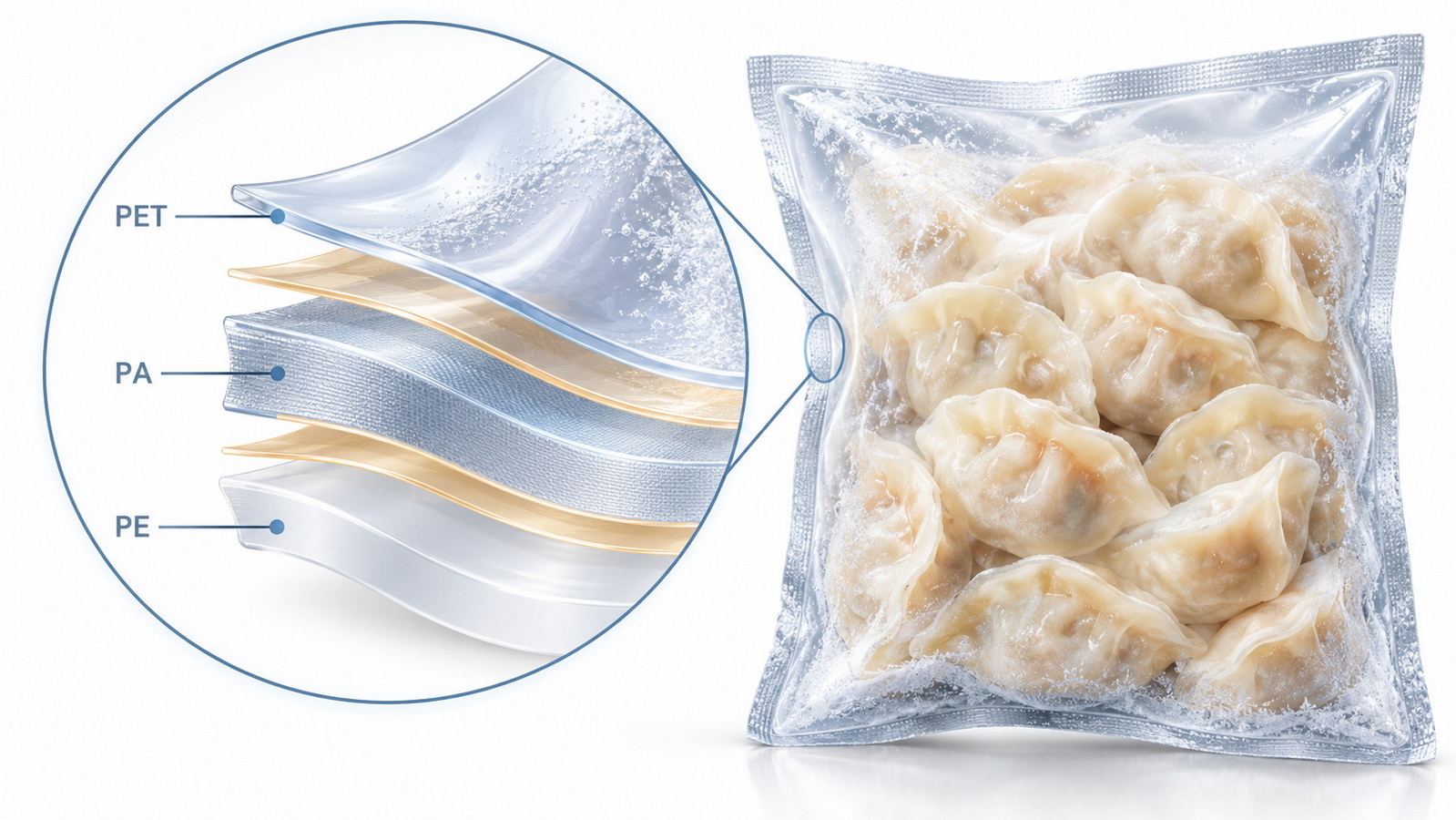
PET/PE is a common starting point, while nylon-containing structures can improve puncture and flex resistance. PE sealants are widely used for their sealing and low-temperature properties. However, resin grade, layer thickness, additives, and laminate construction still affect performance.
Do not prescribe thickness alone. Two pouches with the same overall thickness can differ substantially in layer distribution, cold-impact resistance, and sealing behavior.
A useful specification identifies:
- Each layer and its nominal thickness.
- Approved resin grades or a controlled performance-based equivalent.
- Total thickness tolerance.
- Seal dimensions and acceptance criteria.
- Puncture, leak, and cold-conditioned handling requirements.
- Printing, zipper, and dimensional tolerances.
- Intended filling, freezing, storage, thawing, and consumer-use conditions.
For EU markets, the European Commission identifies Regulation (EC) No 1935/2004 as the general food-contact framework and Regulation (EC) No 2023/2006 as the manufacturing-practice requirement. Plastic food-contact materials also fall under applicable provisions of Regulation (EU) No 10/2011, including relevant amendments.
For U.S. markets, the FDA explains that compliance depends on the regulatory status of the individual substances in the finished article and their intended conditions of use. An effective food-contact notification can also be specific to the identified substance manufacturer.
Accordingly, an "FDA certificate" displayed on a website is not sufficient purchasing evidence. Request the regulatory basis for the complete construction and its intended application.
CE and RoHS should not replace food-contact documentation for an ordinary frozen food pouch. Buyers must assess packaging machinery separately from the pouch itself: a machine-related compliance document does not establish the safety of films, inks, adhesives, or closures that contact food.
Separate the following questions:
1. Does the material contain recycled content?
2. Is the finished pouch compatible with a defined recycling stream?
3. Is the complete construction certified compostable?
4. Is it suitable for the intended food-contact use?
5. Does it still perform reliably under freezing and distribution conditions?
These are different claims. For example, a compostable product listing should be checked against the exact product covered rather than treated as approval of a manufacturer's entire range.
A more responsible purchasing specification names the applicable destination-market requirement and asks for evidence covering the finished pouch, including printing and closures.
A supplier can reproduce the same artwork while changing the sealant grade, layer balance, adhesive, or zipper.
Prevent this by attaching an approved specification to the purchase contract and requiring written authorization before material or subcontractor changes. Retain reference samples from the approved production run.
A sample that looks strong on an office desk may behave differently after freezing. Cold conditions can expose brittle layers, puncture vulnerability, or seal weaknesses.
Test filled packs under the intended conditions. Include handling and distribution simulations rather than relying exclusively on empty-bag demonstrations.
Check the legal entity, manufacturing address, standard, scope, status, and validity dates. BRCGS provides certification verification tools, while IAF CertSearch supports verification of accredited management-system certificates.
A valid certificate at one site does not automatically establish certification of another production site.
Film and sealant selection affect sealing windows, hot-tack behavior, and resistance to contamination. A pouch that performs poorly on the filling line may create rejects and downtime even when its purchase price is attractive.
Compare total cost per acceptable filled pack, not only price per thousand empty pouches.
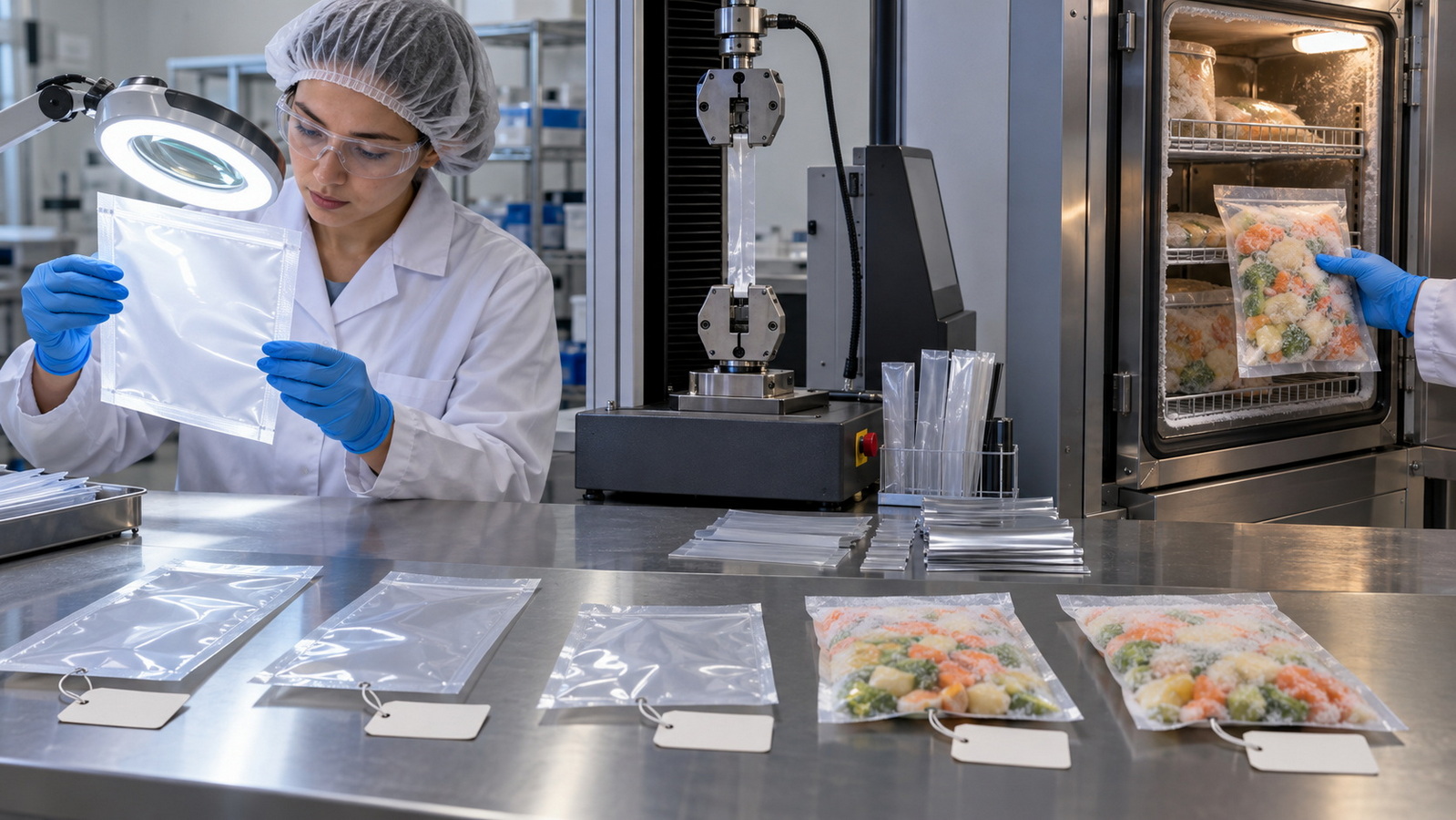
A frequently overlooked purchasing risk is that the approved sample and the first commercial shipment are not produced under equivalent conditions.
An empty development sample cannot fully demonstrate how the final pouch will behave with the buyer's product, on the buyer's sealing equipment, and after freezing. Frozen food packaging performance depends on the interaction between the structure, seal formation, product contamination, and cold handling.
A stronger qualification plan therefore includes:
- A sample made from the proposed commercial material structure.
- Confirmation of printing, adhesive, closure, and production route.
- A trial on the intended filling equipment.
- Testing after freezing with the actual product.
- Retained samples from the first commercial batch.
- Requalification after material, process, or production-site changes.
Also ask the converter to document laminate release criteria, including any required adhesive curing and applicable residual-solvent controls. Treat these as process-specific requirements to be agreed with the supplier, not a universal number of days.
The practical lesson is simple: approve a reproducible manufacturing specification, not merely an attractive prototype.
Request the business license, production address, process flow, equipment list, current certificates, and subcontracting policy.
During a live video review or site audit, follow a job through material receipt, printing, lamination, slitting, pouch making, inspection, and packing. Ask how incoming lots and finished orders are linked.
1. Screen existing structures to identify promising materials.
2. Review the proposed specification and compliance documents.
3. Produce customized samples.
4. Run a filling and sealing trial.
5. Test cold-conditioned filled packs.
6. Approve a pilot production lot before wider purchasing.
Do not assume that a freezer-storage pouch is suitable for microwave heating or boiling. FDA conditions of use distinguish frozen storage without heating from frozen or refrigerated foods reheated in the container.
For empty pouches and rollstock, agree storage and transport conditions with the converter. Define carton strength, pallet protection, roll orientation, lot labels, moisture protection, and receiving checks.
Keep empty-packaging logistics separate from the temperature-controlled distribution requirements of the filled frozen food.
Commercial terms should also specify responsibility for inspection, freight damage, customs documentation, delivery milestones, and replacement of nonconforming material.
The most suitable frozen food pouch manufacturer depends on the product, filling equipment, annual purchasing volume, destination market, and tolerance for development risk.
HLun PACK is a relevant candidate for buyers seeking coordinated packaging-material and equipment support. DQ PACK, BOWE PACK, and YLTPACK publish explicit frozen food offerings; LD PACK, Sunkey, MST, DXC, Beyin, and Guangzhou Novel provide additional options across scale, converting capabilities, and customization. Each still requires application-specific qualification.
To begin a technically useful discussion with HLun PACK, prepare a brief covering the food product, fill weight, pouch dimensions, freezing conditions, annual volume, destination market, and existing machinery. Request a proposed structure, sample plan, compliance package, MOQ, and delivery schedule before placing a production order.
Obtain the certificate number, certified legal entity, site address, standard, scope, and validity dates.
Use IAF CertSearch for applicable accredited management-system certificates and BRCGS Directory or Verify for BRCGS site certification. Check current status rather than relying on the date of a downloaded document.
If a record cannot be located, contact the issuing certification body. Resolve the discrepancy before treating the certificate as verified.
Yes. "PET/PE" does not identify the PE grade, additives, individual layer thicknesses, adhesive system, or sealing characteristics.
PE density, comonomer, slip and antiblock additives, sealing range, and low-temperature impact properties can affect the result. Compare detailed specifications and filled-pack performance rather than material abbreviations alone.
No. Heating introduces a different use condition.
Specify whether consumers will heat the food inside the pouch, including expected temperature and time. FDA guidance explicitly distinguishes frozen storage without thermal treatment from products intended for reheating in the container. Obtain documentation and testing appropriate to the actual use.
Require written notification before the change.
Review whether it affects food-contact authorization, migration documentation, sealing performance, puncture resistance, or cold handling. FDA guidance makes clear that regulatory status depends on the relevant substances, specifications, and conditions of use.
The contract should identify which changes require renewed trials, documentation, or buyer approval.
Request figures for the same structure, size, printing method, closure, and number of designs.
Distinguish total factory tonnage from production allocated to the order. Also separate technical MOQ, economic MOQ, and any promotional trial-order MOQ.
For example, YLTPACK advertises a 1,000-piece frozen food MOQ, while other shortlisted companies publish larger factory-scale figures without a directly comparable project MOQ. Those statements answer different questions and must be reconciled through a written quotation.
The sources below support the market context, compliance guidance, certification checks, and manufacturer profiles. Market estimates are not presented as official Chinese export statistics.
1- Flexible Packaging Association: announcement of the 2025 State of the U.S. Flexible Packaging Industry Report, including its reporting basis and 2024 industry output. [flexpack]
2- Mordor Intelligence: Flexible Frozen Food Packaging Market, including global 2025 and 2026 volume estimates. [mordorintelligence]
3- European Commission: official food-contact materials framework and manufacturing-practice requirements. [food.ec.europa]
4- U.S. Food and Drug Administration: regulatory status of food-contact components and intended-use conditions. [fda]
5- International Accreditation Forum: accredited certificate verification through IAF CertSearch. [iafcertsearch]
6- BRCGS: Directory and Verify certification-checking resources. [brcgs]
7- Manufacturer information: HLun PACK, DQ PACK, BOWE PACK, LD PACK, DXC PACK, Sunkey, MST, Beyin, Guangzhou Novel, and YLTPACK. [hlunpack]


