


close
Choose Your Site
Global
Social Media
Views: 288 Author: HLun PACK Publish Time: 2026-07-08 Origin: Site


Content Menu
● Why Labels and Stickers Matter More Than Ever
● Core Functions of Labels and Stickers in Packaging
>> 1. Information and Safety Communication
>> 2. Branding and Marketing Value
>> 3. Operational and Shipping Efficiency
● Printing Your Own Labels vs. Professional Printing
>> Working With Professional Label Printers
● Key Sticker and Label Materials (and When to Use Them)
>> Polyester (Including Kraft and White Paper‑Faced Labels)
>> Vinyl and Static Cling Vinyl
>> Clear and White Polypropylene (PP)
>> Foil Paper, Felt, and Velvet
● Main Label and Sticker Printing Methods
>> Flexographic Printing (Flexo)
>> Screen Printing (Specialty Applications)
● Comparing Label Printing Methods at a Glance
● Finishing Options That Elevate Labels and Stickers
>> BOPP (Biaxially Oriented Polypropylene)
>> Holographic and Glitter Films
>> Gloss UV, Matte UV, and Spot UV
● Expert Perspective: Matching Label Strategies to Complex Packaging Lines
● Practical Decision Steps for Choosing Label and Sticker Printing
● CTA
● FAQ
In my work with packaging manufacturers and brand owners, I've seen labels and stickers transform "just a box or pouch" into a complete, high‑performing packaging experience. When you're running paper packaging, flexible films, or granular and liquid packaging equipment on the same floor, choosing the right printing method and material becomes a strategic decision, not a cosmetic one. [gv-printing]
From a practical perspective, labels and stickers are your most agile tool to update branding, comply with regulations, and test promotions without re‑engineering entire packaging lines. In this guide, I'll walk you through printing methods, materials, finishes and real‑world decision paths so you can confidently specify the best options for your equipment and applications. [labelandnarrowweb]
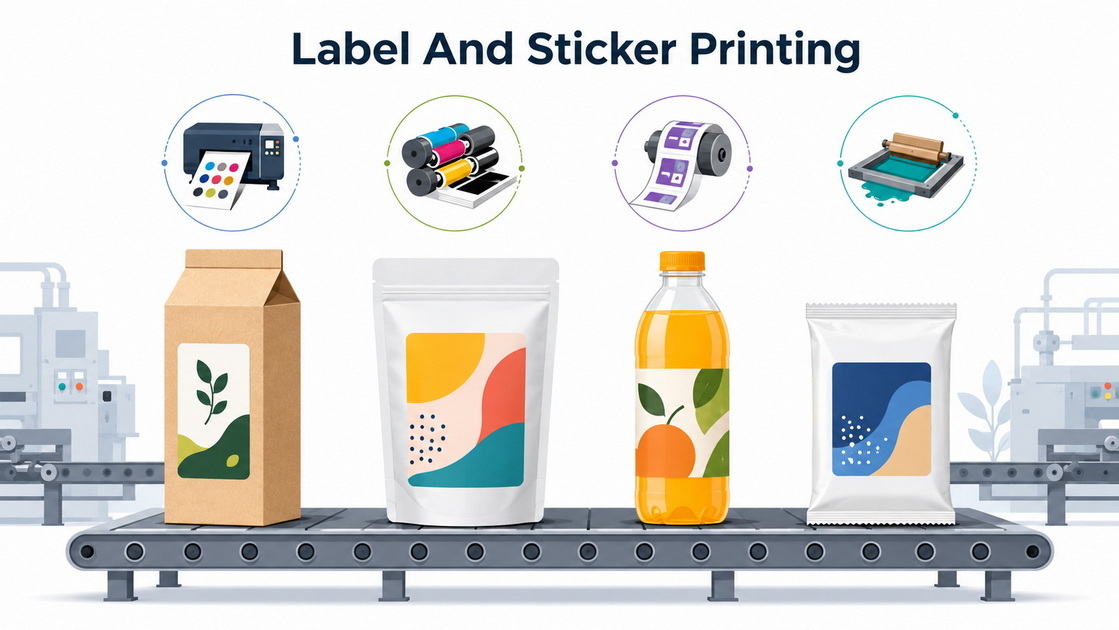
Labels and stickers have always conveyed information, but today they carry branding, compliance, and user experience on their shoulders. [arrsys]
- They add a personalized touch to otherwise generic stock packaging, turning plain cartons or pouches into recognizable brand assets. [arrsys]
- They enable fast iterations—new ingredients, regulations, or campaigns—without replacing your core packaging substrate or equipment. [blog.konicaminolta]
- They reduce risk: you can A/B test messages, colors, or icons on labels before committing to a full packaging redesign. [blog.konicaminolta]
Think of them as your "agile layer" on top of paper boxes, flexible bags, bottles, and sachets.
Well‑designed labels make key information unmissable. [gv-printing]
- Regulatory warnings (flammable, fragile, toxic ingredients)
- Shelf life, lot and batch codes for granular and powder products
- Instructions for use on liquid packaging (dosing, storage, safety)
Because labels catch the eye first, clarity here is a powerful trust signal for both consumers and auditors. [labelandnarrowweb]
A plain kraft box or white pouch can feel anonymous; a strong label turns it into a brand touchpoint. [arrsys]
- Logo and color system that stays consistent across paper and flexible packaging
- Campaign labels for seasonal offers or limited runs
- Artwork stickers inside the packaging to enhance the unboxing moment
This is particularly effective when you rely on standardized packaging formats but still need differentiated shelf presence. [stickergiantus]
In high‑volume environments, labels are also data carriers. [arrsys]
- Barcodes and QR codes for warehouse and shipping systems
- Handling instructions to prevent damage in transit
- Internal tracking labels for work‑in‑progress on multiple packaging lines
Custom shipping labels allow you to merge functionality with branding so the first impression remains cohesive even before unboxing. [arrsys]
One of the first decisions packaging teams face is whether to print in‑house or work with professional label converters. [stickernation.co]
Printing your own labels can make sense when:
- You ship low or irregular volumes
- You need ultra‑fast changes for internal tracking
- Your graphics are simple and non‑critical
However, you'll face trade‑offs:
- Time and labor to manage design, printing, cutting and inventory
- Higher ink and material costs per label over time
- Limited durability compared with industrial materials and processes [arrsys]
Professional label partners bring specialized equipment and materials that are difficult to match with office printers. [gv-printing]
- Access to offset, flexographic, and high‑resolution digital presses
- Industrial‑grade adhesives and face stocks designed for paper, film, glass, and metal
- Guidance on regulatory compliance, durability, and finishing options
For brands operating multiple packaging formats (paper cartons, flexible pouches, liquid bottles, powder sachets), professional printing is almost always more cost‑effective and consistent beyond very small runs. [stickernation.co]
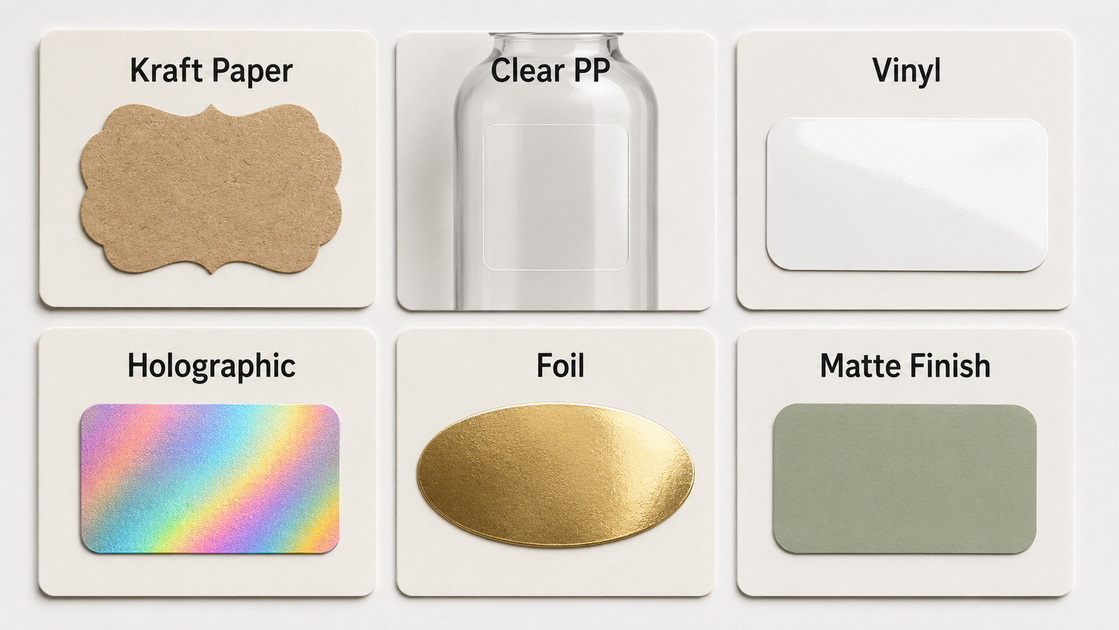
Choosing the right material is as important as choosing the printing method. Below are common options and their best applications. [gv-printing]
Polyester labels can mimic metal or chrome finishes and withstand harsh environments. [gv-printing]
- Suitable for exterior labeling on equipment or durable goods
- Strong adhesive and resistance to weather and abrasion
- Ideal for long‑term branding or safety labels
Kraft labels, made from 100% recycled paper, emphasize sustainability and natural aesthetics, often used on eco‑friendly paper packaging. [gv-printing]
Industrial vinyl is highly flexible and resistant to chemicals and weather, making it ideal for outdoor or heavy‑duty applications. [gv-printing]
Static cling vinyl uses static electricity instead of permanent adhesive:
- Perfect for temporary promotions on glass or smooth surfaces
- Leaves no residue when removed, enhancing user experience [arrsys]
Destructible labels are tamper‑evident: if someone tries to remove them, they break apart rather than peel clean. [arrsys]
- Common for "fragile" labels and warranty or security seals
- Useful on high‑value equipment, components, or controlled goods [stickerprintingguide.wordpress]
Polypropylene is a cost‑effective alternative to vinyl with strong resistance to water, oil, and many chemicals. [gv-printing]
- Clear PP works well for "no‑label look" on bottles
- White PP offers a stable base for vivid colors and permanent adhesion
- Suitable for food, cosmetics, and household liquids where resistance and clarity are critical [gv-printing]
These materials add tactile and visual richness to labels. [arrsys]
- Foil paper for premium or gift‑oriented products
- Felt and velvet for sensory unboxing experiences, limited editions, or holiday packaging
They work best when you want the label itself to feel like part of the product, not just information. [arrsys]
Shrink sleeves are printed films that tightly wrap around the product when heat is applied, creating almost full‑coverage decoration. [gv-printing]
- Common for beverage bottles, tubes, and certain food containers
- Enable 360‑degree graphics without changing the container shape
- Ideal for highly competitive retail categories where shelf impact matters
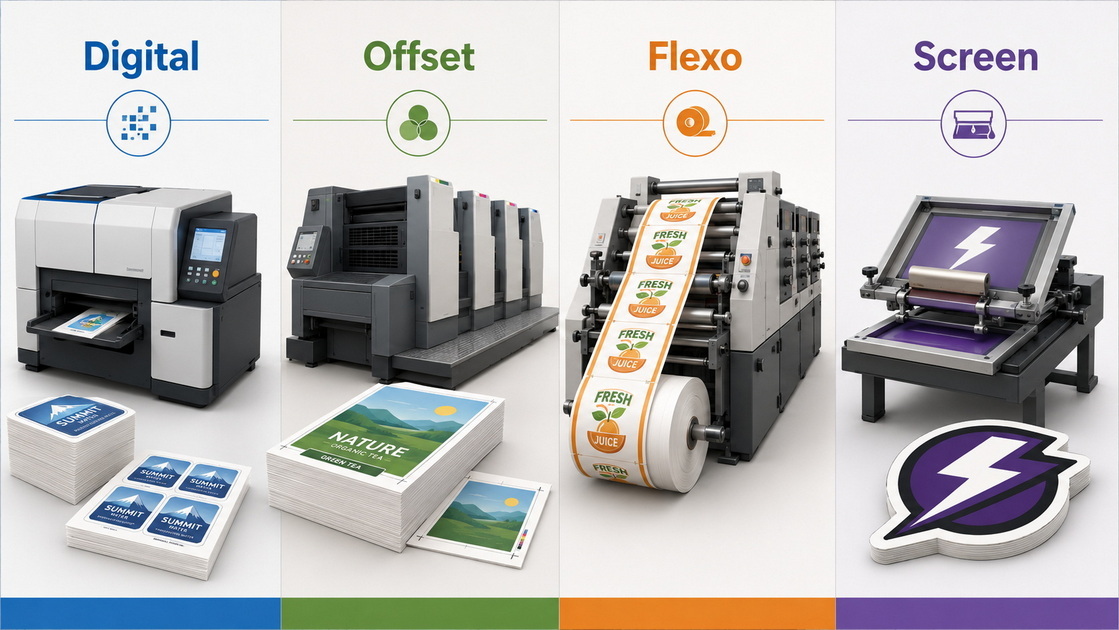
For most packaging operations, you'll choose between digital, offset, flexographic, and screen printing depending on volume and performance needs. [stickernation.co]
Digital UV or aqueous inkjet is now the dominant method for custom stickers and short‑run labels. [dlpmag]
- No plates or screens; setup is quick and cost‑effective for small runs
- Full‑color CMYK at high resolution (up to 1440 DPI on many systems) [stickernation.co]
- Supports variable data (unique QR codes, serial numbers, personalization)
Digital is ideal when you:
- Produce 1–5,000 labels per design
- Frequently change artwork or regulatory text
- Need rapid prototypes or on‑demand short runs [stickergiantus]
Limitations include slightly higher per‑unit cost at very high volumes and potential batch‑to‑batch color variation vs. offset. [stickernation.co]
Sheet‑fed offset feeds individual sheets through the press, making it suitable for small and medium batches with high consistency. [stickernation.co]
- Excellent color stability and clean fine detail
- Good choice for premium paper labels on cartons
- More efficient than digital once you reach mid‑volume runs
Setup involves plate creation, so it becomes most economical when you commit to a stable design over thousands of labels. [stickernation.co]
Flexo printing uses flexible plates wrapped on cylinders, transferring ink directly onto webs of paper or film. [stickerprintingguide.wordpress]
- Highly economical for large volumes of labels and flexible packaging
- Runs fast and integrates easily with existing roll‑to‑roll packaging lines [flexography]
- Compatible with a wide range of substrates and inline finishing
Flexo remains a workhorse for industrial label and flexible packaging production, especially where designs are stable but volumes are high. [dlpmag]
Rotary offset wraps the image around cylinders for high‑speed, high‑quality printing. [arrsys]
- Strong color fidelity and vibrant graphics
- Suitable for continuous webs of labels or flexible packaging
- Often used when brands need offset‑level quality at scale
This is a compelling option for visually rich labels in sectors like cosmetics or high‑end food. [dlpmag]
Screen printing pushes thick, opaque inks through a mesh screen. [stickerprintingguide.wordpress]
- Outstanding opacity and vibrancy, especially on dark or metallic substrates
- Great for specialty effects, durable outdoor stickers, or branding on equipment
- Less suited to complex full‑color photography and extremely high volumes [stickernation.co]
Used strategically, screen printing can add bold brand markers to selected SKUs while digital or flexo covers the rest.
| Printing method | Best volume range | Key strengths | Typical use cases |
|---|---|---|---|
| Digital inkjet | 1–5,000 labels per design stickernation.co | Fast setup, variable data, high resolution stickernation.co | Custom stickers, short runs, prototypes, seasonal labels stickernation.co |
| Sheet‑fed offset | 1,000–20,000 sheets | Consistent color, cost‑effective mid‑volume stickernation.co | Premium paper labels, branded cartons arrsys |
| Flexographic | 10,000+ labels or meters flexography | Very high speed, low cost at scale flexography | Mass‑market labels, flexible packaging webs flexography |
| Rotary offset | Medium–high web volumes | Vibrant color, continuous production arrsys | High‑graphic labels, flexible packaging arrsys |
| Screen printing | 250–5,000 units stickernation.co | Dense, opaque inks, specialty effects stickernation.co | Equipment decals, specialty stickers on dark materials stickernation.co |
Printing is only half the story; finishing determines durability, look, and feel. [gv-printing]
BOPP is a plastic‑based material used widely for labels needing high durability. [gv-printing]
- Resistant to oils, moisture, and heat
- Cost‑effective for large runs
- Common in food, personal care, and household packaging
These finishes rely on metalized vinyl and special flakes to create highly reflective effects. [arrsys]
- Ideal for limited editions, kids' products, or promotional campaigns
- Draw attention on crowded shelves and social media unboxings
Hot foil stamping uses an engraved plate and metallic foil to create luxurious metallic accents. [gv-printing]
- Works brilliantly for logos, borders, and premium badges
- Can be combined with embossing for added depth and texture
UV coatings cure to a hard, protective surface. [arrsys]
- Gloss UV for high‑shine, attention‑grabbing labels
- Matte UV for sophisticated, low‑glare finishes
- Spot UV to highlight only specific elements such as logos or key claims
Lamination adds a plastic film over the printed surface. [gv-printing]
- Improves resistance to water, oil, and abrasion—ideal for high‑touch products
- Matte lamination gives a smooth, understated look
- Gloss lamination enhances color saturation and shine
From a packaging engineer and content strategist perspective, the "best" option isn't static; it depends on your mix of products and equipment. [linkedin]
For example:
- On paper cartons, you might use sheet‑fed offset labels with kraft or white paper for core branding, plus small digital stickers to support limited campaigns.
- On flexible packaging for granular or powder products, flexo or hybrid digital‑flexo presses provide economical, high‑volume production with inline varnishing and laminations. [wh]
- On liquid packaging (bottles, sachets), you might specify clear PP labels with BOPP finishing and UV coatings to withstand moisture and handling. [stickergiantus]
In multi‑line operations, it often makes sense to standardize on a small set of material families and printing methods, then vary artwork and data digitally. This reduces complexity in procurement and keeps brand consistency across the portfolio.
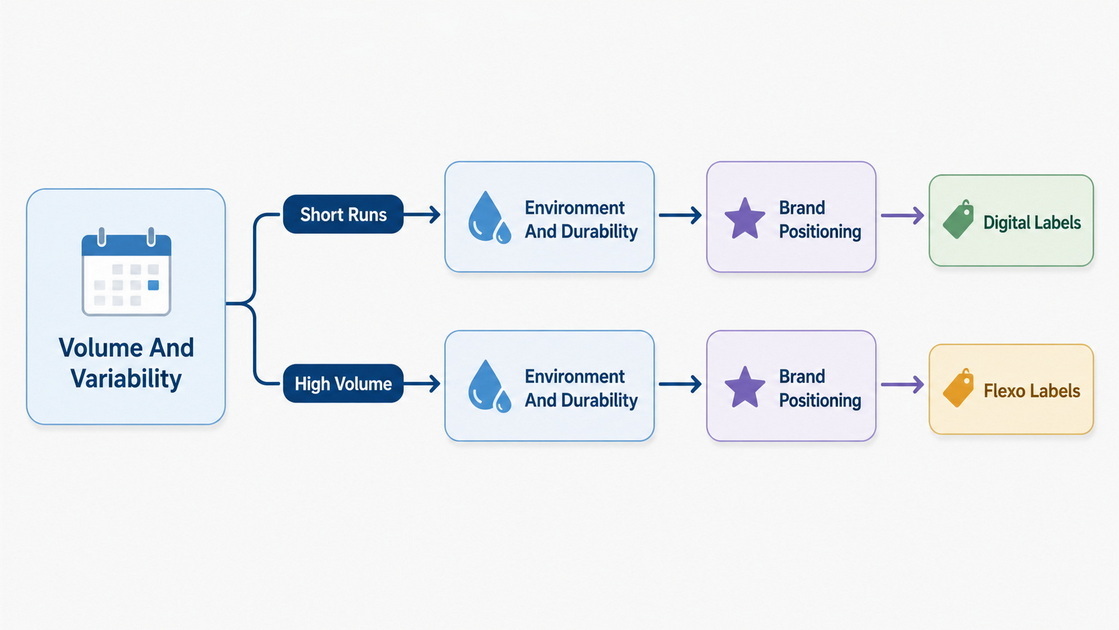
To move from theory to practice, here is a simple decision path you can use internally:
1. Define volume and variability.
- If you need frequent artwork changes and low volumes, prioritize digital.
- If artwork is stable and volumes are high, compare flexo and offset. [flexography]
2. Map environment and durability needs.
- Exposure to oils, moisture, or chemicals suggests PP, vinyl, or BOPP plus UV or lamination. [arrsys]
- Short‑life promotions on clean surfaces can use static cling vinyl. [gv-printing]
3. Clarify brand positioning.
- Premium or eco‑focused brands may prefer kraft, foil, felt, or velvet to signal their story. [arrsys]
- Mass‑market lines may stick to PP or paper with simple UV coatings.
4. Check equipment compatibility.
- Coordinate with your packaging equipment supplier to ensure labels feed, apply, and adhere correctly, especially on fast granular or liquid lines. [wh]
5. Pilot, then scale.
- Start with a digitally printed pilot run to validate design and messaging, then move successful SKUs to flexo or offset for long‑term efficiency. [blog.konicaminolta]
Ready to upgrade your labels and stickers across paper, flexible, and liquid packaging? Contact our packaging experts to choose the best printing and material options for your next production run.
1. What's the most cost‑effective label printing method for small runs?
For 1–5,000 labels per design, digital printing is typically the most cost‑effective because it avoids plate and setup costs while delivering high resolution and fast turnaround. [stickernation.co]
2. How do I choose between vinyl and polypropylene labels?
Use vinyl for extreme outdoor or chemical exposure and PP for cost‑effective resistance to water and oils on food, cosmetic, or household packaging. [gv-printing]
3. Are holographic and glitter labels durable enough for retail packaging?
Yes, when produced on industrial substrates and properly finished, holographic and glitter labels can withstand typical retail handling while delivering strong shelf impact. [gv-printing]
4. When should I consider shrink sleeve labels instead of traditional pressure‑sensitive labels?
Shrink sleeves are ideal when you want 360‑degree coverage, complex graphics, and minimal container redesign, especially for beverages and personal care products. [arrsys]
5. Can I mix different printing methods across my product portfolio?
Absolutely. Many brands use digital for short‑run campaigns, offset or flexo for core SKUs, and screen printing for specialty effects, as long as they maintain consistent color management and material choices. [flexography]
1. PakFactory. "What are the best options for Label and Sticker Printing?" arrsys
2. StickerNation. "Sticker Printing Methods Explained: Digital, Litho & Screen." stickernation.co
3. GV Printing. "Label Sticker Printing: Techniques, Materials, and Applications." gv-printing.com
4. Digital Labels & Packaging Magazine. "The latest in digital flexible package printing." dlpmag.com
5. Flexography.org. "Label Printing & the Growth of the Flexible Packaging Market." flexography.org
6. Konica Minolta. "Digital Label Printing Trends for 2026: A Blueprint for High-Margin …" blog.konicaminolta.ca
7. Label & Narrow Web. "Epson predicts labeling trends for 2026." labelandnarrowweb.com


