


close
Choose Your Site
Global
Social Media
Views: 222 Author: HLun PACK Publish Time: 2026-04-16 Origin: Site


Aqueous coating has quietly become the default finishing choice for modern paper packaging, but from a converter's perspective it is far more strategic than "just a clear top layer." As a packaging machinery manufacturer working daily with paperboard, inks, and high-speed lines, we see first-hand how the right aqueous (AQ) coating can reduce waste, improve shelf impact, and keep production running smoothly. [bpkc]
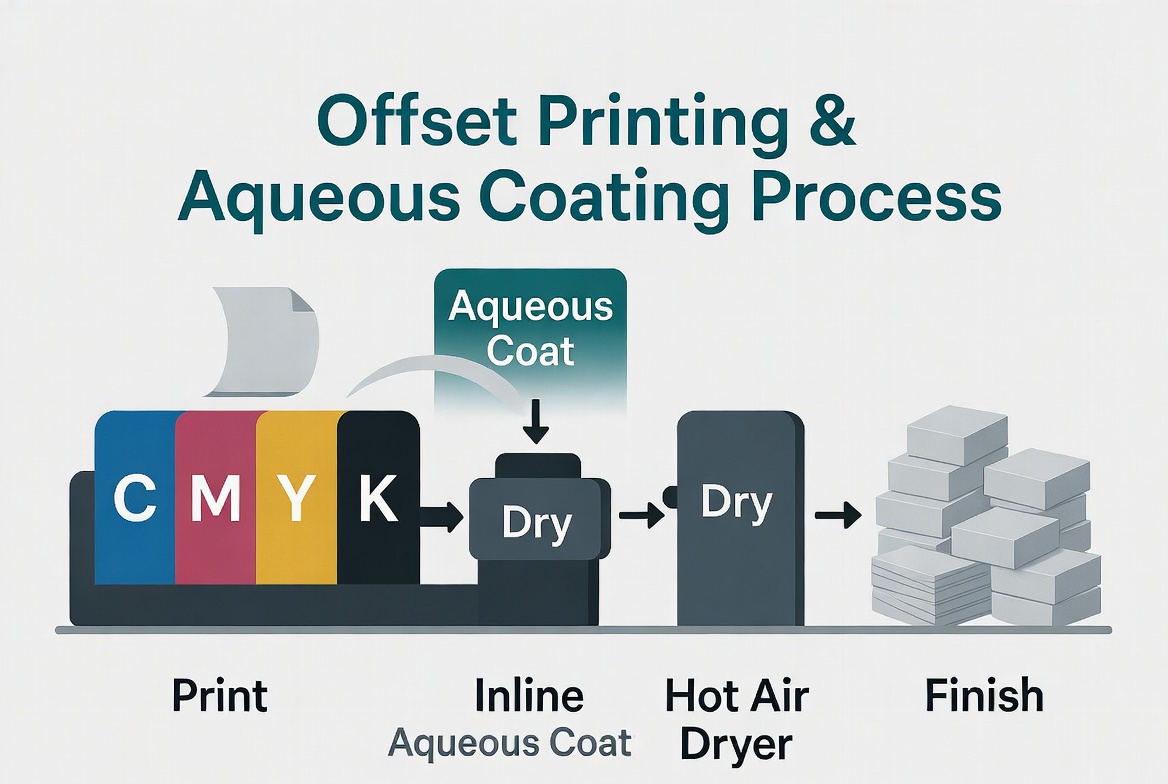
At its core, aqueous coating is a clear, water‑based finish applied on press over printed paper or paperboard to protect the surface and enhance appearance. The coating is laid down inline during printing and then rapidly dried with heated air, leaving a thin polymer film that seals the ink and adds a chosen finish such as gloss, satin, or matte. [royle]
Because it is water‑based and low in volatile organic compounds (VOCs), AQ is widely regarded as an eco‑friendly alternative to traditional solvent‑heavy coatings. This is one of the key reasons it has become the standard for paper packaging in sectors like food, FMCG, and retail where both sustainability and brand presentation matter. [packhit]
From an operations standpoint, AQ's fast drying means printed sheets can move quickly into die‑cutting, folding, and gluing without long wait times, keeping high‑volume packaging lines efficient. [pakoro]
In practical packaging projects, we recommend coating whenever the printed surface will face frequent handling, friction, or mailing. That includes: [clearprint]
- Folding cartons and rigid boxes for retail shelves
- E‑commerce mailers and shipping inserts
- Brochures, catalogs, and manuals packed inside boxes
- Point‑of‑sale displays and shelf talkers [pakfactory]
However, there are cases where no coating or partial coating is better. For example, greeting cards or note cards that need to be written on by the end user can become difficult to mark if fully coated. In these projects, we either skip the coating or design "no‑coat" writing panels. [bpkc]
It is also critical to remember that water‑based does not mean waterproof. AQ coatings resist fingerprints, smudges, and minor moisture, but they are not designed to survive aggressive chemicals or heavy liquid exposure. For perfumes, aggressive solvents, or products prone to leaking, we often recommend specialized barriers or different finishing technologies. [packhit]
From a production engineer's perspective, AQ is a fairly straightforward inline process—provided your equipment and settings are optimized.
1. Ink is printed on the substrate using offset or other compatible processes.
2. A dedicated coating unit applies the AQ as a flood coating over the entire printed area. [pakoro]
3. The sheet passes through a heated air or IR system, which forces water to evaporate rapidly and cures the polymer film. [4over4]
4. The coated sheets exit the press nearly dry, ready for finishing steps like die‑cutting, creasing, and folding. [4over4]
On high‑speed lines, proper control of viscosity, coating weight, and dryer temperature is essential to avoid issues like curling, wrinkling, or blocking (sheets sticking together). In our own equipment projects, we calibrate the coating units to the specific board grade and ink system to maintain a smooth, even film across long runs. [asset.fujifilm]
From both brand and production viewpoints, AQ offers a balanced mix of protection, appearance, and sustainability.
AQ uses water‑based solvents and low‑VOC chemistry, making it significantly more sustainable than many solvent‑based or plastic‑heavy finishes. Coated paper remains easily recyclable, and cleanup can be done without harsh detergents, reducing both environmental load and plant safety risks. [stampaprints]
For brands positioning themselves as eco‑conscious, this is a tangible, defensible improvement over heavy laminates or fully plastic‑based coatings. [pakfactory]
AQ coatings form a thin protective film that guards against:
- Scratches and scuffs during converting and transit
- Fingerprints and smudges on high‑touch surfaces
- Rub‑off of inks, especially darker or metallic areas [magnuminks]
By sealing the ink layer from air exposure, AQ can also help maintain the intensity of metallic inks and reduce yellowing over time compared with some varnishes. [bpkc]
Because AQ dries quickly on press, it allows printers and converters to move jobs into downstream finishing much faster than with traditional varnish. This reduces work‑in‑progress inventory, shortens lead times, and minimizes the risk of set‑off between sheets. [clearprint]
From a cost perspective, AQ is generally more affordable than UV coatings or lamination, especially for medium‑to‑large print runs. It has become the default coating in many plants precisely because it balances performance with total cost of ownership. [gentlever]
Unlike some heavy‑gloss finishes, many AQ formulations remain easy to write or print over, which is useful for packaging that needs variable data, stamping, or handwriting. AQ also works well across a range of print processes, particularly offset printing on folding carton board. [stampaprints]
One of the biggest advantages of AQ is the variety of finishes available, allowing you to match tactile experience with brand positioning.
Gloss AQ delivers a highly reflective surface that boosts color saturation and image contrast. It is ideal for: [pakoro]
- Retail cartons with photographic imagery
- Promotional sleeves and high‑impact display packaging
- Catalog covers and marketing inserts [packhit]
If you need extreme gloss, UV or laminate may still outshine AQ, but many brands now prefer AQ gloss as a more balanced, less plastic‑looking alternative. [bpkc]
Satin AQ sits between gloss and matte, providing moderate sheen and strong scuff resistance. We often recommend satin when: [pakoro]
- You want a premium look without the mirror reflection of gloss
- Packages will be stacked or rubbed in transit
- Text legibility and photography need to be balanced [packhit]
Matte AQ gives a low‑glare, soft visual appearance while keeping colors dense and well defined. It is especially effective on: [4over4]
- Luxury boxes and cosmetic cartons
- High‑end literature and rigid box components
- Brands emphasizing minimalism and subtlety [pakfactory]
Soft‑touch AQ adds a velvety, tactile feel that strongly supports premium positioning. Many beauty, electronics, and specialty food brands use this to differentiate on shelf, as the soft, almost rubberized touch immediately signals "high‑end." [bpkc]
Some specialized AQ formulations can mimic dry‑erase surfaces, providing high gloss and erasability at lower cost than lamination. In practice, these are used more for promotional boards and inserts than for everyday packaging, but the technology underlines how flexible water‑based coatings have become. [pakoro]

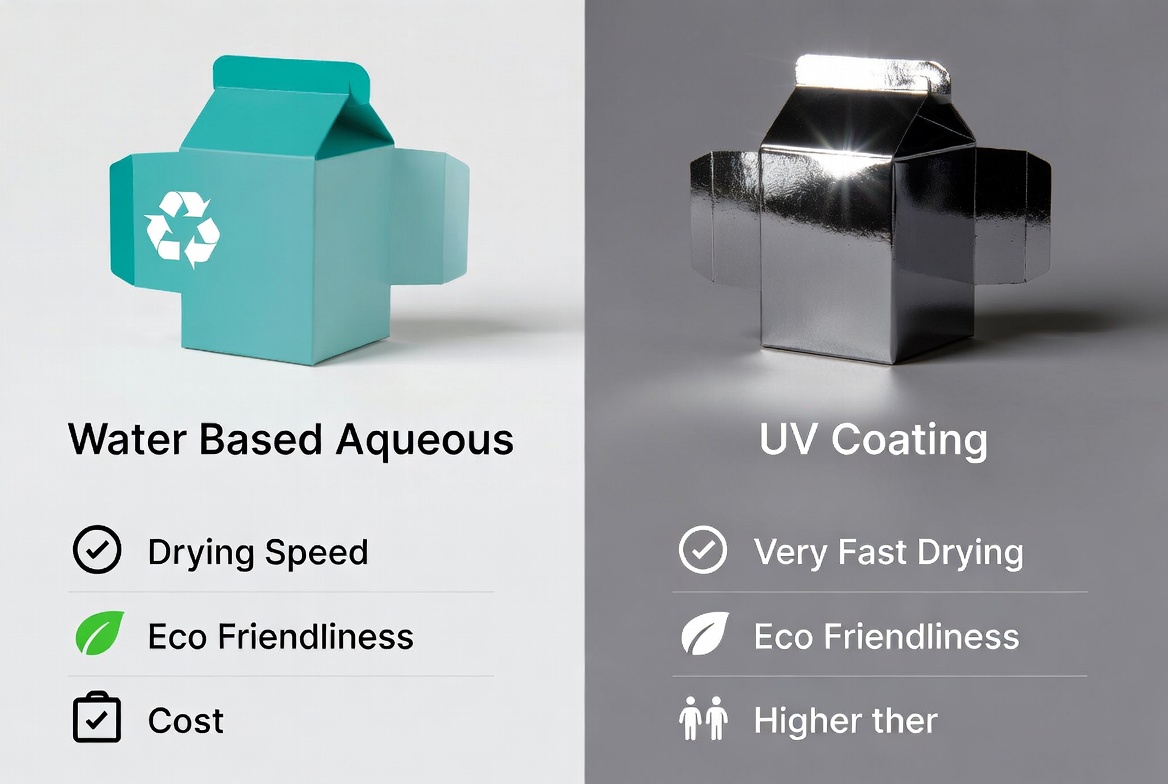
For packaging engineers and buyers, the real question is rarely "What is AQ?" but "Is AQ the right coating compared with UV or varnish for this job?" [corkindustries]
| Feature / Aspect | Aqueous (AQ) Coating | UV Coating | Varnish |
|---|---|---|---|
| Application style | Flood coating only (bpkc) | Flood or spot (bpkc) | Flood or spot (bpkc) |
| Drying speed | Fast, hot‑air drying (bpkc) | Instant UV curing (bpkc) | Slowest to dry (bpkc) |
| Base chemistry | Water‑based, low VOC (bpkc) | Chemical / oligomer‑based (bpkc) | Water or solvent‑based (bpkc) |
| Finish options | Matte, satin, gloss, soft‑touch (bpkc) | Mainly high‑gloss, some matte (bpkc) | Matte, satin, gloss (bpkc) |
| Protection level | High, suitable for most packaging (bpkc) | Very high; best for extreme abrasion (bpkc) | Good; may yellow over time (bpkc) |
| Environmental impact | Recyclable, minimal waste (bpkc) | Less eco‑friendly; may include plastics (bpkc) | Variable; some yellowing and solvent use (bpkc) |
| Typical use cases | Food, FMCG, retail cartons (bpkc) | Premium covers, high‑wear pieces (corkindustries) | Budget jobs, selective spot effects (bpkc) |
In our project reviews, we often guide customers toward AQ when they want a combination of:
- Sustainable story and recyclability
- Reliable protection under normal supply‑chain stress
- Competitive cost at scale [pakfactory]
UV and varnish remain valuable tools, but AQ has earned its position as the standard because it delivers enough performance for most paper packaging while aligning with environmental and cost targets. [packhit]
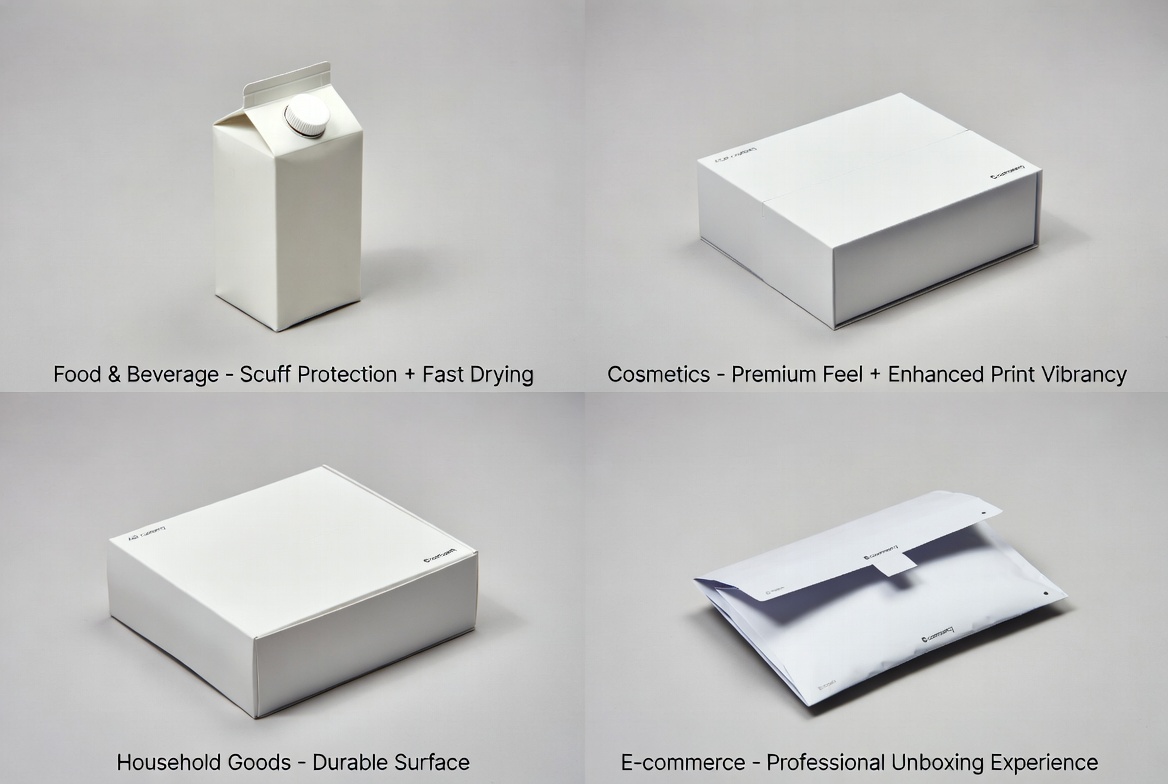
Drawing on the broader industry and what PakFactory and other converters report, we see several recurring successful use patterns for AQ coatings.
- Food packaging: AQ is widely used on food cartons as a non‑toxic, water‑based finish that supports recyclability and consumer safety perception. [pakfactory]
- Household and FMCG products: High‑volume cartons for detergents, tissues, and household goods rely on AQ for fast drying and scuff resistance. [bpkc]
- Retail and branded packaging: Brand owners leverage gloss or soft‑touch AQ to elevate color richness and tactile feel without resorting to plastic laminates. [packhit]
- Printed collateral in packaging: Manuals, inserts, and catalogs packed with products often use AQ to resist fingerprints and maintain a clean look through handling. [royle]
In each of these scenarios, the ability to coat inline, dry quickly, and move straight to cutting and folding is critical to meeting tight lead times.
Even though aqueous coating is versatile, there are engineering considerations and limitations you should factor into your design and production planning.
- Chemical sensitivity: Fragrances, alcohol‑based formulas, and certain oils can attack AQ films, leading to softening or staining if leaks occur. [corkindustries]
- Not fully waterproof: AQ protects against incidental moisture and fingerprints but is not a substitute for true moisture or vapor barriers. [4over4]
- No spot effects with standard AQ: Because AQ is usually applied as a flood coat, it cannot selectively highlight small design elements the way spot UV can. [corkindustries]
- Curl or warp risk: Incorrect coating weight, poor dryer balance, or mismatched board can introduce curl or waviness. [asset.fujifilm]
From a converter's standpoint, we mitigate these issues by running coating and substrate tests early in a project, adjusting coat weight and dryer settings, and, where needed, combining AQ with other barrier technologies.
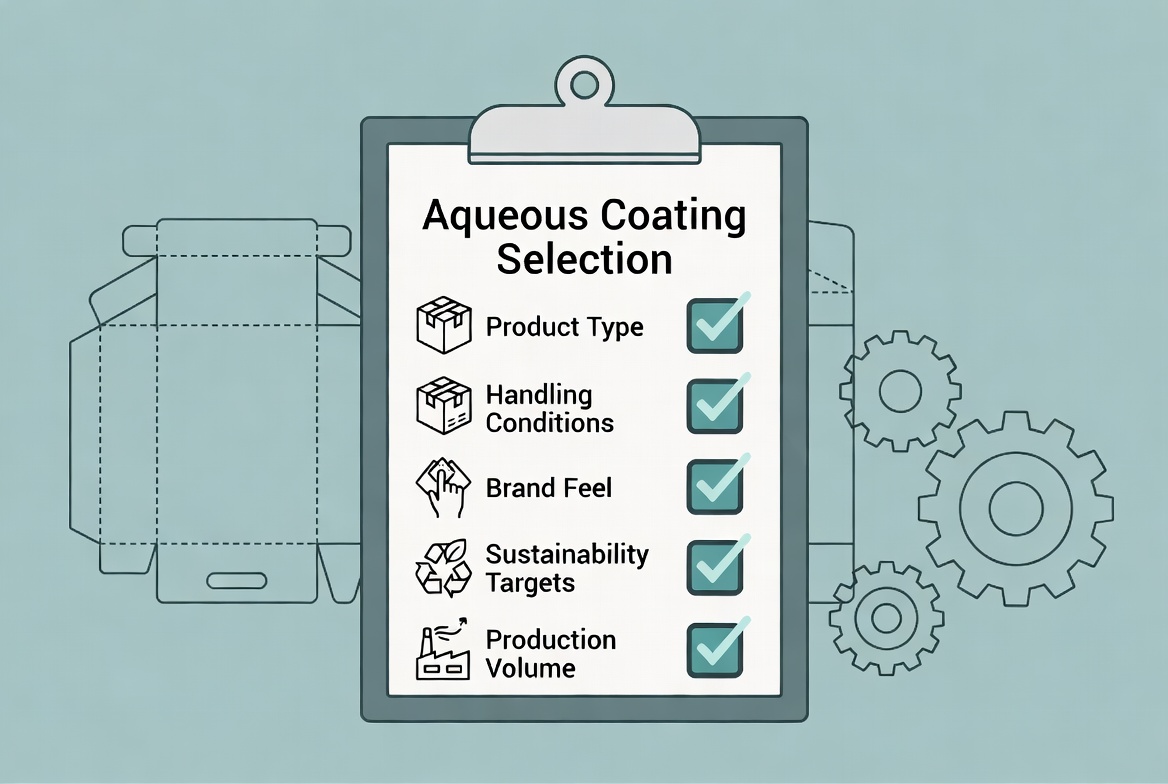
When we advise customers on coating choices for paper packaging, we use a simple decision checklist that can help your internal teams as well:
1. What is being packed?
- Food, personal care, or household goods often align well with AQ.
- Aggressive chemicals or high‑moisture environments may need additional barriers. [bpkc]
2. How is the pack handled and shipped?
- Standard retail logistics usually suit AQ protection.
- Extremely rough handling or high abrasion may justify UV coating or lamination. [gentlever]
3. What is the desired brand feel?
- Natural, sustainable, and premium can often be achieved with matte or soft‑touch AQ.
- Ultra‑gloss or metallic "pop" may favor UV spot treatments. [corkindustries]
4. What are sustainability targets?
- If recyclability and reduced plastic are core KPIs, AQ is typically the preferred route. [pakfactory]
5. What is the production scale and budget?
- For large‑volume runs, AQ's inline application and cost profile are highly attractive. [gentlever]
If you are planning a new packaging line or optimizing an existing one, consider AQ as a standard baseline for all paper components unless a clear technical reason dictates otherwise. In particular, it makes sense to: [packhit]
- Standardize one or two AQ finishes (e.g., gloss and matte) across multiple SKUs to simplify procurement.
- Use soft‑touch AQ selectively on hero SKUs or premium lines to create tiered brand experiences.
- Pair AQ with high‑quality paperboard and precise color management to maximize perceived value without inflating material cost. [bpkc]
From our packaging machinery perspective, specifying AQ in conjunction with compatible board grades and inks enables smoother commissioning of new lines and more predictable performance over time.
If you are evaluating coatings for a new packaging project, it is worth treating aqueous coating as a strategic design variable rather than a last‑minute checkbox. By aligning your product requirements, sustainability goals, and brand positioning with the right AQ formulation, you can improve both shelf impact and operational efficiency.
For support in translating these choices into real‑world packaging performance, consider working directly with a converter or machinery partner who has hands‑on experience integrating AQ coating into high‑speed production lines. This is where companies like ours can help you turn a simple clear coat into a measurable advantage in quality, cost, and sustainability. [pakfactory]
1. Is aqueous coating food‑safe?
AQ coatings are widely used on food packaging because they are water‑based, low in VOCs, and compatible with standard food‑contact board systems, but final food safety compliance always depends on the full material and regulatory review for your region. [packhit]
2. Can aqueous coating replace lamination?
For many standard retail cartons, AQ can provide sufficient protection and visual enhancement without lamination, though it does not match the extreme barrier or stiffness that film laminates offer in demanding environments. [corkindustries]
3. Will aqueous coating crack when folded?
AQ is generally more flexible than UV coatings and less prone to cracking along fold lines when applied correctly on suitable board stocks. [bpkc]
4. Does aqueous coating affect recyclability?
Most paper and paperboard coated with AQ remain readily recyclable because the water‑based film is thin and designed to break down in standard pulping processes. [stampaprints]
5. Can I write or overprint on aqueous‑coated surfaces?
Many AQ formulations are designed to remain receptive to ballpoint pens, markers, and even some overprinting processes, though testing on your specific stock and coating is recommended before full‑scale production. [stampaprints]
1. PakFactory. "What is Aqueous Coating for Printing and Packaging?"
<https://pakfactory.com/blog/learn/what-is-aq-aqueous-coating/> [bpkc]
2. PakFactory. "Aqueous Coating | PakFactory®."
<https://pakfactory.com/aqueous-coating.html> [pakfactory]
3. PackHit. "Aqueous Coating in Packaging: Process, Types, Benefits, and Uses."
<https://packhit.com/packaging/finishes/coating/aqueous/> [packhit]
4. Pakoro. "What Is Aqueous Coating For Printing And Packaging?"
<https://pakoro.com/blog/what-is-aqueous-coating-for-printing-and-packaging/> [pakoro]
5. Royle Printing. "Understanding the Differences Between Coatings."
<https://www.royle.com/blog/coatings> [royle]
6. BPKC. "What Is Aqueous Coating In Packaging Printing?"
<https://bpkc.com/blogs/blog/what-is-aqueous-coating-in-packaging-printing> [bpkc]
7. Cork Industries. "Notable differences between Aqueous Coatings and UV Coatings."
<https://corkindustries.com/notable-differences-between-aqueous-coatings-and-uv-coatings/> [corkindustries]
8. 4over4. "What is Aqueous Coating? Eco‑Friendly Print Finish Explained."
<https://www.4over4.com/content-hub/stories/what-is-aqueous-coating> [4over4]
9. Stampaprints. "The Importance of Aqueous Coating in the Packaging Industry."
<https://stampaprints.com/blog/what-is-aqueous-coating/> [stampaprints]
10. Clear Print. "When to Use an Aqueous Coating."
<https://www.clearprint.com/when-to-use-an-aqueous-coating/> [clearprint]
11. Magnum Inks. "Everything You Need to Know About Aqueous Coating Printing."
<https://magnuminks.com/resources/aqueous-coating-printing/> [magnuminks]
12. Fujifilm. "Aqueous Coatings Guide."
<https://asset.fujifilm.com/master/americas/files/2020-03/ddf86f4fdba06e415a7c184160fea61f/AqueousCoatingGuide.pdf> [asset.fujifilm]


