


close
Choose Your Site
Global
Social Media
Views: 222 Author: Amanda Publish Time: 2026-02-06 Origin: Site


Content Menu
● What Are Standard Cereal Box Dimensions?
>> Quick Reference Table: Typical Cereal Box Dimensions (Inches)
● Inside a Cereal Box: Structure and Components
● Short History: How Cereal Box Packaging Evolved
● How Cereal Box Dimensions Influence Consumer Decisions
● Materials for Cereal Boxes and Food Safety
● How to Measure Cereal Box Dimensions Correctly
>> Step-by-Step Measuring Method
● Why Accurate Cereal Box Dimensions Matter for Operations
● Choosing the Best Cereal Box Size for Your Brand
>> Simple Dimension-Planning Checklist
● Cereal Box Dimensions and Packaging Machinery
● Design, Branding, and Sustainability Trends in Cereal Packaging
>> Sustainability and Right-Sizing
● How HLun Pack and Pakoro Can Support Your Cereal Packaging
● Call to Action: Design Smarter Cereal Boxes with HLun Pack
● FAQs About Cereal Box Dimensions
>> 1. How tall is a standard cereal box?
>> 2. What are the typical dimensions of a family-size cereal box?
>> 3. Why do some cereal boxes look big but feel half empty?
>> 4. How do I convert cereal box dimensions between inches, centimeters, and millimeters?
>> 5. Can custom cereal box dimensions still work with automated packaging machinery?
Designing the right cereal box dimensions is not just about fitting flakes into a carton; it is about shelf impact, logistics efficiency, and a consistent brand experience from factory line to breakfast table.

For most brands, cereal box sizes fall into a few predictable ranges that balance shelf visibility, packing efficiency, and portion expectations.
- Regular cereal box: About 8–12 in high, 6–8 in wide, 2–3 in deep.
- Family size cereal box: About 10–14 in high, 6–8 in wide, 2–3 in deep.
- Mini / single-serve boxes: Often around 5–10 in high, 4–5 in wide, 1.5–2 in deep.
- Multipack / variety pack: Outer carton dimensions vary depending on the number of inner boxes.
Tip: When you move into retail chains, working within these standard ranges helps you align with existing shelf schematics and shipping carton sizes.
Box Type | Height | Width | Depth |
Regular cereal box | 8–12 in | 6–8 in | 2–3 in |
Family size box | 10–14 in | 6–8 in | 2–3 in |
Mini / travel box | 5–7 in | 4–5 in | 1.5–2 in |
Example: Cheerios | ≈ 11.25 in | ≈ 7.75 in | ≈ 1.625 in |
Example: Frosted Flakes | ≈ 12.375 in | ≈ 8.375 in | ≈ 2.625 in |
A cereal box is a small piece of packaging engineering: every panel and closure impacts stability, print area, and perceived quality.
- Outer carton: Printable paperboard shell that carries brand graphics and structural strength.
- Front panel: Hero visuals, brand logo, product name, key claims.
- Side panels: Nutrition facts, ingredients, certifications, legal information.
- Back panel: Promotions, games, recipes, or storytelling to increase dwell time.
- Top closure: Foldable flaps, sometimes with a re-locking tab to improve convenience.
- Bottom closure: Locking bottom that keeps the box upright and supports stacking.
- Internal bag (liner): Food-contact layer that protects crunch, aroma, and shelf life.
Modern cereal packaging grew from early health-food experiments and quickly became a battlefield of branding and convenience.
- In the 1860s, early granola-like cereals paved the way for packed breakfast products and later boxed formats.
- As branded cereals emerged, boxes evolved from plain containers to marketing canvases with mascots, games, and health claims.
- Standardized dimensions appeared as brands optimized for retail shelving, palletization, and mass-production efficiency.
The size and proportion of a cereal box shape how large the product feels, how visible it is in the aisle, and how premium or basic it appears.
- Perceived value: Taller or wider boxes often signal “more cereal,” even if weight is similar.
- Target audience fit: Compact boxes suit single professionals or niche products; tall family-size boxes target large households.
- Health perception: Clean layouts, muted colors, and moderate dimensions tend to align with “healthy” and “organic” cues.
- Price positioning: Oversized packaging with promotional badges supports value or bulk messaging; smaller precise boxes support premium positioning.
Choosing the right material is critical for food safety, sustainability goals, and print quality.
- Paperboard / cardboard: The most common; provides rigidity, good print surface, and cost-effective die-cutting.
- Kraft paper: More natural look, often used with eco-positioning; biodegradable and recyclable.
- Inner liner: Food-grade plastic or coated paper that protects against moisture and oxygen, keeping cereal crunchy.
Correct measurements prevent misprints, filling problems, and shipping inefficiencies.
- Define orientation: Place the box upright as it would stand on shelf.
- Measure height: From base to top edge.
- Measure width: Across the front panel from left to right.
- Measure depth: From front panel to back panel.
- Record in order: Use the convention Length × Width × Height or clearly state the format required by your converter.
Precise dimensions link your marketing ideas with real-world manufacturing, line speed, and logistics.
- Manufacturing consistency: Stable dimensions reduce carton jams, filling errors, and material waste.
- Efficient packaging: Standardized sizes improve case-packing density and pallet utilization.
- Retail compliance: Major retailers plan shelf sets to specific heights and widths; out-of-spec boxes can be rejected or poorly placed.
- Customer satisfaction: Easy-to-store, easy-to-open boxes reduce negative reviews and returns.
- Reduced waste: Right-sized boxes cut unnecessary board usage and improve sustainability performance.
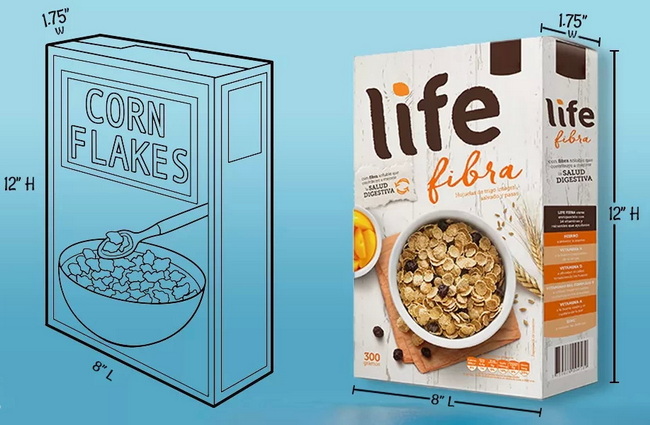
Different brands need different box dimensions, depending on positioning, channel, and production constraints.
- Target customer: Single adults, kids, or families will respond differently to size and format.
- Price point: Budget cereals often use larger boxes for perceived value; premium cereals may choose compact, dense packaging.
- Product density: Granola weighs more than puffed rice, so the same net weight may require a smaller box.
- Channel: E-commerce, club stores, and supermarkets each favor different size ranges and case formats.
- Define your net weight and serving size clearly.
- Estimate bulk density of the cereal to calculate required volume.
- Select a standard height range based on your target segment (mini, regular, or family).
- Adjust width and depth to balance shelf impact and case-pack efficiency.
- Validate with your packaging supplier and filling machine provider before finalizing.
Even the best design fails if it does not run smoothly on your packaging line, so box dimensions must match actual machine capabilities.
- Cartoning machines have minimum and maximum carton sizes; staying within that window reduces changeover time and downtime.
- Filling systems require stable box bases and consistent heights to avoid spillage and inaccurate fills.
- Automatic case packers work best with standardized box footprints, which determine how many units fit per shipping case.
- Line integration is smoother when designers, marketers, and machine suppliers collaborate early on dimensions and tolerances.
Current cereal packaging trends integrate smart dimensions with visual storytelling and eco-conscious materials.
- Eye-catching fronts: Bold colors, strong imagery, and clear product shots dominate the front panel.
- Readable typography: Large, legible fonts for key benefits to support quick scanning on crowded shelves.
- Interactive backs: QR codes, games, and storytelling encourage repeat engagement and social sharing.
- Window cut-outs: Small transparent areas let consumers see the cereal inside, increasing trust.
- Reduced empty space: Tighter dimensions cut air in the box, save board, and improve shipping efficiency.
- Recycled content: Many brands specify recycled paperboard and promote this on-pack.
- Plastic-light solutions: Thinner liners or alternative coatings support plastic reduction goals.
To turn dimensions into a scalable solution, brands often need both high-quality materials and reliable machinery.
- Custom paper and flexible packaging: Tailored board grades and structures that match your brand's size and sustainability targets.
- Integrated packaging machinery: Filling, cartoning, and case-packing solutions designed around your final cereal box dimensions.
- End-to-end engineering: From creative structural design to on-site line deployment, ensuring your chosen box size runs smoothly in real production.
Action-oriented benefit: By aligning structural design with machinery upfront, you can reduce launch risk, shorten time to market, and protect your long-term packaging investment.
If you are ready to move from generic sizes to optimized cereal box dimensions that support both your brand and your production line, now is the time to act.
- Step 1: Share your cereal type, target market, and desired net weights.
- Step 2: Request a dimension and structural design proposal aligned with your filling machinery and logistics constraints.
- Step 3: Prototype, test on-line, and refine until performance and customer experience meet your standards.
Get started now: Contact the HLun Pack team to co-create a cereal box solution that delivers reliable line performance, strong shelf impact, and a more sustainable packaging footprint from day one.
Contact us to get more information!
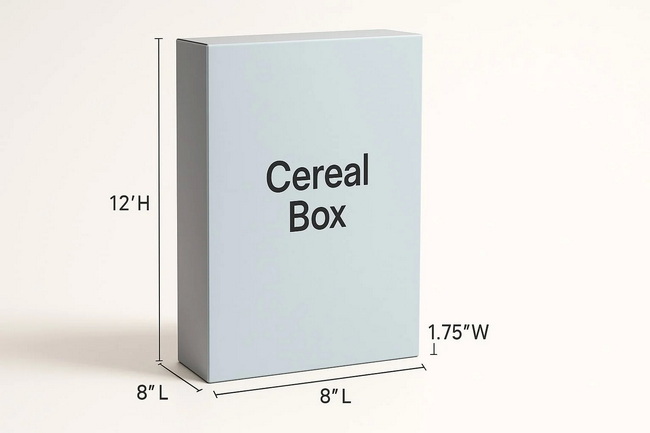
Most standard cereal boxes are about 8–12 inches tall, while family-size versions often reach 10–14 inches depending on brand and weight.
A typical family-size cereal box ranges around 14–16 inches in height, 8–9 inches in width, and 2–3 inches in depth, providing significantly more volume than regular packs.
Manufacturers sometimes use taller boxes for shelf presence and to match planograms, but product density, settling during transport, and marketing choices can leave extra headspace inside.
To convert, multiply inches by 2.54 for centimeters, and by 25.4 for millimeters; many standard cereal boxes are roughly 30 × 20 × 5–6 cm.
Yes, as long as the custom size stays within your machinery's minimum and maximum limits and is validated through line trials with your packaging partner.
1. https://pakoro.com/blog/cereal-box-dimensions/
2. https://citipackaging.com/blog/cereal-box-dimensions/
3. https://packagingbee.co.uk/blog/cereal-box-dimensions/
4. https://www.dreamcustomboxes.com/how-to-measure-dimensions-of-cereal-box/
5. https://www.icustomboxes.com/blog/how-tall-is-a-cereal-box-complete-guide-about-cereal-box-dimensions/
6. https://www.gentlepk.com/how-tall-is-a-cereal-box-the-cereal-box-dimensions/
7. https://www.pacdora.com/tools/custom-cereal-boxes
8. https://www.hlunpack.com
9. https://www.hlunpack.com/fillling-machine.html
10. https://breakingthelines.com/opinion/cereal-packaging-boxes-the-complete-guide-for-brands-and-consumers/
11. https://www.harlemworldmagazine.com/cereal-box-design-how-packaging-bee-helps-brands-stand-out/


